Battery Backup for Houston RV Parks and Mobile Home Communities

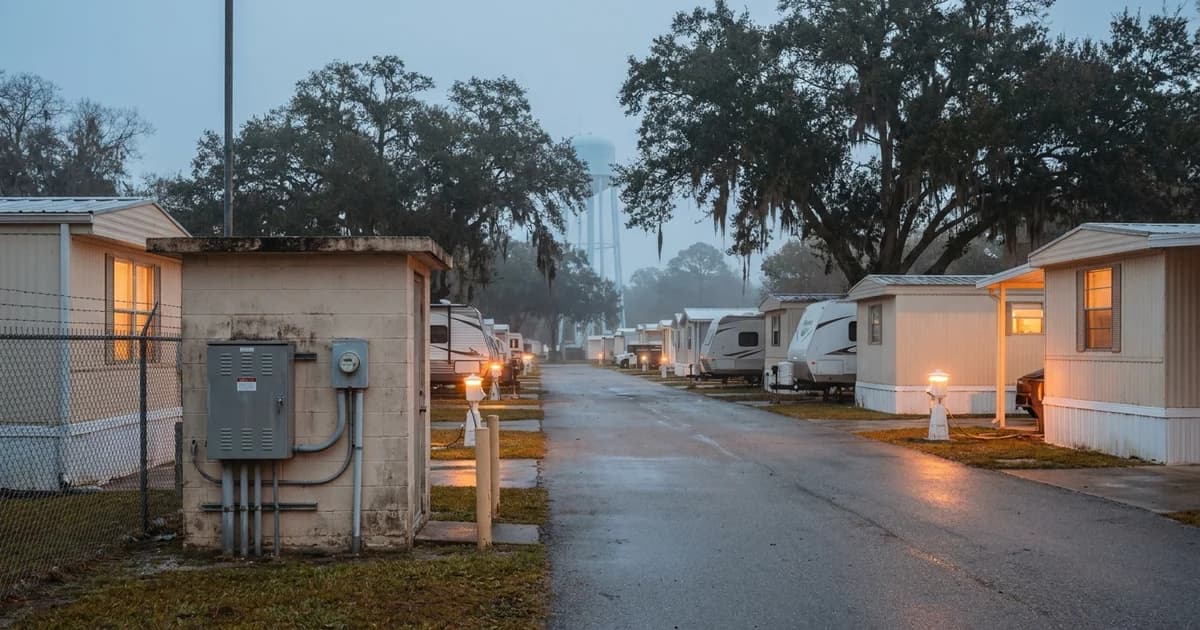
If you run an RV park or a manufactured housing community on the Texas Gulf Coast, you already know how a storm week goes. Hurricane Beryl knocked out roughly 2.2 million CenterPoint customers at peak in July 2024, and more than a million were still dark days later (Houston Public Media, 2024). National Weather Service heat indices ran 100 to 106 F while crews worked (Texas Tribune, 2024). Here's the thing most vendors won't tell you up front: you don't own the dwellings. You own the infrastructure between the meter and the pedestal, and that's the only honest scope for a backup system.
Key Takeaways
- A park operator's backup scope is the common systems, not the spaces. The well, the booster pump, the lift station, the gate, the office and the clubhouse are yours. The homes and coaches are not.
- Water and wastewater are the two systems with a legal floor. Texas requires 35 psi in normal operation and 20 psi in emergencies (30 TAC 290.46(r)), and lift stations must ride through the longest outage on record for the past 60 months (30 TAC 217.63).
- Backing up every pedestal is a utility problem, not a battery problem. A 40 space park can calculate out past 114 kVA of demand under NEC 551.73.
- Manufactured homes carry real heat risk. In Maricopa County, 23 percent of 2025 indoor heat deaths happened in an RV, trailer or mobile home, which are only 5 percent of housing (Maricopa County Public Health, 2026).
What does a park operator actually control?
Everything from the utility meter to the pedestal lug, and nothing past it. That boundary is the whole design brief. Texas counts 776,232 mobile homes among 12,616,736 housing units statewide, per the Census Bureau's 2024 American Community Survey one year estimates (Census Reporter, table B25024). Almost none of those structures belong to the operator who keeps their water running.
Your common systems usually come down to seven things:
- The community water well, its submersible pump and the pressure or booster pump that holds the distribution loop
- The lift station or the on site wastewater treatment plant
- The entry gate and access control
- The office, including the phone system and the payment terminal
- The laundry
- The clubhouse or storm shelter
- Site and street lighting
Notice what that list is. It's a small water utility, a small wastewater utility, and a building. That is a familiar commercial backup profile, and it is nothing like backing up 90 dwellings. The moment a proposal starts implying every space gets covered, the arithmetic behind it has stopped being real.
Why do water and wastewater come first?
Because they are the only two systems on the property that carry a regulatory floor. Under 30 TAC 290.46(r), a public water system must be operated to deliver at least 35 psi throughout the distribution system in normal conditions and at least 20 psi during emergencies (Texas Administrative Code). Drop below 20 psi and 290.46(q) routes the operator to a TCEQ decision flowchart where a boil water notice is the ordinary outcome.
Most operators don't realize their park already qualifies. A system serving at least 15 service connections, or at least 25 individuals for 60 days a year, is a public water system in Texas (30 TAC 290.38). A 40 space community with its own well is a regulated utility with a compliance officer, and that officer is you.
Wastewater is stricter still. A lift station must be designed to prevent discharge from the station and from every point upstream during electrical power failures, and the backup provision has to operate for at least as long as the longest outage on record for the past 60 consecutive months, or 20 minutes, whichever is longer (30 TAC 217.63). The rule also requires the owner to pull and document 60 months of outage records from the serving utility. After Beryl, that record now includes a multi day event for most of the Houston metro, which means the compliance bar moved for every park in the affected footprint.
The state anticipated part of this. Designated affected utilities file an Emergency Preparedness Plan for holding pressure through a 24 hour outage, and TCEQ sets a higher bar inside Harris and Fort Bend Counties than elsewhere (TCEQ). Notices still happen by the dozen: roughly 160 were in effect across eight Southeast Texas counties days after Beryl (KHOU, 2024). The rule protects the system. Nothing in it keeps your well pump spinning.
If your community runs on a private well, the mechanics are the same ones in our
.Can a battery back up every RV pedestal?
No, and the code math says so plainly. Under NEC Article 551, a minimum share of sites must carry 50 ampere, 125/250 volt receptacles and a further share must carry 30 ampere receptacles, and Section 551.73 assigns each 50 ampere site 12,000 VA of calculated load and each 30 or 20 ampere site 3,600 VA before demand factors (JADE Learning, NEC 551.73 service sizing).
Run it for a 40 space park with 16 fifty amp sites and 24 thirty amp sites:
| Line item | Value |
|---|---|
| 16 sites at 12,000 VA | 192,000 VA |
| 24 sites at 3,600 VA | 86,400 VA |
| Connected load | 278,400 VA |
| Demand factor, 36 or more sites | 41 percent |
| Calculated demand | 114,144 VA, about 476 A at 240 V |
That is the arithmetic we run on every park site survey before quoting anything. Even at half the code calculated demand, a 24 hour outage draws on the order of 1,370 kWh. For scale, our largest commercial tier delivers 131.40 kWh of usable capacity and 34.5 kW of continuous output across three controllers. You would need roughly ten of them and still be short on continuous output during a hot afternoon. Pedestal level backup is a utility scale build with a substation conversation attached, not a battery decision.
So the boundary is this: back up the systems that keep the property habitable and compliant, and tell residents plainly that their coach or home is their own load.
Why does a manufactured home heat up faster?
Because the HUD Code sizes the thermal envelope against a design condition, not against an outage. Under 24 CFR 3280.511, a manufacturer affixes a Comfort Cooling Certificate stating the home's cooling design was calculated on a 75 F indoor temperature against a specified outdoor dry bulb and wet bulb (24 CFR 3280.511). That certificate assumes the air conditioner is running. Cut the power and the assumption is void.
The measured evidence is unkind. A 2026 study in Environmental Research Communications monitored 27 mobile homes and found nine held nighttime minimum temperatures above 75 F at least 10 percent of the time, with roughly a third of participating residents facing high heat related health risk (Heris et al., 2026). That was a Colorado summer. Houston is not.
The mortality data is blunter. In Maricopa County's 2025 Annual Heat Report, 111 heat related deaths occurred indoors, and about 23 percent of them happened in an RV, trailer or mobile home, even though those structures make up only 5 percent of county housing. An air conditioning unit was present in 94 percent of indoor cases, and among those, the unit was not functioning in 72 percent (Maricopa County Department of Public Health, 2026). A dead AC and a dead grid produce the same indoor temperature.
That's the real reason a backed up clubhouse matters. It isn't an amenity. During Beryl, the operators we talked to weren't worried about laundry revenue. They were worried about the resident on oxygen in space 22 with nowhere air conditioned to sit. A cooled common room with working outlets is the cheapest resident safety measure a park owner can buy, and it sits well inside battery scale.
A composite look at one 90 space community
The following is a composite drawn from multiple Houston area site surveys. It does not describe any single customer, and no real community is named.
Picture a 90 space mixed community west of Houston: 60 manufactured home lots, 30 RV spaces, one well with a submersible pump and a booster set, a duplex lift station, a gate, an office, a laundry and a clubhouse. Its Beryl week was five days without power, a boil water notice on day two, and residents driving to relatives to sleep.
The backup scope that survived the engineering review had four circuits on it, in this priority order:
- Well and booster pump. Keeps distribution pressure above the 20 psi trigger and keeps the boil water notice from starting.
- Lift station controls and one pump. Satisfies the no discharge requirement in 217.63 without a fuel contract.
- Clubhouse HVAC, lighting and outlets. The cooling and charging point for 90 households.
- Gate, office and site lighting. Access for EMS, and a lit property at night.
Nothing on that list is a dwelling. All of it is the operator's own equipment on the operator's own meters, and the package sits in the two controller class at 23 kW of continuous output. The residents' spaces stayed where they were, which is the honest answer and the one that survives a board meeting.
If you also own rental units on site, the split responsibility question is covered in our
, and shared meter issues overlap with the .What should an operator do before next storm season?
Pull the records first. Section 217.63 already requires 60 months of outage documentation from your electric utility, and that document sets the runtime target your lift station backup must meet. Then meter the well house and the clubhouse for two weeks to get real continuous draw instead of nameplate. Then size. The wider sizing and ERCOT picture is in our
.Or call Eos at 833-989-3737 to talk through your setup with an installer.
Frequently Asked Questions
Can a battery back up an entire RV park?
Not realistically. Using NEC 551.73 values, a 40 space park with 16 fifty amp sites calculates to about 114,144 VA of demand after the 41 percent factor for parks of 36 or more sites (JADE Learning). That is a service upgrade conversation, not a storage one. Back up common systems instead.
Is my park's water system legally required to hold pressure?
If it serves 15 or more connections, or 25 people for 60 days a year, it is a public water system in Texas (30 TAC 290.38). It must hold 35 psi normally and 20 psi in emergencies (30 TAC 290.46). Losing power does not suspend the rule.
How long does my lift station backup have to run?
At least as long as the longest power outage on record for the past 60 consecutive months, or 20 minutes, whichever is longer (30 TAC 217.63). If the outage record exceeds 48 hours and you use a generator, you also need a guaranteed fuel supply contract and on site storage.
Are manufactured homes really more dangerous in a heat outage?
The data says yes. Maricopa County recorded 111 indoor heat related deaths in 2025, with about 23 percent in RVs, trailers or mobile homes despite those being 5 percent of housing stock (Maricopa County Public Health, 2026). A cooled clubhouse is a meaningful mitigation.
Should residents get their own batteries?
That's their call, and it is a separate purchase from anything the operator installs. What the operator can do is keep water, wastewater, access and a cooled common space alive, then tell residents plainly what is and isn't covered before the next storm.
Sources
- Texas Administrative Code, Title 30, Section 290.46, "Minimum Acceptable Operating Practices for Public Drinking Water Systems," retrieved 2026-09-08, http://txrules.elaws.us/rule/title30_chapter290_sec.290.46
- Texas Administrative Code, Title 30, Section 290.38, "Definitions," retrieved 2026-09-08, https://www.law.cornell.edu/regulations/texas/30-Tex-Admin-Code-SS-290-38
- Texas Administrative Code, Title 30, Section 217.63, "Emergency Provisions for Lift Stations," retrieved 2026-09-08, https://www.law.cornell.edu/regulations/texas/30-Tex-Admin-Code-SS-217-63
- Texas Commission on Environmental Quality, "Emergency Preparedness Plan for Affected Utilities," retrieved 2026-09-08, https://www.tceq.texas.gov/drinkingwater/homeland_security/disasterprep/epp
- U.S. Census Bureau, American Community Survey 2024 one year estimates, Table B25024 "Units in Structure," via Census Reporter, retrieved 2026-09-08, https://censusreporter.org/data/table/?table=B25024&geo_ids=04000US48
- U.S. Code of Federal Regulations, Title 24, Section 3280.511, "Comfort Cooling Certificate," retrieved 2026-09-08, https://www.law.cornell.edu/cfr/text/24/3280.511
- Maricopa County Department of Public Health, "2025 Annual Heat Report," April 2026, retrieved 2026-09-08, https://www.maricopa.gov/ArchiveCenter/ViewFile/Item/6510
- Heris, Niles, Wilson, McCurdy, Lacourse and Lankau, "Assessing indoor heat vulnerability and cooling strategies in three mobile home communities in Boulder, Colorado, USA," Environmental Research Communications, 2026, retrieved 2026-09-08, https://iopscience.iop.org/article/10.1088/2515-7620/ae7189
- JADE Learning, "Sizing RV-Park Electrical Services Using NEC Table," NEC Article 551 service calculation reference, retrieved 2026-09-08, https://www.jadelearning.com/blog/sizing-rv-park-electrical-services-using-nec-table/
- Houston Public Media, "Houston power outages, Hurricane Beryl, CenterPoint," retrieved 2026-09-08, https://www.houstonpublicmedia.org/articles/news/hurricane/2024/07/08/492833/houston-power-outages-hurricane-beryl-centerpoint/
- Texas Tribune, "Beryl power outage, debris, rain and heat," retrieved 2026-09-08, https://www.texastribune.org/2024/07/11/beryl-power-outage-debris-rain-heat-sargent-texas/
- KHOU, "Hurricane Beryl: 160 boil water notices in effect in SE Texas," retrieved 2026-09-08, https://www.khou.com/article/news/local/harris-county/southeast-texas-boil-water-notices-beryl/285-f552d9a8-1680-485e-bbb9-0375b8c4a089