Battery Backup for Small and Edge Data Centers in Houston: Continuity Beyond the UPS

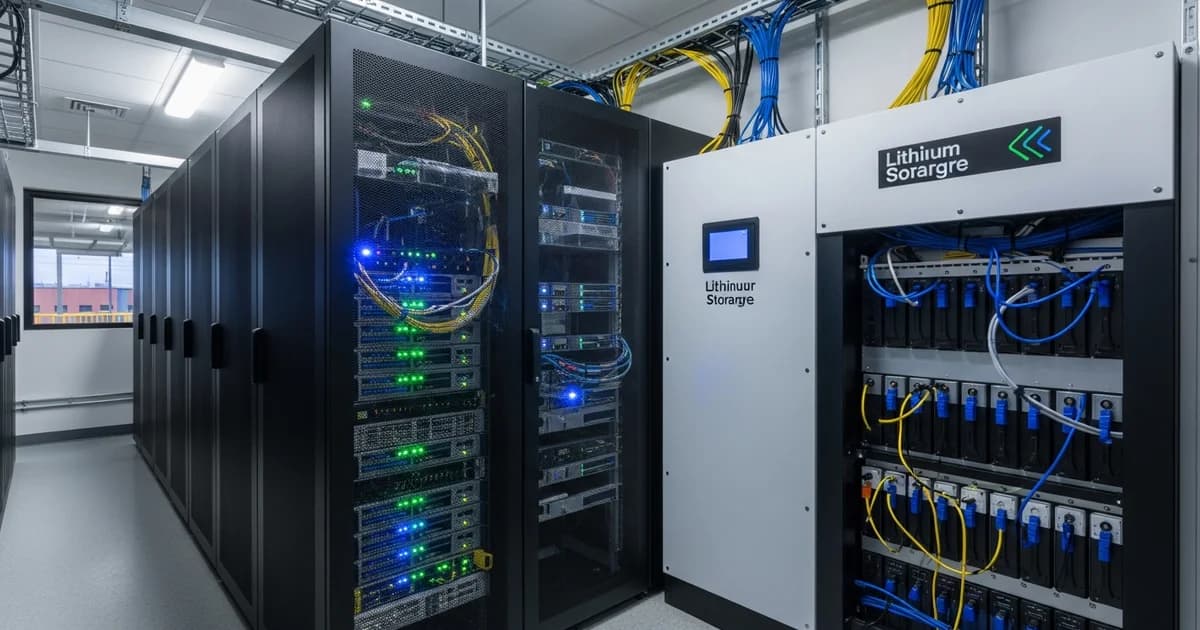
A UPS is built to buy you minutes. A Houston outage costs you hours. That mismatch is where server rooms and edge compute nodes lose data, revenue, and equipment. A typical data center UPS carries the IT load 5 to 15 minutes, long enough for a graceful shutdown or a failover, not long enough to ride through a multi-hour ERCOT event or a Beryl-class storm that left some commercial sites dark for over a week (Camali Corp, 2025).
Most small and edge operators size their UPS correctly and still get hurt. The gap is not the UPS. It is everything between "UPS exhausted" and "grid restored." This post shows how battery energy storage bridges that gap, why cooling is the hidden failure point, how to size 50 to 250 kWh systems with N+1 in mind, and what an hour of downtime actually costs.
Key Takeaways
- A data center UPS typically runs 5 to 15 minutes, enough for graceful shutdown, not multi-hour ride-through (Camali Corp, 2025).
- Over 90% of mid and large enterprises report a single hour of downtime costs more than $300,000 (ITIC via TechTarget, 2024).
- Cooling, not compute, is usually the first thing to fail. Server rooms hit thermal limits in minutes.
- Small and edge facilities typically need 50 to 250 kWh of storage, sized by rack count, IT load, and cooling load.
- Battery plus generator is a stack, not an either-or. Apply N+1 thinking to the battery layer.
[INTERNAL-LINK: get a fixed-price install quote for your Houston server room -> /home-backup-planner?source=blog&slug=battery-backup-houston-data-centers-small-edge]
Why does a UPS run out before the lights come back on?
A typical data center UPS sustains the IT load for 5 to 15 minutes, and even hardened critical clusters usually top out around 20 to 30 minutes (Camali Corp, 2025). It was never designed for ride-through. It is a power-quality device and a bridge, holding the load steady through the seconds it takes a generator to start, and giving you a clean window to shut down or fail over if the generator does not.
That role matters. A UPS conditions dirty power and covers the genset transfer window. A standby generator still needs 10 to 90 seconds to crank, sync, and stabilize before it can accept load, and the UPS owns those seconds. The problem starts when the genset fails to start, runs short on fuel, or the outage outlasts the diesel tank. In 2026, large-scale battery storage is the layer that turns minutes into hours, covering the multi-hour gap a UPS was never meant to fill (MANLY Battery, 2025).
Houston makes this concrete. When Hurricane Beryl crossed the metro in July 2024, more than 2.2 million CenterPoint customers lost power, and some commercial sites stayed dark for over a week (Texas Tribune, 2024). No UPS in the building covers a week. The question is what sits between the UPS and the next reliable power source.
For the broader business case, see our [INTERNAL-LINK: commercial battery backup pillar guide for Texas businesses -> /blog/commercial-battery-backup-texas-businesses].
What does an hour of downtime actually cost?
Over 90% of mid and large enterprises report that a single hour of downtime costs upward of $300,000, and 40% put the figure at $1 million or more (ITIC via TechTarget, 2024). The classic per-minute benchmark runs about $5,600 a minute, roughly $336,000 an hour, and it has trended higher for data-intensive operators (TechTarget, 2024).
Those are enterprise numbers. Scale them down and the logic holds. A small or edge operator does not lose $300,000 an hour, but the bill adds up fast: lost transactions, SLA penalties, missed orders, and data-integrity recovery after a hard shutdown. For a regional logistics firm or an MSP running an on-prem rack, a half day offline during a storm can erase a quarter's margin on that site.
Is the math really that lopsided? Compare the one-time cost of a battery layer against a single multi-hour outage during peak season. For most Houston operators we survey, one avoided event pays for a meaningful share of the system. Even at a fraction of the enterprise figures, an SMB-scale edge node loses real money every hour the racks sit dark.
For the Texas-specific framing, read [INTERNAL-LINK: what a power outage costs a Texas business per hour -> /blog/business-interruption-power-outage-cost-texas].
[INTERNAL-LINK: check what a battery system would cost to protect your operation -> /home-backup-planner?source=blog&slug=battery-backup-houston-data-centers-small-edge]
The hidden failure point is cooling, not compute
Server rooms overheat fast. A sealed rack room with no active cooling can cross safe thermal limits in minutes, which means a UPS that only backs the IT load lets the room cook while the servers still show full battery. The racks do not run out of power. They run out of cool air, and they shut themselves down to protect the hardware.
[PERSONAL EXPERIENCE] On Houston commercial site surveys we run into the same blind spot again and again. The UPS protects the servers, and nothing protects the CRAC unit, the mini-split, or the in-row cooling. So the operator has carefully sized 15 minutes of IT runtime, but the room hits thermal shutdown in 6 or 8 minutes because the cooling died the instant utility power dropped. The compute battery is irrelevant once ambient temperature climbs past the gear's tolerance.
This is what generic UPS sizing guides miss. To ride through an outage, the backup has to carry the cooling load along with the IT load. A 20 kW IT load with 10 kW of cooling is a 30 kW backup problem, not a 20 kW one. Storage that ignores cooling buys runtime the room will never get to use.
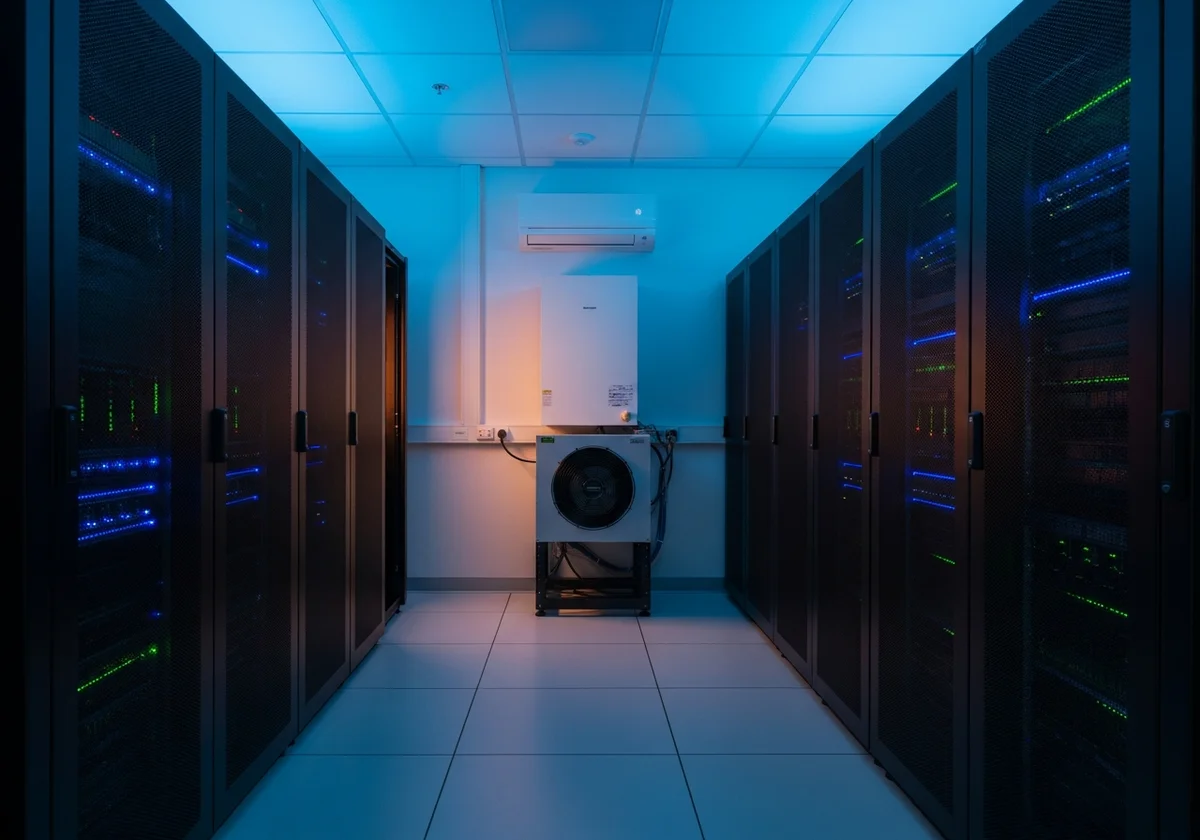
In an unbacked or IT-only-backed room, cooling is the first system to fail. Without active CRAC or in-row cooling, a dense rack room can reach thermal shutdown thresholds in minutes, forcing servers offline while their UPS still reports charge. Effective ride-through sizing must include the cooling load, not just the compute load.
Composite case study: a 12-rack Houston edge node through Beryl
The following is a composite based on patterns we see across Houston commercial site surveys. It does not describe a single real client, and no real names or identifying details are used.
Picture a 12-rack colocation closet for a regional logistics firm in northwest Houston. The IT load runs about 30 to 45 kW. The room has a 2N UPS rated for 10 minutes and one 60 kW standby generator. On paper, a textbook small-room design. Then Beryl arrives in July 2024, more than 2.2 million CenterPoint customers lose power, and the cracks show (Texas Tribune, 2024).
Failure one comes in the first two minutes. Utility power drops, the UPS picks up the IT load cleanly, and the generator begins its start sequence. But the mini-split cooling is not on the UPS, so during the 90-second transfer window the room temperature spikes. The genset comes online, yet by then the room has brushed its thermal alarm and the team is load-shedding non-critical racks to save the rest.
Failure two comes on day two. The generator runs fine, but diesel deliveries across the metro stall as roads and suppliers are overwhelmed. The 60 kW genset has fuel for roughly a day at load, and the refill does not arrive on schedule. The site faces a controlled shutdown, not because the design was wrong, but because nothing covered the fuel-logistics gap.
[ORIGINAL DATA] When we model this composite with a 100 to 150 kWh battery layer between the UPS and the generator, both failures close. The battery carries IT plus cooling through every transfer event, so the room never spikes during genset start. It also adds hours of buffer that let the operator stagger generator runtime and survive the fuel-delivery gap without a hard shutdown. The generator stops being the only line of defense and becomes the long-haul layer it was meant to be. Sizing scales with rack count and load, landing most small and edge facilities in the 50 to 250 kWh range.
How much battery does a small or edge data center need?
Small and edge facilities typically land in the 50 to 250 kWh range, scaling with rack count, IT load in kW, cooling load, and target ride-through hours (MANLY Battery, 2025). The starting math is simple: total backed load in kW multiplied by target hours, plus the cooling load, plus headroom for inefficiency and future growth.
Work an example. A 30 kW IT load plus 10 kW of cooling is 40 kW. Four hours of ride-through is 160 kWh of usable energy, and after round-trip losses and a depth-of-discharge buffer you are realistically specifying near 180 to 200 kWh. Trim the target to two hours and you are closer to 90 to 100 kWh. The lever that moves the number most is not rack count. It is the ride-through hours you need before a generator or the grid takes over.
[UNIQUE INSIGHT] Here is where most operators stop short. They apply N+1 redundancy to the UPS modules and the generator, then treat the battery as a single monolithic block. Reserved N+1 capacity, by definition, cannot be counted toward committed runtime (CoreSite, 2025). The battery layer deserves the same discipline. If your committed ride-through is four hours, the redundant unit is on top of that, not inside it. And battery plus generator is a stack, not a choice: the battery covers the transfer window and short ERCOT events, then bridges the multi-hour and fuel-logistics gaps, while the generator handles sustained multi-day runtime.
Integration is straightforward. The battery sits between your existing UPS and your existing generator, extends ride-through, reduces how often the genset has to start and cycle, and conditions the handoffs so the cooling load never sees an interruption. You keep the hardware you have and add the layer that was missing.
For commercial sizing and pricing, see [INTERNAL-LINK: Eos commercial battery options -> /plans/commercial], or get a system spec for your exact rack count and load below.
[INTERNAL-LINK: get a fixed-price install quote for your Houston server room -> /home-backup-planner?source=blog&slug=battery-backup-houston-data-centers-small-edge]
Riding through ERCOT events and grid instability
Battery storage rides through short ERCOT-driven sags, frequency events, and brief interruptions without ever transferring to the generator, which cuts wear, fuel use, and start cycling while keeping uptime continuous. Not every grid wobble is a hurricane. During summer peak stress, the Texas grid sees frequency excursions and short interruptions that a generator would meet with a full, noisy, fuel-burning start. A battery simply absorbs them.
The edge footprint that depends on this is growing fast. The edge data center market was valued at roughly USD 50.86 billion in 2025 and is projected to reach USD 109.20 billion by 2030, a 16.5% CAGR (MarketsandMarkets, 2025). More edge nodes mean more small rooms in buildings never designed for grid volatility, and the Houston metro carries that volatility on top of hurricane risk.
The point is continuity first. A battery layer keeps your room online through events that are too short to justify a generator start and too frequent to ignore. For local grid context, see [INTERNAL-LINK: ERCOT grid reliability in Houston -> /blog/ercot-grid-reliability-houston]. A refrigeration-and-equipment parallel from another vertical is in our piece on [INTERNAL-LINK: another Houston business continuity example -> /blog/battery-backup-houston-veterinary-clinics].
[INTERNAL-LINK: book a free Houston commercial site assessment -> /home-backup-planner?source=blog&slug=battery-backup-houston-data-centers-small-edge]
Or call to talk through your rack count, cooling load, and target ride-through with a Houston installer who will actually come survey the room.
Frequently Asked Questions
How long can a battery keep my Houston server room running?
It depends on your combined IT and cooling load and the capacity installed. A 50 to 250 kWh system commonly delivers a few to several hours of ride-through, compared with the 5 to 15 minutes a UPS provides (Camali Corp, 2025). Size by your real backed load, not just rack count.
Do I still need a generator if I have battery storage?
For multi-day outages, yes. Battery plus generator is a stack, not an either-or. The battery covers the genset transfer window, rides through short ERCOT events, and bridges the multi-hour and fuel-logistics gaps. The generator handles sustained multi-day runtime when storage alone cannot.
Will battery backup keep my cooling running, not just the servers?
Yes, as long as cooling loads are included in the sizing. This is the single most common gap we find on Houston site surveys: the UPS backs the IT load while the CRAC or mini-split goes dark, and the room hits thermal shutdown in minutes even though the servers still show charge.
How much does data center downtime cost per hour?
For most mid and large enterprises, more than $300,000 per hour, with 40% reporting losses above $1 million (ITIC via TechTarget, 2024). For SMB and edge operators the figure is lower but still material once you count lost transactions, SLA penalties, and data-integrity recovery.
The bottom line for Houston server rooms
A UPS and a battery layer solve different problems, and you need both. Quick recap:
- A UPS buys minutes. Battery storage buys hours. A Houston outage runs hours to days.
- Cooling, not compute, is usually the first system to fail. Back the cooling load too.
- Downtime is expensive, often six figures an hour for mid-size operators and material even for edge nodes.
- Size most small and edge sites at 50 to 250 kWh, and apply N+1 to the battery layer, not just the UPS.
- Battery plus generator is a stack: the battery bridges the gap, the generator carries the long haul.
If you run a server room or an edge node anywhere in the Houston metro, the gap between UPS minutes and grid restoration is the part nobody sizes for. We will come survey the room, measure your IT and cooling load, and spec a system that actually rides through.
[INTERNAL-LINK: get a fixed-price install quote for your Houston server room -> /home-backup-planner?source=blog&slug=battery-backup-houston-data-centers-small-edge]