Alvin and Manvel Battery Backup: Backup Power on Brazoria County Lots

Alvin and Manvel Battery Backup: Backup Power on Brazoria County Lots
Alvin, Texas holds a United States weather record. Tropical Storm Claudette dropped 42 inches of rain on the town in a single 24-hour period in July 1979, and no American gauge has beaten it since (NOAA Weather Prediction Center, 1979). That record isn't trivia if you're buying backup power here. It tells you what a stalled tropical system does to this stretch of Brazoria County.
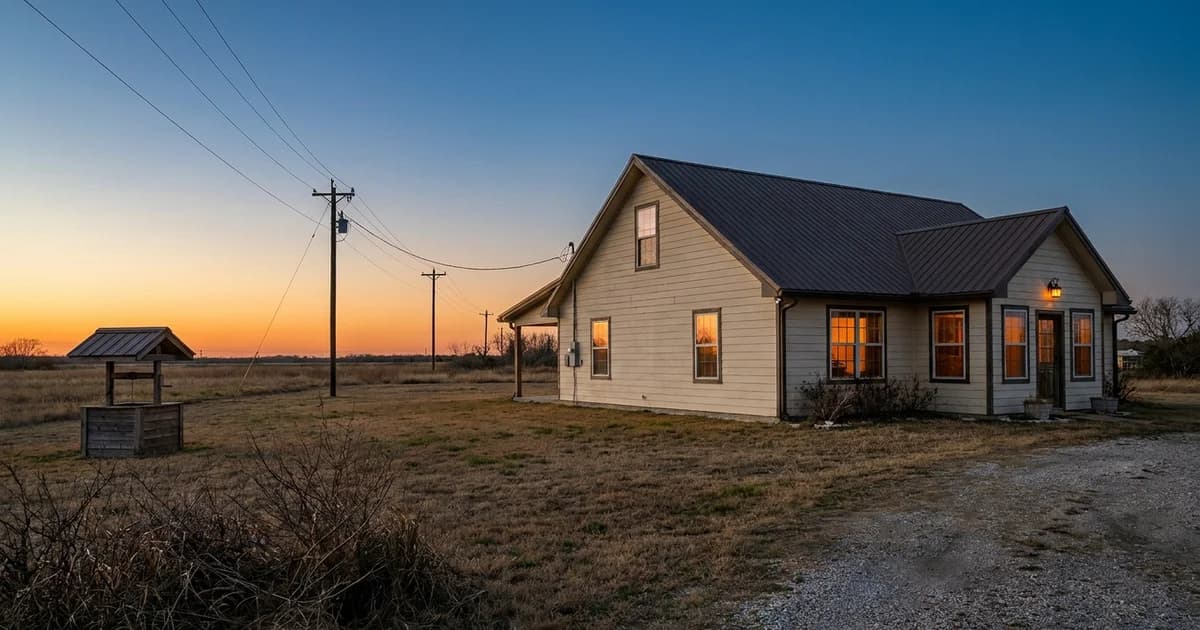
Alvin and Manvel homes also aren't suburban homes electrically. Plenty sit outside city water and sewer, on acreage, at the far end of a long overhead tap line. Here is what that changes: how restoration works out here, which loads you carry that a Pearland homeowner doesn't, and what to size for.
Key Takeaways
- Alvin's 42 inches of rain in 24 hours during Tropical Storm Claudette, July 1979, is still the US record (NOAA WPC).
- Manvel counted 5,179 residents in the 2010 Census and 9,992 in 2020, and it has kept growing since, so new rooftops keep landing on older distribution lines (US Census Bureau).
- Homes on a well and an aerobic septic system carry two backup-critical loads suburban homes never think about.
- One Eos controller delivers 11.5 kW continuous and 17.1 kW surge, which is what makes a well pump start and an AC start survivable together.
- Restoration runs transmission, then feeders, then tap lines, so low-density rural taps come last.
What makes Alvin and Manvel different from Pearland?
Lot size and utility service, not distance. As of the 2020 Census, Manvel counted 9,992 residents, nearly double its 5,179 in 2010, and Census Bureau estimates show it climbing again since as the SH 288 corridor filled in (US Census Bureau, 2020). Alvin, the older and larger of the pair, sits near 28,000 (US Census Bureau, 2024).
Growth that fast puts new rooftops on distribution infrastructure that predates them by decades. City water and sewer stop at the municipal line, and both cities are wrapped in unincorporated acreage where they never arrive.
[UNIQUE INSIGHT] The useful question isn't how far you live from Houston. It's whether your water and wastewater run on your own electricity. That one fact separates a routine backup job from a larger one, and it splits neighbors on the same road.
Permitting is ordinary: your licensed installer pulls it, and jurisdiction depends on whether you sit inside city limits or in the county. Our Pearland battery backup cost guide covers the Brazoria County path in detail, so this one doesn't have to.
Why do outages last longer on rural Brazoria County feeders?
Because restoration is ordered by customers per repair, and rural tap lines have the fewest customers per mile of line. US electricity customers averaged 11 hours of interruption in 2024, nearly twice the previous decade's annual average, and major events including Hurricanes Beryl, Helene, and Milton accounted for 80 percent of those hours (EIA, 2025).
Utilities restore in a hierarchy: critical facilities first, then transmission, substations and the major distribution lines that reach the most customers, then transformers serving roughly ten homes each, then individual service drops (CenterPoint Energy, 2026). The arithmetic is blunt. One crew hour on a dense feeder brings back thousands of homes. The same hour on a rural tap brings back a dozen, so the tap waits.
Beryl is the local reference point. In July 2024 the storm knocked out roughly 2.2 million CenterPoint customers at peak, more than a million were still dark days later, and the National Weather Service logged heat indices of 100 to 106 F while crews worked (Houston Public Media, 2024).
Now add the Claudette lesson. If water is standing across FM 1462, the crew can't reach the pole even when it's next in line, and you can't drive out either.
What loads does a Brazoria County lot have that a suburban home does not?
Water and wastewater. On a private well and an aerobic septic system, both are electric, and both stop the instant the power does. The EPA estimates more than 23 million US households rely on private wells (US EPA, 2024), and those wells fall outside the Safe Drinking Water Act, so the owner carries the whole system (USGS, 2024).
No power means no pump, so no tap, no shower, and no flush once the pressure tank empties. That's a few hours of stored water, not days.
The septic side is stricter than most people expect. Texas on-site sewage facilities fall under 30 TAC Chapter 285, and aerobic treatment units depend on continuous aeration plus a maintenance contract with a licensed provider reporting at least every four months (TCEQ, 2026). An aerator dead for a week is a treatment problem, not an inconvenience.
For the per-load numbers, see battery backup for Houston homes on a well and keeping an aerobic septic aerator running.
What size battery does an Alvin or Manvel home actually need?
Larger than the suburban default, because four load groups stack instead of two. Sizing answers two separate questions: capacity in kWh decides how long you last, and controller output in kW decides what runs at the same time. On acreage, the second question is the one that bites.
| Load group | Motor or resistive | At startup | Backup priority |
|---|---|---|---|
| AC compressor | Motor | Brief inrush above running draw | High through a Gulf Coast summer |
| Well pump | Motor | Same inrush, cycles on demand | Critical, no water without it |
| Aerobic septic aerator | Motor | Small motor, near continuous | Critical, TCEQ maintenance applies |
| Refrigeration and freezers | Motor | Compressor cycles, short inrush | High, especially deep freezers |
| Lights, Wi-Fi, medical devices | Electronic | No meaningful inrush | Always on, small draw |
[UNIQUE INSIGHT] The binding constraint on these lots is simultaneity of motor starts, not total kWh. Induction motors of the NEMA Design B type common in home equipment draw a brief multiple of running current when they start. Two motors that each start cleanly alone can trip a system when they start together. A well pump kicking in the same second the AC restarts is a normal Tuesday out here.
That's why surge headroom matters more than raw capacity in Brazoria County. Each Eos controller delivers 11.5 kW continuous with 17.1 kW of surge, and the smart panel sequences loads so those starts don't land on the same instant. The Pro tier pairs that controller with three modules, 27 kWh nominal and 26.28 kWh usable, for up to 18 hours at minimal load. Runtime is a range, not a promise. For what each tier includes, see the full plan lineup.
How does a battery compare with a generator out here?
The rural objections differ from the suburban ones. Nobody within earshot complains about a generator at 3am when the nearest neighbor is a pasture away, so the honest comparison is fuel logistics, not noise.
Fuel is the real rural failure mode. A generator is only as good as the next trip to refill it, and the Claudette rainfall regime is exactly when that trip doesn't happen. Roads flood, stations lose power, and the tank stays empty.
Here's the honest half. A battery is a finite reservoir and a generator with fuel isn't. The answer is load discipline: the smart panel drops the pool pump and the second AC zone so the well, the aerator, the fridge, and one comfortable room keep going. Our battery versus generator comparison for Texas puts both side by side.
What does an install look like on an acreage lot?
Same equipment, longer runs and more subpanels. [PERSONAL EXPERIENCE] What our crews find on Brazoria County site surveys that they rarely see in a subdivision: the well head and pressure tank in a separate pump house a hundred feet from the home on its own subpanel, and the septic control panel out near the drain field in a third location.
Those distances change how loads get grouped on the smart panel. A clearly critical load can sit on the wrong side of the property for the simple wiring answer, and the design has to account for that up front.
The battery mounts on a garage or utility-room wall the same way it would anywhere. Work follows NFPA 855 for stationary energy storage and NEC Article 706, the same standards that apply inside Houston city limits. See our Houston metro service area for coverage, and battery backup in Pearland is the nearest location page to Alvin and Manvel.
Which Brazoria County areas does Eos serve?
Alvin, Manvel, Iowa Colony, Rosharon, and the unincorporated pockets between them all sit inside our Houston metro footprint. On a similar rural feeder in another county? Our guide to Richmond and Rosenberg rural backup covers the same problem in Fort Bend.
Or call Eos at 833-989-3737 to talk through your setup with an installer.
Frequently asked questions
How long do power outages last in Alvin and Manvel?
No figure is published for either city, but the restoration order explains the pattern: transmission, then feeders, then tap lines. After Hurricane Beryl in July 2024, roughly 2.2 million CenterPoint customers lost power at peak and more than a million were still out days later (Houston Public Media, 2024).
Will a home battery run my well pump?
Yes, when the system has surge headroom for the pump's startup draw. Each Eos controller handles 11.5 kW continuous and 17.1 kW surge, and the smart panel keeps the pump from starting the same moment as the AC. Our well pump backup guide has the load detail.
Does a battery keep an aerobic septic aerator running?
Yes, and it belongs on the protected list. Texas aerobic treatment units run under 30 TAC Chapter 285 with a licensed provider reporting at least every four months (TCEQ, 2026). The aerator is a small continuous motor load, which makes it cheap to carry.
Do I need a permit for a home battery in unincorporated Brazoria County?
Yes, and your licensed installer pulls it. Jurisdiction depends on whether the property sits inside Alvin or Manvel city limits or in the unincorporated county. Our Pearland cost guide walks the Brazoria County path step by step.
Is Alvin really the US rainfall record holder?
Yes. Tropical Storm Claudette dropped 42 inches of rain on Alvin in 24 hours in July 1979, still the United States 24-hour rainfall record (NOAA Weather Prediction Center, 1979).
The bottom line
A backup decision in Alvin or Manvel comes down to two questions a suburban buyer never asks. Does your water come from your own pump? Does your wastewater depend on your own aerator? If either answer is yes, both belong on the protected list, and the system needs surge headroom to start them alongside an AC compressor. Add a restoration queue that puts rural taps last, and building in margin is the straightforward call.
Sources
- NOAA Weather Prediction Center, Tropical Storm Claudette rainfall, retrieved 2026-08-13, https://www.wpc.ncep.noaa.gov/tropical/rain/claudette1979.html
- US Census Bureau, QuickFacts Manvel city, Texas, retrieved 2026-08-13, https://www.census.gov/quickfacts/manvelcitytexas
- US Census Bureau, QuickFacts Alvin city, Texas, retrieved 2026-08-13, https://www.census.gov/quickfacts/alvincitytexas
- US Energy Information Administration, Hurricanes in 2024 led to the most hours without power in 10 years, retrieved 2026-08-13, https://www.eia.gov/todayinenergy/detail.php?id=66744
- CenterPoint Energy, Systematic Power Restoration, retrieved 2026-08-26, https://actioncenter.centerpointenergy.com/en-us/systematic-power-restoration
- Houston Public Media, Hurricane Beryl power outage coverage, retrieved 2026-08-13, https://www.houstonpublicmedia.org/articles/news/hurricane/2024/07/08/492833/houston-power-outages-hurricane-beryl-centerpoint/
- US Environmental Protection Agency, Private Drinking Water Wells, retrieved 2026-08-13, https://www.epa.gov/privatewells
- US Geological Survey, Domestic Private Supply Wells, retrieved 2026-08-13, https://www.usgs.gov/mission-areas/water-resources/science/domestic-private-supply-wells
- Texas Commission on Environmental Quality, OSSF Maintenance Requirements, retrieved 2026-08-13, https://www.tceq.texas.gov/permitting/ossf/ossfmaintenance.html
- National Fire Protection Association, NFPA 855 Stationary Energy Storage Systems, retrieved 2026-08-13, https://www.nfpa.org/codes-and-standards/nfpa-855-standard-development/855