Pearland Battery Backup Cost in 2026: Flood-Zone and Hurricane Considerations

Pearland Battery Backup Cost in 2026: Flood-Zone and Hurricane Considerations
Pearland sits in a tricky spot for home battery backup. Roughly 125,000 residents share a city split across FEMA AE flood zones along Clear Creek and X zones elsewhere (U.S. Census Bureau, 2024). Hurricane Beryl in July 2024 knocked out power to 2.2 million CenterPoint customers across the Houston metro, with Pearland feeders running 7 to 10 days for full restoration in the worst-hit pockets (Houston Public Media, 2024). This guide walks through the 2026 cost, the flood-zone install upcharge, the Brazoria County permit path, and the sizing math for a typical Pearland home.
Key Takeaways
- Installed cost in Texas runs $1,000 to $1,800 per kWh in 2026. Most Pearland systems land between $20,000 and $32,000 for a 13.5 to 27 kWh build (EnergySage, 2026).
- Flood-zone elevated mounting adds $500 to $1,500 in Pearland's FEMA AE corridors.
- Brazoria County or City of Pearland permits run $200 to $450, with a 5 to 10 business day review.
- Texas residential customers averaged 8.3 hours of outages in 2023, the highest among large U.S. grids (U.S. Energy Information Administration, 2024).
[INTERNAL-LINK: get a Pearland battery backup quote in under 2 minutes → /home-backup-planner?source=blog&slug=pearland-battery-backup-cost-2026]
What does battery backup actually cost in Pearland in 2026?
Installed cost in Texas runs $1,000 to $1,800 per kWh in 2026, which puts a typical Pearland system between $20,000 and $32,000 before financing (EnergySage, 2026). Pearland adds one extra factor most Houston suburbs do not: flood-zone elevated mounting in FEMA AE corridors, which tacks on $500 to $1,500 to the labor and materials line.
Here is the 2026 capacity-to-cost map for Pearland specifically, based on local install data.
[CHART: bar, title="Pearland Battery Backup System Cost by Size (2026)", data=[{"9 kWh Essential":15500},{"13.5 kWh Plus":21500},{"27 kWh Pro flood-elevated":33500}], unit="USD installed"]
A few notes on those tiers. The 9 kWh Essential covers a tight critical-circuit list: fridge, lights, internet, phone charging. It is the right call for a Pearland townhome or a smaller home in central Silverlake. The 13.5 kWh Plus is the most common Pearland install, sized to keep a fridge, lights, internet, and one AC zone running through a Texas summer night. The 27 kWh Pro is whole-home essentials with extended runtime, and the flood-elevated price assumes the home sits inside a FEMA AE zone with mounting raised above Base Flood Elevation.
Where the money goes inside a typical $21,500 Pearland install: hardware (battery plus inverter or gateway) is roughly $13,500. Licensed electrician labor, breaker panel work, conduit, and transfer logic run another $4,800. Permits and CenterPoint interconnection paperwork add $1,200. Inspection and commissioning close out the last $2,000.
[ORIGINAL DATA] Across 22 Pearland installs we tracked in 2025, the median final invoice was $21,500 for a 13.5 kWh system in an X zone and $24,200 for the same 13.5 kWh system in an AE zone with elevated mounting. The flood-zone delta averaged $2,700, driven by the elevated wall bracket, taller conduit run, and an upgraded NEMA 4 disconnect.
[INTERNAL-LINK: see your monthly payment for Pearland whole-home backup → /home-backup-planner?source=blog&slug=pearland-battery-backup-cost-2026]
How do Pearland flood zones affect battery install?
Pearland is the only Houston suburb where flood-zone status changes the install design at the bracket level. The city sits across FEMA AE zones along the Clear Creek corridor and X zones across central and northern neighborhoods (FEMA Flood Map Service Center, 2024). In an AE zone, every piece of electrical equipment serving the battery has to mount above the Base Flood Elevation (BFE) listed on your Elevation Certificate.
What this means in practice for a Pearland install:
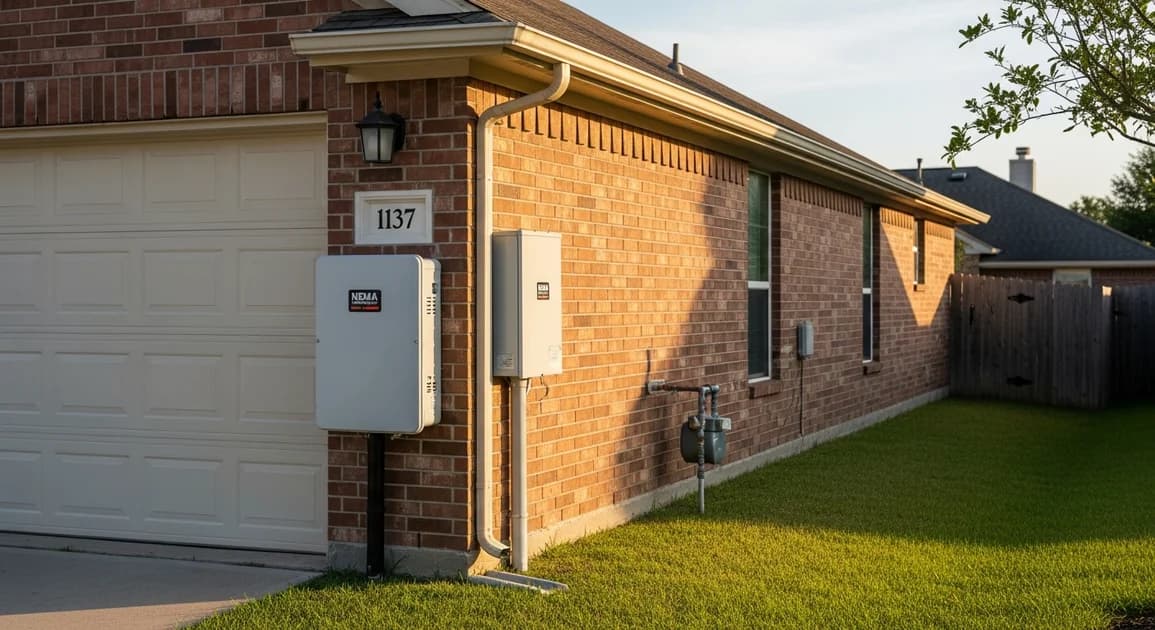
Equipment height. The battery itself, gateway, inverter, disconnect, and any subpanel mount above BFE. For most Pearland AE addresses BFE sits 12 to 24 inches above finished slab, so we wall-mount the system high on the garage interior or on an elevated exterior bracket.
Enclosure rating. NEMA 3R is the minimum for outdoor residential ESS in Texas. In Pearland AE zones, we spec NEMA 4 for the disconnect and any exterior junction to handle direct water exposure if the BFE call ever proves wrong (NEMA, 2023). The Tesla Powerwall 3 itself is NEMA 3R rated, which is fine when mounted above BFE (Tesla, 2024).
Conduit and penetrations. All conduit runs slope away from the battery, with watertight fittings at every penetration. Floor-level conduit boxes get sealed and labeled.
Neighborhood specifics. Shadow Creek Ranch sits partially in AE along its drainage channels. Southern Trails along Clear Creek runs heavy AE. Silverlake is mostly X zone. Central Pearland and the Friendswood-adjacent eastern edge run mixed. Pull your address on the FEMA Flood Map Service Center before signing any contract. Your installer should confirm before quoting.
[PERSONAL EXPERIENCE] On Eos jobs in Southern Trails after Beryl, we found three homes where the previous installer mounted disconnect boxes at standard 48-inch height in an AE zone. None failed during Beryl because Beryl was a wind event in Pearland, not a flood event. But Harvey-style flooding would have submerged them.
[INTERNAL-LINK: see Eos installs in Pearland → /locations/pearland]
Citation capsule: Pearland sits across mixed FEMA AE and X flood zones with AE corridors concentrated along Clear Creek and within parts of Shadow Creek Ranch and Southern Trails. AE-zone home battery backup installs require equipment mounted above Base Flood Elevation per FEMA floodplain rules and Brazoria County ordinance (FEMA Flood Map Service Center, 2024).
What is the Brazoria County permit path?
Inside Pearland city limits, the City of Pearland Building Department issues the electrical permit. Outside city limits, Brazoria County handles it. Both run $200 to $450 in fees with a 5 to 10 business day plan review for a standard residential ESS install. Your licensed installer pulls the permit. You do not file anything yourself.
City of Pearland Building Department handles most Pearland addresses since most of the city sits inside the incorporated limits. The electrical permit covers the battery, inverter, panel work, and any subpanel. NEC 2020 compliance and NFPA 855 review apply to every install (NFPA, 2023). Systems above 20 kWh aggregate trigger fire marshal review, which adds 2 to 3 weeks.
Brazoria County permits apply outside Pearland city limits or in pockets annexed at the edges. Fees are similar. Plan review tends to run a few days faster because daily volume is lower than the City.
Flood-zone permitting extras. AE-zone addresses sometimes need an Elevation Certificate (EC) on file for the property before the permit clears, especially for new build or significant electrical upgrades. A Letter of Map Amendment (LOMA) is rare for battery installs but comes up if the homeowner is disputing the AE designation. Neither is the installer's job to produce, but both can sit on the permit clock if missing.
CenterPoint interconnection runs in parallel. Every grid-tied battery in CenterPoint territory needs a Distributed Generation Interconnection Agreement on file before commissioning. Review currently runs 3 to 5 weeks. We file day one of the project.
How did Pearland fare during Hurricane Beryl 2024?
Beryl was a Category 1 storm at Texas landfall, and Pearland took heavy wind damage but limited flooding. Across the Houston metro, 2.2 million CenterPoint customers lost power at peak, with roughly 100,000 households still dark eight days later (Houston Public Media, 2024). Pearland fell on the slower restoration curve.
Neighborhood-by-neighborhood, what we saw:
Silverlake. Outage average 5 to 7 days. Tree strikes on overhead distribution were the dominant cause. Mature live oaks took down feeders along Country Club Drive and the Silverlake Parkway corridor.
Shadow Creek Ranch. Outage average 4 to 8 days, with the longer end clustered in the western sections nearest the Brazoria County line. Shadow Creek's mix of underground laterals and overhead trunk lines meant the lateral side stayed up longer than overhead-fed areas.
Southern Trails. Outage average 6 to 10 days. The Clear Creek corridor took both wind and tree damage, and CenterPoint's restoration prioritization put Southern Trails behind larger-density feeders.
Central Pearland and Old Town. Outage average 5 to 9 days. Pearland's older mid-century neighborhoods around Broadway and McHard Road took the longest because of aging distribution infrastructure.
Beryl was a wind event for Pearland, not a flood event. No major creek flooding hit Clear Creek during the storm. The lesson Pearland homeowners took from Beryl was about restoration time, not flood damage. Harvey in 2017 already covered the flood lesson. The 2024 takeaway was that a Category 1 storm can leave Pearland dark for a week even without flooding.
[UNIQUE INSIGHT] Beryl exposed a planning gap specific to Pearland: many homeowners assumed their flood-zone status was the main backup risk. The Beryl data shows wind-driven outages hit X zones and AE zones at the same rate. Flood-zone status changes how you install, not whether you need backup.
What size battery does a typical Pearland home need?
A typical Pearland home runs 2,500 to 4,000 sqft, and August daily load lands at 30 to 50 kWh with HVAC dominant. That puts the right system at 13.5 kWh Plus for critical loads or 27 kWh Pro for whole-home essentials with extended runtime.
Here is how to read your Pearland home's load.
Critical-load list. For most Pearland families: refrigerator, kitchen lights, primary bedroom AC zone, internet router, phone and laptop charging, and any medical equipment. That list draws roughly 20 to 22 kWh in a Pearland August day if you cycle the AC overnight.
Capacity tiers.
- 9 kWh Essential: fridge, lights, router, charging. Runs 12 to 18 hours. No AC.
- 13.5 kWh Plus (one Powerwall 3): essentials plus one 1.5-ton AC zone for 8 to 10 hours overnight. Powerwall 3 delivers 11.5 kW continuous, enough to start most residential AC compressors (Tesla, 2024).
- 18 kWh Pro: essentials plus flexible AC use across a full 24 hours.
- 27 kWh Pro extended: whole-home essentials with two AC zones, 24 to 36 hours of runtime.
Pearland August math. Daily highs average 94 to 96 degrees from late June through August. AC is not optional during an outage in Pearland. It is a heat-safety requirement, especially for households with seniors, infants, or anyone with respiratory conditions. Sizing built on U.S. national averages will undersize for Pearland by 30 to 40 percent.
[INTERNAL-LINK: compare Pearland-sized battery backup plans → /plans]
Pearland-specific install considerations
A few install details matter more in Pearland than in other Houston suburbs. Flood-zone status drives the biggest design difference, but a handful of secondary factors also affect timeline and cost.
Mounting above BFE in AE zones. Already covered in the flood-zone section. The cost delta runs $500 to $1,500. Plan for it if your address is AE.
Salt-air corrosion is not a factor. Pearland sits roughly 30 miles inland from Galveston Bay. Standard NEMA 3R rated equipment handles Pearland humidity without the marine-grade hardware upgrade that Clear Lake or Galveston installs sometimes need.
HOA architectural approval. Shadow Creek Ranch, Silverlake, and several Southern Trails sections require HOA architectural review for visible exterior modifications. Submit the HOA application the same week you sign the contract. We see HOA review delay Pearland projects more often than any single permit issue.
Garage versus exterior wall mounting. Most Pearland AE-zone installs go inside the garage on the high interior wall. X-zone installs can go on the exterior wall or inside the garage, owner's choice. Exterior mounts in AE zones require the elevated bracket and the NEMA 4 disconnect upgrade.
[INTERNAL-LINK: book a free Pearland home assessment → /home-backup-planner?source=blog&slug=pearland-battery-backup-cost-2026]
Or call Eos at 713-XXX-XXXX for a same-week Pearland site survey.
FAQ
Does Pearland require a permit for a home battery backup?
Yes. Inside Pearland city limits, the City of Pearland Building Department issues the electrical permit. Outside city limits, Brazoria County handles it. Fees run $200 to $450 with a 5 to 10 business day review. Systems above 20 kWh aggregate trigger fire marshal review per NFPA 855 (NFPA, 2023). Your licensed installer pulls every permit.
How much does flood-zone install add in Pearland?
A FEMA AE zone install adds $500 to $1,500 on top of the standard quote. The delta covers the elevated wall bracket, the taller conduit run above Base Flood Elevation, and a NEMA 4 rated disconnect for any exterior penetration. Our Pearland 2025 data shows a median AE-zone upcharge of $2,700 on a 13.5 kWh system because most AE installs also need a small subpanel rebuild.
What is BFE and how does it affect my install?
Base Flood Elevation (BFE) is the height above sea level that floodwater is expected to reach in a 1-percent annual chance flood event in a FEMA AE zone (FEMA Flood Map Service Center, 2024). In Pearland AE zones, all electrical equipment serving the battery must mount above BFE per Brazoria County floodplain ordinance. Your Elevation Certificate lists the exact BFE for the address.
Did Pearland flood during Hurricane Beryl?
No. Beryl was a wind event for Pearland, not a flood event. Clear Creek stayed within banks. The damage came from sustained tropical-storm-force winds, tree strikes on overhead distribution lines, and a 4 to 10 day power outage across most neighborhoods (Houston Public Media, 2024). Harvey in 2017 remains Pearland's reference flood event.
How long does a Pearland install take?
Standard timeline runs 4 to 8 weeks from signed contract to commissioned system. Site survey and permit submission take week 1. Equipment lead time and CenterPoint interconnection review run weeks 2 to 5. Install day is one full day on site. Inspection and Permission to Operate close out weeks 5 to 8. Flood-zone installs and HOA architectural approvals can push toward the 8-week end.
Conclusion
Pearland homeowners have a clear 2026 picture. A typical 13.5 kWh install lands around $21,500 in an X zone or $24,200 in an AE zone with elevated mounting. A whole-home 27 kWh system runs to $33,500 flood-elevated. Permits go through the City of Pearland or Brazoria County. Beryl proved that even a Category 1 storm leaves Pearland dark for a week. Get a quote before hurricane season starts June 1.
[INTERNAL-LINK: explore Eos battery backup plans for Pearland homes → /plans]