Battery Backup for Aerobic Septic Systems in Texas: Keep the Aerator Running

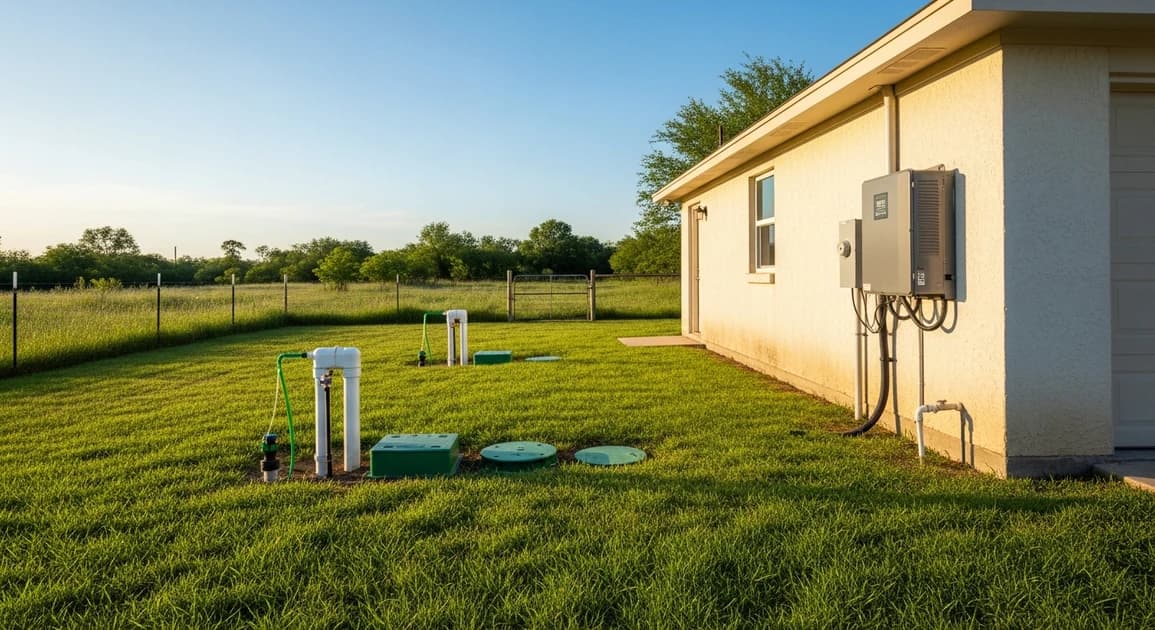
Battery Backup for Aerobic Septic Systems in Texas
The aerator on your aerobic septic system is the quietest appliance on your property. It draws about as much power as a bright light bulb, hums along around the clock, and nobody thinks about it. Then a storm takes the grid down, the compressor stops, and the clock starts. Within about a day the tank begins going anaerobic, and you will not get a warning, because the alarm panel that is supposed to alert you lost power at the same instant. This guide covers what an aerobic treatment unit actually needs during an outage, how long you have, and how to size a home battery so the whole question goes away.
Key Takeaways
- An aerobic treatment unit (ATU) is an electrical appliance. When the grid drops, the aerator, spray pump, and alarm panel all stop, though the tank keeps receiving wastewater.
- Septic professionals put the practical deadline near 24 hours without aeration before the aerobic bacteria begin dying off, with early disruption starting at 4 to 8 hours (Barnes Sewer & Septic, 2025).
- The load is tiny. The widely installed Hiblow HP-80 aerator is rated at 71 watts, and a full ATU uses roughly 2.5 to 3 kWh per day (Hiblow, 2026).
- An Essential 9 kWh battery carries the septic system alone for days. A Plus 18 kWh system covers the aerator, a well pump, and the refrigerator together.
[INTERNAL-LINK: check if your home qualifies for a 9 to 45 kWh system → /home-backup-planner?source=blog&slug=battery-backup-septic-system-aerator-texas]
Does an aerobic septic system work during a power outage?
No. An aerobic treatment unit is an electrical appliance, and it stops treating wastewater the moment the grid does. The aerator compressor, the spray or drip effluent pump, the chlorinator dosing cycle, and the control panel all go dark at once. The tank keeps receiving everything your household sends it. It just stops doing anything about it.
This is the point that trips people up, because a conventional gravity septic system genuinely does not care about electricity. Waste flows to the tank, solids settle, liquid moves to the drain field, no pump required. If a neighbor with a conventional system shrugs off outages, that experience does not transfer to your ATU.
Texas has an enormous number of homes in this situation. The state counts roughly 2.2 to 2.6 million on-site sewage facilities, and OSSFs are the system of choice for about 20% of new homes built in Texas (TCEQ, On-Site Sewage Facilities Program, 2026). In the unincorporated stretches of Harris, Montgomery, Fort Bend, and Waller counties, where lots sit beyond the sewer lines, aerobic systems are the default for new construction.
One more detail that matters in practice: the alarm panel is unpowered too. The system that is designed to warn you about a failed aerator cannot warn you about anything during the outage that caused the failure.
How long can an aerobic septic system go without power?
The commonly cited threshold is about 24 hours. Around that point, the aerobic bacterial colony that does the actual treatment begins dying off for lack of oxygen (NeedSeptic, 2026). Some septic professionals report the first disruption to the bacterial community starting as early as 4 to 8 hours after power loss (VDW Water & Sewer, 2025).
What does "going anaerobic" look like on your property? Sulfide odor around the tank is the first sign most homeowners notice. Then comes cloudy effluent, sludge carrying over into the pump tank, and spray heads discharging under-treated water onto the lawn. That last one is not just unpleasant. Surface discharge in Texas is governed by 30 TAC Chapter 285, and effluent that creates ponding or nuisance conditions is a compliance problem, not a cosmetic one (TCEQ, OSSF Rules Compilation RG-472, 2025).
Recovery is slower than failure. After a multi-day outage, extension-service guidance is to minimize water use for roughly three more days after power returns, because the bacterial colony needs time to rebuild before it can handle a normal household load (LSU AgCenter, 2025). If the colony crashed hard, you may be paying your maintenance provider for a service call and a restart, and aerator pump replacements in Texas commonly run $500 to $1,200 (Texas Septic Guide, 2026).
Houston-area homeowners have lived this recently. Hurricane Beryl knocked out power to 2.2 million CenterPoint customers in July 2024, and 88,000 were still dark eight days later (Texas Tribune, 2024). On our post-Beryl service calls in Montgomery and Waller counties, the pattern homeowners on aerobic systems described was the same: days of odor, an alarm panel screaming the moment power returned, and a maintenance callout to get the tank back on track.
How many watts does a septic aerator use?
Far less than most people assume. Common residential linear-diaphragm septic air pumps draw 70 to 120 watts continuously. The Hiblow HP-80, one of the most widely installed aerators in Texas, is rated at 71 watts, a 0.1 HP motor (Hiblow, 2026). The larger HP-120 runs near 100 to 120 watts (Wholesale Septic Supply, 2026).
The second load is the effluent or spray pump, typically a 1/2 HP, 115V submersible unit (Franklin Electric E-Series spec, Wholesale Septic Supply, 2026). It draws roughly 500 to 900 watts while running, but only runs a few minutes per dose cycle. The control panel and alarm add a handful of watts on standby.
Run the daily arithmetic and the number stays small. An aerator at about 100 watts for 24 hours is roughly 2.4 kWh per day. Add a few spray cycles and panel standby and a typical Texas ATU lands near 2.5 to 3 kWh per day. That is the whole system. For scale, a single 9 kWh battery holds about three days of that.
Why a battery beats a generator for this specific load
A septic aerator is a small, constant, unattended load, and that is exactly the load profile a generator handles worst and a battery handles best. Every septic-service article you will find on this subject says "get a backup generator." For this load, that is the wrong tool.
Think through the outage itself. A portable generator cannot run unattended overnight, needs refueling every 6 to 10 hours, and must never run in an enclosed space. Nobody stays awake for three nights to babysit 100 watts. A standby generator solves the attention problem but burns fuel around the clock at a rate sized for the whole house, all to protect a load smaller than a ceiling fan.
A battery inverts every one of those problems. It runs silently, has no refueling step, transfers power automatically, and needs no one home. If you evacuate for a hurricane, or the outage hits your weekend property while you are away, the aerator keeps humming and the bacterial colony never knows anything happened. When power returns, there is no alarm to clear and no restart to pay for.
That is our honest read after years of installs on rural Texas properties: the septic aerator may be the single best-matched load for a home battery on the entire property, precisely because it is small, constant, and unattended.
[INTERNAL-LINK: see your monthly payment for whole-home backup → /home-backup-planner?source=blog&slug=battery-backup-septic-system-aerator-texas]
What size battery do you need for an aerobic septic system?
The aerator alone is trivially small, so the real sizing question is what else lives on the same rural property. Here is how the tiers map to this persona:
- Essential (9 kWh): covers the aerator, control panel, and spray pump for multiple days. At roughly 2.5 to 3 kWh per day of septic load, 8.76 usable kWh is about three days of dedicated runtime. This is the right choice only if you are on municipal water and protecting the ATU specifically.
- Plus (18 kWh): the realistic rural default. With 17.52 usable kWh, it runs the aerator, spray pump, well pump, refrigerator, lights, and Wi-Fi together through a multi-day outage.
- Pro (27 kWh) and above: adds air conditioning cycling and a second refrigerator or freezer for larger acreage homes.
Capacity is only half the check. The other half is surge, because the spray pump and especially a well pump draw a sharp starting spike several times their running watts. The Eos smart controller supplies 11.5 kW continuous and 17.1 kW of surge, which clears a 1/2 HP effluent pump and a 1 HP well pump starting at the same moment with room to spare.
Here is the combined-load point that most planning gets wrong. The homeowner with an ATU almost always also has a private well, and both stop at the same instant the grid does. Sizing for one and ignoring the other is the most common mistake we see on rural site surveys. We cover the water side in detail in our guide to keeping a private well pump running through an outage.
[INTERNAL-LINK: compare the 18 kWh Plus system for well plus septic homes → /plans/plus]
How to put your septic system on battery backup
The install itself is a half-day of electrical work, but a little homework makes the site survey faster and the sizing sharper. Here is the sequence:
- Find the septic circuit. ATU power usually runs from a dedicated breaker to a weatherproof control panel near the tank, sometimes on a separate sub-feed if the tank sits far from the house.
- Get the nameplate numbers. Read the aerator model (Hiblow HP-80 or HP-120, Gast, Secoh) and the effluent pump horsepower off the panel or your last maintenance report. Your TCEQ-licensed maintenance provider's inspection sheet lists both.
- Decide what shares the backup. Well pump, refrigerator, a room of lights, Wi-Fi. Write the list before the site survey so sizing starts from reality.
- Confirm the panel work. Backed-up circuits move to a smart panel or a backed-up sub-panel. The septic circuit is a prime candidate for always-on priority because it costs almost nothing to carry.
- Set load priorities. The aerator stays on continuously. The spray pump and well pump run on demand. Discretionary loads shed first if the outage stretches.
- Test it. Simulate an outage, confirm the aerator restarts on its own, and check that the control panel alarm clears.
- Tell your maintenance provider. Have the backup noted on your file, so a post-outage inspection reads your healthy system correctly instead of assuming a recovery.
If you are in rural Fort Bend County, our Richmond and Rosenberg backup planning guide walks through the local picture, and closer to the bayous, sump pump backup during Houston flooding covers the other water-system load worth protecting. You can compare all of the battery backup plans by capacity in one place.
What to do during an outage if you do not have backup yet
Cut the water going into the tank. Everything else follows from that one move, because a powerless ATU can still receive wastewater but cannot treat it, and every gallon you send adds to the backlog the bacteria must process later.
In practice that means shorter showers, fewer flushes, and holding off on laundry and the dishwasher until power returns, per extension-service guidance (Oklahoma State Extension, PSS-2920, 2024). After an outage longer than about three days, keep minimizing water use for roughly three more days while the bacterial colony rebuilds (LSU AgCenter, 2025).
When power returns, do not ignore the alarm. If it will not clear, or odor lingers past a few days, call your maintenance provider rather than waiting it out. And skip the folk remedies: pouring bleach or additives into the tank does not restart a colony, it sets it back further.
The 100-watt math, one more time
Here is the asymmetry worth remembering:
- The load at risk: about 100 watts, roughly 2.5 to 3 kWh per day.
- The cost of losing it: days of odor, a compliance-sensitive discharge problem, a maintenance callout, and possibly a $500 to $1,200 aerator replacement.
- The fix: a battery that carries that load for days without noise, fuel, or anyone home.
Whether the answer is an Essential protecting the septic system alone or a Plus carrying the well and refrigerator with it, the sizing conversation takes minutes once the nameplate numbers are in hand.
[INTERNAL-LINK: book a free Houston home assessment → /home-backup-planner?source=blog&slug=battery-backup-septic-system-aerator-texas]
Prefer to talk it through first? Call Eos at 713-207-2222 and we will walk your septic and well loads with you before anyone visits.
Frequently asked questions
Does a septic system work during a power outage?
A conventional gravity system does, because it moves waste without pumps. An aerobic treatment unit does not: its aerator, effluent pump, chlorinator, and control panel are all electric, so treatment stops the moment the grid drops even though the tank keeps receiving wastewater.
How long can an aerobic septic system go without power?
The commonly cited threshold is about 24 hours before the aerobic bacteria begin dying off (Barnes Sewer & Septic, 2025), and some professionals report disruption starting at 4 to 8 hours. After long outages, recovery takes roughly three additional days of reduced water use.
How many watts does a septic aerator use?
Most residential linear-diaphragm aerators draw 70 to 120 watts continuously. The widely installed Hiblow HP-80 is rated at 71 watts (Hiblow, 2026). The full system, with spray cycles and the control panel, uses roughly 2.5 to 3 kWh per day.
Can a home battery run my septic aerator and my well pump at the same time?
Yes. A Plus 18 kWh system covers both plus a refrigerator through a multi-day outage, and the controller's 11.5 kW continuous output and 17.1 kW surge clear the well pump's starting spike and the spray pump together with headroom to spare.
Do I still need my TCEQ maintenance contract if I add battery backup?
Yes. Texas counties require an active maintenance contract with a licensed provider on aerobic systems, with inspections roughly every four months (Fort Bend County Environmental Health, 2026). Backup power protects the system between visits. It does not replace the contract.
This article explains battery backup for aerobic septic systems in Texas and reflects Eos specifications as of July 2026. Final sizing depends on your aerator, pumps, and household loads and is confirmed at the free site survey.
Sources
- TCEQ, On-Site Sewage Facilities (OSSF) Program, retrieved 2026-07-01, https://www.tceq.texas.gov/permitting/ossf/ossfgeneral.html
- TCEQ, On-Site Sewage Facility Rules Compilation (RG-472), retrieved 2026-07-01, https://www.tceq.texas.gov/downloads/publications/rg/on-site-sewage-facility-rules-compilation-rg-472.pdf
- NeedSeptic, Aerobic vs Anaerobic Septic Systems: Which Is Better?, retrieved 2026-07-01, https://needseptic.com/blog/aerobic-vs-anaerobic-septic
- VDW Water & Sewer, Issues and Solutions with Aerobic Systems, retrieved 2026-07-01, https://www.vdwws.com/blog/issues-and-solutions-with-aerobic-systems
- LSU AgCenter, septic system guidance following power outages, retrieved 2026-07-01, https://www.lsuagcenter.com/articles/page1763651597123
- Texas Septic Guide, Aerobic Septic Maintenance in Texas, retrieved 2026-07-01, https://www.texassepticguide.com/learn/aerobic-septic-maintenance-texas
- Texas Tribune, Texans face days-long power outages after Hurricane Beryl, retrieved 2026-07-01, https://www.texastribune.org/2024/07/15/texans-power-outages-hurricane-beryl/
- Hiblow, HP-80 Septic Air Pump product specifications, retrieved 2026-07-01, https://hiblowaerators.com/products/hiblow-hp-80-septic-air-pump/
- Wholesale Septic Supply, Linear Diaphragm Pumps collection, retrieved 2026-07-01, https://www.wholesalesepticsupply.com/collections/linear-diaphragm-pumps
- Wholesale Septic Supply, Franklin Electric E-Series aerobic septic effluent pump specification, retrieved 2026-07-01, https://www.wholesalesepticsupply.com/products/franklin-electric-e-series-aerobic-septic-efflient-pump
- Oklahoma State University Extension, PSS-2920, Septic Systems: What to Do After Severe Weather, retrieved 2026-07-01, https://extension.okstate.edu/fact-sheets/septic-systems-what-to-do-after-severe-weather
- Fort Bend County Environmental Health, Aerobic Maintenance Information, retrieved 2026-07-01, https://www.fortbendcountytx.gov/government/departments/health-and-human-services/environmental-health/aerobic-maintenance-information