V2H Installer in Houston: What to Look for and Questions to Ask

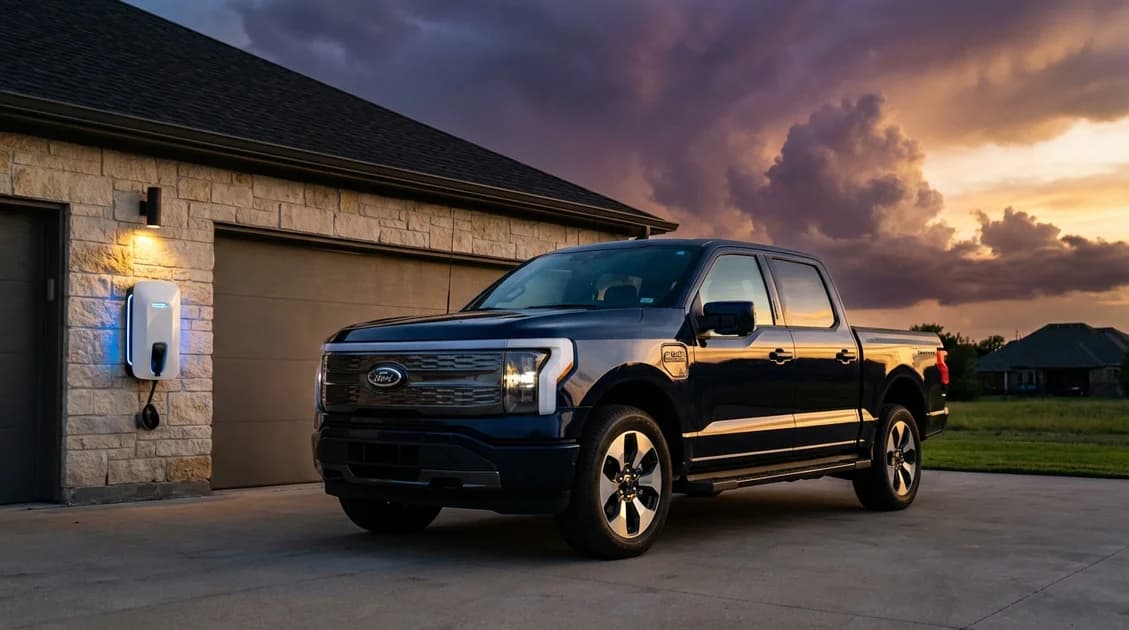
Hurricane Beryl made the stakes clear. In July 2024, more than 2.2 million Houston-area CenterPoint customers lost power, and 870,000 of them were still in the dark four days later (Houston Public Media, 2024). Plenty of those homeowners had a V2H-capable EV sitting in the driveway with 100+ kWh of stored energy, and no way to connect it to their home.
The problem wasn't the truck. The problem was no qualified V2H installer had set up the system beforehand.
This guide explains what separates a real V2H installer from a general electrician, how the Houston permit process works, and the six questions you should ask before you sign anything.
Key Takeaways
- V2H installation requires a bidirectional charger, a transfer switch, and EVITP-certified labor. It is not a standard Level 2 EV charger job.
- In Houston, a City of Houston electrical permit is required for every V2H installation. Qualified contractors pull it for you.
- EVITP certification costs $275, takes about 20 hours, and is the baseline credential to require from any V2H installer (AFDC, 2025).
- Total installed cost in the Houston metro runs $5,000-$15,000, depending on panel condition and charger model.
What Makes V2H Installation Different from a Standard EV Charger Job?
V2H is not a Level 2 charger install with extra steps. A standard Level 2 charger moves electricity in one direction: from the grid into your car. A bidirectional V2H system reverses that flow, converting your EV's DC battery power to AC household current and routing it through your home's panel.
That requires different hardware and different skills. Every V2H charger must meet UL 9741, the safety standard for bidirectional electric vehicle supply equipment. A standard EVSE is not UL 9741 certified. Most electricians who install Level 2 chargers have never worked with UL 9741-rated equipment.
The global V2H market was valued at $2.13 billion in 2024 and is projected to reach $11.13 billion by 2033, growing at 18.7% annually (Growth Market Reports, 2024). More contractors are advertising V2H capability as that market grows. Not all of them have the experience to back it up.
What the market growth means for Houston buyers: A fast-growing niche attracts contractors who've never done the work before. The EVITP credential and charger-specific experience questions below exist specifically to separate legitimate V2H installers from electricians who are learning on your job.
Beyond the charger itself, most V2H setups also require a transfer switch or automatic transfer switch (ATS) to isolate your home from the grid during an outage. Without proper isolation, your home's wiring becomes a safety hazard to CenterPoint lineworkers restoring power on your street. A qualified installer designs this correctly from the start.
What Certifications Should You Require?
At minimum, your V2H installer needs three things: a Texas state electrical license, EVITP certification, and hands-on experience with the specific charger your EV requires.
Texas state electrical license: All electrical work in Houston requires a licensed electrician. Your contractor should hold a Master Electrician license from the Texas Department of Licensing and Regulation (TDLR), or work under one. You can verify any license at tdlr.texas.gov before signing a contract.
EVITP certification: The Electric Vehicle Infrastructure Training Program is the industry-recognized credential for EV charging installers. It costs $275, takes about 20 hours of coursework and hands-on training, and must be renewed every three years (AFDC, 2025). An electrician without EVITP has no formal training in EV charging infrastructure. For V2H specifically, that gap is significant.
Charger-specific experience: This one surprises most homeowners. Each V2H system ties to a specific charger model, and each charger has its own installer requirements. Ford F-150 Lightning owners need a Ford Charge Station Pro with the Home Integration System. GM vehicle owners need the GM Energy PowerShift Charger. Wallbox Quasar 2 has its own installation network. These are not interchangeable, and contractors must complete manufacturer training to install them correctly.
| Credential | How to Verify | Why It Matters |
|---|---|---|
| Texas TDLR electrical license | tdlr.texas.gov | Legal requirement for all electrical work in Houston |
| EVITP certification | EVITP.org member search | Baseline training for EV charging infrastructure |
| Charger-specific training | Ask for documentation | Each OEM charger has distinct installation requirements |
Ask any prospective installer which charger brands they're certified to install. An electrician who says "bidirectional is just like Level 2 but in reverse" is a red flag. It isn't.
How Does the Houston Installation Process Work?
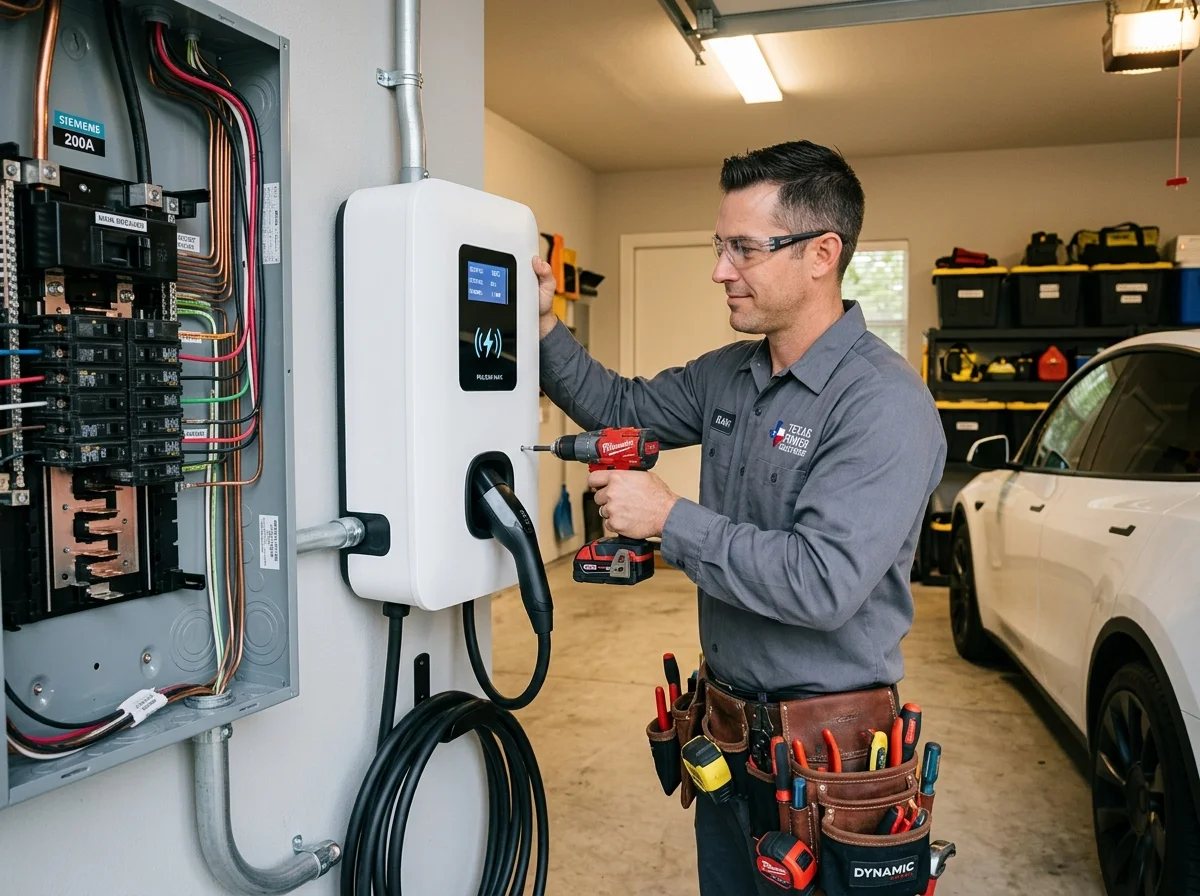
Every V2H installation in the City of Houston requires an electrical permit. This applies whether you're in Houston proper or surrounding incorporated cities like Pearland, Sugar Land, or Katy, each of which has its own permitting authority. A qualified contractor pulls the permit on your behalf. If a contractor asks you to pull your own permit, find someone else.
The permit process requires a licensed electrician to submit the scope of work and obtain approval before the installation begins. After the work is complete, a city inspector signs off on the final installation. That inspection is what protects you if something goes wrong later.
There's a second layer specific to Houston: CenterPoint Energy's interconnection requirements. For V2H systems that operate in backup-only mode, the key requirement is proper grid isolation. Your system must disconnect from the grid automatically when CenterPoint's power goes out, so the bidirectional charger never backfeeds the utility lines.
For V2G configurations (where your EV exports power to the grid), CenterPoint requires a signed Distributed Generation Interconnection Agreement before the system can operate (CenterPoint Energy, 2025). A contractor experienced in Houston installations knows this distinction and handles the paperwork.
One more Houston-specific factor: panel capacity. Many Houston homes, especially those built before 2000, have 100-amp or 150-amp panels. A 9.6 kW V2H charger (Ford's output) or 10.2 kW charger (GM's output) can push those panels to their limit. Panel upgrades to 200 amps are a common requirement, and a transparent installer tells you up front whether yours needs one.
From our installations in the Houston metro: Panel upgrades are the most common unplanned cost we see. Homes built before 1990 are especially likely to need one before a bidirectional charger can be safely installed. Always get a panel assessment included in your quote.
How Much Does V2H Installation Cost in Houston?
Total installed cost for a V2H system in the Houston metro typically runs $5,000 to $15,000. The wide range comes down to three variables: which charger your EV requires, whether your panel needs an upgrade, and local labor rates.
| Component | Typical Range |
|---|---|
| Bidirectional charger hardware | $1,700-$7,300 |
| Electrical installation labor | $1,500-$3,000 |
| Panel upgrade (if required) | $1,500-$3,500 |
| City of Houston permit | $150-$400 |
| Total | $5,000-$15,000+ |
The charger hardware range is wide because the GM Energy PowerShift Charger bundle runs $7,299 while the Wallbox Quasar 2 costs roughly $2,500-$4,000. Ford's Charge Station Pro with the Home Integration System falls in the middle. There is no single right answer: use the charger your EV was designed for.
Get at least three quotes. V2H installation is not a commodity service, and pricing varies significantly between contractors based on experience level. A dramatically low bid often means an installer without proper credentials cutting corners on equipment or permitting.
The 6 Questions to Ask a V2H Installer Before You Hire
This is the practical core of finding a qualified contractor. Ask every prospective installer these six questions before you commit.
1. "Are you EVITP certified and can I see your Texas electrical license number?"
This filters out the majority of unqualified bidders immediately. Require documentation, not just a yes. Verify the TDLR license number at tdlr.texas.gov before the site visit.
2. "Have you installed [my specific EV's required charger] before?"
Ford Lightning, Silverado EV, and Ioniq 5 all require different charger hardware with different installation protocols. An installer without experience on your specific system is learning on your job.
3. "Will you pull the City of Houston permit and handle the CenterPoint paperwork?"
The right answer is yes, included in the quote. A contractor who asks you to manage the permit process is either inexperienced or trying to avoid accountability for the work.
4. "Do you expect my panel to need an upgrade?"
Ask this before signing, not after the work starts. A qualified installer assesses your panel during the site visit and gives you a firm answer. "We'll figure it out when we get there" is not acceptable.
5. "What's your timeline from permit application to final inspection?"
A reputable contractor gives you milestones: permit submission date, installation date, inspection date. Vague timelines often mean the contractor has too many jobs open and yours will drag.
6. "What's your warranty and callback policy if something fails?"
V2H systems sit at the intersection of your home's electrical panel and your EV's battery management system. Get the warranty terms in writing, including who covers what if a component fails within the first year.
How Much Backup Power Will Your EV Actually Provide in Houston?
Here's a number you won't see in the marketing materials. GM claims the Silverado EV can power a home for up to 21 days. That claim is technically true, but it assumes 5.3 kWh of daily usage. The average Houston home uses 43 kWh per day, more than eight times that figure (Texas Electricity Ratings, 2024).
At real Houston consumption rates, backup duration looks quite different.
Two to five days is genuinely useful backup power for a Houston hurricane outage. It gets longer in critical-circuit mode. If you turn off the A/C and run only your refrigerator, lighting, and a few outlets, consumption drops to roughly 15-20 kWh/day and backup duration roughly doubles.
Pairing a V2H-capable EV with a whole-home battery backup system is the most effective strategy. The stationary battery handles instant switchover and runs the home overnight. The EV's larger capacity handles the multi-day sustained load.
Frequently Asked Questions
Does V2H installation void my EV's warranty?
Using your EV for V2H does not void the vehicle warranty when you use the OEM-approved charger and installation method. Ford and GM designed their V2H systems for exactly this purpose. Third-party bidirectional chargers on vehicles not engineered for V2H are a separate issue, and those configurations are outside manufacturer warranty regardless of installer quality.
Is a V2H installer the same as a solar installer?
Not exactly. Solar installers work with DC arrays, string inverters, and net metering equipment. V2H involves AC bidirectional power flow through your EV's onboard charger into your home panel. The skill sets overlap in some areas but the specific equipment and protocols differ. Look for someone with EVITP credentials and V2H charger experience specifically, not just a solar background.
Can any licensed Houston electrician install a V2H system?
Technically, a licensed electrician can pull the permit. But most licensed electricians in Houston have no hands-on V2H experience and no EVITP certification. Without those, they're working through the installation manual on your job, which increases the risk of errors that could affect your panel, your EV's battery system, or the warranty on your charger hardware.
How long does a V2H installation take in Houston?
The physical installation itself takes 4-8 hours for a straightforward job without a panel upgrade. Add 1-2 weeks for the City of Houston permit application and final inspection. If a panel upgrade is required, add another 1-3 days of work. From signed contract to a system that's fully operational, plan for 2-4 weeks total.
The Short Version
V2H installation in Houston requires a specific set of credentials, a permit, and a contractor who knows the CenterPoint interconnection process. Most general electricians don't have all three.
Before you hire anyone, get their EVITP certification number, their Texas TDLR license number, and a clear answer on whether your panel needs an upgrade. Get the permit included in the quote. Get the warranty in writing.
Eos Backup and Battery installs V2X bidirectional systems in the Houston metro, handling permits and site assessment as part of the process.