Texas City and La Marque Battery Backup: Backup Power in the Refinery Corridor

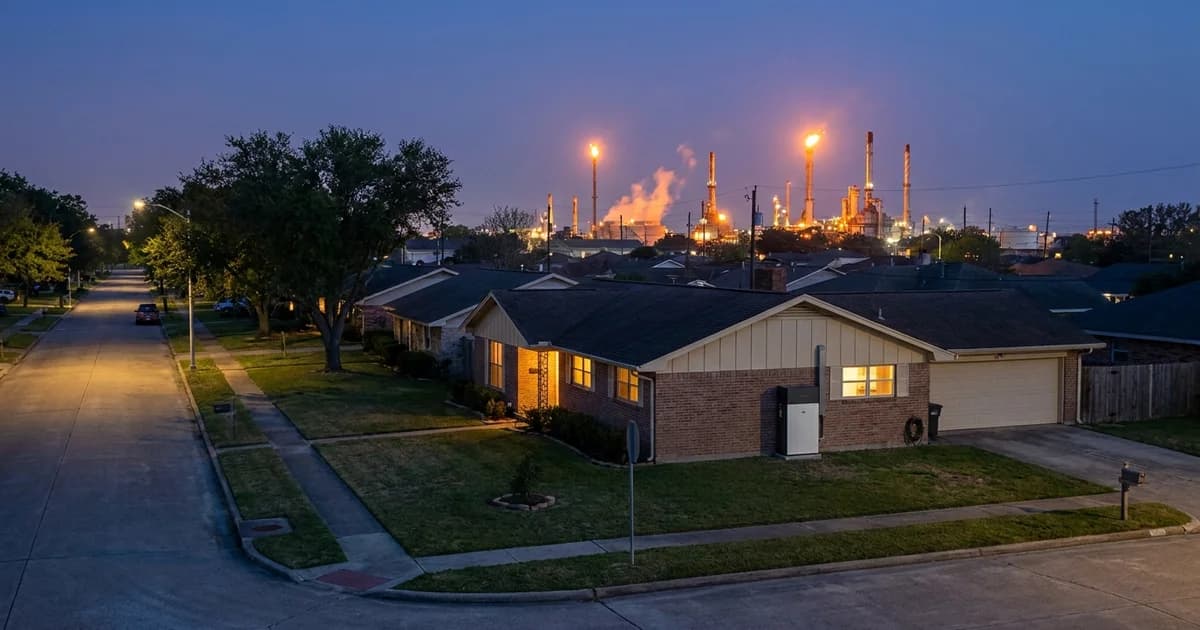
Every Wednesday at noon, eleven sirens sound across Texas City and La Marque for thirty seconds. Residents barely look up. It is the one shared sound in both cities, and it is also the clearest signal that backup power here is not the same problem it is in Katy or The Woodlands.
Most Houston-area battery guides get two things wrong about these ZIP codes. They assume CenterPoint runs the wires, and they assume the house has a modern service panel. Neither holds in 77590, 77591, 77592 or 77568. This guide covers what actually changes for a home battery on the mainland side of Galveston Bay: who approves the install, what takes the power out, what the sirens ask your house to do, and why the electrical panel usually decides the design.
Key Takeaways
- Texas City and La Marque sit in Texas-New Mexico Power territory, not CenterPoint, so a battery needs a TNMP interconnection application, a Letter of No Objection, and a $227 DG meter change fee (TNMP).
- The local siren instruction is "Go indoors; close all windows and doors; turn off the air conditioning," which makes almost everything left in a sealed house electrical (City of Texas City).
- 36.5% of housing in the Texas City ISD boundary was built before 1970, which usually means a 100A or 125A panel and a circuit prioritization design (NCES ACS Dashboard, 2019-23 ACS).
- The levee protects property from surge. It has never protected the grid, and after Beryl in July 2024 roughly 73% of Galveston County was dark on Monday (FOX 26 Houston, 2024).
Who runs the wires in Texas City and La Marque?
Texas-New Mexico Power, not CenterPoint. The Texas City Economic Development Corporation names TNMP as the transmission and distribution service provider delivering power to the city, and describes a company serving roughly 230,000 homes and businesses statewide (Texas City EDC). That single fact changes your entire approval path.
Here is why it matters. The company printed on your bill is a retail electric provider, and it does not own the poles. The wires company does, and the wires company is the one that approves a battery. In these ZIP codes that is TNMP, and TNMP runs its own distributed generation process with its own portal, its own paperwork and its own fee schedule.
The sequence runs eleven steps (TNMP). Your installer submits the application, site plan, one-line diagram and inverter specification through the DG portal. You affirm the submission. TNMP reviews and studies it, then sends an interconnection agreement. You sign and return it. TNMP issues a Letter of No Objection approving the installation. Your installer files a completion notification with photographs. TNMP may inspect and test. TNMP installs its DG meter, and that step carries a $227 DG meter change fee. Only after the meter goes in are you authorized to interconnect. Your load profile is then revised 30 to 45 days later.
Citation capsule: Homes in Texas City and La Marque interconnect a battery through Texas-New Mexico Power, not CenterPoint. TNMP's distributed generation process runs eleven steps, ends in a Letter of No Objection, and charges a $227 DG meter change fee when the utility installs its distributed generation meter (TNMP).
Practical test for any quote you receive: if an installer walks you through a CenterPoint timeline for a house in 77590, they have not worked your ZIP code. Ask which portal they will file in. The answer tells you everything.
What actually takes the power out here
Two documented failure modes, and they behave nothing alike. One is a storm with a multi-day tail. The other is a single piece of substation hardware that takes an evening.
Start with the hardware. On February 4, 2022, a switch at a substation in south Texas City failed and arced, and system protection devices de-energized part of that substation. A relay at a second substation then did not operate as intended, unnecessarily de-energizing another transmission line and pushing current on an adjacent line past safe operating levels. Power came back to most of the area around 10 p.m., and the rest of the system was restored by 3:30 a.m. the next morning (TNMP). TNMP had visually and infrared inspected that switch days earlier and found nothing.
Now the storm. When Hurricane Beryl came ashore in July 2024, TNMP activated its emergency operations plan and pulled crews from its Central Texas and North Texas regions down to the Gulf Coast before landfall (TNMP). Across Galveston County, about 73% of the county had no electricity on the Monday after the storm, and 43% were still out on Wednesday morning, with the county judge telling residents to expect full restoration by the end of that weekend (FOX 26 Houston, 2024).
Citation capsule: Mainland Galveston County loses power two ways. Equipment faults go dark for an evening, as on February 4, 2022, when a substation switch failure and a misoperating relay left Texas City and La Marque restoring until 3:30 a.m. (TNMP). Storms go dark for days, as after Beryl in July 2024.
Both shapes argue for storage. A compact utility restores an ordinary fault quickly, which is exactly the outage a battery covers without you noticing. And a storm that overwhelms it produces the multi-day window where a battery is the only thing still running.
What the sirens ask your house to do
The instruction is three clauses long and every one of them is an electrical instruction in disguise. Texas City publishes it plainly: "Go indoors; close all windows and doors; turn off the air conditioning" (City of Texas City).
Eleven sirens cover the two cities. Nine sit in Texas City, two in La Marque, and Texas City runs a thirty-second test every Wednesday at noon (City of La Marque). A high-low alternating tone means go indoors. A single continuous tone is the all clear.
| Siren system | Detail |
|---|---|
| Sirens in Texas City | 9 |
| Sirens in La Marque | 2 |
| Weekly test | Wednesdays at noon, 30 seconds |
| Go indoors tone | High low, alternating |
| All clear tone | Single continuous tone |
| Information channels | Everbridge alerts, 530 AM radio, cable Channel 16 |
On April 16, 1947, the SS Grandcamp caught fire and exploded at the Texas City docks, and the anchor monument records 576 persons known dead with another 178 listed as missing (Texas State Historical Association). That day is the reason this community treats emergency notification as infrastructure rather than paperwork.
Here is the reframe nobody writes down. Once the house is sealed and the air conditioning is off, every remaining comfort and safety function runs on electricity. Ceiling and box fans. The refrigerator holding a week of groceries. A CPAP or an oxygen concentrator. The router. The cable box carrying Channel 16. The phone that receives the Everbridge alert and the all clear. In August, in Galveston County, that list is not optional.
Citation capsule: The shelter in place instruction shared by Texas City and La Marque is "Go indoors; close all windows and doors; turn off the air conditioning," delivered by eleven sirens and tested every Wednesday at noon (City of Texas City). Sealing the house removes the mechanical cooling, so fans, refrigeration, communications and medical devices become the entire load list.
Now the honest limit, because some backup marketing skips it. A battery does not let you run central air through a shelter in place order, since the order is to shut the air conditioning off. And CDC guidance is explicit that a fan is not a substitute in dangerous heat: "Do not rely on a fan as your main cooling source when it's really hot outside" (CDC). What a battery buys is air movement, cold storage, communications and medical continuity while the order stands, plus an instant restart of the air conditioning at the all clear instead of a wait on the grid.
The levee protects the property, not the power
The Texas City Hurricane Flood Protection System covers 36 square miles of the greater Texas City, La Marque and Hitchcock area and is designed against a 15-foot National Geodetic Vertical Datum hurricane storm surge, built between 1962 and April 1987 (City of La Marque). It is a serious piece of civil engineering, and it does nothing for your electricity.
Hurricane Ike makes the distinction concrete. Ike came ashore on September 13, 2008 as a Category 2 storm, and the National Weather Service estimated surge on Galveston Island and the west side of Galveston Bay at 10 to 15 feet, with the highest inundation of at least 10 feet on the bay side of the island and along the mainland Galveston County coast (NOAA NWS Houston/Galveston). That mainland coast is this shoreline.
Citation capsule: The Texas City levee protects 36 square miles against a 15-foot NGVD design surge (City of La Marque), while Hurricane Ike pushed 10 to 15 feet of surge onto Galveston Island and the west side of Galveston Bay in September 2008 (NOAA NWS Houston/Galveston). The levee is a surge control. It is not a reliability control.
Two consequences follow. If your lot sits outside the protected line, along the bay shoreline or out toward the Texas City Dike, treat flood elevation as a design input and mount the equipment high rather than at grade. And whatever the levee does for your property, it is never a reason to ride out a mandatory evacuation. If the county calls your zone, you leave, and the system waits for you.
We cover the mainland Galveston County side of the bay from our Houston base, and our League City service page is the nearest city page to Texas City and La Marque.
Your panel is probably older than your roof
Housing age drives more battery designs here than square footage does. Within the Texas City Independent School District boundary, 36.5% of housing was built before 1970, 40.9% between 1970 and 1999, and 22.5% in 2000 or later (NCES ACS Education Demographic Dashboard, 2019-23 ACS).
More than a third of the local housing stock predates 1970, and a large share of those homes were wired to 100A or 125A service. Most were never upgraded, because nothing ever forced the issue. A 1960s brick ranch runs a 1960s load.
That is the conversation I have most often on a Texas City site survey. We open the panel on a 1962 house, find a small service with almost no spare breaker space, and the homeowner braces for a five-figure service upgrade quote. Usually that is not the answer. A battery connected on the load side has to respect the capacity limit of the busbar it lands on, and pushing a small service to a large one drags in the meter base, the mast, sometimes the utility drop, and a second round of permitting.
The design fork is simpler than it looks. Instead of upgrading everything, we install a smart panel and prioritize circuits: the loads that must ride through move to the protected side, and everything else stays on the grid side. In these two cities the protected list writes itself, because it is the same list the sirens produce. Fans and the air handler, refrigeration, medical devices, the router, and one lighting circuit.
Our finding: On the older Texas City and La Marque housing stock, panel capacity, not battery capacity, is the constraint that decides the design more often than any other single factor.
What size system a Texas City or La Marque home needs
Sizing starts from the equipment math, not from square footage. Each Eos battery module is 9 kWh nominal and 8.76 kWh usable, and each smart controller delivers 11.5 kW continuous with 17.1 kW of surge headroom, which is what lets a central air conditioner restart cleanly at the all clear.
Three profiles cover most of what we see on this side of the bay.
Older 1,200 to 1,600 sq ft home on a small service. Essentials only. Fans, refrigeration, router, medical devices, one lighting circuit. This is the shelter in place load list and the evening-outage load list, and they are the same list.
Typical 2,000 to 2,600 sq ft home. The homeowner wants the essentials through the order and central air back the moment the all clear sounds, plus enough capacity to ride out a summer evening fault like the one in February 2022. More storage, same controller.
Larger household or a medically dependent one. Multi-day coverage aimed at a Beryl-shaped restoration window, where the county spent days rather than hours getting back to full.
Citation capsule: Eos sizing in Texas City and La Marque is built from a load list rather than a house size, using 8.76 kWh of usable capacity per battery module and a controller rated 11.5 kW continuous with 17.1 kW surge. The site survey is where the list gets written, because the existing panel sets the ceiling.
The honest limit: nobody can size your system from a ZIP code and a square footage. The survey is where the load list gets built, and on an older panel that list is negotiated against what the busbar allows.
Or call Eos at 833-989-3737 to talk through your setup with an installer.
Frequently Asked Questions
Is Texas City served by CenterPoint or TNMP?
Texas-New Mexico Power. The Texas City EDC names TNMP as the transmission and distribution provider for the city (Texas City EDC). That means a battery goes through TNMP's distributed generation process, ending in a Letter of No Objection and a $227 DG meter change fee (TNMP).
Does a home battery help during a shelter in place order?
Yes, for everything the order leaves running. Fans, refrigeration, the router, the cable box on Channel 16, and medical devices. It does not run central air, because the instruction is to turn the air conditioning off (City of Texas City). CDC also warns against relying on a fan as your main cooling source in extreme heat (CDC).
Can I add a battery to a 100-amp panel in an older Texas City home?
Usually yes, without a full service upgrade. With 36.5% of Texas City ISD housing built before 1970 (NCES, 2019-23 ACS), small services are common here. The standard answer is a smart panel plus circuit prioritization, sized against what the existing busbar allows. The site survey decides.
Did the levee stop the power from going out during Hurricane Ike?
No. The levee is designed against a 15-foot NGVD surge across 36 square miles (City of La Marque), while Ike delivered 10 to 15 feet of surge on the west side of Galveston Bay in September 2008 (NOAA NWS). Flood protection and grid reliability are separate systems.
The short version
- Your wires company is TNMP, so the approval path runs through a TNMP portal, a Letter of No Objection and a $227 meter change fee, not a CenterPoint timeline.
- The siren protocol seals the house and shuts the air conditioning off, which turns fans, refrigeration, communications and medical devices into the entire load list.
- The levee protects property from surge and nothing else, and Beryl showed what a mainland Galveston County restoration week actually looks like.
- On a pre-1970 house, the panel sets the ceiling, and circuit prioritization usually beats a full service upgrade.
Sources
- Texas-New Mexico Power, Interconnecting Distributed Generation, retrieved 2026-09-02, https://tnmp.com/customers/interconnecting
- Texas-New Mexico Power, Issues That Triggered Texas City, La Marque Outage Identified, retrieved 2026-09-02, https://tnmp.com/about-us/news-media/issues-triggered-texas-city-la-marque-outage-identified
- Texas-New Mexico Power, TNMP Prepares for Hurricane Beryl to Strike Gulf Coast Service Territory, retrieved 2026-09-02, https://tnmp.com/about-us/news-media/tnmp-prepares-hurricane-beryl-strike-gulf-coast-service-territory
- Texas City Economic Development Corporation, Infrastructure and Utilities, retrieved 2026-09-02, https://www.texascityedc.com/170/Infrastructure-Utilities
- City of Texas City, Emergency Siren System, retrieved 2026-09-02, https://texascitytx.gov/194/Emergency-Siren-System
- City of La Marque, Emergency Siren System, retrieved 2026-09-02, http://www.cityoflamarque.gov/178/Emergency-Siren-System
- City of La Marque, Flood Protection Levee, retrieved 2026-09-02, https://www.cityoflamarque.gov/612/Flood-Protection-Levee
- NOAA National Weather Service Houston/Galveston, Hurricane Climatology: the 2000s, retrieved 2026-09-02, https://www.weather.gov/hgx/hurricanes_climatology_2000s
- National Center for Education Statistics, ACS Education Demographic Dashboard, Texas City ISD, retrieved 2026-09-02, https://nces.ed.gov/Programs/Edge/ACSDashboard/4842510
- Centers for Disease Control and Prevention, Heat and Older Adults Aged 65 and Older, retrieved 2026-09-02, https://www.cdc.gov/heat-health/risk-factors/heat-and-older-adults-aged-65.html
- Texas State Historical Association, Handbook of Texas: Texas City Disaster, retrieved 2026-09-02, https://www.tshaonline.org/handbook/entries/texas-city-disaster
- FOX 26 Houston, Galveston County battles brutal heatwave in wake of Hurricane Beryl power outages, retrieved 2026-09-02, https://www.fox26houston.com/news/galveston-county-residents-cope-outages-hurricane-beryl-aftermath-continues
Eduardo Donadi Neto is Founder and CEO of Eos Backup and Battery, which designs and installs home battery backup systems across the Houston metro and mainland Galveston County. Equipment ratings reflect Eos residential specifications as of September 2026. Confirm your service size and interconnection requirements at the site survey.