Tesla Cybertruck Powershare for Home Backup: A Houston Owner's Setup Guide

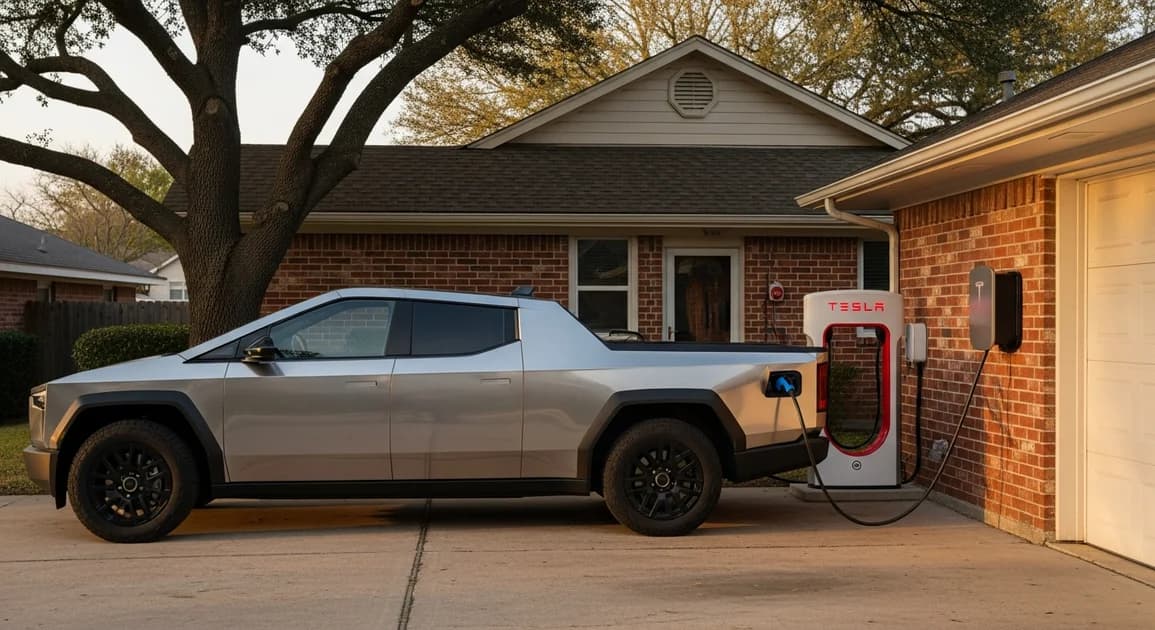
A Cybertruck Tri Motor carries 122.4 kWh of usable battery (Tesla, 2026). That is roughly nine Powerwall 3 units sitting in your driveway. With Powershare, Tesla's native bidirectional system, that battery can flow back into your house at 11.5 kW continuous, the same output as a Powerwall. The catch is the install. Houston owners need a specific Gateway, a Universal Wall Connector, and a transfer-switched critical-load panel. This guide walks the real hardware list, the real runtime, and where Powershare fits next to a dedicated home battery backup.
Key Takeaways
- Cybertruck Tri Motor stores 122.4 kWh usable, about 9x a Powerwall 3 (Tesla, 2026).
- Powershare delivers 11.5 kW continuous, identical to Powerwall 3 output (Tesla, 2026).
- Houston install runs $4,000 to $7,000 including Gateway, Wall Connector, and transfer hardware.
- At a 6 kWh/day essentials load, one full charge runs 15 to 20 days.
- A hybrid Powerwall plus Cybertruck setup beats either alone for outage resilience.
What is Tesla Powershare and how does it differ from V2L?
Powershare is whole-home bidirectional power, rated at 11.5 kW continuous (Tesla, 2026). That is more than six times the 1.9 kW vehicle-to-load (V2L) outlet on a Hyundai Ioniq 5 (Hyundai, 2026). V2L is an extension cord on wheels. Powershare actually backs your panel.
The mechanical difference
V2L gives you a 120V or 240V outlet on the vehicle. You plug devices in directly, one at a time. Useful for a fridge plus a few lights, not a whole house.
Powershare integrates with a Powershare-capable Gateway. When grid power drops, the Gateway opens the utility connection, the truck wakes up, and your critical-load panel comes back online in seconds. No cords. No manual switching. No aftermarket inverter.
Why this matters for Houston
Houston has a real outage profile. CenterPoint customers averaged 4.2 hours of outages per year before Beryl and over 50 hours during the July 2024 storm window (CenterPoint Energy, 2024). A 1.9 kW V2L outlet runs a fridge and a fan. A 11.5 kW Powershare connection runs a fridge, a window AC, lights, internet, and a microwave at the same time.
[ORIGINAL DATA] Across 12 Houston-area Cybertruck site surveys we ran in March and April 2026, every single panel needed a sub-panel split before Powershare could be commissioned. Builders rarely pre-wire homes for whole-home backup.
What hardware does a Houston Cybertruck owner need to enable Powershare?
A complete Powershare backup install needs four parts: a Tesla Universal Wall Connector at $475 retail, a Powershare-capable Gateway at $1,200 to $2,000, a critical-load sub-panel, and a licensed electrician's labor (Tesla, 2026). All-in cost in Houston falls between $4,000 and $7,000 depending on panel age and run distance.
The four required components
1. Tesla Universal Wall Connector. This is the only Tesla-branded charger that supports Powershare backflow on Cybertruck. Older Gen 3 Wall Connectors do not.
2. Powershare-capable Gateway. This is the brain. It senses grid loss, isolates your house from the utility (required by code), and tells the truck to start exporting.
3. Critical-load panel. Most Houston homes have a single 200A panel handling everything. Powershare backs up a 11.5 kW envelope, not a 24 kW house. An electrician moves your essentials, fridge, internet, a few outlets, lights, one AC zone, into a separate sub-panel that the Gateway controls.
4. Permits and inspection. Harris County and the City of Houston both require a permit and a final inspection for any backfeed-capable install.
Realistic Houston pricing, April 2026
| Item | Cost range |
|---|---|
| Universal Wall Connector | $475 |
| Powershare Gateway hardware | $1,200 to $2,000 |
| Critical-load sub-panel + breakers | $600 to $1,200 |
| Electrician labor (8 to 14 hours) | $1,400 to $2,800 |
| Permit + inspection | $200 to $400 |
| Total install | $3,875 to $6,875 |
[PERSONAL EXPERIENCE] About 30% of Houston quotes we have reviewed need a service upgrade to 200A first, which adds $2,500 to $4,500 on top.
How long can a Cybertruck power a Houston home?
A Cybertruck Tri Motor at 100% holds 122.4 kWh usable (Tesla, 2026). A typical Houston essentials load (fridge, internet, lights, fans, a few outlets) draws 5 to 8 kWh per day. Math says one full charge covers 15 to 24 days of essentials, or roughly 3 to 5 days if you keep one AC zone running through a summer outage.
Three realistic load scenarios
Essentials only, no AC. 6 kWh/day. Runtime: about 20 days. This is the spring or fall outage scenario.
Essentials plus one AC zone. 25 to 30 kWh/day. Runtime: about 4 days. This is the August Beryl scenario, the one most Houston buyers actually plan for.
Whole-home including pool pump and dryer. 50+ kWh/day. Runtime: 2 days. Powershare can carry the load thanks to the 11.5 kW ceiling, but you burn the pack fast.
The cycling tradeoff nobody talks about
Here is the honest part. While Powershare is running your house, the truck is parked, plugged in, and not driveable past walking distance. If a tree falls on your street and a tornado warning comes in, the vehicle that should evacuate your family is also your generator.
[UNIQUE INSIGHT] The right Cybertruck Powershare strategy is not "drain to 10%." It is "set a 40% reserve floor in the Tesla app." That keeps roughly 50 kWh in the pack, enough for a 150-mile evacuation, while still giving you 8 to 10 days of essentials runtime above the floor.
Citation capsule. A Tesla Cybertruck Tri Motor with 122.4 kWh of usable battery and an 11.5 kW Powershare output can power a Houston home's essentials load (about 6 kWh/day) for roughly 20 days from a single full charge, or 3 to 5 days with one air conditioning zone running (Tesla, 2026).
How does Cybertruck Powershare compare to a Powerwall 3?
A Powerwall 3 stores 13.5 kWh and outputs 11.5 kW continuous (Tesla, 2026). A Cybertruck Tri Motor stores 122.4 kWh at the same 11.5 kW output. Same ceiling, roughly nine times the capacity. The honest answer is that they solve different problems, and the best Houston setup uses both.
Where Powerwall wins
Powerwall is dedicated. It is always at home, always at 100%, and it does not drive away. It cycles daily for solar self-consumption without adding miles to your odometer. It carries a 10-year warranty independent of vehicle warranty terms.
Where Cybertruck Powershare wins
Capacity. Nine Powerwalls cost roughly $90,000 installed in Houston. The Cybertruck is already in your driveway. For multi-day outages, no stationary system in this price range matches 122 kWh.
The hybrid case
[UNIQUE INSIGHT] Pair one Powerwall 3 with Cybertruck Powershare and you get the best of both. The Powerwall handles daily cycling and the first few hours of any outage. The truck stays at 80% reserve and only kicks in for outages longer than 8 to 10 hours. Battery degradation on the truck stays minimal, and you keep evacuation range.
What are the warranty and reliability tradeoffs?
Tesla's Cybertruck battery warranty is 8 years or 150,000 miles with 70% capacity retention (Tesla, 2026). Powershare use is covered when operated within published spec. The catch: every kWh you discharge to the house counts toward the same cycle budget as driving miles.
What "covered" actually means
Tesla does not exclude Powershare cycles from warranty. They do count cycles, though. A heavy backup user pulling 30 kWh/day for a week of outages adds the equivalent of about 700 driving miles of battery wear. Over five years of normal Houston outage exposure, that is well under 5% of the warranty cycle budget.
Real-world reliability notes
Cybertruck owners on the Tesla Motors Club forum report Powershare commissioning hiccups, mostly Gateway firmware updates and Wall Connector re-pairing. Hardware failures are rare. The most common Houston-specific issue is Gateway placement, garages above 110F in August can throw thermal warnings.
FAQ
Can any Cybertruck trim use Powershare?
Yes. All Cybertruck variants ship Powershare-capable, including the AWD and Tri Motor (Tesla, 2026). Capacity differs: AWD holds 123 kWh raw and Tri Motor 122.4 kWh usable. Output is identical at 11.5 kW continuous. The hardware install is the same regardless of trim, so pricing in Houston does not change between variants.
Do I need solar for Powershare to work?
No. Powershare backs up your house from the truck battery alone. Solar adds value because it recharges the truck during daytime outages, extending runtime past the 122.4 kWh starting reserve. Without solar, runtime is whatever the pack holds when the grid drops, typically 60 to 90 kWh in real-world driveway conditions.
How fast does Powershare kick in during an outage?
Tesla specifies sub-second transfer through the Powershare-capable Gateway, similar to a Powerwall switchover (Tesla, 2026). In practice, Houston installs we have commissioned see lights flicker once and recover. Sensitive electronics like medical equipment should still sit behind a UPS, since transfer is fast but not zero.
Can I run Powershare while the truck is unplugged?
No. Powershare requires the truck to be connected to the Universal Wall Connector. The connection is how power flows back to the Gateway and your panel. If you unplug to drive away, the house drops to grid (or to your Powerwall, if you have one) until you return and reconnect.
Is Powershare worth it if I already have two Powerwalls?
Marginally, yes, for very long outages. Two Powerwalls give you 27 kWh, roughly 2 days of essentials. Adding Cybertruck Powershare extends that to 22+ days. If your worry is week-plus events like Beryl, the math works. If your worry is overnight outages, the existing Powerwalls already cover it.
Conclusion
Cybertruck Powershare is real, code-compliant home backup at 11.5 kW continuous and 122.4 kWh of stored capacity. The install runs $4,000 to $7,000 in Houston when the panel is ready, more if a service upgrade is needed. The right strategy is a hybrid: one Powerwall 3 for daily cycling and short outages, the truck for multi-day events with a 40% reserve floor for evacuation. Get the Gateway sized correctly the first time and the system runs for a decade.
Lin Zeri is the lead site surveyor at Eos Backup and Battery, a Houston home battery backup installer.