Sharpstown and Southwest Houston Battery Backup: Renters, Mid-Century Roots and Brays Bayou

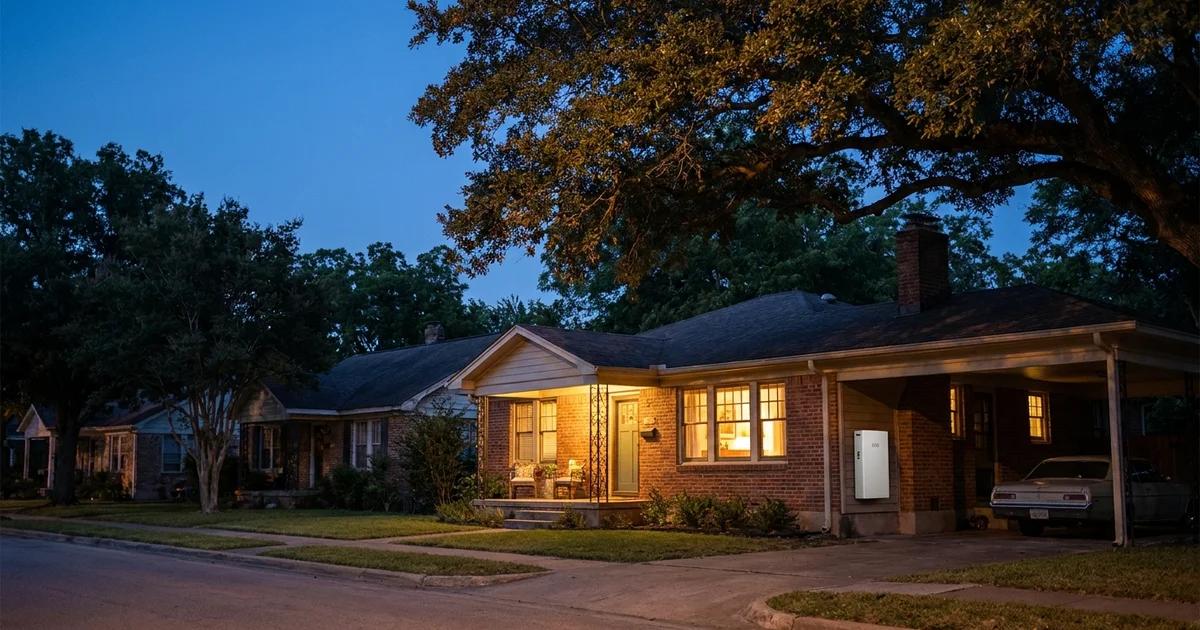
Sharpstown has a reputation as a neighborhood of older ranch houses. When I went looking for the numbers, the picture was more complicated, and more interesting. The 1950s bungalows are real, but they are a minority of what stands in the area today.
I am going to stick to what public data supports, and say plainly where I could not find any. Your own main breaker and your own lease tell you more than a neighborhood name can.
Key Takeaways
- Developer Frank Sharp dedicated Sharpstown on March 13, 1955 (Sharpstown Civic Association).
- Only about 22 percent of housing units in ZIP 77036 and 39 percent in ZIP 77074 were built before 1970. The largest group in both was built in the 1970s (U.S. Census Bureau ACS 2020-2024, via Census Reporter).
- Renters occupy about 82 percent of occupied units in 77036 and 67 percent in 77074. For most households here, a permanent battery is a conversation with a landlord.
- Brays Bayou runs along the western edge of Sharpstown. A battery keeps power on after an outage. It does not move water.
How old are the homes in Sharpstown, really?
Older than the suburbs, but younger than the legend. The Sharpstown Civic Association says the development was dedicated "with much fanfare on March 13, 1955," and describes post-World War II bungalows alongside modern and traditional homes (Sharpstown Civic Association).
The Census puts numbers on what stands there now. I pulled the 2020-2024 American Community Survey tables for the two ZIP code tabulation areas that cover most of Sharpstown, 77036 and 77074:
| ZIP 77036 | ZIP 77074 | |
|---|---|---|
| Total housing units | 30,387 | 15,245 |
| Built 1950 to 1959 | 636 (2%) | 3,137 (21%) |
| Built 1960 to 1969 | 5,654 (19%) | 2,633 (17%) |
| Built before 1970, all | about 22% | about 39% |
| Built 1970 to 1979 | 12,288 (40%) | 5,130 (34%) |
(U.S. Census Bureau ACS 2020-2024 5-year, tables B25034 and B25003, via Census Reporter.)
Two cautions. ZIP codes do not follow neighborhood lines, so treat these as the area, not your block. And the table counts apartments, townhomes and houses together. It does not tell you how many are single-family 1950s ranches, and I could not find a public dataset that does. If you want the story for a specific street, the county appraisal record for your address lists the year built.
Who actually owns the equipment here?
Often, someone else. In the same Census data, 22,102 of 26,855 occupied units in 77036 are rented, about 82 percent. In 77074 it is 8,808 of 13,233, about 67 percent.
That changes the question. If you rent, the decision about a permanently installed battery belongs to the property owner, and you cannot wire anything into a landlord's panel on your own. Our landlord guide explains why an owner might want one, and our apartment and condo guide covers who can install what in a multi-unit building.
If you are a tenant, the useful move is to bring the landlord a specific question: would you consider a system for the building or for my unit? Our comparison of whole-home batteries and portable power stations is the honest answer for what you can do on your own while you wait. If you own, keep reading, because the next sections are for you.
Is the panel in an older Sharpstown house a problem?
It might be, and it might not. An older house can still be on 100-amp service, though many have been upgraded over the years. I could not find public data on how many Sharpstown homes have that service size, so I won't give you a percentage.
Here is how the rule works. A 100-amp panel limits how much back-fed breaker capacity a battery can add under the electrical code. Our 100-amp panel guide explains when an upgrade is needed and three code-legal ways around it.
The practical step is simple: open the panel door and read the number on the main breaker. If it says 100, you have a question for an installer, not a dealbreaker.
What about Brays Bayou and flooding?
Brays Bayou is 31 miles long and, per Wikipedia's summary, "straddles the western edge of Sharpstown" (Wikipedia, Brays Bayou). It has flooded badly before. The same article puts Tropical Storm Allison in 2001 at about 6,000 homes flooded along the bayou.
Since then the Harris County Flood Control District and the Army Corps of Engineers have been widening the channel under Project Brays, a $480 million effort. In a January 2021 update the district reported 21 miles of channel improvements, four detention basins covering more than 800 acres, and expected reduced flood risk for more than 15,000 structures, with nine bridge projects still to go and a goal of finishing that year (HCFCD). I could not load a page confirming the exact date the project closed out, so I am not stating one.
During Tropical Storm Beta in 2020, residents of Meyerland and Westbury credited the project with keeping their homes dry. The project manager was careful, though: it reduces flood risk, but it cannot stop all flooding (KPRC).
I do not have a verified account of how Sharpstown specifically fared in Harvey or in the Tax Day flood, so I will not make one up. Whether a particular house floods depends on its elevation and its distance from the channel. The Harris County Flood Control District floodplain tools will tell you for an address. For how placement works in a flood-prone lot, read our flood elevation guide, and for the Brays story in neighborhoods downstream, our Meyerland and Braeswood guide goes deeper than I will here.
Do not buy a battery to solve a flooding problem. If a lot floods, drainage and elevation come first. The battery is for the outage that follows.
What size system fits an older Sharpstown house?
It depends on the loads, and I do not have a verified average draw for Sharpstown homes. Measure your own. Read the nameplate on your air-conditioner outdoor unit and your refrigerator, and list the three things you cannot lose.
Per our plan specs, the Essential plan's 8.76 kWh of usable capacity delivers up to 6 hours at minimal load, and larger plans add capacity from there. Every Eos plan uses one controller rated for 11.5 kW continuous and 17.1 kW surge, which sets how many big loads can start together. Central air is usually the load that decides whether one module is enough. In a 1950s house with older ductwork, expect it to matter.
A reasonable priority order:
- Refrigerator, freezer, Wi-Fi, lights and phone chargers.
- Medical equipment.
- A sump pump or other flood-related device, if you have one.
- Central air, which usually decides whether you need more than one module.
How is this different from Alief and the rest of southwest Houston?
Alief and Mission Bend sit just west and have their own issues, including a county line that changes permitting. Our Alief and Mission Bend guide looks at recent outages and typical sizing there. What sets Sharpstown apart, as far as the data shows, is how many households rent and how much of the housing stock is multi-unit 1970s construction rather than mid-century single-family.
For storm preparation that applies across the metro, see our hurricane season battery guide.
What did we leave out on purpose?
These claims come up whenever people talk about this part of town. I left them out because I could not support them:
- The share of Sharpstown homes on 100-amp service. No public dataset found.
- How Sharpstown fared in specific flood events. I found no verified neighborhood-level account.
- Which streets lose power most often. CenterPoint does not publish that by neighborhood in a form I could verify.
- Install timelines and permit costs. They vary by property and utility.
If a neighborhood guide hands you confident numbers on any of these without a source, ask where they came from.
What to do next
- Find out if you own or rent, and if you rent, ask the landlord the specific question.
- If you own, read your main breaker and write down the number.
- Check your address on the county floodplain tools before deciding where equipment goes.
- List the loads you cannot lose and size from there.
Or call Eos at 833-989-3737 to talk through your setup.
Frequently asked questions
Are most Sharpstown homes from the 1950s?
No. About 22 percent of housing units in ZIP 77036 and 39 percent in ZIP 77074 were built before 1970, and the 1970s are the largest group in both (U.S. Census Bureau ACS 2020-2024, via Census Reporter). The data does not say how many of those are single-family houses.
Can a renter in Sharpstown install a home battery?
Not a permanent one without the property owner's approval. See our landlord guide for the owner's side of the conversation.
Does a battery protect against Brays Bayou flooding?
No. A battery keeps power on after the grid fails. It does not stop water, and placement matters in flood-prone areas.
Do I need a panel upgrade in an older house?
Not necessarily. It depends on your main breaker and how the battery connects. See our 100-amp panel guide for the options.