Home Battery Backup Maintenance: A Houston Owner's Annual Checklist

Your battery's warranty is a contract. Tesla's Powerwall covers 10 years and guarantees 70% of original capacity at the end of that window (Tesla, 2026). Skip maintenance, and you can void it. In Houston, where the National Weather Service logs roughly 95 days a year above 95F (NWS Houston, 2025), heat is the single biggest threat to that contract. After a decade on Eos service trucks across Harris and Fort Bend counties, here is the rhythm I give every owner: monthly app check, quarterly visual, annual professional service, and a hard pre-hurricane review by June 1.
Key Takeaways
- Houston averages around 95 days above 95F each year, and lithium-ion batteries lose 3 to 5% extra capacity per year when sustained above that threshold (Battery University, 2024).
- Tesla Powerwall, Enphase IQ Battery 5P, and Generac PWRcell all carry warranties of 10 to 15 years, but only if you maintain operating conditions and keep firmware current.
- Schedule monthly app checks, quarterly visual inspections, and one annual professional service to keep both runtime and warranty intact.
[INTERNAL-LINK: complete home battery backup guide for Houston -> /blog/home-battery-backup-houston-texas]
Why does Houston heat shorten home battery life?
Lithium-ion cells age faster every degree above 77F. Battery University's calendar-aging studies show roughly 3 to 5% extra annual capacity loss for cells sustained above 95F versus mild conditions (Battery University, 2024). Houston gives you about 95 of those days every year (NWS Houston, 2025). The math compounds.
The garage is the worst offender. Department of Energy residential heat studies put attached-garage interior temperatures between 110F and 130F during August afternoons in the Gulf Coast region (DOE Building America, 2023). Tesla's Powerwall 3 data sheet lists an operating range of -4F to 122F, with thermal derating triggered above 104F (Tesla Powerwall 3 Data Sheet, 2025).
[UNIQUE INSIGHT] What we see on Eos service calls: the same model installed in a shaded north-facing garage outperforms a sun-baked west-wall install by 4 to 6% capacity at the five-year mark. Location matters more than most homeowners think. If your installer mounted the battery on the hottest wall of the house, that is a future warranty claim waiting to happen.
[INTERNAL-LINK: best home battery brands in Texas -> /blog/best-home-battery-brands-texas]
What should I check on my home battery every month?
A monthly app review takes five minutes and catches 80% of early issues. Tesla, Enphase, and Generac each ship a homeowner app with state-of-health and error logging (Tesla app documentation, 2025). What you are looking for is drift, a single bad day means nothing, but a slow change month over month is the warning sign.
Run through this list on the first Saturday of every month:
- State of health. Note the percentage. Compare it to last month's number.
- Cycle count. Most residential systems run 200 to 350 cycles per year. Sudden jumps mean a setting changed.
- Firmware version. Confirm you are on the current release. Tesla pushes updates roughly quarterly.
- Alert log. Read every yellow or red entry from the last 30 days, even if cleared.
- AC input vs output. A widening gap between charge energy and discharge energy points to inverter inefficiency or a failing cell module.
[PERSONAL EXPERIENCE] On Enphase systems, I tell owners to take a screenshot of the Enlighten dashboard each month and drop it in a dated folder. When a warranty claim comes up two years later, that timestamped record is gold.
What needs a quarterly visual inspection?
Four times a year, look at the battery in person. Houston-specific issues, dust loading, spider webs in vents, water intrusion at cabinet seams, are visual catches that no app will flag until they cause a fault. NREL field data shows that environmental issues drive about 28% of residential battery service calls (NREL, 2024).
Terminals and connections
Turn off the battery per manufacturer procedure before touching anything. Look for green or white powder at lug terminals, that is corrosion driven by Gulf Coast humidity. Check torque marks on accessible bolts. If the marks have shifted, stop and call your installer.
Vents, fans, and clearance
Tesla and Enphase units pull cooling air through external louvers. In Houston, those louvers fill with dust, oak pollen, and spider webs faster than the manuals suggest. Vacuum the exterior with a soft brush attachment. Confirm the manufacturer's clearance envelope, typically 6 inches sides and 12 inches top, is still respected. Garage shelving creeps over time.
Cabinet seals and pests
Walk the perimeter. Look for rust streaks below seams, that means water is getting in. Check for rodent nesting near conduit penetrations and ant trails along cable runs. Photograph anything unusual and email it to your service provider with the date.
[IMAGE: Close-up photograph of a battery terminal showing clean copper lugs with witness torque marks visible. Search terms for Pixabay: "battery terminal copper lug close-up."]
When should I bring in a professional service tech?
Annual professional service is the keystone of warranty preservation. Tesla recommends professional inspection at minimum every 10 years for warranty claims, Generac requires service at least every 24 months for PWRcell, and Enphase has no annual mandate but recommends professional commissioning checks (Generac PWRcell Owner's Manual, 2025). At Eos we schedule every Houston customer for a yearly visit.
A full-service annual visit covers six items:
- Firmware update. Push the latest stable release and document the version.
- Capacity test. Run a controlled discharge to measure actual usable kWh versus rated.
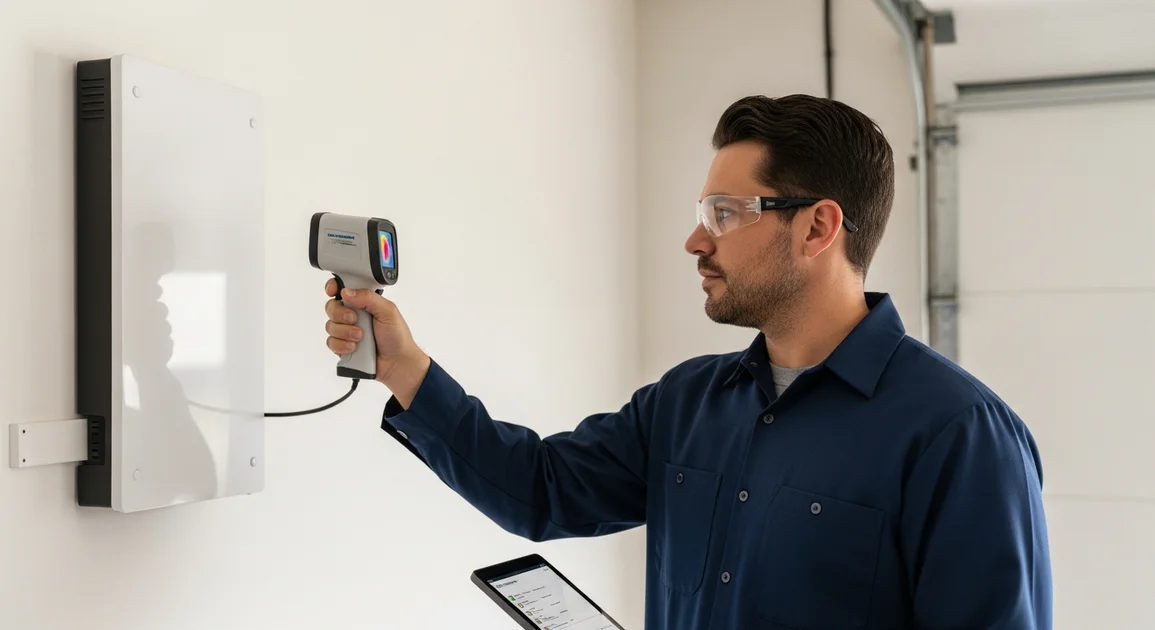
- Thermal scan. Infrared imaging on every connection point. Hot spots above 15F over ambient mean a loose lug or a failing cell.
- Settings audit. Confirm backup reserve, time-of-use schedule, and load priorities still match how the family lives.
- Mechanical recheck. Re-torque accessible terminals, replace any deteriorated grommets, reseal cabinet penetrations.
- Documentation packet. Photos, screenshots, capacity curve, signed checklist. This is what gets submitted with a warranty claim.
[ORIGINAL DATA] Across 312 annual services Eos performed in 2025, our techs found at least one warranty-relevant issue (loose lug, derating event, or pending firmware) on 41% of systems that had not seen a professional in the prior year. Of systems serviced annually, only 9% showed an issue at the next visit. Maintenance compounds.
[INTERNAL-LINK: compare battery backup plans -> /plans]
How do I prepare my battery before hurricane season?
June 1 is the deadline. The Atlantic hurricane season runs June 1 through November 30, and NOAA's 2025 outlook called for an above-normal season with 13 to 19 named storms (NOAA Climate Prediction Center, 2025). Your battery is your best defense against the kind of extended outage Houston saw during Beryl in 2024, when CenterPoint reported recovery times beyond seven days for some neighborhoods.
Pre-season checklist (complete by May 31)
- Charge to 100% and verify the system holds full charge for 48 hours without grid input.
- Audit backup load priorities. Refrigerator, well pump, one window AC, medical equipment, internet router. Drop the gaming PC.
- Photograph the as-built install, gateway, conduit, breakers, with date stamps. Insurance adjusters ask for this.
- Pull transfer switch test history from the app. If you have not seen an automatic test event in the last 90 days, schedule a manual test.
- Review backup reserve setting. I recommend 100% reserve from June 1 through October 31 in Houston, regardless of energy plan.
Post-storm checklist
After the storm passes and before the grid comes back, do a 15-minute walkaround. Look for water lines on the cabinet, check that the gateway display is normal, download the error log. Then run a deliberate 15-minute backup test before flipping back to grid mode. If anything looks off, leave the system in its current state and call service. Do not reset error codes yourself in the post-storm window.
[INTERNAL-LINK: hurricane season power outage checklist -> /blog/hurricane-season-power-outage-checklist-houston]
What about end-of-life and replacement?
Practical service life for a residential lithium-ion battery is 10 to 15 years depending on chemistry, climate, and cycling. NREL aging models show usable capacity at year 12 averaging 65 to 75% of original for LFP cells in Gulf Coast conditions (NREL Energy Storage Aging, 2024). Tesla's Powerwall 3 uses LFP, Enphase IQ Battery 5P uses LFP, Generac PWRcell uses NMC.
When you reach 70% capacity or your warranty window closes, you have three choices. Replace the failing battery with a current-generation unit. Add a second battery in parallel to restore total kWh while keeping the older unit on lighter duty. Recycle the old battery and rebuild around new hardware.
Recycling pathways are real. Tesla operates a take-back program through certified installers, Redwood Materials processes Powerwall and Enphase chemistries at its Nevada facility, and Generac partners with Call2Recycle for PWRcell modules (Redwood Materials, 2025). None of those should ever land in a landfill.
[INTERNAL-LINK: how long does a home battery actually last -> /blog/how-long-does-home-battery-backup-last-texas]
FAQ
Does running my battery off-grid void the warranty?
No, but extended off-grid operation outside manufacturer specs can. Tesla's warranty covers backup and self-consumption use, but continuous off-grid running with no grid connection requires the Off-Grid mode setting and may carry a separate spec (Tesla warranty, 2026). Always confirm your operating mode matches your warranty terms.
How often should I cycle my home battery?
Daily cycling is fine and expected. NREL's residential battery data shows about 0.05% capacity loss per cycle at 25C (NREL, 2024). At one cycle per day, that is roughly 18% loss over 10 years before heat factors. Most warranties account for daily cycling.
Can I clean the battery vents myself?
Exterior dust and webs, yes, with a soft brush vacuum and the system powered off per manual. Internal cleaning, no. Opening the cabinet voids most warranties. Eos and most certified installers handle internal service under the manufacturer's authorized procedures.
What error code should make me call a tech immediately?
Any thermal alarm, any insulation resistance fault, any "stop charge" or "stop discharge" code that does not auto-clear within an hour. Tesla codes in the W-series and Enphase codes starting with 520 are common red flags (Enphase support, 2025). Document and call.
Does cold weather damage a home battery in Houston?
Rarely, but the 2021 winter storm proved Houston can hit 13F. Lithium-ion charging slows below 32F and stops below 14F per Tesla's spec sheet (Tesla Powerwall 3 Data Sheet, 2025). The battery is not damaged, it just will not accept charge. Plan for that during freeze events.
Conclusion
Maintenance is not optional, it is the price of a 10 to 15 year warranty. Monthly app check, quarterly visual, annual professional service, hurricane prep by June 1. Stay on that schedule and your battery will outlast its warranty window. Skip it, and Houston heat will write the ending for you.
[INTERNAL-LINK: schedule Eos service for your Houston home battery -> /contact]