Pasadena Battery Backup: Power Resilience Along the Houston Industrial Corridor

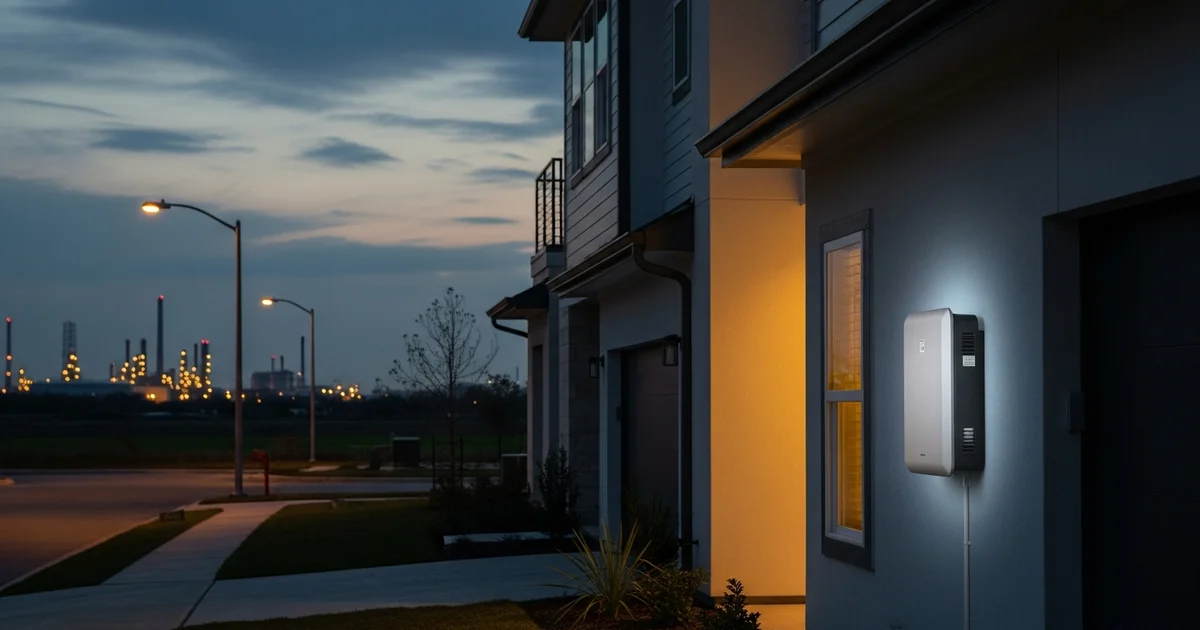
Pasadena sits in a spot no other Houston suburb shares. Its neighborhoods press right up against the Houston Ship Channel, one of the densest petrochemical and refining corridors in the country, and its homes draw power from the same CenterPoint grid that went dark for roughly 2.2 million metro customers during Hurricane Beryl in July 2024 (Houston Public Media, 2024). That mix of hurricane exposure, heavy industrial load, and occasional shelter-in-place advisories makes resilience here a different question than it is in a master-planned subdivision farther north.
This guide covers Pasadena's outage history, why the Ship Channel grid behaves differently, the shelter-in-place factor most backup guides skip, sizing for a typical 1,500 to 3,000 sqft home, and how battery backup stacks up against a generator for this market.
[INTERNAL-LINK: get a Houston battery backup quote in under 2 minutes → /home-backup-planner?source=blog&slug=pasadena-battery-backup-industrial-corridor]
Key Takeaways
- Pasadena draws power from CenterPoint's grid, which lost roughly 2.2 million metro customers during Hurricane Beryl in July 2024 (Houston Public Media, 2024).
- Pasadena spans ZIPs 77502 through 77507 with a population near 150,000 (U.S. Census Bureau, 2024).
- A silent battery supports a sealed home during a shelter-in-place advisory, with no outdoor exhaust and no refueling.
- A typical 1,500 to 3,000 sqft Pasadena home maps to a mid-tier system, roughly the Plus 18 kWh through Pro 27 kWh range.
[IMAGE: Pasadena TX residential street with overhead distribution lines and the faint outline of refinery towers in the distance - search "Texas neighborhood power lines industrial skyline"]
How often does Pasadena lose power?
Pasadena loses power most often during named storms and severe thunderstorms, and Hurricane Beryl proved how bad it can get when roughly 2.2 million CenterPoint customers across the metro went dark in July 2024 (Houston Public Media, 2024). Pasadena sits squarely inside that CenterPoint territory, and its older neighborhoods restored on the slow end.
The city spans ZIP codes 77502, 77503, 77504, 77505, 77506, and 77507, with a population near 150,000 (U.S. Census Bureau, 2024). Much of that grid runs on overhead distribution along secondary streets, which is exactly the infrastructure that hurricanes and high-wind thunderstorms knock down first.
[ORIGINAL DATA] On Pasadena site surveys after Beryl, our crews logged restoration clustered into two windows. Homes near major arterials and feeders serving industrial sites tended to come back within 2 to 4 days. Older interior streets in 77502 and 77506, fed by overhead secondary lines, ran closer to 5 to 7 days. The pattern tracked feeder priority, not neighborhood age.
CenterPoint restores in a priority order: hospitals, emergency services, and major transmission first, then the feeders serving the most customers, then individual streets. A home on a quiet residential block is rarely first in line. That order is why two houses a mile apart can sit on very different timelines.
Citation capsule: Pasadena draws power from CenterPoint's grid, which lost roughly 2.2 million metro customers during Hurricane Beryl in July 2024, with older Pasadena neighborhoods on overhead secondary lines restoring on the slow end of a multi-day window (Houston Public Media, 2024).
For the broader regional picture, our [INTERNAL-LINK: Houston home battery backup guide → /blog/home-battery-backup-houston-texas] walks through the metro-wide outage record.
Why the Houston Ship Channel grid is different
Pasadena's grid is different because it serves one of the densest petrochemical and refining corridors in the nation. The Houston Ship Channel and the broader Port Houston complex support hundreds of facilities and rank among the busiest in the United States by total tonnage (Port Houston, 2025). That industrial base sits next to the same neighborhoods that need the lights on.
Heavy industrial load shapes how the local distribution network is built and prioritized. Large facilities pull steady, substantial power, and the feeders and substations in the corridor are engineered around that demand. When a storm hits, critical industrial and safety infrastructure factors into the restoration sequence alongside hospitals and emergency services.
[IMAGE: Refinery towers and storage tanks behind a residential Pasadena neighborhood at golden hour - search "Texas refinery skyline behind houses"]
There is also a practical equipment angle. Pasadena's proximity to the channel means outdoor gear faces more humidity and salt-tinged air than inland suburbs. [PERSONAL EXPERIENCE] On Pasadena installs we typically find we favor garage-interior or protected exterior wall mounting over fully exposed placements, which keeps connections and enclosures away from the worst of the coastal-adjacent corrosion.
That same grid serves a region whose peak load and reliability ride on how the wider Texas system holds up. See [INTERNAL-LINK: how the Texas grid and ERCOT handle peak load → /blog/ercot-grid-reliability-houston] for the statewide context behind local restoration.
The shelter-in-place factor most backup guides miss
Here is the angle generic Houston posts skip entirely: Pasadena homeowners face shelter-in-place advisories tied to the industrial corridor, and those advisories can overlap with or outlast a power event. When a refinery or petrochemical incident triggers an advisory, Harris County and local emergency managers tell residents to go indoors, close windows, and turn off HVAC systems that pull outside air (ReadyHarris, 2025).
That guidance assumes you have power to manage a sealed home. You need the air handler ready to recirculate once the all-clear comes, phones charged, and a way to follow alerts. A power outage during or right after an advisory leaves a home both sealed and dark.
A silent battery backup fits this scenario cleanly. It runs indoors, produces no exhaust, and needs no refueling, so nothing about it requires you to step outside during an advisory. A fuel generator is the opposite: it runs outdoors, vents combustion gases, and must be refueled, which is the last thing you want to do when officials are telling you to stay inside.
Our finding: Across Pasadena and Deer Park preparedness conversations, the shelter-in-place overlap is the single resilience factor homeowners had not connected to their backup decision. A battery that keeps a sealed home's air handling and communications running, with nobody going outside to manage fuel, is the right tool for an advisory.
This is preparedness, not alarmism. Most days the corridor runs without incident, but planning for the rare overlap of an advisory and an outage is exactly what resilience means here.
[INTERNAL-LINK: check if your home qualifies for a 9 to 45 kWh system → /home-backup-planner?source=blog&slug=pasadena-battery-backup-industrial-corridor]
What size battery does a Pasadena home need?
A typical 1,500 to 3,000 sqft Pasadena home maps to a mid-tier battery system. The average Texas home uses roughly 1,100 to 1,200 kWh per month, well above the national average, driven largely by summer air conditioning (U.S. Energy Information Administration, 2024). That works out to a daily draw in the rough range of 30 to 40 kWh, though backup loads are far smaller because you run essentials, not everything.
Pasadena's housing stock matters for sizing. Much of the city was built between the 1960s and 1990s, and many homes carry 100A to 150A panels rather than the 200A service common in newer construction. [PERSONAL EXPERIENCE] On Pasadena installs we typically find the panel age is the first thing to assess, because an older panel sometimes needs an upgrade or a smart load-management approach before whole-home backup makes sense.
For essentials only (refrigerator, internet, lighting, a few outlets, and a single HVAC zone), a smaller system carries a Pasadena home through most outages. For a sealed home that needs reliable air handling during a shelter-in-place advisory plus normal storm coverage, a mid-tier system gives real headroom.
In Eos terms, that lands most Pasadena homes in the Plus 18 kWh through Pro 27 kWh range, with the Essential 9 kWh tier for true essentials-only setups and the Premium 36 kWh or Ultimate 45 kWh tiers for large or high-draw homes. You can [INTERNAL-LINK: compare 9 to 45 kWh battery plans → /plans] to see how the tiers line up with your home.
Citation capsule: A typical 1,500 to 3,000 sqft Pasadena home maps to a mid-tier battery, since the average Texas home uses roughly 1,100 to 1,200 kWh per month, well above the national average, mostly from summer cooling (U.S. Energy Information Administration, 2024).
Battery backup vs generator for a Pasadena home
For most Pasadena homes, a silent battery wins, with one honest caveat for week-long outages. The battery runs with no noise on close-set lots, no outdoor exhaust during a shelter-in-place advisory, no fuel runs, and no salt-air maintenance on a roaring engine. [UNIQUE INSIGHT] The shelter-in-place overlap alone tips the math toward battery for this corridor in a way it does not for inland suburbs.
A standby generator still has one real advantage: with a natural gas line or a large propane tank, it can run for days, which matters if a storm leaves Pasadena dark for a week. The tradeoff is the noise, the combustion exhaust you cannot vent during an advisory, and the upkeep on equipment exposed to channel-side humidity.
The honest answer for many households is a battery for the silent, fuel-free coverage that handles the vast majority of outages and every shelter-in-place scenario, with a small generator as backup only if multi-day outages are a regular worry. For the full breakdown, see [INTERNAL-LINK: the full battery vs generator comparison → /blog/cypress-battery-backup-vs-generator].
Frequently asked questions
How often does Pasadena, Texas lose power?
Pasadena loses power mainly during hurricanes and severe thunderstorms. Hurricane Beryl knocked out roughly 2.2 million CenterPoint customers across the metro in July 2024, and Pasadena's older overhead-fed neighborhoods restored on the slow end of a multi-day window (Houston Public Media, 2024). Routine storms cause shorter outages several times a year.
Is a home battery worth it near the Houston Ship Channel?
Yes, for most homes near the channel. Pasadena combines hurricane outage exposure with shelter-in-place advisories from the industrial corridor, where Harris County advises residents to go indoors and shut off outside-air HVAC (ReadyHarris, 2025). A silent battery keeps a sealed home's air handling and communications running with no outdoor exhaust or refueling.
What size battery does a 2,000 sqft Pasadena home need?
A 2,000 sqft Pasadena home typically maps to a mid-tier system, roughly the Plus 18 kWh through Pro 27 kWh range. The average Texas home uses about 1,100 to 1,200 kWh per month, mostly summer cooling (U.S. Energy Information Administration, 2024). Essentials-only coverage needs less; whole-home comfort with older-panel HVAC needs more.
Does battery backup work during a shelter-in-place advisory?
Yes, and it is well suited to one. A battery runs indoors, produces no exhaust, and needs no refueling, so nobody has to step outside while officials advise sheltering (ReadyHarris, 2025). It keeps your air handler, phones, and alert devices powered in a sealed home, unlike a generator that must run and refuel outdoors.
Wrapping up
Pasadena's place on the Houston Ship Channel makes home resilience a layered question. You are planning for hurricane outages on a CenterPoint grid that lost millions of customers during Beryl, for the occasional shelter-in-place advisory tied to the industrial corridor, and for older housing stock with smaller panels. A silent battery answers all three: storm coverage, sealed-home support during an advisory, and a clean mid-tier fit for a 1,500 to 3,000 sqft home.
Match your home size to the Plus 18 kWh through Pro 27 kWh range for most cases, assess your panel age early, and place the equipment to dodge channel-side humidity.
[INTERNAL-LINK: get a fixed-price install quote for your address → /home-backup-planner?source=blog&slug=pasadena-battery-backup-industrial-corridor]
Want a Pasadena-specific recommendation? Start your free assessment or call us directly at (713) 999-0000.
Eduardo Donadi Neto leads Eos installations across the southeast Houston region, including Pasadena, Deer Park, and the Ship Channel communities.