Cypress Battery Backup vs Generator: Which Wins for a Northwest Houston Home?

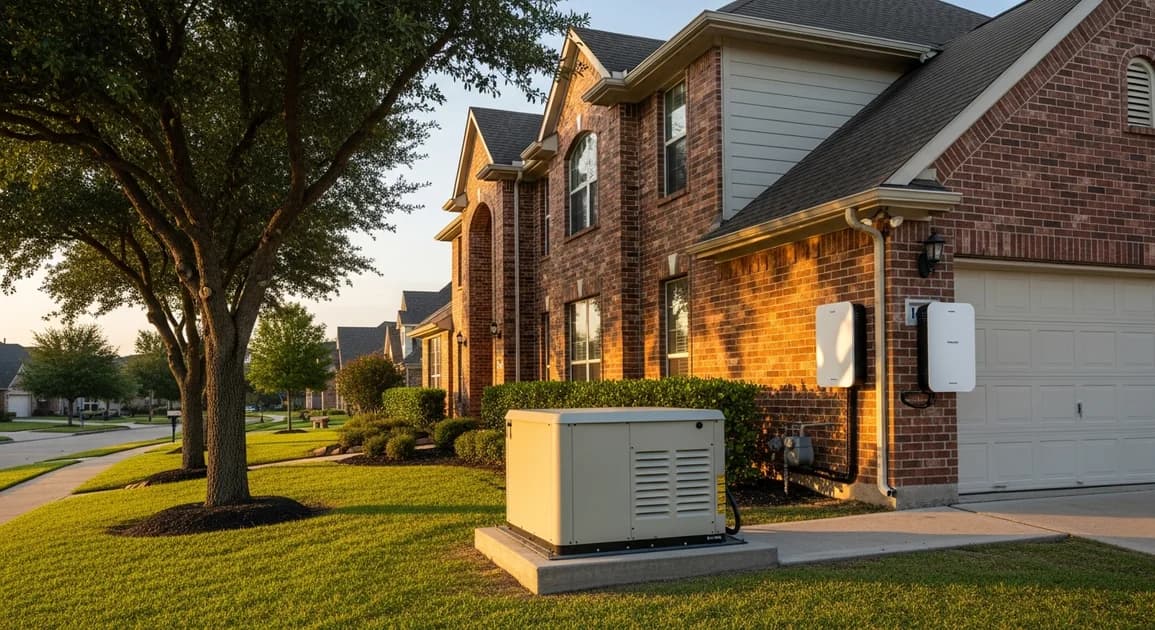
When Hurricane Beryl swept through Harris County in July 2024, roughly 2.2 million CenterPoint customers across the Houston metro lost power (Houston Public Media, 2024). In Cypress, the restoration tail stretched 4 to 8 days for many neighborhoods inside 77429 and 77433. That experience reset the backup conversation for Northwest Houston. The old answer was a standby generator. The new question is whether a home battery backup makes more sense for a typical Cypress home in 2026. This article works through both options honestly, with sizing, cost, noise, HOA realities, and which one we actually recommend for different Cypress situations.
[INTERNAL-LINK: Get a Cypress backup recommendation → /home-backup-planner?source=blog&slug=cypress-battery-backup-vs-generator]
Key Takeaways
- Cypress saw 4 to 8 day Beryl restoration tails in 77429 and 77433 (CenterPoint outage tracker, 2024).
- A home battery backup runs silent, needs no fuel, and clears Cinco Ranch and Bridgeland HOA review more easily than a standby generator.
- A 22 kW Generac standby costs $8,000 to $12,000 installed and runs indefinitely on natural gas, which still matters for week-long outages.
- For most Cypress homes a 13.5 to 27 kWh battery is enough; for households that lost power 5+ days during Beryl, a hybrid system is the honest answer.
[IMAGE: Aerial-style view of a Cypress TX suburban subdivision with mature trees and overhead distribution lines after a storm - search "suburban Texas neighborhood storm aftermath"]
What's the Cypress power outage picture?
Cypress sits in CenterPoint's Northwest service territory, and the 4 to 8 day Beryl restoration tail in 77429, 77433, and 77065 was not an outlier. Harris County's tree canopy plus overhead distribution lines means hurricane and severe thunderstorm outages happen, and the rebuild order favors hospitals and major arterials first (CenterPoint outage tracker, 2024).
Beryl 2024 in the Cypress zip codes
[ORIGINAL DATA] Eos field crews working post-Beryl in Cypress documented restoration timelines clustered around two windows. Most homes inside Cinco Ranch and the older sections of 77429 saw power back within 4 days. Bridgeland and the newer 77433 builds, plus pockets near Boudreaux Road, waited 6 to 8 days. The difference came down to which feeder line was rebuilt first, not how new the neighborhood was.
Why Cypress sees longer tails than inner-loop Houston
Two structural reasons. First, the Cypress metro of roughly 200,000 residents (US Census Bureau, 2024) sits at the end of long radial feeders running northwest from the grid core. Second, the mature pine and oak canopy in subdivisions like Towne Lake and Cinco Ranch puts more limbs on more lines per storm than denser, newer-built areas with underground distribution.
What homeowners actually felt
Lost refrigerator and freezer contents within 36 hours. HVAC down through July heat indexes above 105F. Garage doors that would not open. Cell coverage degraded as towers ran out of backup fuel. The single most repeated comment we heard in Cypress estimates last fall was "I am not doing that again."
Citation capsule: Hurricane Beryl in July 2024 knocked out power for 2.2 million CenterPoint customers in the Houston metro, with Cypress zip codes 77429, 77433, and 77065 experiencing typical restoration times of 4 to 8 days due to mature tree canopy over overhead distribution lines (Houston Public Media, 2024).
How does a home battery backup work in Cypress?
A home battery backup in Cypress is almost always a wall-mounted lithium iron phosphate system installed in the garage or on an exterior wall. The unit charges from the grid (or paired solar), and when CenterPoint power drops, an automatic transfer switch isolates your home and the battery powers your circuits within milliseconds, with zero noise and zero emissions (EnergySage, 2026).
Typical Cypress sizing
Most Cypress homes we estimate fall into a 13.5 to 27 kWh range. A 13.5 kWh single-unit system covers refrigeration, internet, lighting, a few outlets, and a single HVAC zone for roughly 12 to 18 hours. A 27 kWh stacked system runs the full home, including central AC cycling, for 1 to 2 days without solar recharge. Solar paired with battery extends runtime indefinitely as long as the panels see sun.
Garage placement and the HOA question
Cinco Ranch, Bridgeland, and Towne Lake all require architectural review committee (ARC) approval for exterior equipment. [PERSONAL EXPERIENCE] We've found that interior garage wall installs sail through ARC review because nothing is visible from the street. Exterior wall placements need a paint match and sometimes a screening detail, but they still clear more easily than the concrete pad a generator requires.
Installed cost in the Cypress market
Texas residential battery installs run $1,000 to $1,800 per kWh including hardware, electrical work, and permitting (EnergySage, 2026). A 13.5 kWh single system lands around $14,000 to $20,000 installed in Cypress. A 27 kWh stacked system runs $25,000 to $38,000 depending on panel work and transfer switch complexity.
[INTERNAL-LINK: Size a battery for your Cypress home → /home-backup-planner?source=blog&slug=cypress-battery-backup-vs-generator]
[IMAGE: Wall-mounted home battery backup unit installed on a garage wall in a suburban home - search "home battery wall mount garage"]
How does a standby generator work in Cypress?
A standby generator in Cypress is typically a 20 to 22 kW air-cooled Generac or Kohler unit on a concrete pad outside the home, fueled by natural gas from CenterPoint Energy Gas service. When grid power drops, the automatic transfer switch starts the engine within 10 to 30 seconds, and the unit can run continuously for as long as gas pressure holds (Generac, 2025).
Fuel: natural gas is the Cypress norm
Most Cypress neighborhoods have natural gas service, which removes the propane tank refill problem. Natural gas service did stay up through Beryl in most Cypress areas, though some older feeders saw pressure drops. For homes without gas service (rare in Cypress but common further out), a 500-gallon propane tank is the alternative and adds $3,000 to $5,000 to the install.
Weekly exercise cycle and maintenance
Standby generators run a 10 to 20 minute self-test every week, usually mid-morning. Owners hear it. Neighbors hear it. The exercise cycle is non-negotiable for warranty coverage. Annual maintenance contracts run $300 to $600 and cover oil, filters, and spark plugs. Skip maintenance and the unit will not start when you need it. We see this every storm.
Installed cost and timeline
A 22 kW Generac standby installed in Cypress runs $8,000 to $12,000 including the pad, gas line tie-in, transfer switch, and permitting (Generac dealer pricing, 2025). Lead times stretched to 4 to 6 months after Beryl. As of May 2026 they are back to roughly 6 to 10 weeks for most Cypress installers.
[IMAGE: Standby home generator on a concrete pad next to a suburban Texas home - search "Generac standby generator residential install"]
Battery vs generator: side-by-side for a Cypress home
The honest comparison depends on which failure mode you care about most. A battery wins on noise, HOA approval, daily utility, and emissions. A standby generator wins on multi-day runtime and lower upfront cost. Both clear the 12 to 36 hour outage window that covers about 80% of Cypress events outside hurricane season (CenterPoint reliability data, 2024).
[CHART: comparison table, title="Battery Backup vs Standby Generator for a Cypress Home", rows=["Runtime","Installed cost","Fuel","Noise","Winter reliability","HOA approval","Maintenance"], cols=["Battery","Standby generator"]]
Runtime honesty
A 13.5 kWh battery without solar covers 12 to 18 hours of essentials. A 27 kWh stacked system covers 1 to 2 days. Add solar and you run indefinitely in summer daylight. A 22 kW standby on natural gas runs as long as gas flows, which is days to weeks. For the 4 to 8 day Beryl scenario, battery-only is short unless paired with solar.
Noise and the HOA reality
A 22 kW Generac runs at 65 to 75 dB at 23 feet (Generac spec sheets, 2025), which is loud-conversation volume at the property line. Cinco Ranch and Bridgeland ARC committees increasingly push back on generator placements close to neighboring lots. Batteries are silent. We see ARC packets approved in 2 to 3 weeks for batteries versus 6 to 10 weeks for generators with screening requirements.
Winter freeze reliability
[UNIQUE INSIGHT] Uri 2021 left 4.5 million Texans without power and contributed to 246+ deaths (ERCOT post-event analysis, 2021). Natural gas pressure dropped in pockets of Northwest Houston during Uri, which idled some standby generators. Batteries kept running because the fuel was already in the box. This is the scenario where the battery advantage is sharpest, and it is the scenario most Cypress generator buyers do not think about.
Daily utility
A battery does something every day: it can shift CenterPoint time-of-use charges, back up brief outages without you noticing, and pair with solar for self-consumption. A standby generator sits idle 51 weeks a year and exercises once a week.
Which wins for a typical Cypress home?
For most Cypress homes in 2026, a 13.5 to 27 kWh home battery backup is the right answer. It clears the HOA easier, runs silent through neighborhood-friendly hours, handles 80% of outages, and adds daily value. For households that sat dark 5+ days through Beryl and want true multi-week resilience, the honest recommendation is hybrid: battery for the first 1 to 2 days, generator for the long tail.
When generator-only still makes sense
Three situations. First, tight budget under $12,000 total and willingness to accept noise and maintenance. Second, medical equipment that needs guaranteed multi-day runtime and no solar option. Third, large home over 4,500 sq ft with heavy AC loads where battery sizing would exceed $40,000.
When battery-only is enough
Smaller Cypress home, single-zone HVAC, no medical equipment, willingness to load-shed during a multi-day outage, or pairing with solar. This is the majority of Cypress homes we estimate.
When hybrid is the right call
Larger Cypress home, medical or business-critical loads, history of 5+ day outages on your block, and budget room for both systems. Hybrid is more expensive upfront but it is the only configuration that handles both Uri-style freezes and Beryl-style multi-day tails.
[INTERNAL-LINK: See Cypress service area details → /locations/cypress]
Real Cypress install scenarios
[ORIGINAL DATA] Three anonymized scenarios from Eos Cypress estimates in the last 18 months:
Cinco Ranch, 2,800 sq ft single-story
Couple in their 60s, no medical equipment, lost power 5 days during Beryl. Installed 27 kWh stacked battery in the garage, paired with existing 8 kW solar. ARC approval in 2 weeks. Total install $34,500. Ran through a 14-hour March 2026 thunderstorm outage without the homeowner noticing until they checked the app.
Bridgeland, 3,400 sq ft two-story
Family of four, two work-from-home parents, lost power 7 days during Beryl. Installed 13.5 kWh battery plus 22 kW standby generator. Battery handles overnight quiet hours and short outages; generator covers multi-day events. Total install $32,000. ARC approval took 8 weeks due to generator screening requirements.
Towne Lake, 4,200 sq ft
Empty nesters, generator-only choice. Pre-existing concrete pad from previous generator made the install fast. 22 kW Generac at $11,400 installed. Honest tradeoff: they accepted the noise and weekly exercise cycle for the lower upfront cost and indefinite runtime.
FAQ
Can a home battery backup run my whole Cypress house?
A 27 kWh stacked battery can run a typical 2,500 to 3,500 sq ft Cypress home for 1 to 2 days, including central AC cycling, refrigeration, and full lighting. Larger homes over 4,000 sq ft with heavy AC loads usually need either solar pairing or load management to extend runtime through multi-day events (EnergySage, 2026).
Will Cinco Ranch or Bridgeland HOA approve a battery faster than a generator?
In our experience, yes. ARC packets for garage-interior battery installs typically clear in 2 to 3 weeks because nothing is visible from the street. Generator packets in Cinco Ranch and Bridgeland often require screening details, setback documentation, and noise affidavits, which stretches review to 6 to 10 weeks and sometimes triggers requested revisions.
What happens during a winter freeze like Uri?
Batteries keep running because the fuel sits in the box. During Uri 2021, parts of Northwest Houston saw natural gas pressure drops that idled some standby generators (ERCOT post-event analysis, 2021). For freeze resilience specifically, a battery has the structural advantage. A hybrid system removes the single-fuel risk entirely.
How long does a Cypress install take?
Battery: 1 to 2 days of on-site work plus 4 to 8 weeks of permitting and ARC review. Standby generator: 2 to 3 days of work plus 6 to 10 weeks for permitting, gas line scheduling, and ARC review. Hybrid installs run 6 to 12 weeks total. Lead times stretched after Beryl but normalized by Q1 2026.
Can I add a generator later if I start with a battery?
Yes. Most modern battery installs use a transfer switch and panel layout that accommodates adding a generator input later. We design Cypress installs with hybrid expansion in mind when the homeowner indicates they may add the second system in 1 to 3 years. Plan it upfront and the second install is cheaper.
The bottom line for Cypress
Cypress saw what a multi-day outage looks like during Beryl, and most homeowners are not waiting for the next one to plan a fix. For the majority of Cypress homes, a properly sized home battery backup is the right 2026 answer: silent, HOA-friendly, useful every day, and enough capacity for 80% of outages. For households with medical loads or fresh memories of 7-day Beryl tails, hybrid is the honest call. Call 832-310-9000 or get a Cypress-specific recommendation below.
[INTERNAL-LINK: Get your Cypress backup quote → /home-backup-planner?source=blog&slug=cypress-battery-backup-vs-generator]