Needville and Wallis Battery Backup: Rural Fort Bend and Austin County

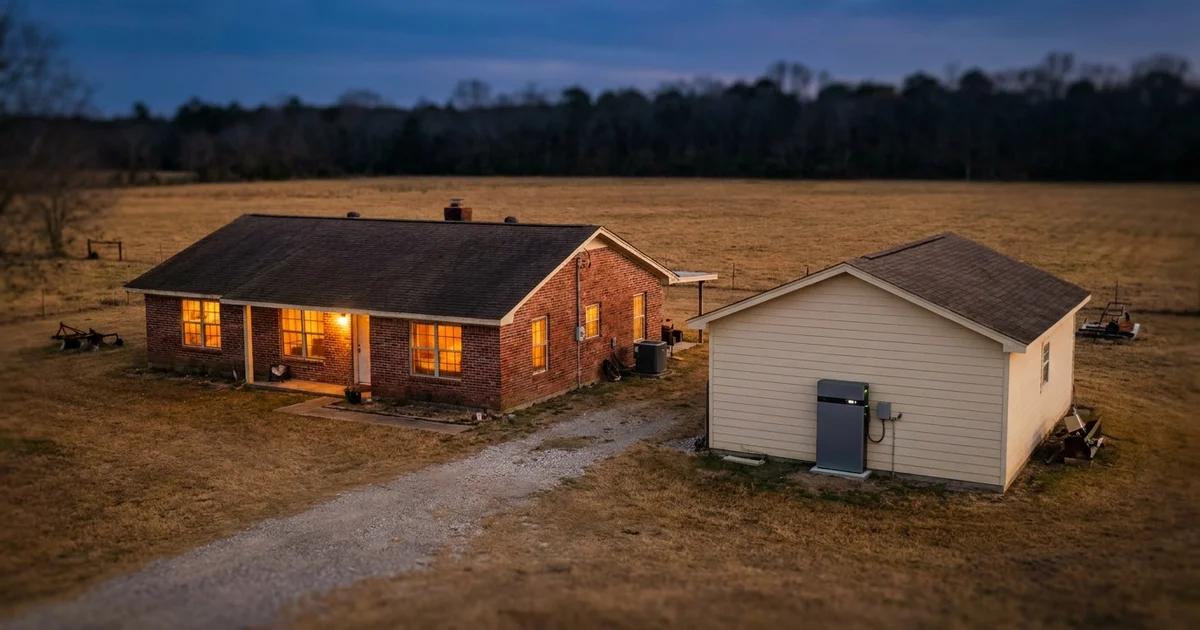
Needville and Wallis are only about a dozen miles apart on State Highway 36, but they are not the same kind of address. One is in Fort Bend County, the other in Austin County. And the first question for a home battery out here is not "how many kWh." It is "who sends me the power, and who do I call when it goes out?"
I started this guide expecting a clean answer to that question and did not get one. So this post says what I could confirm, what I could not, and how to settle the rest in five minutes with your own bill.
Key Takeaways
- Needville had 3,089 residents and 1,192 housing units in the 2020 census; Wallis had 1,292 residents (Wikipedia, citing the 2020 census). Both are small towns with rural lots around them.
- Needville is in Fort Bend County and Wallis is in Austin County (Wikipedia). That matters because San Bernard Electric Cooperative lists Austin County among the eight counties it serves (SBEC).
- I could not confirm which utility serves every Needville or Wallis address. Secondary sources point to CenterPoint for both towns. Your bill is the authority.
- A battery works the same whether the wire belongs to a big utility or a co-op. What changes is who restores your line and how you report an outage.
Who actually provides power in Needville and Wallis?
For Needville, the evidence leans toward CenterPoint. Rate-comparison sites list CenterPoint as the delivery utility for Needville (ElectricRates.org). That is an aggregator page, not a regulator's territory map, so treat it as likely rather than proven.
Wallis is less clear. Aggregator pages and a public outage report list CenterPoint there too (Power Choice Texas). But Wallis is in Austin County, and San Bernard Electric Cooperative states plainly that it serves parts of Austin County, with about 34,000 meters and roughly 4,100 miles of line across eight counties (SBEC, About Us). SBEC's pages do not mention Wallis or Needville at all, so I cannot tell you where its lines stop and CenterPoint's start.
Here is the thing a rate site will not tell you: in Texas you can shop for a retail electric provider in the competitive market, but the wires are owned by a separate delivery company or, in co-op country, by the co-op itself. Your bill names the one that matters. Look for "TDSP" or "delivery charges." That name is who you call for an outage, and it is who must be involved in any interconnection paperwork for your battery.
Is this the same as the Richmond and Rosenberg story?
Partly. Our Richmond and Rosenberg rural guide covers the larger-lot, longer-feeder pattern in the Lamar CISD area, and I won't restate it. Needville and Wallis are further out, smaller, and cross a county line. The extra variable is the utility question above.
What I could verify about the setting is modest. Needville is in southern Fort Bend County on SH 36, about 41 miles from downtown Houston, and is served by Needville ISD (Wikipedia). Wallis sits in far southeastern Austin County along SH 36 and the BNSF railway between Rosenberg and Sealy (Wikipedia). That is all I will assert about the geography.
What do outages look like out here?
I do not have outage-duration data for these two towns, and I did not find any published. Neither CenterPoint nor SBEC, in anything I could load, breaks reliability numbers down to a town like Needville.
What I can anchor is the regional picture. When Hurricane Beryl struck in July 2024, more than 2.7 million households and businesses in the Houston region lost power, about 2.2 million of them CenterPoint customers; on the evening of July 10, 1.6 million were still out (Wikipedia, Hurricane Beryl). That event shows how long a big storm can take to clear. It does not tell me how long Needville waited, and I won't guess.
Rural lines share a common trait you can reason about without a statistic: more miles of wire per customer means more places for a limb or a pole to fail. If you live at the end of a long road, plan for the tail of a restoration, not the average.
Does the Brazos River matter for a Needville or Wallis home?
For some lots, possibly, but I cannot say which. The Brazos crested at nearly 54 feet in Fort Bend County on May 31, 2016, with voluntary evacuations in Richmond and about 150 households evacuated in Rosenberg (CBS News). That article does not mention Needville or Wallis, and I could not confirm that either town flooded.
The honest rule is the same as anywhere: your flood exposure depends on your lot's elevation, not your town's name. Check your address on the FEMA and county flood maps. If equipment placement is a concern, our flood elevation guide covers where a battery can and cannot go. A battery does not stop water. It keeps power on after the grid fails.
What does a rural home need to protect?
Larger rural lots often come with systems that town homes do not: a private well pump, a septic aerator, sometimes a barn freezer or a workshop. Those are the loads that make a rural outage different.
- Well pump. No power means no water. Our well pump guide explains the startup surge and how to size for it.
- Septic aerator. A small load, but it needs to keep running. See the septic aerator guide.
- Refrigerator, freezer, Wi-Fi and lights. The baseline for any home.
- Medical equipment. First in line, always.
- Central air. Usually the load that decides whether you need more than one module.
I do not know whether a given Needville or Wallis home has a well or a septic system, and I will not claim it. Check what you have. If you are not sure, walk the property and the panel.
What size battery fits a rural home?
Start with the plan specs, then adjust for your loads. Per our plan data, the Essential plan has 8.76 kWh of usable capacity and delivers up to 6 hours at minimal load, and larger plans add more (Essential plan). Every Eos plan uses one controller rated for 11.5 kW continuous and 17.1 kW surge, which sets how many large loads can start together. Our smart panel guide explains how to prioritize circuits so a well pump or air conditioner does not starve the refrigerator.
Eos plans are residential-scale. If your property includes a large shop, an irrigation system, or farm equipment, a home battery is not the right tool for those loads. Those need an electrician or an engineer looking at the actual equipment. A home battery is for the house.
What does the co-op question change for a battery?
Practically, three things, and I am flagging them as questions to ask, not rules I can state for your address:
- Who handles interconnection. Some utilities and co-ops have their own application steps for equipment that connects to the home's electrical system. I could not find SBEC's published requirements for home batteries, so ask them directly if your bill shows a co-op.
- Who restores your line. The battery covers you while you wait; it does not change the queue.
- Where you report an outage. The delivery company on your bill, not your retail electric provider.
An installer can confirm the interconnection path during the site visit. Do not assume the process is identical to a CenterPoint address in Sugar Land.
What did we leave out on purpose?
These come up when people talk about rural Texas power, and I could not support them:
- Exact utility territory boundaries between Needville, Wallis, CenterPoint and SBEC. No map I could load settles this.
- Outage frequency or duration for either town. No published town-level data found.
- Whether either town flooded in specific storms. The sources I loaded do not say.
- Interconnection requirements for home batteries at SBEC. Not published in the pages I reached.
- Install timelines. Scheduling and utility steps vary.
If a rural-Texas guide gives confident numbers on any of those without a source, ask where they came from.
What to do next
- Pull your last electric bill and write down the delivery company name.
- Read your main breaker and note whether you have a well pump or septic aerator.
- Look up your address on the county flood tools before deciding where the equipment goes.
- List the three loads you cannot lose and size from there.
For storm-season planning across the region, see our Houston hurricane season guide. If you are further north in Fort Bend, the Fulshear guide may fit better.
Or call Eos at 833-989-3737 to talk through your setup with an installer.
Frequently asked questions
Does CenterPoint serve Needville?
Secondary sources list CenterPoint as the delivery utility for Needville (ElectricRates.org), but I could not confirm it from a regulator's territory map. Check the delivery company on your bill.
Is Wallis served by an electric cooperative?
Possibly for some addresses. San Bernard Electric Cooperative serves parts of Austin County (SBEC), and aggregator pages list CenterPoint for Wallis. I could not resolve which applies to a given address. Your bill will tell you.
Does a home battery work the same with a co-op as with CenterPoint?
The battery hardware does. What can differ is the interconnection process and who restores your line. Ask your utility or co-op about their requirements before you buy.
Can a home battery run a well pump?
Often yes, if the controller's surge rating covers the pump's startup draw. Our well pump guide walks through it.