Fulshear Battery Backup: Backup Power for West Fort Bend New Builds

Most writing about backup power in the Houston suburbs opens with a storm. This one opens with a construction schedule, because in Fulshear the build calendar and the approval calendar decide where a home battery goes and what it costs.
In May 2026, the Census Bureau's Vintage 2025 estimates ranked Fulshear the second fastest-growing city in the country among places of 20,000 residents or more, after 21.0% growth in the twelve months ending July 1, 2025 (U.S. Census Bureau, 2026). Almost everyone reading this is in a house under construction, under contract, or under five years old, inside a community with an architectural review committee. Two approvals and one wiring decision set the outcome.
Key Takeaways
- Fulshear hit 64,630 residents on 21.0% single-year growth, second nationally (U.S. Census Bureau, 2026).
- The cheapest moment to plan a battery is before drywall, while conduit and blocking are free.
- A standalone battery sits between two Texas HOA statutes, so submit it properly.
- Newer feeders cut routine outages, not exposure to a Beryl-class event.
- The HOA approval and the city permit are separate tracks. Run them in parallel.
Why is Fulshear a different backup problem from the rest of Houston?
Fulshear's housing stock is almost entirely new, master-planned, and covenant-governed. In 2026, the Census Bureau put the city at 64,630 residents after a 21.0% single-year gain, behind only Celina, Texas at 24.6%, with all five of the nation's fastest-growing cities in Texas (U.S. Census Bureau, 2026). That growth arrived as subdivisions, not as infill.
Cross Creek Ranch, Cross Creek West, Fulbrook, and Jordan Ranch are the community names most Fulshear buyers recognize, and several of them are still actively selling. In July 2026 Jordan Ranch ranked 49th among the nation's top-selling master-planned communities on 207 sales in the first half of the year (Realty News Report, 2026).
Every one of those communities runs an architectural review committee. CenterPoint Energy is the transmission and distribution utility here, so the grid side of the question matches Houston proper. The paperwork side does not.
Citation capsule: In 2026, the Census Bureau ranked Fulshear, Texas the second fastest-growing U.S. city among places of 20,000 or more, at 21.0% growth to 64,630 residents (U.S. Census Bureau, 2026). Nearly all of that housing is covenant-governed, which moves the battery decision from storm season to the build and approval calendars.
Do newer Fulshear subdivisions actually lose power less often?
Yes for the small outages, no for the big one. Newer sections run on newer feeders with underground residential distribution and fewer overhead spans in tree canopy, which genuinely cuts nuisance interruptions from vegetation and aging equipment. That advantage is real, and it is the smaller half of the problem.
In December 2025, the U.S. Energy Information Administration reported that U.S. customers averaged 11 hours of electricity interruptions in 2024, that major events such as Hurricanes Beryl, Helene, and Milton accounted for 80% of those hours, and that non-major-event interruptions run around 2 hours in a typical year (U.S. Energy Information Administration, 2025). New feeders work on the 2 hours. They do nothing about the 9.
Beryl proved that locally in July 2024, when roughly 2.2 million CenterPoint customers were out at peak, more than 1 million were still out days later, and National Weather Service heat indices ran 100 to 106 F through the restoration (Houston Public Media, 2024). Underground service in a 2023-built section exempted nobody. A new feeder improves your ordinary week, not your worst week.
What should you tell your builder before drywall?
The open-wall window is the cheapest planning moment you get, because conduit, panel placement, and blocking cost almost nothing while the studs are exposed and plenty afterward. In 2025, the Census Bureau put the median completed single-family home in the United States at 2,142 square feet (U.S. Census Bureau, 2025). Fulshear plans run well past that.
Five things to ask for, in this order:
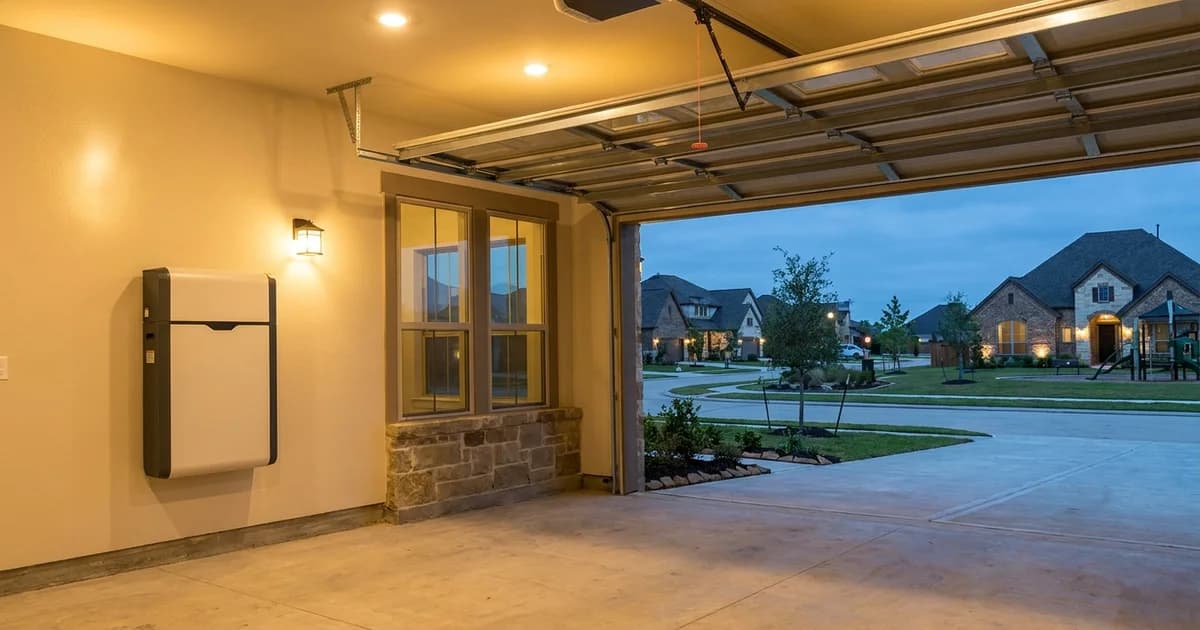
- Pick the equipment wall now. An interior garage wall is the usual answer here, and it removes most of what a review committee would otherwise ask about.
- Request empty conduit from the meter and main panel to that wall, plus a data path beside it.
- Get the load calculation and service size in writing. Confirm the panel is 200 A and ask what the busbar is rated for.
- Photograph the open wall and keep the panel schedule before insulation.
- Confirm who holds the electrical permit during construction, since that decides who files what later.
From the field: The build calendar and the architectural review calendar run independently, and homeowners discover they are out of sync at the worst time. The conduit decision happens before drywall. The committee submission cannot happen until there is an address and a set of elevations. Start the wiring conversation early and file the day elevations exist.
Our metro-wide guide on
covers the builder conversation in more depth.What size battery does a Fulshear floor plan need?
Square footage is the wrong input. Air conditioning tonnage is the right one, and the honest question is what must keep running through a multi-day event, not what runs on a normal Tuesday.
The hardware sets the boundaries. One Eos controller delivers 11.5 kW continuous and 17.1 kW surge. Each battery module is 9 kWh nominal and 8.76 kWh usable, and modules stack. Four modules give 36 kWh nominal and 35.04 kWh usable on a single controller, which is where larger Fulshear homes usually land.
Two points matter more than the capacity number. A large central air conditioning compressor draws a brief inrush at startup, ordinary NEMA Design B motor behavior, and the surge rating exists to absorb it. Separately, 200 A service and busbar headroom decide whether a service change enters the project at all, which is why that panel schedule is worth having.
Can your Fulshear HOA say no?
They can delay you, and the way to avoid a denial is to submit something that answers their questions first. Cross Creek Ranch, Cross Creek West, Fulbrook, and Jordan Ranch all run committees that approve exterior modifications before work starts.
Here is the part nobody explains. Texas Property Code Section 202.010 voids any dedicatory instrument provision prohibiting a solar energy device, and it borrows the definition from a separate state statute, which counts a mechanical or chemical device able to store solar-generated energy (Texas Property Code Sec. 202.010). Section 202.019 protects standby generators, but only units powered by natural gas, liquefied petroleum gas, diesel, biodiesel, or hydrogen and rated at not less than seven kilowatts (Sec. 202.019). A battery burns no fuel, and with no solar array it is not unambiguously a solar energy device either. It sits in the gap between two protective statutes. Do not assume the solar statute carries you.
Even where Section 202.010 clearly applies, a committee keeps real authority. It can regulate location, hold roof-mounted equipment within the roofline, require visible frames, brackets, piping, or wiring in a silver, bronze, or black tone commonly available, and require prior approval. A decision must come within a reasonable period or the period the dedicatory instrument specifies. The statute sets no day count, and neither should anyone promising you one.
Submit a package that closes the loop: a site plan with the equipment wall marked, an elevation photo, the manufacturer specification sheet with dimensions and color, a screening plan if anything is visible from the street, contractor license and insurance, and a note that you will pull a city electrical permit.
The fastest path to a yes is placement. An interior garage wall-mount is not an exterior modification under most dedicatory instruments, which takes the appearance argument off the table. The statewide walkthrough is in our guide on
.Citation capsule: Texas Property Code Section 202.010 voids HOA provisions prohibiting a solar energy device while still allowing regulation of location, roofline alignment, color tone, and prior approval. Section 202.019 protects standby generators but defines them by fuel type and a seven-kilowatt minimum, leaving a standalone battery outside both definitions.
What does the City of Fulshear require?
An electrical permit, filed with the city. Fulshear's building and electrical requirements are codified in Chapter 8 of the city's Code of Ordinances, including Article V on electrical work (City of Fulshear Code of Ordinances). Permit applications and inspections are handled by the city, separately from any HOA review.
Texas law sets minimum residential, commercial, and electrical code requirements and then lets local governments adopt later editions for their own areas, which is why the guidance is always to ask the local code department what applies to your project (Texas State Law Library, 2026). The adopted edition carries a practical consequence, so confirm which one is in force with the permitting office before you submit. Article 706, the National Electrical Code article written specifically for energy storage systems, first appeared in the 2017 edition (IAEI Magazine, 2019). Under an older adopted edition, plan review leans on listed-equipment documentation, the Article 480 battery provisions, and interconnection rules rather than a dedicated storage article. That is a paperwork reality, not a safety concern: clean one-line diagrams move faster either way. The permit and the HOA approval are separate, and neither substitutes for the other.
How the whole sequence fits together
Run the two calendars in parallel:
- Under contract: choose the equipment wall, ask for empty conduit and a data path.
- Framing: confirm service size, panel location, and busbar rating in writing.
- Before insulation: photograph the open wall, keep the panel schedule.
- Elevations issued: file the architectural review submission.
- Near completion: size around cooling load and pull the electrical permit.
- After closing: install, inspect, commission.
We cover west Fort Bend with the crews that handle
, and the nearest service page to Fulshear is .Or call Eos at 833-989-3737 to talk through your setup with an installer.
Frequently asked questions
Can my HOA in Fulshear deny a home battery?
They can require prior approval and regulate location, screening, and color tone under Texas Property Code Section 202.010, and a standalone battery with no solar array falls between that statute and the generator statute. An interior garage wall-mount usually is not an exterior modification at all.
Should I pre-wire for a battery while my Fulshear home is being built?
Yes. Empty conduit from the meter and main panel to the chosen wall, plus blocking and a data path, costs very little while the studs are open. After drywall the same work means cutting, patching, and repainting.
What size battery does a 3,500 square foot Fulshear home need?
Cooling tonnage drives it, not floor area. Each Eos battery is 9 kWh nominal and 8.76 kWh usable and modules stack, while one controller supplies 11.5 kW continuous and 17.1 kW surge. Larger plans here typically land on four modules.
Do I need a permit for a home battery in Fulshear?
Yes, an electrical permit from the City of Fulshear. The city's building and electrical requirements sit in Chapter 8 of its Code of Ordinances (City of Fulshear Code of Ordinances), and the adopted code edition is worth confirming with the permitting office before submittal. HOA approval is separate.
Do newer Fulshear neighborhoods lose power less often than older Houston ones?
For routine interruptions, yes. In 2024, U.S. customers averaged 11 hours of interruptions and major events were 80% of them (U.S. Energy Information Administration, 2025). Beryl-class exposure is the same metro-wide.
Sources
- U.S. Census Bureau, "Vintage 2025 City and Town Population Estimates," retrieved 2026-08-18, https://www.census.gov/newsroom/press-releases/2026/vintage-2025-city-town-pop-estimates.html
- U.S. Census Bureau, "Characteristics of New Housing," retrieved 2026-08-18, https://www.census.gov/construction/chars/highlights.html
- U.S. Energy Information Administration, "Hurricanes in 2024 led to the most hours without power in the United States in 10 years," retrieved 2026-08-18, https://www.eia.gov/todayinenergy/detail.php?id=66744
- Texas Property Code Section 202.010, retrieved 2026-08-18, https://texas.public.law/statutes/tex._prop._code_section_202.010
- Texas Property Code Section 202.019, retrieved 2026-08-18, https://texas.public.law/statutes/tex._prop._code_section_202.019
- City of Fulshear, "Code of Ordinances, Chapter 8 Buildings and Other Structures, Article V Electrical," retrieved 2026-08-18, https://library.municode.com/tx/fulshear/codes/code_of_ordinances?nodeId=PTIICOOR_CH8BUOTST_ARTVEL
- IAEI Magazine, "Energy Storage Systems: NEC Article 706," retrieved 2026-08-18, https://iaeimagazine.org/2019/2019march/energy-storage-systems-nec-article-706/
- Houston Public Media, "Houston power outages after Hurricane Beryl," retrieved 2026-08-18, https://www.houstonpublicmedia.org/articles/news/hurricane/2024/07/08/492833/houston-power-outages-hurricane-beryl-centerpoint/
- Texas State Law Library, "Building Codes in Texas," retrieved 2026-08-18, https://guides.sll.texas.gov/building-codes/texas
- Realty News Report, "Houston Tops Master-Planned Communities Rankings," retrieved 2026-08-18, https://realtynewsreport.com/houston-tops-master-planned-communities-rankings/
General information for west Fort Bend County homeowners, reflecting Eos specifications as of August 2026. Not legal advice, and no promise of a specific approval or permitting timeline. Confirm covenant language with your association and code requirements with the City of Fulshear.