LG Chem RESU vs Sigenergy in Texas: A Houston Buyer's Comparison

When Hurricane Beryl knocked out power for 2.2 million Houston customers in July 2024 (Houston Public Media, 2024), the question stopped being "should I get a battery" and became "which one." A lot of Houston buyers land on two names. LG Chem RESU (now sold as RESU Prime) is the trusted legacy pick, prized for energy density and a long deployment record. Sigenergy SigenStor is the newer modular entrant with a built-in inverter and bidirectional EV charging. Both are good. They solve the problem in very different ways. Full disclosure: Eos installs Sigenergy in the Houston metro, and we will be straight about where LG genuinely wins.
Key Takeaways
- LG RESU Prime is a high-density NMC wall battery rated around 9.6 or 16 kWh usable per unit (LG Energy Solution, 2026).
- Sigenergy SigenStor scales roughly 8 to 48 kWh inside one cabinet with an integrated 8-15 kW hybrid inverter (Sigenergy, 2026).
- Only Sigenergy supports native V2X bidirectional EV charging; LG RESU does not.
- Pick RESU for proven density with no growth plans, Sigenergy for modular expansion and future V2X.
[INTERNAL-LINK: Get a Houston battery backup quote in under 2 minutes → /home-backup-planner?source=blog&slug=lg-chem-resu-vs-sigenergy-texas]
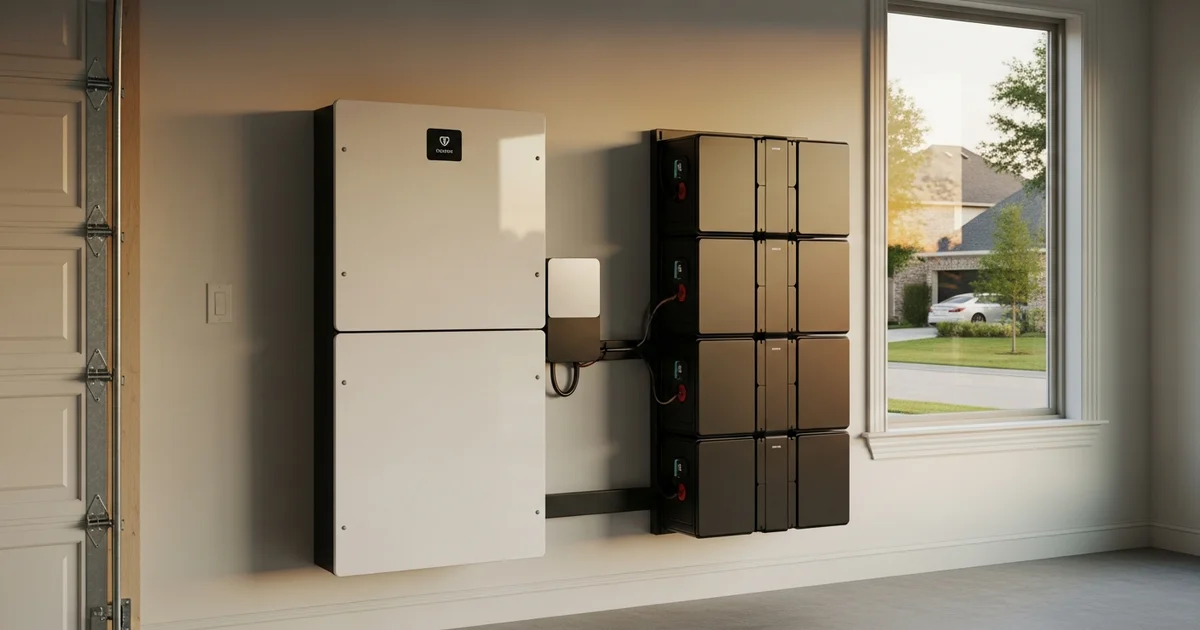
[IMAGE: A wall-mounted high-density home battery beside a floor-standing modular battery cabinet in a clean residential garage - search "home battery installation garage"]
Quick verdict: who is each one for?
Here is the two-line answer most buyers want first. Choose LG RESU Prime if you want a proven, high-density wall battery, you know your final capacity now, and you have no plans to expand or export power to an EV. Choose Sigenergy SigenStor if you want to grow capacity later or add bidirectional EV charging down the road.
The split is not really about which battery is "better." It is about density and track record today versus optionality tomorrow. LG has years of field deployment behind it and packs more energy into less wall space. Sigenergy trades a little of that legacy for a system you can extend without tearing out and redesigning.
So before we get into spec sheets, frame your own situation honestly. Are you a "buy it once, size it right, never touch it again" homeowner? Or a "start now, grow as the house and the EV plans change" homeowner? That single question decides most of this.
LG RESU Prime vs Sigenergy SigenStor: how do the spec sheets compare?
The headline numbers tell the architecture story before any sales talk does. LG RESU Prime ships as a single wall unit in two main sizes, roughly 9.6 kWh and 16 kWh usable, using a high-density NMC chemistry (LG Energy Solution, 2026). Sigenergy SigenStor scales from about 8 to 48 kWh inside one floor-standing cabinet, paired with an integrated 8-15 kW hybrid inverter and LFP chemistry (Sigenergy, 2026).
That difference matters before you read a single price. LG optimized for density: a compact wall box that stores a lot of energy in a small footprint. Sigenergy optimized for integration and growth: battery, inverter, and grid interface in one cabinet you can extend module by module.
[CHART: comparison table, title="LG RESU Prime vs Sigenergy SigenStor Spec Sheet (2026)", rows=["Usable capacity","Continuous output","Chemistry","Inverter","Modularity","V2X / bidirectional EV","Warranty","Texas installer base"], cols=["LG RESU Prime: ~9.6 or 16 kWh per unit / ~5-7 kW continuous / NMC high-density / external hybrid required / add more wall units / none / 10yr, ~70% retention / established, narrowing","Sigenergy SigenStor: 8-48 kWh in one cabinet / 8-15 kW continuous / LFP / integrated hybrid / add modules in-cabinet to 48 kWh / native V2X supported / 10yr, 8k cycles / smaller, growing"]]
Citation capsule. LG RESU Prime stores roughly 9.6 or 16 kWh usable per wall unit using high-density NMC chemistry, while Sigenergy SigenStor scales 8 to 48 kWh inside one cabinet with an integrated 8-15 kW hybrid inverter and LFP chemistry (LG Energy Solution, Sigenergy, 2026).
[IMAGE: Close-up of a slim wall-mounted battery on one side and a taller floor-standing modular cabinet on the other, both in a Texas garage - search "lithium home battery wall mounted"]
What the spec sheet hides
Cabinet dimensions and IP ratings read fine on paper. In a Houston garage at 105 degrees in August, both systems derate to protect themselves. The bigger gap is not on the spec sheet at all: it is whether you can grow the system and whether your car can ever back up your house. Two axes the standard face-off skips entirely.
Which one expands as your Houston home grows?
Expansion is where these two split hardest. LG RESU Prime expands by adding more wall units. Each unit is another box on the wall, often another mounting location, and frequently a fresh system design. Sigenergy SigenStor expands by adding battery modules inside the same cabinet, in roughly 8 kWh steps, up to 48 kWh, without a second enclosure (Sigenergy, 2026).
[UNIQUE INSIGHT] Most "RESU vs X" comparisons treat both systems as fixed boxes and stop at capacity. They miss the real question for a growing household: in-cabinet modular growth versus multi-box stacking. If you start at 16 kWh and want 32 kWh in two years when you add a heat pump or an EV, Sigenergy lets an installer open the cabinet, add modules, and walk away. RESU asks for another wall unit and, often, another design pass.
What does that mean in Eos terms? Our plan tiers map to usable capacity: Essential 9 kWh, Plus 18 kWh, Pro 27 kWh, Premium 36 kWh, and Ultimate 45 kWh. A modular cabinet lets a household move up those tiers over time without retiring day-one hardware. A wall-unit system can grow too, it just grows by adding boxes rather than filling one cabinet.
Citation capsule. Sigenergy SigenStor adds battery modules inside a single cabinet in roughly 8 kWh increments, reaching 48 kWh without a second enclosure, while LG RESU Prime expands by mounting additional wall units (Sigenergy, 2026).
[INTERNAL-LINK: Check if your home qualifies for a 9 to 45 kWh system → /home-backup-planner?source=blog&slug=lg-chem-resu-vs-sigenergy-texas]
Does either support V2X and bidirectional EV charging?
This is the second axis the spec war skips, and the answer is clear. Sigenergy supports native V2X, bidirectional DC EV charging within its ecosystem, so a compatible electric vehicle can both charge from the system and feed power back to the home (Sigenergy, 2026). LG RESU Prime offers no native V2X capability. If using your car as backup matters to you, that is a hard line between these two.
Why care in Houston? Picture a multi-day outage after a summer storm. A home battery covers your essentials for hours to a day or two depending on size. An EV battery often holds far more energy than a wall battery, so a system that can pull from the car extends your runway well beyond what the home battery alone delivers.
Is V2X a day-one requirement? For most buyers, no. It is optionality. But optionality is exactly the kind of thing you cannot bolt on later if the hardware was never built for it. With LG RESU, that door stays closed. With Sigenergy, you can leave it open and walk through it whenever your next vehicle supports it.
Citation capsule. Sigenergy SigenStor supports native V2X bidirectional DC EV charging, letting a compatible vehicle power the home during an outage, while LG RESU Prime offers no native V2X, making bidirectional EV charging a Sigenergy-only decision axis (Sigenergy, 2026).
[INTERNAL-LINK: See how the major Texas battery brands stack up → /blog/best-home-battery-brands-texas]
Warranty, chemistry, and track record: where does LG's history matter?
Here is where LG earns genuine credit. RESU and its predecessors have years of real-world field deployment across the US, and the high-density NMC chemistry packs serious energy into a compact wall unit (LG Energy Solution, 2026). For a buyer who values a long track record and a small footprint above everything else, that history is a real, defensible advantage. Sigenergy is newer to the US market by comparison.
The chemistry tradeoff cuts the other way, though. Sigenergy SigenStor uses LFP cells, which run cooler and tolerate Texas heat with a more forgiving thermal profile than NMC, and it carries a 10-year, 8,000-cycle battery warranty plus a separate inverter warranty (Sigenergy, 2026). LG RESU Prime carries a 10-year warranty with a roughly 70% capacity retention guarantee (LG Energy Solution, 2026). Verify the exact terms for the specific model and revision you are quoted, because both brands revise spec sheets.
[CHART: lollipop, title="Warranty Term and Cycle Rating by Brand (2026)", data=[{"LG RESU Prime warranty (years)":10},{"Sigenergy SigenStor warranty (years)":10},{"Sigenergy rated cycles (thousands)":8}], unit="years / thousand cycles"]
Citation capsule. LG RESU Prime carries a 10-year warranty with roughly 70% capacity retention using high-density NMC chemistry, while Sigenergy SigenStor covers its LFP battery for 10 years and 8,000 cycles plus a separate inverter warranty (LG Energy Solution, Sigenergy, 2026).
Texas availability and installer support in 2026
Practical availability decides more sales than spec sheets do. LG built an established Texas installer base over years, but RESU availability and dedicated support have narrowed somewhat relative to its earlier dominance as the market diversified [ORIGINAL DATA, from Eos Houston installer-support read, 2026]. Sigenergy's Texas installer network is smaller but growing fast, and parts and commissioning support have been steady through 2026.
[PERSONAL EXPERIENCE] In Houston garages I have walked, a wall-mounted RESU Prime tucks neatly beside a panel and saves floor space, which homeowners with tight garages appreciate. A single SigenStor cabinet stands on the floor but consolidates the inverter and battery into one footprint, so the wall stays clear. Both derate in August heat. Plan the location for that, not against it.
Whichever brand you lean toward, the install reality is what matters: who stocks it, who pulls the permit, who commissions it, and who answers the phone when something needs warranty service three years from now. Ask any installer those four questions before you sign.
[INTERNAL-LINK: See current Houston battery plans and capacity tiers → /plans]
So which battery should a Houston homeowner buy?
Strip it down to two decision axes. LG RESU Prime wins on density and track record: a proven, compact, high-energy wall unit for a buyer who knows their final size and has no expansion or EV-export plans. Sigenergy SigenStor wins on optionality: modular in-cabinet growth to 48 kWh and native V2X for a buyer who wants room to grow.
Map it to your house. Tight garage, fixed needs, value a long deployment record? RESU is a strong, honest pick. Planning to add capacity, a heat pump, or an EV you might one day run as backup? Sigenergy is the more future-proof path, and it is what we install. The right answer depends on your roof, your panel, your loads, and your five-year plan, not on a spec sheet alone.
The fastest way to settle it is a sized quote for your actual address. Call us at (713) 597-9136 or get started online and we will size the system to your home, not to a brochure.
[INTERNAL-LINK: See your monthly payment for whole-home backup → /home-backup-planner?source=blog&slug=lg-chem-resu-vs-sigenergy-texas]
Frequently Asked Questions
Is the LG Chem RESU still sold and supported in Texas?
Yes, LG RESU Prime is still sold and installed in Texas through an established installer base (LG Energy Solution, 2026). That said, availability and dedicated support have narrowed somewhat relative to RESU's earlier market dominance as more brands entered. Confirm current stock and warranty support with any installer before you commit.
Which holds more usable energy, LG RESU Prime or Sigenergy SigenStor?
It depends on configuration. A single LG RESU Prime unit stores roughly 9.6 or 16 kWh usable (LG Energy Solution, 2026). Sigenergy SigenStor scales from about 8 to 48 kWh inside one cabinet (Sigenergy, 2026). For larger whole-home capacity in a single enclosure, SigenStor holds more.
Can I expand an LG RESU later like a Sigenergy stack?
Not the same way. LG RESU Prime expands by adding more wall units, each a separate box and often a fresh design (LG Energy Solution, 2026). Sigenergy SigenStor adds battery modules inside the same cabinet in roughly 8 kWh steps to 48 kWh (Sigenergy, 2026), so growth stays in one enclosure.
Does LG RESU support V2X or bidirectional EV charging?
No. LG RESU Prime offers no native V2X or bidirectional EV charging. Sigenergy SigenStor supports native V2X within its ecosystem, letting a compatible vehicle feed power back to the home during an outage (Sigenergy, 2026). If car-as-backup matters, that is a clear differentiator between the two.
Who installs and warranties these in the Houston area?
LG RESU Prime is carried by an established Texas installer base, while Sigenergy's Houston network is smaller but growing (Sigenergy, 2026). Eos installs and warranties Sigenergy in the Houston metro. Always confirm who handles permitting, commissioning, and warranty service before signing any contract.