Battery Backup vs. Generator: Houston Homeowner's Guide

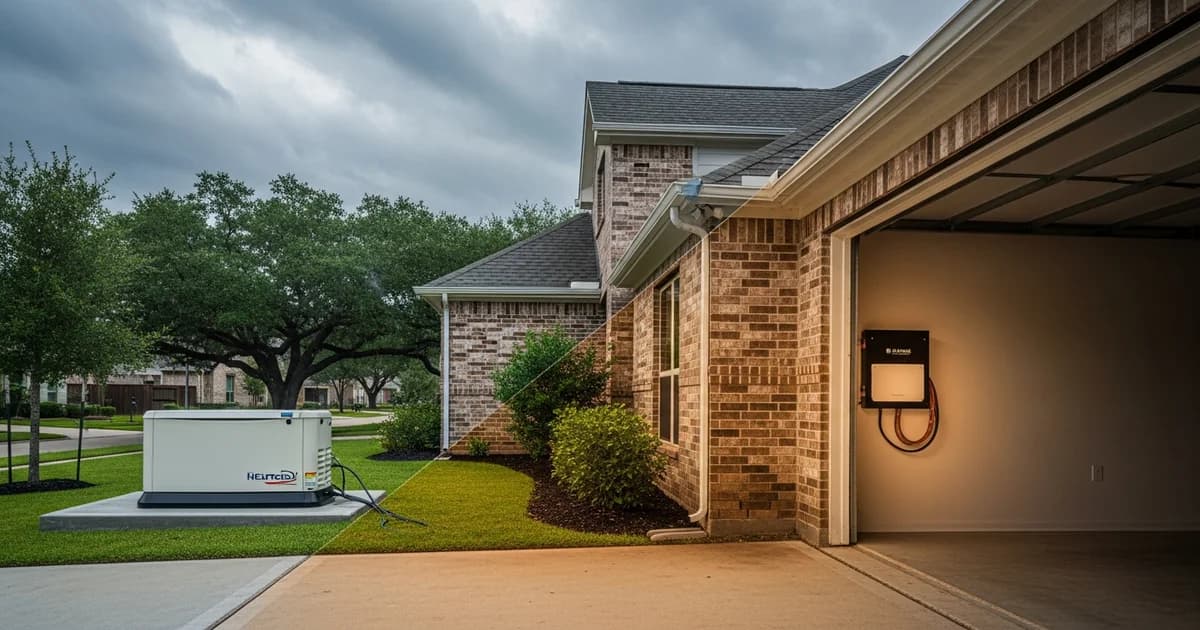
When Hurricane Beryl hit Houston in July 2024, 2.6 million customers lost power. Eight hundred sixty thousand of them were still in the dark four days later, and full restoration stretched past ten days for the hardest-hit neighborhoods (Texas Tribune, 2024). That kind of outage forces a real decision: battery backup or standby generator?
Both options work. Both have real tradeoffs. The right answer depends on six factors specific to your home, your neighborhood, and the type of disaster you're most likely to face. This guide is the Houston-specific companion to our broader Texas state-level battery vs generator analysis: same comparison, different lens. The Texas hub frames the question across metros (Dallas, Austin, San Antonio, Houston). This guide walks through each factor as Houston homeowners specifically face them, with neighborhood-level HOA realities, post-Beryl decision data, and CenterPoint restoration patterns. If you live in the Houston metro, start here. If you live elsewhere in Texas, start with the hub.
Key Takeaways
- For most Houston homeowners, battery backup outperforms a standby generator on noise, maintenance, and 20-year cost ($61K vs. $91K over 20 years, EnergySage, 2026).
- Natural gas generators failed during Winter Storm Uri because the gas supply froze, not the machines. Battery systems have no equivalent dependency.
- If you need 5+ days of whole-home power during a major hurricane, a hybrid battery-plus-generator system bridges the gap.
What Kind of Outages Is Houston Actually Preparing For?
In 2024, major-event outage hours across the U.S. averaged nearly 9 hours per customer, almost double the 2014-2023 average (EIA Electric Power Annual, Dec 2025). Houston homeowners face an unusual combination: summer hurricanes that knock out distribution lines for days, and winter freezes that can collapse the generation supply itself.
Most cities prepare for one type of disaster. Houston prepares for two, and they have almost opposite implications for backup power. That distinction is what makes the battery-versus-generator choice more complicated here than in, say, Florida or Minnesota.
Consider what the last five years actually produced. Winter Storm Uri in February 2021 knocked out power for 4.5 million Texas homes. The May 2024 derecho took down roughly 800,000 customers in the Houston metro. Then Beryl hit in July 2024, affecting 2.6 million customers. Three major events. Three very different causes.
The key takeaway from that chart: Uri and Beryl were both massive, but they worked differently. Beryl was a grid distribution problem, lines physically damaged by wind. Uri was a generation collapse triggered by fuel supply failure. Your choice of backup system should account for both.
How Much Does Each Option Cost in Houston?
Over 20 years, a solar-plus-battery system costs roughly $60,961 compared to $91,319 for a natural gas standby generator, a difference of more than $30,000 (EnergySage, Feb 2026). The upfront numbers are closer: a 13.5 kWh battery system runs around $15,200 installed, while a comparable standby generator starts around $12,000 installed.
The gap widens because generators consume fuel every hour they run, and they need annual maintenance costing $200-$600 per year. A single technician visit averages $273 (Angi, 2026). Battery systems carry essentially no ongoing fuel cost and typically need only remote firmware updates.
One important sizing note for Houston: a single 13.5 kWh battery is often undersized for whole-home coverage in Texas summers. Running a 3-ton AC through the night requires more capacity. Many Houston homeowners are purchasing 27-36 kWh of total storage, which pushes the installed cost to $28,000-$38,000 upfront. That's still well below the generator's 20-year total, but the initial investment is higher than a generator's sticker price.
Which System Is More Reliable in a Texas Power Outage?
Only 20% of Texas households had generator access during Winter Storm Uri, yet even many of those generators couldn't run. That's because natural gas production in Texas declined nearly 45% during the freeze, and fuel issues caused 31.4% of all generating unit failures (FERC Final Report on February 2021 Freeze, 2021).
Here's what most comparison guides miss: the generators themselves mostly worked fine. The gas supply didn't. Residential gas lines froze or lost pressure as upstream production collapsed. Homeowners with perfectly functional standby generators had no fuel to run them. Battery systems have no equivalent dependency.
This is the insight that changes the calculus for Texas specifically. In most states, "does natural gas supply fail?" is a theoretical question. In Texas, it already happened once at scale, affecting 4.5 million homes (PMC/NIH, Jan 2023). There's no guarantee it won't happen again.
Battery systems offer two other reliability advantages that matter in real outages. First, they switch on in milliseconds. No startup sequence, no 10-30 second gap while electronics restart. If you have medical equipment or a home office, that instant-on response isn't a luxury. Second, batteries have no moving parts. There's nothing to seize, flood, or overheat during the chaos of a major storm.
Generators do win on one reliability dimension: unlimited runtime via natural gas line. If the gas flows, the generator runs. That advantage is real and worth acknowledging. It just comes with an asterisk that every Texas homeowner should read.
Citation capsule: During Winter Storm Uri in February 2021, fuel supply issues caused 31.4% of all Texas generating unit failures, according to FERC's final report on the event (FERC, 2021). Natural gas production across the state declined nearly 45%, cutting off pressure to residential gas lines across the Houston metro and beyond. Homeowners with fully functional standby generators had no fuel to run them. A home battery system avoids this failure mode entirely: it stores energy drawn from the grid or solar panels before the outage begins, with no dependency on continuous fuel delivery during the event. That distinction makes battery backup the more resilient choice specifically for winter freeze scenarios in Texas, where fuel supply disruption is a documented, large-scale historical risk rather than a theoretical concern.
How Long Will Each System Last During an Outage?
A 25 kWh battery system powers an average Houston household for approximately 30 hours under normal summer load conditions (Click2Houston / Base Power, Mar 2025). That's roughly one full day, which covers most Houston outages from summer thunderstorms and smaller events. Beryl-scale outages are a different story.
For a 10-day outage like the worst-affected Beryl zones, runtime math gets serious fast. A single 13.5 kWh battery unit handles 8-12 hours of whole-home load in Texas summer heat. Running your AC overnight requires 27-36 kWh of total storage. A standard 3-ton AC unit draws 3-5 kW. At 4 kW for 8 hours of overnight running, you need 32 kWh of capacity just for that one appliance.
A standby generator on natural gas runs indefinitely as long as the gas line holds pressure. That's its core advantage. On propane, a 500-gallon tank buys you roughly 4-8 days depending on load. For outages longer than 3-4 days, generators have a structural advantage that battery-only systems can't match without a solar array to recharge from.
If your primary fear is a Category 4 direct hit followed by a 10-day grid-down situation, this is the honest math you need to hear. A solar-plus-battery system handles most outages comfortably and recharges daily. But without sun (cloudy days post-storm) and without a large enough bank, there are scenarios where a generator's unlimited runtime wins. A hybrid system addresses that gap.
What About Noise, HOA Rules, and Fuel Storage?
Standby generators produce 60-70 decibels of continuous noise at 23 feet, roughly equivalent to a vacuum cleaner running nonstop (EnergySage, 2026). In Houston's dense suburban neighborhoods, that becomes a community friction point fast.
Working with homeowners across Katy, Sugar Land, and The Woodlands, we've found that HOA restrictions on generators are more common and more restrictive than most people expect. Some HOAs prohibit standby generators entirely on lots under a certain size. Others require setback distances from property lines that aren't feasible on standard suburban lots. And some simply ban equipment that produces sustained noise over a noise ordinance threshold.
Battery systems don't make noise. They have no emissions. They sit flush against a garage wall or interior utility room. No HOA has ever flagged a battery installation we've done, and no neighbor has ever complained. That's not a minor convenience point. In Pearland, Friendswood, and League City, where lots run 6,000-8,000 square feet, a generator's placement and noise footprint is genuinely complicated.
Fuel storage adds another dimension. A 500-gallon propane tank requires permits, setback compliance, and ongoing supplier relationships. Natural gas eliminates the storage problem but introduces the pipeline dependency discussed above. Battery systems need none of this. They store energy, not fuel.
The 6-Factor Decision Framework
There's no universal right answer between battery and generator for Houston homeowners. The choice depends on your specific situation across six factors. Use this framework as a structured way to work through the decision, not as a rigid prescription.
1. Expected outage duration. If most of your outages are 1-3 days (summer storms, typical hurricane damage), battery handles that range well. If you're in a flood-prone area where restoration takes 7-10 days after a major event, a generator or hybrid gives you coverage battery alone may not.
2. Budget horizon. Generators win on upfront cost. Batteries win over 20 years. If you plan to sell your home in 3-5 years, the long-term TCO advantage of battery matters less. If you're in your forever home, the $30,000 savings over 20 years is real money.
3. Solar panels. If you have solar or plan to install it, battery is the natural pairing. Your panels recharge the battery during daylight, giving you multi-day coverage during outages as long as it's sunny. A generator paired with solar doesn't benefit from that synergy.
4. HOA or noise sensitivity. If you're in a neighborhood with HOA restrictions, a dense lot, or close neighbors, battery is almost certainly the better choice. Check your HOA covenants before you buy anything.
5. Medical equipment. If anyone in your home depends on a CPAP, oxygen concentrator, or other medical device, the instant-on response of a battery system is not optional. A generator's 10-30 second startup window can interrupt devices in ways that matter.
6. Primary risk: freeze or major hurricane. If you're most worried about a Uri-style winter freeze, battery eliminates the fuel supply risk entirely. If your biggest fear is a direct Category 4 strike with 10 days of grid-down, a generator or hybrid covers the extended runtime that battery alone may not.
| Factor | Battery | Generator | Hybrid |
|---|---|---|---|
| Upfront cost | Neutral | Wins | Neutral |
| 20-year cost | Wins | Loses | Neutral |
| Noise level | Wins (silent) | Loses (60-70 dB) | Neutral |
| HOA compatibility | Wins | Loses | Neutral |
| Fuel dependency | Wins (none) | Loses | Neutral |
| Instant-on response | Wins (ms) | Loses (10-30s) | Wins |
| AC runtime (5+ days) | Loses* | Wins | Wins |
| Freeze reliability | Wins | Loses | Wins |
*Battery wins on AC runtime when paired with solar and sufficient capacity (27-36 kWh).
Frequently Asked Questions
Is a whole-house generator or battery backup better for Houston homes?
For most Houston homes, battery backup is the better choice for outages under 3-4 days, especially summer storms where fuel supply can be disrupted. Generator or hybrid systems make more sense if you need 5+ days of full-home coverage for rare major events like a Category 4 hurricane making direct landfall.
What happened to gas generators during Winter Storm Uri in Texas?
Natural gas generators largely failed during Uri because the gas supply froze. FERC's final report found that fuel issues caused 31.4% of all Texas generating unit failures in February 2021 (FERC, 2021). Residential gas lines faced the same issue. Battery systems have no equivalent fuel dependency.
How much does a home battery backup cost in Houston compared to a generator?
Both start at $12,000-$15,200 installed. Over 20 years, a battery system costs roughly $61,000 vs. $91,000 for a natural gas standby generator (EnergySage, 2026), primarily because generators require ongoing fuel and $200-$600 per year in maintenance (Angi, 2026).
Can a home battery backup run my air conditioner in Texas heat?
Yes, but sizing matters. A standard 3-ton AC unit draws 3-5 kW. A 13.5 kWh battery powers it for 3-4 hours. For overnight AC coverage during a summer outage, 27-36 kWh of battery storage is the realistic target for most Houston homes.
What is a hybrid battery-generator system and is it worth considering?
A hybrid setup pairs a battery (for instant-on response and daily loads) with a generator (for extended outages beyond battery capacity). It costs more upfront but eliminates both the battery's runtime limit and the generator's startup delay and fuel-only risk. Eos installs both battery-only and hybrid configurations.
Making the Right Call for Your Home
For most Houston homeowners, battery backup wins. It's quieter, cheaper over time, more reliable during a Texas freeze, and easier to live with in an HOA-restricted suburb. A 27-36 kWh system paired with solar handles the vast majority of outages you're actually likely to face.
But generators win in specific scenarios. If you need 10 days of uninterrupted whole-home power after a direct major hurricane strike, a generator or hybrid system is the honest answer. Acknowledging that matters. The goal is the right system for your situation, not the one with the better marketing story.
Key takeaways:
- Battery wins on 20-year cost, noise, HOA compliance, and freeze reliability.
- Generator wins on unlimited runtime and lower upfront cost.
- Hybrid covers both, at a higher upfront investment.