What Happens to Your Home Battery When You Replace the Roof?

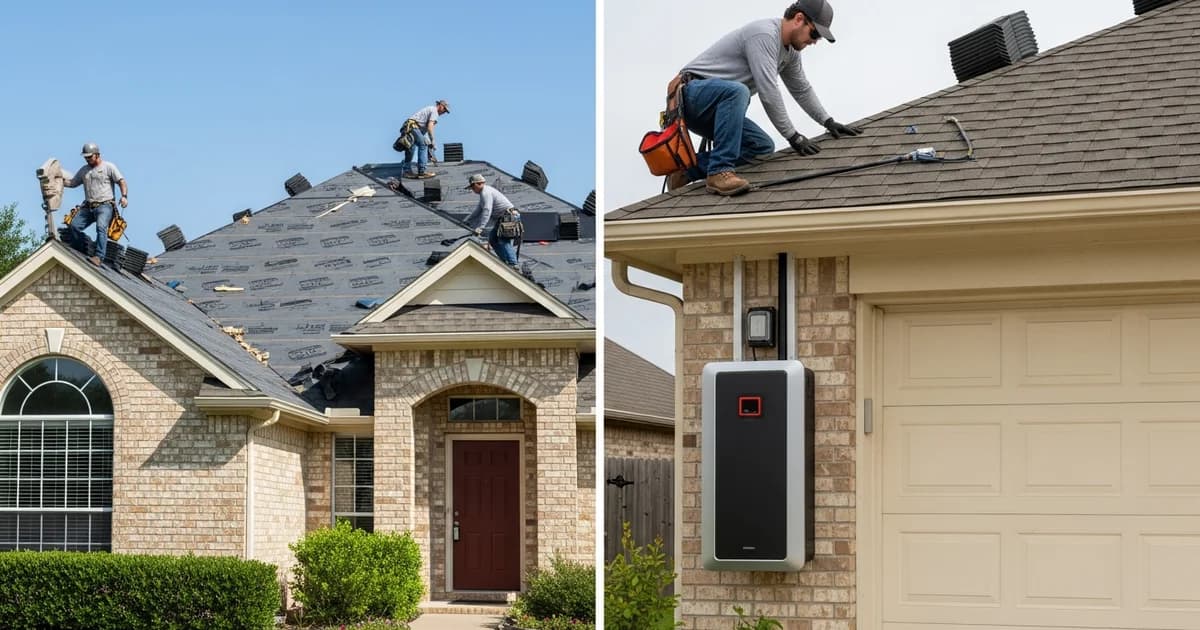
Houston roofs take a beating. In 2025, the Insurance Institute for Business and Home Safety reported that Gulf Coast asphalt shingle roofs often need replacement in 12 to 20 years, well short of the warranty, because of hail and hurricane wind (IBHS, 2025). A home battery is built to last 10 to 15 years. So the math is simple: most owners will reroof at least once while their battery is still on the wall. The question I hear on every site visit is the same. "I just paid for this battery. Will the next roof job wreck it or cost me a fortune to work around?" Here is exactly what gets touched, what does not, what it costs, and how to line up the crews.
Key Takeaways
- A wall or garage-mounted home battery is almost never touched during a roof replacement, because it lives on a vertical wall, not the roof deck.
- Only roof-mounted solar panels must come off before the reroof and go back after, a service called detach and reset.
- In 2025, EnergySage put residential detach and reset in the low to mid four figures, scaling with panel count (EnergySage, 2025).
- Sequence the work roofer-first, then solar reset, with one person owning the whole timeline.
- A standalone battery with no solar pays nothing extra at reroof time.
[INTERNAL-LINK: get a Houston battery backup quote in under 2 minutes -> /home-backup-planner?source=blog&slug=home-battery-roof-replacement-coordination]
Does a roof replacement even touch your home battery?
In most installs, no. The battery hangs on a vertical wall, on the garage exterior, in a utility room, or on the side of the house, so a roofing crew works entirely above and around it. A wall-mounted unit and its conduit run are not part of the roof envelope, which means the people tearing off shingles never need to disturb it.
On a typical Houston job, our battery sits well below the roofline with several feet of clear wall around it. When a roof crew arrives, the worst they do near the unit is drape a tarp to catch debris and, if their general contractor asks, kill the breaker feeding it for the day. After a decade coordinating these installs across Harris and Fort Bend counties, I have not seen a standard reroof require moving a wall-mounted battery.
A few cases differ. A ground-mounted enclosure on a pad sits even further from the action, and a garage-interior battery is fine unless the crew cuts into that ceiling. The only real exception is the rare unit on a wall section roofers must open up, and a good installer flags that before the job, not during. The enclosure, its disconnect, and its wiring run are all separate from the roof deck, so for the vast majority of Houston homes the battery simply stays put.
The real coordination job is your solar panels, not the battery
Here is the reframe most homeowners miss: the battery is the easy part. If you have roof-mounted solar, the panels and their mounting rails sit directly on the roof deck, and they must come off before the reroof, then go back on after. That service is called detach and reset, and it is where all the cost and scheduling actually lives.
Roofers cannot shingle under a live solar array. The panels block the deck, and every rail penetration has to be re-flashed when the new roof goes on. So the panels get detached, the wiring is safely disconnected, the roof is replaced, and then the array is remounted and re-commissioned. A licensed solar installer or a roofer's solar subcontractor performs this, never the general roofing crew alone.
Roof-mounted solar panels must be detached before a reroof and reset after, while a wall-mounted battery is untouched (EnergySage, 2025). The practical takeaway: separate the two systems in your head. Battery stays. Solar detaches. Once you split the objection that way, a scary "what about my whole system?" shrinks to one manageable line item on the roof job.
If you own a standalone battery with no solar, you skip this entire section. There is nothing on your roof to remove, so a reroof is just a reroof.
What does detach and reset cost, and how long does it add?
In 2025, EnergySage put detach and reset for a residential roof-mounted array in the low to mid four figures, with larger systems landing at the higher end as panel count climbs (EnergySage, 2025). This is a third-party solar and roofing market cost, not a battery charge, and it shows up on the roof job, not your battery quote.
Three things drive the price. Panel count is the biggest lever, since each panel has to come off and go back on. Roof complexity matters too: steep slopes, multiple planes, and tight access slow the crew down. And condition counts. If conduit, critter guards, or aging flashing need rework, that adds labor on top of the base detach and reset.
On schedule, detach and reset commonly adds one to two coordination days that bracket the reroof, per standard solar installer practice in 2025. The detach lands a day or so before the roofers start, and the reset and re-commissioning happen once the new roof is buttoned up. Budget that time into the roof job timeline so nobody is caught waiting.
The honest part: if you own a standalone battery and no solar, none of this applies to you. There is nothing to detach, nothing to reset, and no added days. Budget detach and reset into the roof project only if panels live on your roof.
[INTERNAL-LINK: see your monthly payment for whole-home backup -> /home-backup-planner?source=blog&slug=home-battery-roof-replacement-coordination]
How to sequence a reroof when you have a battery or solar
The correct order is roofer-first, solar-reset-second, with a single point of coordination over both crews. Confirm up front that the battery can stay energized, or schedule a brief planned shutdown if the installer wants one for safety. Never let a roofer start with panels still on the deck.
Here is the single-coordinator sequence we hand Houston owners, with the contractor who owns each step:
| Step | What happens | Who owns it |
|---|---|---|
| 1 | Book the reroof and lock a start date | Homeowner + roofer |
| 2 | Schedule solar detach to land 1 to 2 days before roofing | Solar installer |
| 3 | Roof gets torn off and replaced | Roofer |
| 4 | Solar panels reset and re-commissioned | Solar installer |
| 5 | Verify battery and solar talk again, monitoring back online | Solar installer |
The battery rarely needs its own step, which is exactly the point. It sits on the wall through steps 1 through 5 and waits for solar to come back. If you have no solar, you only need steps 1 and 3, plus a quick check that the battery rode through the work fine. For more on what a clean install handoff looks like, see our coordinating a battery install during roof or solar work walkthrough.
Keeping your battery online during the work
A wall-mounted battery can usually keep running through a reroof. The catch is solar: if your array is detached, your solar charging pauses until the reset is done, so the battery leans on grid charging in the meantime. The unit itself stays functional the whole time.
What if the installer de-energizes the system for safety during detach? That is a planned, temporary shutdown. Once the work is clear, the battery rides on grid charge and keeps holding backup capacity. Your monitoring app may show solar as offline during this window. That is expected and temporary, not a fault.
So is losing solar input a problem during a reroof? Not really. The battery still charges from the grid, still backs up your critical loads, and returns to full solar charging the moment the array is reset. To keep firmware and monitoring healthy through that transition, follow our guide to keeping your battery and monitoring healthy.
Coordinating the roofer and the solar installer without losing your mind
Assign one owner of the timeline. Either the solar installer coordinates the roofer, or you do, but get both crews on one shared schedule and confirm the warranty handoff in writing. A documented handoff is what protects both your roof warranty and your solar and battery warranty.
Watch the warranty gotchas. Pin down who warranties the roof penetrations after the array is reset, since mount points must be re-flashed into the new roof. Document panel condition with photos before detach and after reset. Get the reset date in writing so the solar crew is not scrambling to fit you in after the roofers leave.
Finally, verify the finish. Confirm the mounts were re-flashed, the system was re-commissioned, and the battery's backup function was actually tested after the work, not just assumed. A reroof done with a battery in place should end with your full system, backup included, proven working. For the bigger picture on living with backup power here, see our home battery backup in Houston guide.
Frequently Asked Questions
Do I have to remove my home battery to replace my roof?
No. A wall or garage-mounted battery stays in place, because it lives on a vertical wall, not the roof deck. Only roof-mounted solar panels need removal. In 2025, EnergySage confirmed batteries are untouched while panels require detach and reset (EnergySage, 2025).
How much does it cost to detach and reset solar panels for a reroof?
In 2025, EnergySage put residential detach and reset in the low to mid four figures, scaling with panel count (EnergySage, 2025). Bigger arrays sit at the higher end. This is a solar and roofing market cost, billed on the roof job, not your battery.
Can my battery keep working during the roof replacement?
Usually yes. A wall-mounted battery runs on grid charge throughout a reroof. Solar charging pauses only if the array is detached, which is temporary. The IBHS notes Gulf Coast roofs often last just 12 to 20 years, so plan for this once or twice (IBHS, 2025).
Who should I call first, the roofer or the solar installer?
Loop both in early and have one of them own the schedule. Solar detach is timed to land one to two days before the roofers start, per standard installer practice in 2025. A single coordinator keeps the five-step sequence from slipping.
Does a standalone battery with no solar cost anything extra at reroof time?
No. With no roof-mounted equipment, there is nothing to detach or reset, so you add zero steps, days, or dollars. The battery on your wall is unaffected by the work happening above it on the roof deck.
Ready to move forward?
The reroof objection comes down to five things. The battery stays on the wall. Roof-mounted solar detaches and resets. Sequence the job roofer-first. Put one person in charge of the timeline. Document every warranty handoff. Handle those, and a roof replacement becomes a non-event for your backup power.
If you are still deciding on a system and want one that is easy to live with through a future reroof, you can compare 9 to 45 kWh battery plans across the Essential, Plus, Pro, Premium, and Ultimate tiers. When you are ready, get a fixed-price install quote for your address and we will scope a clean wall mount from day one.
[INTERNAL-LINK: get a fixed-price install quote for your address -> /home-backup-planner?source=blog&slug=home-battery-roof-replacement-coordination]
Prefer to talk it through? Call Eos at (713) 555-0199 and we will walk you through coordinating your battery, solar, and roof in one conversation.