Battery Backup for Houston Breweries: Protecting Fermentation

Battery Backup for Houston Breweries: Protecting Fermentation
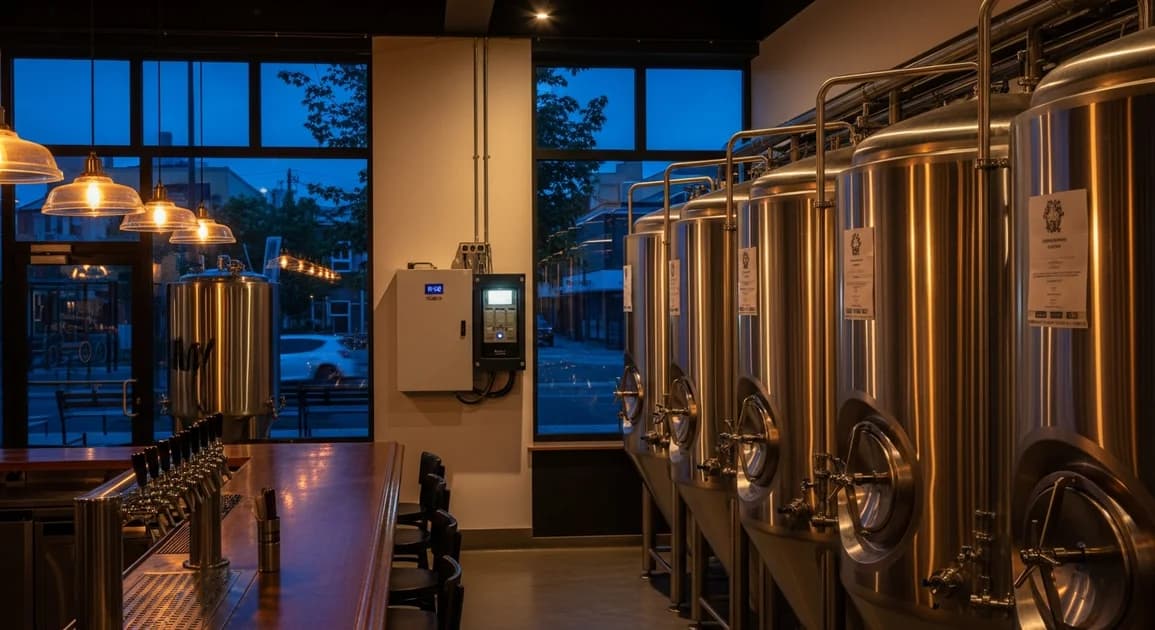
For a brewery, a Houston outage threatens the one thing you cannot replace overnight: the beer itself. Unfinished beer in the fermenters has to hold a narrow temperature or the batch develops off-flavors, and the walk-in and glycol chiller that keep everything cold stop with it. On the taproom side, warm kegs mean foamy pours and lost sales. A spoiled fermentation is weeks of tank time and product gone. Here is how to protect the product and the taproom.
Key Takeaways
- Ale yeast ferments best around 55 to 75 degrees and lager yeast around 46 to 56 degrees (BJCP); warmer temperatures drive off-flavors like fusel alcohols and esters.
- Draught beer should be kept at or below 38 degrees, or it loses carbonation and foams when poured (Brewers Association).
- There were 9,796 operating US craft breweries in 2024 (Brewers Association, 2025), a competitive market where lost product hurts.
- Hurricane Beryl left about 2.2 million CenterPoint customers without power (Houston Public Media, 2024), with more than 1 million still out days later (Texas Tribune, 2024).
- Honest sizing: one controller protects a critical fermentation and cold zone. A full production brewery needs a larger design and often a generator.
[INTERNAL-LINK: get a backup quote for your brewery → /home-backup-planner?source=blog&slug=battery-backup-houston-breweries-taprooms]
Can a battery protect a Houston brewery's product during an outage?
Yes, for the critical fermentation and cold-storage zone. A battery can keep the glycol chiller and fermenter temperature control running, the walk-in cooler and keg storage cold, and the taproom POS, draft, and lighting live. That protects the beer and keeps the taproom pouring. What one small unit will not do is run a full production brewery's entire refrigeration load at once, a large continuous draw that needs a commercial design and often a generator.
That honesty matters here, because the product is irreplaceable on a short timeline. We protect the fermentation and cold chain first, then scale the design to the brewery.
Why fermentation and cold storage are the highest-stakes loads
Because beer is made by temperature as much as by recipe. Ale yeast works best around 55 to 75 degrees and lager yeast around 46 to 56 degrees (BJCP), and letting a fermenter drift warm pushes yeast to produce off-flavors: fusel alcohols that taste harsh and solvent-like, and a spike in fruity esters. In a Houston summer, an unpowered fermenter heats toward room temperature fast, and that can change or ruin a batch.
Cold storage is the other half. The Brewers Association advises keeping draught beer at or below 38 degrees, because above that carbonation comes out of solution and the beer pours as foam (Brewers Association). A warm walk-in means lost carbonation, lost product, and a taproom that cannot serve. The chart shows how tight and cold these targets are.
What an outage actually costs a brewery
More than a slow day, because the loss compounds. A ruined fermentation is not just spilled beer: it is the grain, hops, and yeast that went into it, plus the weeks of tank time that fermenter is occupied, which forfeits the future sellable output of that tank too. A warmed walk-in adds lost kegs and packaged product on top. None of it comes back with the power.
Beryl made the hospitality toll visible. Local reporting documented Houston breweries and restaurants dark for days, with venues racing to cook off or move walk-in inventory before it spoiled (Houstonia, 2024). For a brewery, that same scramble hits tanks of unfinished beer that cannot simply be relocated. Our guide on [INTERNAL-LINK: the cost of business interruption from a Texas power outage → /blog/business-interruption-power-outage-cost-texas] frames the wider math.
What Hurricane Beryl meant for Houston breweries
It meant days without the refrigeration a brewery lives on. Beryl knocked out power to about 2.2 million CenterPoint customers (Houston Public Media, 2024), and more than a million were still without power days later (Texas Tribune, 2024), under a heat advisory with the index near 106 degrees (Houston Public Media, 2024). For a fermenter or a walk-in, that is days of drifting warm.
The scale of the business hit is on the record. By late August, the Small Business Administration had approved more than $216 million in disaster loans for the Beryl declaration (SBA, 2024). Backup power is how a brewery keeps its product out of that tally.
A composite look: a brewery through a multi-day outage
The following is a composite illustration, not a specific client, drawn from the breweries we see across Houston. Picture a production brewery with a taproom: several fermenters on glycol, a walk-in cooler full of kegs, a brite tank, a draft system, and a POS. When the grid drops, the glycol chiller stops, the walk-in warms, and the clock starts on every tank of unfinished beer.
With a battery system on a critical plan, the glycol chiller and fermenter temperature control keep running, the walk-in stays cold, and the taproom keeps pouring and ringing sales. Paired with a generator for a long event, the brewery protects its tanks and its cold storage instead of dumping batches. To compare with the food side, read our guide on [INTERNAL-LINK: battery backup for Houston restaurants → /blog/battery-backup-restaurants-houston].
How much battery does a brewery need?
It depends on how much refrigeration you must hold. A taproom or a critical fermentation and cold-storage zone is a contained plan. A full production brewery running multiple glycol chillers and a large walk-in around the clock is a big, continuous load that scales the system up, often alongside a generator for multi-day runtime.
Here is the honest hardware picture. Our modular system uses 9 kWh nominal battery modules (8.76 kWh usable each), stacking to 45 kWh on one controller rated 11.5 kW continuous and 17.1 kW surge, with a 10-year warranty. The surge rating handles the startup spike when a glycol chiller kicks on. One controller covers a critical fermentation and cold zone; a full production brewery typically needs a commercial design in the 60 to 200 kWh range across multiple controllers.
[INTERNAL-LINK: see commercial battery options and sizing → /plans/commercial]
The right first question is which tanks and coolers must stay cold, not how many kilowatt-hours. Our guide on [INTERNAL-LINK: commercial battery backup for Texas businesses → /blog/commercial-battery-backup-texas-businesses] walks through that load-priority process.
[INTERNAL-LINK: talk through a brewery backup plan → /home-backup-planner?source=blog&slug=battery-backup-houston-breweries-taprooms]
Prefer to talk it through? Call Eos at 713-207-2222 for a same-week Houston commercial site survey.
Frequently asked questions
Can a battery keep fermentation temperature controlled during an outage?
Yes, that is the core of the plan. A battery keeps the glycol chiller and fermenter temperature control running so a batch holds its target range. Ale ferments best around 55 to 75 degrees and lager around 46 to 56 degrees (BJCP), and holding that through an outage protects the beer from off-flavors.
What happens to beer if the cold storage warms up?
It loses quality. Draught beer kept above 38 degrees loses carbonation and pours as foam (Brewers Association), and warm storage can spoil kegged and packaged product. A battery keeping the walk-in and glycol running protects both the product and your ability to serve it.
How big a battery does a brewery need?
It depends on your refrigeration load. A taproom or a critical fermentation and cold-storage zone can start with one 45 kWh controller. A full production brewery running multiple glycol chillers and a large walk-in typically needs a 60 to 200 kWh commercial design across multiple controllers, often with a generator. We size it to your brewery.
Can a battery start a glycol chiller or compressor?
Yes, with the right surge rating. Those are motor-driven and spike on startup, drawing several times their running load for a moment. Our controller provides 17.1 kW of surge above its 11.5 kW continuous output to handle that inrush, so a priority chiller can run during an outage.
Is a battery better than a generator for a brewery?
Often you want both. A battery switches over instantly so the chiller never stops, protecting fermentation in the critical first moments, and a generator adds the long, fuel-fed runtime a multi-day outage needs. Using them together covers both the instant handoff and the extended duration.
This article is general information for Houston brewery and taproom operators and reflects Eos specifications as of July 2026. The case is a composite illustration, not a specific client, and does not promise a specific runtime or product outcome. Confirm equipment loads, electrical code, and permitting for your brewery with the appropriate professionals.