Battery Backup for Houston Laundromats: Machines and Payments

Battery Backup for Houston Laundromats: Machines and Payments
When the power fails at a laundromat, everything stops at once: the machines freeze mid-cycle with clothes still wet, the card and coin kiosks go dark so no one can pay, and an unattended 24-hour store loses its lights and cameras. For the neighborhood, a closed laundromat is not minor, because many families have no other way to wash clothes. Here is how to protect what matters during an outage.
Key Takeaways
- About 19.6 million US households, roughly 16%, did not have a washer and dryer in 2019 (U.S. Census Bureau, 2021), so a laundromat is an essential neighborhood service.
- Water heating consumes about 90% of the energy it takes to run a clothes washer (ENERGY STAR), which is why full-facility backup is a heavy job.
- A gas dryer still needs electricity for its motor, controls, and blower, so it stops in an outage even though the heat is gas.
- Hurricane Beryl left about 2.2 million CenterPoint customers without power (Houston Public Media, 2024), with about 1.26 million still out days later (Texas Tribune, 2024).
- Honest sizing: one controller protects payments, controls, lighting, security, and a subset of machines. Full backup needs a larger design.
[INTERNAL-LINK: get a backup quote for your laundromat → /home-backup-planner?source=blog&slug=battery-backup-houston-laundromats]
Can a battery keep a Houston laundromat running during an outage?
Yes, for the systems that keep it open and paying. A battery can keep the payment kiosks running so customers can still pay, the machine controls live, the lights and cameras on, and a subset of machines working. That keeps the laundromat open and earning. What one small unit will not do is run every dryer and the water heating at once, a heavy continuous load that needs a commercial design and often a generator.
That honesty shapes the plan. We protect payments, access, safety, and a working subset of machines first, then scale from there. Staying open at all is what keeps customers coming back.
Why a laundromat matters when the power is out
Because for a lot of households it is the only option. About 19.6 million US households, roughly 16%, did not have their own washer and dryer as of 2019 (U.S. Census Bureau, 2021), and in a neighborhood outage those families still need clean clothes for work and school. A laundromat that stays open becomes an essential service exactly when it is hardest to find one.
That community role is also good business. The store that keeps its lights on and its payment system working during an outage earns loyalty and captures the demand that competitors, sitting dark, cannot serve. Reliability is a real edge in an essential-service business.
Where a laundromat's power goes
Mostly into heat, which is the honest complication. Water heating alone consumes about 90% of the energy it takes to run a clothes washer (ENERGY STAR), and commercial dryers are heat-intensive too. That heavy heating load is why backing up an entire laundromat, every machine and the water heaters, is a large commercial job rather than a small one.
The machines themselves still need electricity beyond the heat. A commercial dryer's motor, drum, controls, and blower all run on power, so even a gas-heated dryer stops in an outage. The chart shows where a wash cycle's energy actually goes.
What Hurricane Beryl meant for Houston neighborhoods
It meant more than a week without the basics for many. Beryl knocked out power to about 2.2 million CenterPoint customers (Houston Public Media, 2024), and about 1.26 million were still without power days later (Texas Tribune, 2024), with the heat index forecast as high as 106 degrees and the National Weather Service warning of dangerous conditions (Houston Public Media, 2024). Businesses that run on electricity, laundromats included, could not open.
The scale of the hit shows in the recovery. By late August, the Small Business Administration had approved more than $216 million in disaster loans for the Beryl declaration (SBA, 2024). A laundromat that stays open through an outage protects its own revenue and serves its neighborhood at the same time.
A composite look: a laundromat through a multi-day outage
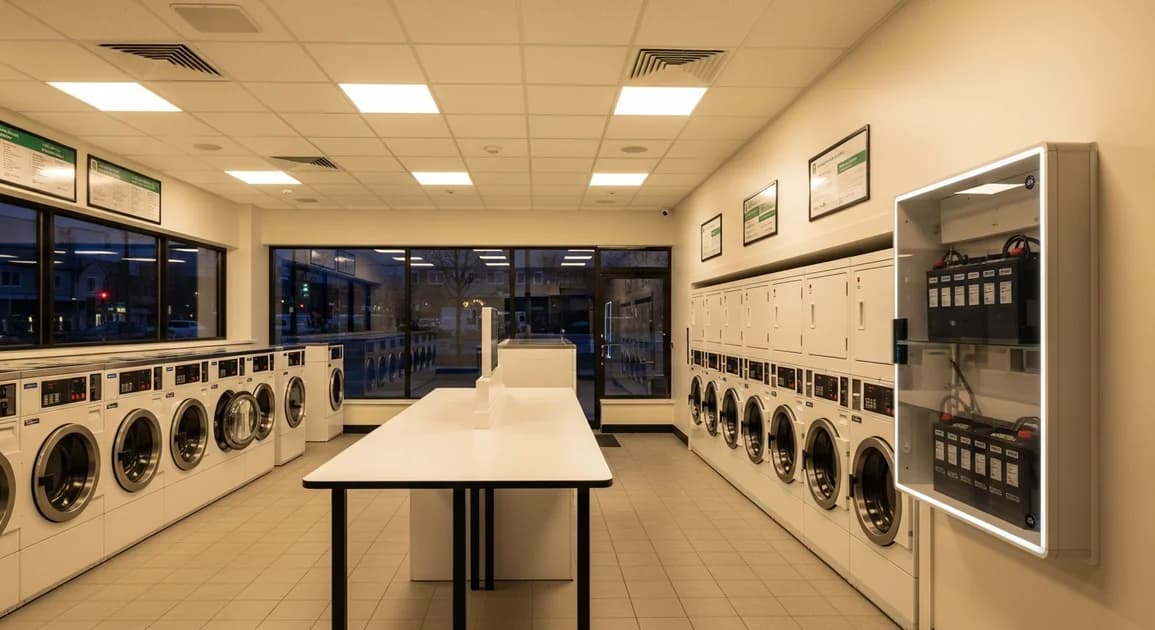
The following is a composite illustration, not a specific client, drawn from the laundromats we see across Houston. Picture a self-service store: rows of washers and dryers, two card-and-coin payment kiosks, a change machine, overhead lighting, and security cameras watching an unattended floor. When the grid drops, the machines stop mid-cycle, the kiosks go dark, and customers are stranded with wet clothes.
With a battery system on a critical plan, the payment kiosks and machine controls stay live, the lights and cameras keep working, and a subset of washers and dryers keep running so people can still do laundry. The store stays open and safe instead of turning a line of neighbors away. To compare with another unattended small business, read our guide on [INTERNAL-LINK: battery backup for Houston self-storage facilities → /blog/battery-backup-houston-self-storage-facilities].
How much battery does a laundromat need?
It depends on how many machines you keep running. Protecting the payment kiosks, controls, lighting, security, and a subset of machines is a contained, achievable plan. Running every dryer and the water heaters at once is the heavy load that scales the system up, often with a generator for a multi-day event.
Here is the honest hardware picture. Our modular system uses 9 kWh nominal battery modules (8.76 kWh usable each), stacking to 45 kWh on one controller rated 11.5 kW continuous and 17.1 kW surge, with a 10-year warranty. The 17.1 kW surge handles motor startup. One controller covers payments, controls, lighting, security, and a few machines; a full laundromat backing all machines and water heating typically needs a commercial design in the 50 to 150 kWh range across multiple controllers.
[INTERNAL-LINK: see commercial battery options and sizing → /plans/commercial]
The right first question is which machines and systems must stay live, not how many kilowatt-hours. Our guide on [INTERNAL-LINK: commercial battery backup for Texas businesses → /blog/commercial-battery-backup-texas-businesses] walks through that load-priority process.
[INTERNAL-LINK: talk through a laundromat backup plan → /home-backup-planner?source=blog&slug=battery-backup-houston-laundromats]
Prefer to talk it through? Call Eos at 713-207-2222 for a same-week Houston commercial site survey.
Frequently asked questions
Can a battery keep the payment system and machines running?
Yes, that is the core of a laundromat plan. A battery keeps the card and coin payment kiosks, the machine controls, lighting, and security running, plus a subset of washers and dryers, so customers can still pay and do laundry. Running every machine and the water heating at once is a larger job we design separately.
Why do the machines stop even if my dryers are gas?
Because they still need electricity. A gas dryer uses gas for heat, but its motor, drum, controls, and blower all run on power, so it stops the moment the grid does. A battery keeping those circuits live lets a gas dryer keep working during an outage.
How big a battery does a laundromat need?
It depends on how much you protect. Payments, controls, lighting, security, and a few machines fit one 45 kWh controller. Backing every dryer and the water heaters typically needs a 50 to 150 kWh commercial design across multiple controllers, often with a generator. We size it to your store.
Why is a laundromat worth backing up?
Because it is an essential service. About 19.6 million US households lacked their own washer and dryer in 2019 (U.S. Census Bureau, 2021), and during an outage those families still need clean clothes. Staying open protects your revenue and serves the neighborhood.
Is a battery better than a generator for a laundromat?
Each has a role. A battery is silent, fuel-free, and switches over instantly, keeping payments and a subset of machines running with no gap, and it handles motor startup surge. A generator adds longer runtime for heavy loads like dryers and water heating. Many stores use both.
This article is general information for Houston laundromat operators and reflects Eos specifications as of July 2026. The case is a composite illustration, not a specific client, and does not promise a specific runtime or revenue outcome. Confirm equipment loads, electrical code, and permitting for your store with the appropriate professionals.