Home Battery Lightning Protection: How Houston Systems Stay Safe

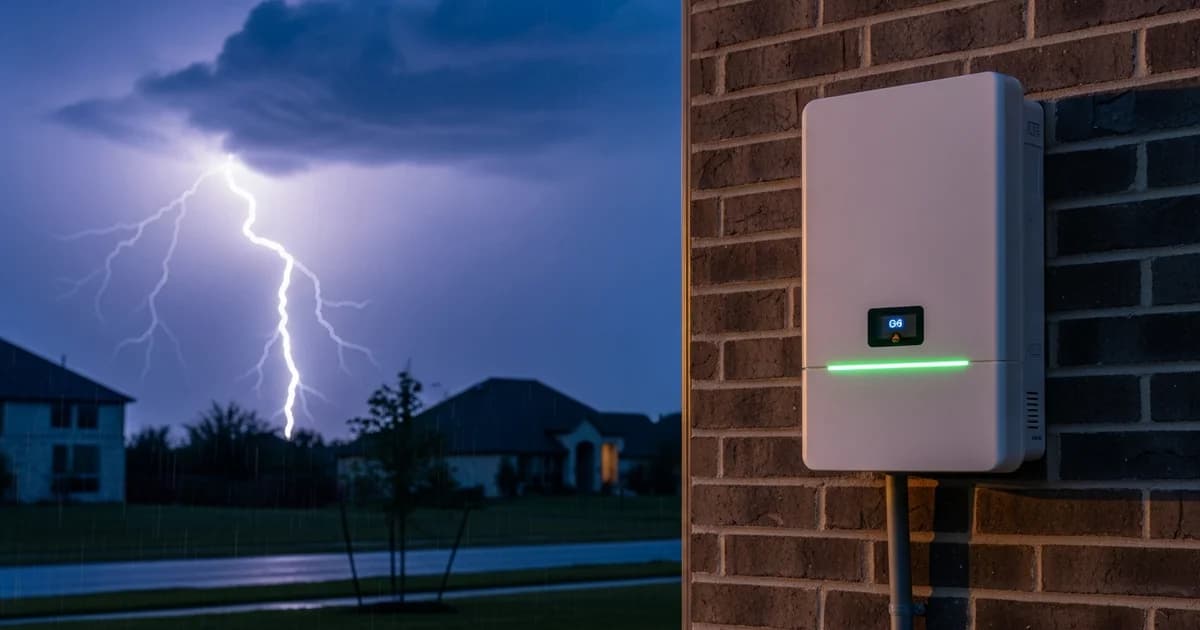
Texas recorded 40.4 million lightning events in 2024, more than the next three states combined (Vaisala Xweather Annual Lightning Report, 2025). The upper Gulf Coast around Houston gets hit hard. San Jacinto County, just northeast of the city, logged the most cloud-to-ground flashes of any U.S. county.
So if you are about to spend real money on a home battery, the worry is fair. Will a strike fry it during a July storm?
Here is the short version. A properly installed system is built to survive Houston storm season. This guide walks through what actually threatens the battery, the three layers that protect it, what happens in the milliseconds of a strike, and what your warranty covers.
Key Takeaways
- A direct strike on a residential battery is rare; the real risk is an induced surge from a nearby strike (Vaisala, 2025).
- Three layers protect the battery: surge protective devices (SPDs), code-required grounding and bonding, and the battery's own internal protection.
- The 2020 and 2023 NEC (Section 230.67) require a Type 1 or Type 2 SPD on every dwelling service.
- A whole-home SPD is the recommended first line of defense and works alongside, not instead of, the battery's protection.
- Lightning caused $1.04 billion in U.S. homeowner claims in 2024, averaging $38,558 per claim in Texas (Triple-I, 2025).
[INTERNAL-LINK: get a free Houston home assessment for your battery install → /home-backup-planner?source=blog&slug=home-battery-lightning-strike-protection]
Can lightning actually damage a home battery?
A direct lightning strike on a residential battery is rare. The realistic threat is an induced surge: a nearby strike that couples energy into your wiring and rides in on power or data lines. With Texas seeing 40.4 million lightning events in 2024, those near misses are common around Houston (Vaisala, 2025).
Think about how lightning behaves. When a bolt hits a tree, a utility pole, or the ground a few houses away, it dumps a huge current into the earth and into nearby conductors. That fast-changing field induces a voltage spike on your home's wires. The battery never takes a direct hit, yet a transient still arrives at its terminals.
San Jacinto County, on Houston's northeast edge, recorded 11.2 cloud-to-ground strikes per square kilometer in 2024, the highest of any U.S. county (Vaisala, 2025). For a Houston homeowner, that density is exactly why installers treat surge protection as standard, not optional. The math is simple: more strikes nearby means more chances for an induced surge.
So no, your battery is not a lightning rod waiting to be vaporized. The question that matters is how the system handles a surge, and the answer is layered.

What are the three layers that protect your battery?
Protection is layered, not single-point. Three defenses stack together: surge protective devices at the panel, code-required grounding and bonding, and the battery's own internal protection. No single layer does the whole job, and that redundancy is the point. If one stage is overwhelmed, the next catches what gets through.
Layer one: surge protective devices (SPDs). A Type 1 or Type 2 SPD sits at or near your service equipment and clamps voltage spikes before they spread through the house. Since the 2020 NEC (Section 230.67), every dwelling service must have one, and the 2023 NEC kept that rule (Leviton, NEC Code Requirements for Surge, 2023). These devices are tested to UL 1449, the safety standard for surge protectors.
Layer two: grounding and bonding. Your grounding electrode system gives surge energy a low-resistance path to earth. Proper bonding ties metal parts to that system so a transient does not jump across components. This is the layer that diverts the bulk of the energy safely away.
Layer three: internal protection. The battery and inverter carry their own defenses, including a battery management system (BMS), fusing, and surge-rated inputs. If a transient slips past the first two layers, internal suppression and isolation absorb or block what remains.
A Type 1 or Type 2 SPD, required on every U.S. dwelling service since the 2020 NEC under Section 230.67, clamps voltage transients before they reach your battery, while grounding diverts surge energy to earth and the battery's internal BMS isolates anything that gets through (Leviton, 2023).
For the difference between a battery and a plug-in protector, see how surge protectors and battery backup differ.
What happens to the battery during a strike?
In a nearby strike, the SPD clamps the incoming transient and grounding diverts the energy to earth, all in millionths of a second, before it reaches the battery. In a rare direct strike, the grounding electrode system carries the bulk of the current away. The sequence is fast and automatic, with no homeowner action required.
Here is the chain of events. The surge arrives on the service conductors. The Type 1 or Type 2 SPD sees the voltage spike cross its clamping threshold and shunts the excess to ground in nanoseconds. Grounding and bonding give that energy somewhere to go. Whatever fraction slips past meets the inverter's surge-rated inputs and the battery's BMS, which can trip protectively and then self-recover once the transient passes.
Our finding: On every Houston install, we verify grounding electrode continuity and confirm a Type 2 SPD is in place at the gateway before energizing the system. That sequence, not luck, is what protects the battery on the first stormy night.
There is one more layer most competitors miss. A grid-tied battery islands during a power outage, meaning it electrically disconnects from the utility grid the instant the grid goes down. So if lightning knocks out power mid-storm, your battery is already isolated from the service line. That islanding shields it from grid-borne surges that travel in on the utility feed during the exact storm that caused the outage. On-premises transients still need the SPD, but the grid path is cut.
[INTERNAL-LINK: check if your home qualifies for a 9 to 45 kWh system → /home-backup-planner?source=blog&slug=home-battery-lightning-strike-protection]
Should you add a whole-home surge protector too?
Yes. A whole-home, service-entrance surge protector is the recommended first line of defense, and it works alongside the battery's protection rather than replacing it. Pairing the two creates a cascade: the service SPD takes the first hit, and the battery's internal protection mops up the rest.
This matters more than most people expect, because lightning is not even the main source of surges. The National Electrical Manufacturers Association estimates that 60 to 80 percent of surges originate inside the home, from large loads like HVAC compressors and pumps cycling on and off (ESFI, Surge Protective Devices, 2024). A whole-home SPD guards against both the daily internal spikes and the storm-season external ones.
Roughly 60 to 80 percent of household power surges come from internal sources such as HVAC and appliance cycling, not lightning, which is why a service-entrance SPD plus the battery's own protection covers far more events than a plug-in strip ever could (ESFI, 2024).
A point-of-use strip protects one outlet. A service-entrance Type 2 SPD protects the whole panel, and it ties directly into the same gateway your battery uses. If you want the wiring picture, here is how a home battery connects to your electrical panel.
Does the warranty cover surge and lightning damage?
Manufacturer warranties on home batteries and inverters cover defects, and when the unit is installed to code with proper grounding and an SPD, surge-related faults are typically addressed under those terms. A documented direct lightning event is usually a homeowner-insurance claim. In Texas, lightning claims averaged $38,558 in 2024, well above the national average of $18,641 (Triple-I, 2025).
The condition that keeps warranty coverage valid is a permitted, inspected, code-compliant install. Skip the grounding verification or the required SPD, and a manufacturer can argue the fault came from an improper installation. Do it by the book, and you stay covered.
Two practical tips. Keep your permit, inspection records, and install documentation in one folder. And confirm with your insurer that your policy covers lightning and surge events, since most homeowner policies do, and the documentation makes any future claim cleaner.
How are Houston installs protected from day one?
A code-compliant, permitted Houston install bakes in protection before the system ever turns on. That means grounding electrode continuity is verified, bonding is confirmed, and a Type 2 SPD is placed at the gateway, all checked at the site survey and again at inspection. Nothing about storm protection is left to chance after the fact.
On our Houston installs, the site survey covers the grounding electrode system, the bonding path, the right SPD location at the gateway, and the permit and inspection schedule. We do this on the front end because the upper Gulf Coast lightning density gives no margin for shortcuts. By the time the battery is energized, the three protection layers are already in place and verified.
If you want the full local picture, here is everything on home battery backup in Houston. And you can explore battery backup plans from 9 to 45 kWh to see which size fits your home.
Ready to move? Call our Houston team or start online to book a free, no-pressure home assessment.
[INTERNAL-LINK: book a free Houston home assessment → /home-backup-planner?source=blog&slug=home-battery-lightning-strike-protection]
Frequently Asked Questions
Can lightning destroy my home battery?
A direct strike is rare. The common threat is a nearby strike that induces a surge on your wiring, and SPDs are built to clamp it. With Texas logging 40.4 million lightning events in 2024, layered protection (SPD, grounding, internal BMS) makes catastrophic loss unlikely (Vaisala, 2025).
Do I still need a whole-home surge protector if I have a battery?
Yes. A service-entrance SPD is the recommended first line of defense and complements the battery's internal protection. Since 60 to 80 percent of surges start inside the home from appliance cycling, a whole-home SPD covers far more events than lightning alone (ESFI, 2024).
What happens to my battery if lightning hits during an outage?
A grid-tied battery islands, meaning it disconnects from the utility grid the moment the grid goes down. That isolation shields it from grid-borne surges traveling in on the service line mid-storm. On-premises transients are still handled by the SPD and the battery's internal protection.
Does my warranty cover a power surge?
When the system is installed to code with grounding and an SPD, surge faults are typically addressed under manufacturer warranty terms. A documented direct lightning event is usually a homeowner-insurance claim. Texas lightning claims averaged $38,558 in 2024 (Triple-I, 2025).
How do I know my install is properly grounded?
A permitted, inspected install verifies grounding electrode continuity and bonding, and the inspection records it. Ask your installer to confirm the grounding and the SPD location at the site survey. Since the 2020 NEC (230.67), a Type 1 or Type 2 SPD is required on every dwelling service.
The bottom line
Houston storm season is real, but a properly installed home battery is built to ride it out. The protection comes from three layers working together:
- Nearby strikes that induce surges, not direct hits, are the realistic risk.
- SPDs clamp transients, grounding diverts the energy, and the battery's internal BMS isolates the rest.
- A whole-home surge protector is the recommended first line of defense.
- A permitted, code-compliant install keeps your warranty valid and your system protected from day one.
Get the install right and lightning becomes a non-event. Book a free Houston home assessment and we will verify grounding, SPD placement, and sizing for your address before anything is energized.
Sources
- Vaisala Xweather, Top Airports and Towns in the U.S. Struck by Lightning in 2024, retrieved 2026-06-15, https://www.vaisala.com/en/press-releases/2025-01/top-airports-and-towns-us-struck-lightning-2024-vaisala-xweather-annual-lightning-report-here
- Leviton, NEC Code Requirements for Surge (230.67), retrieved 2026-06-15, https://leviton.com/products/commercial/surge-protection/nec-code-requirements-for-surge
- Electrical Safety Foundation International (ESFI), Surge Protective Devices, retrieved 2026-06-15, https://www.esfi.org/program/surge-protective-devices-626
- Insurance Information Institute (Triple-I), Lightning Caused $1.04B in US Homeowners Claim Payouts in 2024, retrieved 2026-06-15, https://www.iii.org/press-release/triple-i-lightning-caused-104b-in-us-homeowners-claim-payouts-in-2024-frequency-drops-215-year-over-year-061925