Holiday Season Power Outage in Houston: Lights, Cooking and Guests

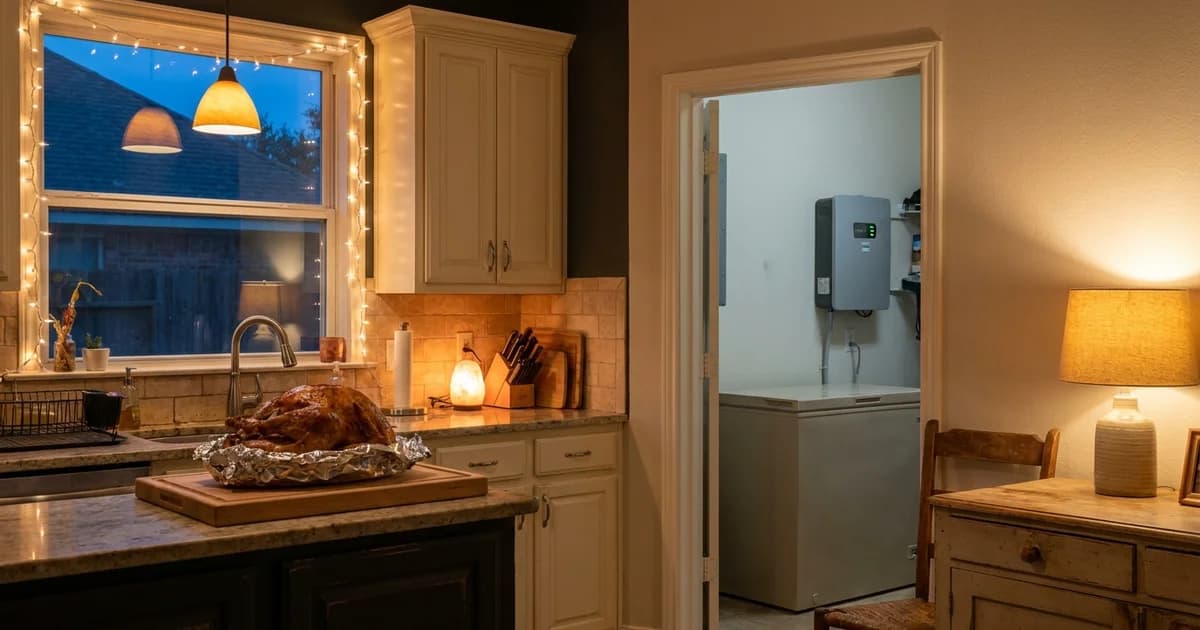
Your house runs differently from late November through New Year's. The oven works for hours, a second freezer fills up, the roofline is lit, and relatives are plugged into every outlet. A holiday power outage in Houston hits all of that at once, and a battery sized for an ordinary Tuesday may not cover it.
I'm not going to claim outages are more likely in these weeks. I could not find a dated public source that says so, so I'm leaving that number out. This post is about load, not odds: what the season adds to your house, and what a battery has to do about it.
Key Takeaways
- The season adds loads, not a different kind of outage: more oven time, more freezer food, more guests, more lights.
- LED light strands use 70 percent less energy than incandescent ones (U.S. Department of Energy), so lights are the smallest item on the list.
- A refrigerator is safe for about 4 hours without power, a full freezer for about 48 (USDA FSIS).
- Cook the bird outdoors, away from the house, never on a battery circuit.
What does the season add to your electric load?
Think in watts first. The Virginia Tech Cooperative Extension wattage list gives a frost-free 16 cubic foot refrigerator about 725 W, a microwave 750 to 1,100 W and a portable heater 750 to 1,500 W (Virginia Cooperative Extension, Estimating Appliance and Home Electronic Energy Use). Those are ranges, and your nameplate overrides them.
Every Eos plan uses one controller rated for 11.5 kW continuous and 17.1 kW surge. Capacity in kWh sets how long you run. The kW limit sets what can run at the same time. In a normal week you stay far under the limit. At 3 p.m. on Thanksgiving, you might not.
Our wattage chart for common Houston loads has the full table. Below is the seasonal short list.
Can a battery run the oven on Thanksgiving?
An electric oven is the biggest single decision. A whole electric range, oven plus burners, can present about a 12.5 kW connected load, which meets or beats an 11.5 kW controller (GE Appliances, via our range guide). You rarely draw all of it at once, but the oven element cycles hard when it's cold and full.
The practical answer is to stagger. Use the oven for the main dish and keep the other burners idle, or move sides to a microwave (750 to 1,100 W) and a toaster oven (about 1,225 W), both from the Virginia Tech list above. Gas ranges mostly just need a spark, so they ask very little of a battery.
This is a bundle post, so I'll stay brief. Our electric range guide walks through burners, induction and gas in detail.
Are Christmas lights a real load on a battery?
Not really, if they're LED. The Department of Energy says LED strands consume 70 percent less energy than conventional incandescent strands, and puts the cost of lighting a 6-foot tree for 12 hours a day over 40 days at $0.27 with LEDs versus $10 with incandescent (U.S. Department of Energy, How Do Holiday Lights Work?).
Those are electricity costs, not battery math, but the ratio carries over. A few LED strands on a tree and a roofline add up to a few dozen watts, a rounding error next to the oven.
Old incandescent strands are a different story. Plug in a dozen of them and you've added a heater to the circuit. If you're keeping an older set, count the watts on the box.
A quick rule: read the wattage on each light box, add it up, and compare to the loads that matter. Ten LED strands rarely cost you an hour of runtime. Ten incandescent strands might.
What about the extra fridge and the chest freezer?
This is where the season hurts. You buy food days ahead, the garage freezer is full, and a second fridge holds drinks and side dishes. USDA says a refrigerator keeps food safe for about 4 hours without power if the door stays closed, and a full freezer holds for about 48 hours, a half-full one for about 24 (USDA FSIS, Keep Food Safe During an Emergency).
So the fridge is the urgent one. A battery that keeps it running removes the 4 hour clock entirely. The freezer matters on longer outages, and a bulk-loaded freezer is worth protecting. Our guide to how long food lasts in the fridge without power covers the spoilage side, and the deep freezer guide covers sizing for it.
I haven't published a typical running wattage for a chest freezer here, because no public source I could verify gives one. Read your nameplate.
What happens when guests raise the load?
Guests change three things. Doors open more often, so the fridge works harder. Phones, laptops and tablets pile onto the same few outlets. And the thermostat gets a vote from eight people instead of three.
Chargers are small: a laptop is about 50 W on the Virginia Tech list, a television 65 to 170 W. Those barely register.
The big swing is cooling or heat. Houston Novembers and Decembers can be mild or swing warm, so central air may or may not be running. If it is, it's the largest single load in the house. Our guide to keeping your house cool in a Houston outage covers the AC side. If a cold front brings a freeze, winter storm preparation matters more.
Then there's hot water. A 40 gallon electric water heater runs 4,500 to 5,500 W on the Virginia Tech list, by itself nearly half your controller's limit. More showers, more dishes, more laundry. That's the load most hosts forget.
Where should the turkey fryer go?
Outdoors, in the open, and not on any battery circuit. The Consumer Product Safety Commission advises placing the fryer in an open area away from walls, fences and other structures, and never using it in, on or under a garage, breezeway, carport or porch (CPSC, CPSC Issues Safety Tips for Turkey Fryers, 2003). The same notice reported 75 fire, flame or burn incidents since 1998, 28 of them in 2002.
That release is more than two decades old, so I'm using it for the placement advice, not as a current count. NFPA goes further: it calls Thanksgiving by far the leading day for home cooking fires, and it discourages oil-based turkey fryers altogether (NFPA, Thanksgiving safety tips).
NFPA also names unattended cooking as the leading factor in cooking fires (NFPA, Safety with cooking equipment). A power outage makes people improvise, and improvising near a gas flame is how a bad night gets worse. If power drops mid-meal, turn off appliances you were using, finish what you can on the stove, and keep the fryer out of the plan.
A fryer burns propane, so it isn't a battery question at all. It belongs here because outages are when people bend the rules.
How big a system covers a full house?
Match the system to the day you're worried about. Use the capacity numbers from our plans: one battery module is 9 kWh nominal (8.76 kWh usable), and each added module adds that again. All plans share the 11.5 kW controller.
A few matching rules:
- Fridge, freezer, lights, Wi-Fi, chargers: a single module covers this for hours. These are the loads that must not drop.
- Add the microwave, toaster oven and a few comfort loads: still comfortable, as long as you don't stack them with the water heater.
- Add central air and a dishwasher cycle: you need the extra modules for runtime, and a plan for sequencing.
- Add the whole electric range and the water heater together: that's the stack that trips an 11.5 kW limit, regardless of battery count.
Capacity buys hours. Sequencing keeps you under the kW limit. Run the heavy things one at a time, and a plan that looks too small on paper often works fine in practice.
A short pre-season checklist
You have a few weeks. Here's a list I'd work through before the cooking starts:
- Check your fridge and freezer nameplates and write the watts down.
- Put an appliance thermometer in each. USDA says the fridge should be at 40°F or below and the freezer at 0°F or below.
- Swap incandescent light strands for LED, or at least count the watts.
- Decide which appliances share a circuit with the oven, and don't plan on using them at the same time.
- Move the turkey fryer plan outdoors, in the open, or skip it.
- Know which of your outlets are on backed-up circuits if you already have a battery.
If you already own a system, our monthly self-test checklist is a good place to start before guests arrive.
What to do next
Pick the day you're planning around and write down the three loads you can't lose. Start there. Everything else is a bonus you can sequence.
Or call Eos at 833-989-3737 to talk through your setup with an installer.
Frequently asked questions
Will a home battery run my Christmas lights?
Yes, easily if they're LED. The Department of Energy puts LED strands at 70 percent less energy than incandescent ones (U.S. Department of Energy). A few strands are a small fraction of a fridge's draw. Count watts on incandescent sets, since they can add up.
How long can food stay in the fridge if the power goes out?
About 4 hours with the door closed, per USDA. A full freezer holds about 48 hours, a half-full one about 24 (USDA FSIS). Past those marks, perishable food should go. A battery on the fridge circuit takes the clock out of play.
Can I run an electric oven on a battery?
One oven alone often fits, but a whole range can present about 12.5 kW, above an 11.5 kW controller. Stagger the burners, lean on a microwave or toaster oven, or cook on gas. Our range guide has the details.
Can I get a battery installed before Thanksgiving?
I can't promise a date, and it depends on scheduling and your utility. What's changed in Texas is the city side. Under SB 1252, in effect since September 1, 2025, cities may not regulate the installation or inspection of residential backup systems up to 50 kW or 100 kWh (TDLR, SB 1252 changes). Houston inspects only the service connection and gas piping, not the batteries (Houston Permitting Center). Licensed electrical contractors and utility interconnection still apply.