Enphase IQ Battery 5P vs Sigenergy: AC-Coupled or DC-Coupled in Texas?

The Enphase IQ Battery 5P and Sigenergy's SigenStor are both modular, both built on safe lithium iron phosphate chemistry, and both excellent choices for a Texas home. The defining difference is how they connect to your solar: Enphase is AC-coupled through its microinverter ecosystem, while Sigenergy is DC-coupled through a single hybrid inverter. That one architectural choice ripples through retrofit friendliness, efficiency, footprint, and cost. Disclosure up front: Eos installs Sigenergy, and we will be straight about where Enphase wins.
[INTERNAL-LINK: get a Houston battery quote in under 2 minutes -> /home-backup-planner?source=blog&slug=enphase-iq-battery-5p-vs-sigenergy-comparison]
Key Takeaways
- The Enphase IQ Battery 5P is 5.0 kWh usable with about 3.84 kW continuous per unit, AC-coupled, and stacks in 5 kWh increments to 40-plus kWh, per Enphase (2025).
- Sigenergy's SigenStor is DC-coupled through one hybrid inverter, scaling roughly 5 to 48 kWh in a single integrated stack, per Sigenergy (2025).
- AC-coupled (Enphase) is the easiest retrofit onto any existing solar; DC-coupled (Sigenergy) is more efficient on a new solar build.
- Enphase carries a notable 15-year warranty; Sigenergy leads on single-stack integration and built-in EV DC charging.
- The right choice hinges on whether you already have solar and how you value footprint versus warranty length.
Quick verdict: who is each one for?
Choose the Enphase IQ Battery 5P if you already own solar (especially Enphase microinverters), want the flexibility of stacking small 5 kWh blocks, and value a long 15-year warranty. Choose Sigenergy if you are building new solar-plus-storage together, want the efficiency of DC coupling and a single compact stack, or want a platform that also handles EV DC charging.
Both use the same safe LFP chemistry and both install cleanly in Houston. This is not a good-versus-bad comparison; it is a fit comparison driven mostly by your solar situation, which the rest of this guide unpacks.
AC-coupled vs DC-coupled: the core difference
The architecture is the whole story here. The Enphase 5P is AC-coupled: each battery has built-in microinverters and ties into your home on the AC side, so it works alongside any existing solar inverter, per Enphase. Sigenergy is DC-coupled: solar and battery share one hybrid inverter and energy stays in DC form from panel to cell, which avoids a conversion step and can edge out AC-coupled round-trip efficiency, per Sigenergy.
In plain terms: AC coupling is the universal adapter that bolts onto whatever you already have, while DC coupling is the integrated design that wrings a bit more out of a system built together. Neither is wrong; they optimize for different starting points.
Citation capsule. The Enphase IQ Battery 5P is AC-coupled with built-in microinverters and ties onto any existing solar, per Enphase, while Sigenergy's SigenStor is DC-coupled through a single hybrid inverter that keeps solar energy in DC form for higher round-trip efficiency on a new build, per Sigenergy, making coupling the central decision between the two.
Here is how the two line up at a glance:
| Spec | Enphase IQ Battery 5P | Sigenergy SigenStor |
|---|---|---|
| Usable capacity | 5.0 kWh per unit | ~5 to 48 kWh per stack |
| Continuous power | ~3.84 kW per unit | ~6 to 12 kW (residential) |
| Coupling | AC-coupled (microinverters) | DC-coupled (hybrid inverter) |
| Scaling | Add 5 kWh units side by side | Add modules to one stack |
| Warranty | 15 years | 10 years-plus |
| Chemistry | LFP | LFP |
Both sets of figures come from the manufacturers' published datasheets (Enphase, Sigenergy, 2025). The table makes the pattern clear: Enphase trades a bit of integration for a longer warranty and finer increments, while Sigenergy trades increment size for a single integrated, higher-power stack.
Expandability and footprint
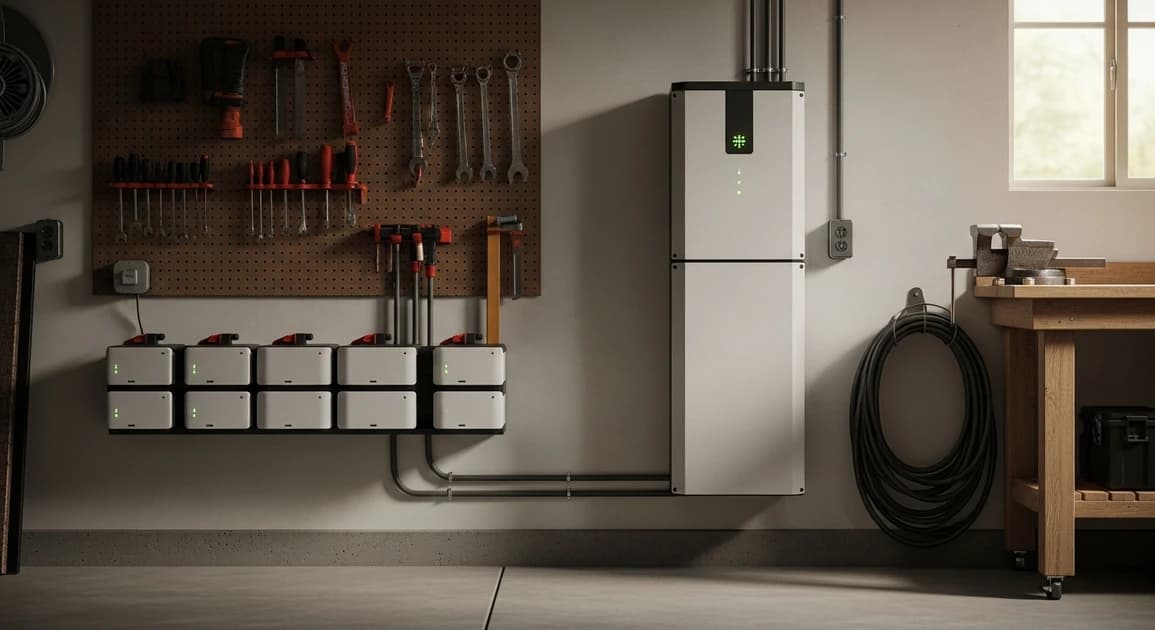
Both scale, but differently. The Enphase 5P grows by adding 5 kWh units side by side, which gives very fine capacity control but means more wall boxes as you scale up, each with its own microinverters. A large Enphase system is a row of units. Sigenergy grows by adding battery modules into one vertical stack under a single inverter, so a large system stays a single compact tower rather than a wall of boxes.
For a homeowner tight on wall space, the single-stack Sigenergy footprint is an advantage at higher capacities. For a homeowner who wants to start very small and add a block at a time, the Enphase granularity is appealing. Both are wall- or floor-mountable in a Houston garage.
Retrofit vs new solar build
This is where the coupling choice gets practical. If you already have solar, particularly an Enphase microinverter array, the IQ Battery 5P is the natural, low-friction addition because it speaks the same AC-coupled language and integrates with the Enphase app and system. Retrofitting onto an existing third-party inverter is also straightforward because AC coupling does not care what made the AC.
If you are designing solar and storage together from scratch, Sigenergy's DC-coupled hybrid inverter is the efficiency play, capturing solar in DC and reducing conversion losses. So the rule of thumb is: existing solar leans Enphase, brand-new solar-plus-storage leans Sigenergy. For more on this retrofit logic, see our guide on adding a battery to existing solar.
[INTERNAL-LINK: see how Eos designs solar-plus-battery in Houston -> /home-backup-planner?source=blog&slug=enphase-iq-battery-5p-vs-sigenergy-comparison]
Warranty and Texas heat
Both use LFP chemistry, which tolerates Houston heat better than older formulations and resists thermal runaway. The standout warranty number is Enphase's: the IQ Battery 5P carries a 15-year warranty, longer than the 10-year coverage common across the category, per Enphase. Sigenergy warrants its system on a 10-year-plus or throughput basis, per Sigenergy.
In the Houston climate, placement matters for both, as we cover in our indoor vs outdoor installation guide: a shaded mount extends real-world life on either platform. The longer Enphase warranty is a genuine point in its favor for buyers who weight that heavily, while Sigenergy counters with tighter integration and EV DC charging built in.
What do they cost in Texas?
Enphase systems price by the 5 kWh unit, and the per-kWh installed cost tends to sit at the premium end of the residential market, with each added unit bringing its own microinverters. Sigenergy prices by the stack and module count, and its range is wide because it scales from a small single stack to a large 40-plus kWh tower. At similar capacities the two land in comparable territory, so cost rarely decides this matchup on its own.
We do not post flat prices, because the real number depends on your solar, your panel, and the capacity you need. The deciding factors here are coupling fit, footprint, and warranty, not a sticker. For the broader field, see our best home battery brands in Texas roundup.
[INTERNAL-LINK: compare more whole-home batteries for Texas -> /blog/tesla-powerwall-3-vs-sigenergy-texas-comparison]
Which one fits your Houston home?
Map it to your solar. If you have existing solar (especially Enphase), want to grow capacity 5 kWh at a time, and prize the 15-year warranty, the IQ Battery 5P is the clean pick. If you are building new solar-plus-storage, want DC-coupled efficiency and a single compact stack, or want EV DC charging in the same platform, Sigenergy fits better. For a third option in the modular space, our FranklinWH vs Sigenergy comparison covers another popular system.
[INTERNAL-LINK: book a free Houston home assessment -> /home-backup-planner?source=blog&slug=enphase-iq-battery-5p-vs-sigenergy-comparison]
Or call our Houston office at (713) 462-2202 to talk through which platform fits your solar and panel.
FAQ
Is Enphase or Sigenergy better in Texas?
Both are strong; it depends on your solar. The Enphase IQ Battery 5P is better for homes with existing solar (especially Enphase microinverters), buyers who want to stack capacity 5 kWh at a time, and those who value its 15-year warranty, per Enphase. Sigenergy is better for new solar-plus-storage builds, DC-coupled efficiency, a single compact stack, and integrated EV DC charging, per Sigenergy.
AC-coupled vs DC-coupled, which is better?
Neither is universally better; they fit different situations. AC coupling (Enphase) is the easiest retrofit onto any existing solar because the battery ties in on the AC side regardless of your inverter. DC coupling (Sigenergy) keeps solar energy in DC form through one hybrid inverter, which can improve efficiency on a new build. Existing solar leans AC-coupled; a fresh solar-plus-storage design leans DC-coupled.
How much does an Enphase IQ Battery 5P cost?
Enphase systems price per 5 kWh unit and tend to sit at the premium end of the residential market, since each unit includes its own microinverters. The installed total depends on how many units you stack and any electrical work your home needs. Because pricing varies by home, we provide a fixed-scope quote after a site survey rather than a flat figure; capacity, solar, and panel condition all factor in.
Can both batteries back up my whole house?
Yes, with enough capacity. The Enphase 5P delivers about 3.84 kW continuous per unit, so whole-home backup means stacking several units to reach the power and energy your loads need, per Enphase. A Sigenergy stack with a 12 kW hybrid inverter reaches whole-home power in one unit. Sizing for both is driven by your peak loads (especially AC startup) and how long you want to run during an outage.
The bottom line
The Enphase IQ Battery 5P and Sigenergy SigenStor are both excellent modular LFP batteries for Texas, and the choice comes down to coupling and context. Enphase wins on retrofit simplicity onto existing solar and a class-leading 15-year warranty; Sigenergy wins on DC-coupled efficiency for new builds, a single compact stack, and built-in EV DC charging. We install Sigenergy because that integration fits most Houston solar-plus-storage projects we design, but if you already have Enphase solar or want the longest warranty, the IQ Battery 5P is a genuinely strong call.
[INTERNAL-LINK: get a Houston home battery quote -> /home-backup-planner?source=blog&slug=enphase-iq-battery-5p-vs-sigenergy-comparison]