Battery Backup for Oxygen Concentrators in Houston Homes

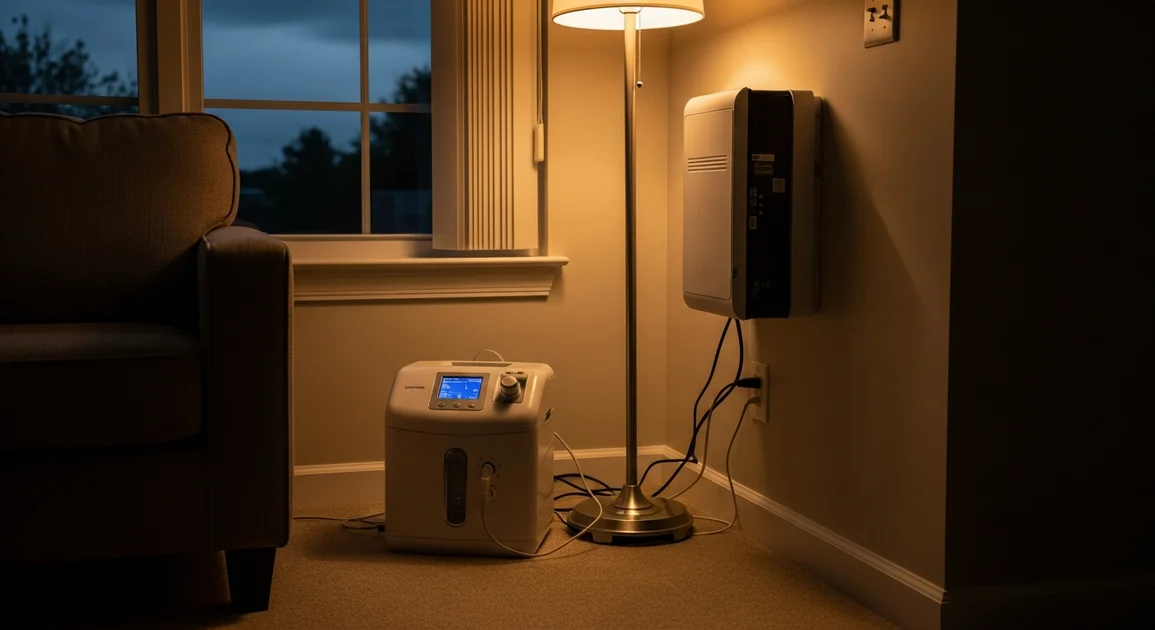
Battery Backup for Oxygen Concentrators in Houston Homes
A home oxygen concentrator does not get a break. It runs around the clock, which means a power outage is not an inconvenience, it is a threat. A home battery can keep a stationary concentrator powered through a Houston outage, and because the draw is steady rather than spiky, the runtime math is straightforward. This is not medical advice. Keep a backup supply of oxygen and coordinate an outage plan with your oxygen supplier.
Key Takeaways
- About 16 million U.S. adults are diagnosed with COPD, and more than 1.5 million adults use supplemental oxygen (CDC, 2024; ATS, 2018).
- A stationary concentrator draws roughly 300 to 350 watts continuously, about 8 kWh of demand per day (Oxygen Concentrator Store, 2026).
- An Essential (9 kWh) system runs a concentrator by itself for roughly 18 to 24 hours; Plus and Pro extend that and add your other essentials.
- This is not medical advice. The American Lung Association advises keeping a non-electric backup supply of oxygen and coordinating your outage plan with your supplier (ALA, 2025).
- Hurricane Beryl left about 2.2 million Houston-area customers without power in 2024, some for over a week (Houston Public Media).
[INTERNAL-LINK: keep your oxygen concentrator powered through an outage → /home-backup-planner?source=blog&slug=battery-backup-oxygen-concentrator-houston]
Can a home battery keep an oxygen concentrator running during a Houston outage?
Yes, a home battery can power a stationary oxygen concentrator for the length of an outage. The system switches to battery power automatically when the grid fails, keeping the concentrator's outlet live. A concentrator may briefly alarm on the transfer and need a moment to resume, so follow your supplier's and manufacturer's instructions.
The battery handles electricity, not the medicine. The American Lung Association advises every home-oxygen user to keep a non-electric backup supply, such as oxygen cylinders, and to plan for outages with their supplier and provider (ALA). The battery makes the concentrator far more dependable, and cylinders remain your backstop.
How much power does a home oxygen concentrator use?
A stationary home oxygen concentrator draws roughly 300 to 350 watts continuously, based on common models like the Philips Respironics EverFlo (about 350 watts) and the Invacare Perfecto2 (about 300 watts) (Oxygen Concentrator Store, 2026). Higher-flow units draw more. Unlike a CPAP that runs only at night, a concentrator runs 24 hours a day, so it demands about 8 kWh over a full day.
Portable oxygen concentrators are a separate category that already run on their own swappable batteries. This article is about the stationary unit that plugs into the wall and stops when the wall does.
What size battery do you need for an oxygen concentrator?
For a concentrator on its own, the Essential 9 kWh system carries it roughly 18 to 24 hours, depending on the model and flow setting. These runtimes use a conservative 450-watt allowance to cover higher-flow settings and conversion losses, so a lower-draw unit lasts longer. That covers many outages, but it is only the concentrator.
Most oxygen users want the fridge, lights, and other essentials covered too, and a longer runway for a multi-day storm. In the oxygen-dependent Houston homes we equip, Plus 18 kWh or Pro 27 kWh is the usual choice for that reason, since it does both. Confirm the right size against your specific concentrator and your supplier's guidance at the free site survey.
[INTERNAL-LINK: size a system for home oxygen → /plans/essential]
Register for CenterPoint critical-care status, and keep backup oxygen
If you depend on electricity for medical equipment, register with CenterPoint for Critical Care or Chronic Condition Residential Customer status (CenterPoint Energy). Understand what it does and does not do. It provides advance notification and disconnection protections, but it does not guarantee uninterrupted power or faster restoration, and it does not exempt you from controlled outages.
That gap is exactly why an independent home battery matters, alongside the backup oxygen cylinders your supplier provides. Register for the protections, keep your cylinders, and let the battery keep the concentrator running. For a broader caregiver plan, see the guide below.
[INTERNAL-LINK: battery backup for aging parents and medical needs → /blog/battery-backup-aging-parents-medical-needs]
Why continuous power sets oxygen apart from CPAP
Oxygen therapy is a different backup problem than CPAP. A CPAP runs only while you sleep and draws a small load, so a battery covers it easily. A concentrator runs every hour of every day at ten times the wattage, so the question is not whether the battery can start it, but how many hours of continuous supply it holds.
That is why oxygen users tend toward Plus or Pro rather than the entry system, and why a multi-day Houston outage in summer heat is so serious for this group. If you also use a CPAP, the same system covers that lighter load too.
[INTERNAL-LINK: CPAP and medical device battery guide → /blog/battery-backup-cpap-medical-device-houston]
[INTERNAL-LINK: get a medical-continuity battery quote in under 2 minutes → /home-backup-planner?source=blog&slug=battery-backup-oxygen-concentrator-houston]
Prefer to talk it through? Call Eos at 713-207-2222 for a same-week Houston site survey.
Frequently asked questions
Can a home battery run my oxygen concentrator?
Yes. A stationary concentrator draws roughly 300 to 350 watts continuously, well within what the system supplies. It switches to battery power automatically when the grid fails, keeping the outlet live.
How long will the battery run my concentrator?
An Essential system runs a concentrator alone for about 18 to 24 hours, and Plus or Pro run longer. Actual runtime depends on your model, flow setting, and the other loads you back up, which the site survey confirms.
Does the battery switch on automatically?
Yes. It transfers to battery power the moment the grid fails, so the outlet stays live. The concentrator may briefly alarm on the transfer and need a moment to resume, so follow your supplier's instructions.
Do I still need backup oxygen cylinders?
Yes, always. The American Lung Association advises keeping a non-electric backup supply of oxygen. The battery makes the concentrator dependable, but cylinders are your medical backstop, and no device replaces them.
What about a portable oxygen concentrator?
Portable units already run on swappable batteries and are a separate category. This system is for the stationary home concentrator that plugs into the wall, which is the one that stops in an outage.
This article covers powering a home oxygen concentrator during outages in Houston and reflects Eos specifications as of July 2026. It is not medical advice. Keep a backup oxygen supply and coordinate your emergency plan with your oxygen supplier and provider.