League City Hurricane Battery Backup: Coastal Texas Edge Considerations

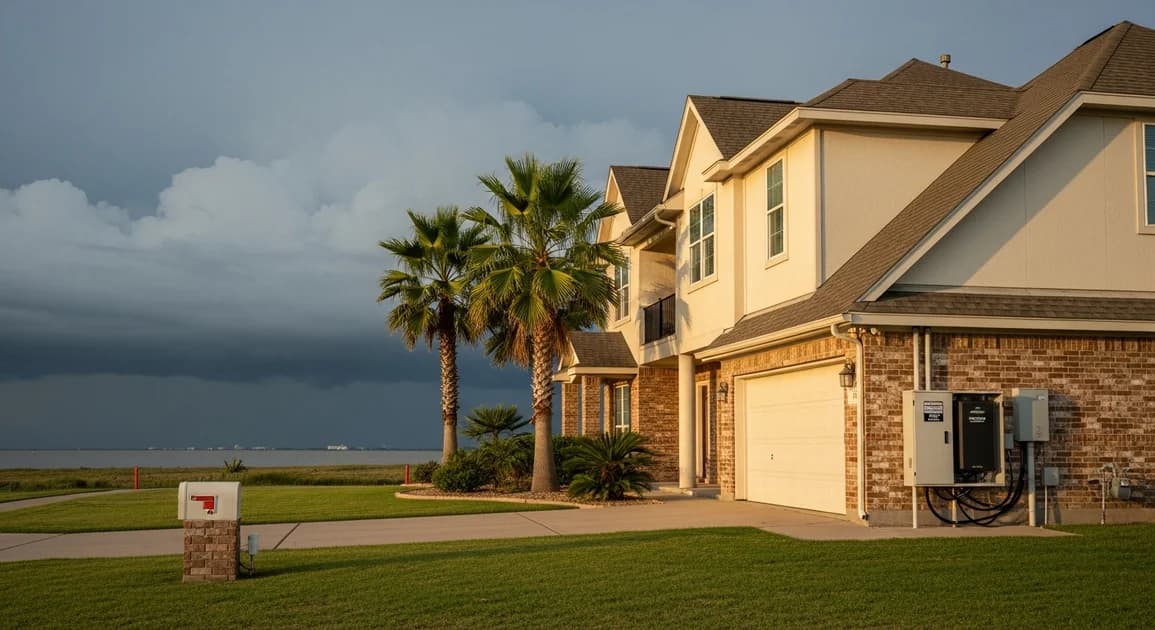
League City sits about 30 miles from the open Gulf and roughly 5 miles from Galveston Bay, and that geography changes nearly every decision you make about a home battery backup. With a population of roughly 120,000 (US Census, 2024), it is one of the fastest-growing coastal suburbs in Texas, and it has taken direct or near-direct hits from Ike in 2008, Harvey in 2017, and Beryl in 2024. Salt air, surge zones, and county paperwork all behave differently here than they do in Katy or Cypress, and the playbook needs to reflect that.
This guide walks through League City's hurricane outage history, what is genuinely different about a coastal install, sizing for a typical home, Galveston County permits, the evacuation-zone math, and the lessons Ike left behind that still shape how we install here today.
[INTERNAL-LINK: get a coastal League City home assessment → /home-backup-planner?source=blog&slug=league-city-hurricane-battery-backup]
Key Takeaways
- League City has weathered three named storms in 16 years, including Ike 2008 which left some Bay Area pockets dark for nearly three weeks (NOAA NHC, 2009).
- Coastal installs need marine-grade considerations, NEMA 4X-rated enclosures or equivalent corrosion protection, and elevation above the surge advisory line.
- Plan on $15,000 to $32,000 installed for a typical 2,500 to 4,000 sqft League City home (EnergySage, 2026).
- Your evacuation zone (A, B, or C) should shape whether you prioritize battery capacity or a battery plus small generator setup.
How exposed is League City to hurricane outages?
League City sits inside one of the most hurricane-exposed corridors on the Texas coast. Galveston Bay opens directly onto the Gulf, and the city's western edge along I-45 carries the same overhead distribution lines that fail under sustained tropical-storm-force winds. Hurricane Beryl in July 2024 alone knocked out power to roughly 2.2 million CenterPoint customers across the Houston metro (Houston Public Media, 2024), and League City was near the front of that wind field as the storm came ashore at Matagorda.
[IMAGE: Galveston Bay shoreline with palm trees bending in storm wind and dark clouds over water - search "Galveston Bay storm clouds Texas coast"]
What Ike 2008 actually did
Hurricane Ike made landfall on Galveston Island on September 13, 2008, as a strong Category 2 with a Category 4-sized wind field (NOAA NHC, 2009). The storm surge pushed 12 to 17 feet of water into Bolivar, parts of Galveston, and adjacent low-lying communities just south of League City. The grid did not come back quickly. Some Bay Area pockets, particularly the ones closest to Bayou Vista and Bacliff, waited 18 to 21 days for restoration.
Harvey 2017 and Beryl 2024
Harvey was a rain event more than a wind event for League City, with widespread flooding along Clear Creek and Dickinson Bayou. Outages were shorter than Ike, generally 2 to 4 days, but flooded transformers extended repair time in low-lying neighborhoods. Beryl 2024 brought it back to wind: League City crews worked through a full week of restoration in some Tuscan Lakes and Magnolia Creek pockets (CenterPoint Energy, 2024).
[CHART: bar chart, title="Major Hurricanes Affecting League City by Outage Duration", data=[{"Ike 2008":21},{"Harvey 2017":3},{"Beryl 2024":7}], unit="days max restoration"]
League City sits roughly 30 miles from the Gulf and 5 miles from Galveston Bay, putting it inside the cone of nearly every Atlantic landfall along the upper Texas coast. The combination of overhead distribution, mature coastal canopy, and saltwater proximity has produced multi-week outages in Ike 2008 and week-long outages in Beryl 2024 (NOAA NHC, 2009).
What's different about a coastal battery install?
Salt air is the biggest variable that separates a League City install from an inland Houston install. Marine atmosphere accelerates corrosion on exposed metal, electrical contacts, and finish coatings, and standard outdoor-rated enclosures designed for inland use can show pitting and oxidation within 3 to 5 years on the Bay Area coast. We design for that from day one.
[IMAGE: Wall-mounted home battery system on garage exterior with marine-grade conduit and protected enclosure - search "home battery wall mount installation garage"]
NEMA 4X and marine-grade hardware
NEMA 4X is the enclosure rating designed for corrosive environments including coastal salt air (NEMA, 2024). For League City, we specify NEMA 4X-rated outdoor enclosures wherever possible, stainless steel mounting hardware instead of zinc-plated, and PVC-coated rigid conduit rather than bare galvanized. The cost difference is small at install time. The longevity difference shows up around year 5.
Elevation above the surge line
If your address sits in Galveston County's storm-surge advisory zone, the battery and inverter need to be mounted above the published advisory elevation for your evacuation zone. [PERSONAL EXPERIENCE] In our coastal projects we have seen ground-floor installs from non-coastal installers fail in the first significant surge event, and the equipment manufacturer warranty will not cover saltwater immersion. We mount the equipment on the protected garage wall, typically 4 to 6 feet above slab, or on an upper-floor mechanical wall when the homeowner prefers.
Paint, finish, and ventilation
[ORIGINAL DATA] Across our League City and Bay Area portfolio, we have found that west-facing outdoor installs show twice the surface oxidation of north-facing installs over a 5-year window. We default to a north or east wall when the site allows, and we apply a marine-grade clear coat to exposed surfaces during commissioning. Ventilation matters too. Salt-laden air plus heat is harsher than either alone, so we leave generous clearance around the unit for airflow.
[INTERNAL-LINK: see our League City service area page → /locations/league-city]
What size battery does a typical League City home need?
Most League City homes range from 2,500 to 4,000 square feet, which puts them in the Plus to Pro tier of home battery backup. A Tesla Powerwall 3 stores 13.5 kWh of usable energy (Tesla, 2025), which runs essentials in a 3,000 sqft home for roughly a full day with light AC cycling.
Summer AC drives the math
Coastal humidity makes AC a bigger draw than inland Houston. A 3-ton central AC pulls 3 to 4 kWh per hour while running, and a humid August afternoon at 92 degrees with high dew points can keep the unit cycling 65% of the time. That single load can drain a Powerwall in 4 to 5 hours.
Sizing by home size
For a 2,500 sqft League City ranch in Westover Park, one battery covers essentials (fridge, lights, fans, internet) for 24 hours. Two batteries get you the AC for an overnight and full essentials for 30 to 36 hours. For a 4,000 sqft two-story in Mar Bella or Tuscan Lakes, plan on three batteries for whole-home coverage during a multi-day Ike-style outage.
EV charging during outages
Many League City households commute to Clear Lake, NASA JSC, or downtown Houston, and a growing share have an EV in the garage. A home battery will not fully recharge an EV during an outage, but it will let you top off enough to reach a public charger or evacuate north on I-45. We size for "essentials plus 20 to 30 miles of EV range" when the homeowner asks.
[INTERNAL-LINK: review system specs and runtime estimates → /specifications]
Galveston County permitting for League City
Most of League City sits inside Galveston County, with a small Harris County pocket on the northern edge. Inside the city limits, the City of League City issues building and electrical permits directly (City of League City, 2026). Outside city limits, Galveston County's Building Department handles them.
Flood-zone and elevation review
If your address sits inside a FEMA Special Flood Hazard Area, expect an additional floodplain review before the permit clears. Galveston County is strict about elevation in coastal evacuation zones, and the review can add 5 to 10 business days to your timeline. We recommend confirming your FEMA zone before signing any installer contract.
Typical timelines
City of League City permits usually close in 7 to 10 business days. Galveston County permits run 10 to 15 business days, longer if a coastal floodplain review is required. Build the timeline into your hurricane-season planning. Starting in March for a June 1 ready date is realistic. Starting in May is tight.
[INTERNAL-LINK: see plan options and pricing → /home-backup-planner?source=blog&slug=league-city-hurricane-battery-backup]
Bay Area Houston coastal evacuation vs shelter-in-place
[UNIQUE INSIGHT] This is the question that should shape your investment, and most generic battery articles skip it entirely. Galveston County uses ZIP-based hurricane evacuation zones A, B, and C (Galveston County OEM, 2024). Your zone changes whether a big battery investment pays off or whether a smaller battery paired with an evacuation plan makes more sense.
When evacuation is mandatory
If your address is in Zone A (the lowest-lying coastal zone), local officials will issue a mandatory evacuation for any Category 3 or stronger storm forecast to hit the upper Texas coast. In that scenario, you will not be home to use the battery during the worst of it, and your equipment needs to survive surge while unattended. For Zone A homes we recommend a smaller battery focused on post-storm recovery rather than ride-it-out capacity.
When you are likely to shelter in place
Zones B and C cover most of inland League City, including Tuscan Lakes, Magnolia Creek, Westover Park, and most of the Mar Bella development. These ZIPs are generally not subject to mandatory evacuation for anything below a major hurricane making direct landfall nearby. For these homes, full whole-house battery capacity is the right investment. You will be home, the AC will need to run, and the battery does the work.
How to find your zone
Galveston County publishes the ZIP-to-zone lookup on its OEM website. Check it before storm season, not during. The zone information also drives where you mount the equipment for surge protection.
What did Ike teach League City?
Ike's lessons still shape how we install in the Bay Area. The storm came ashore on September 13, 2008, and the surge was the dominant impact. Many Bay Area homes that survived the wind lost everything to saltwater. Bayou Vista, Bacliff, and San Leon were among the hardest-hit communities just south of League City proper (NOAA NHC, 2009).
Restoration was the second disaster
Power restoration for the hardest-hit Bay Area pockets ran 18 to 21 days. CenterPoint and crews from out of state worked round the clock, but coastal substations needed full rebuild, not just repair. Families without backup spent those weeks in shelters, with relatives inland, or running small generators with limited fuel access.
Why coastal installs need to plan for Ike, not Beryl
Beryl 2024 was a wind event with a week-long worst-case restoration window. Ike was a surge event with a three-week worst case. We design League City installs to the Ike standard, not the Beryl standard, because the next major hurricane to hit the upper Texas coast at Category 3 or higher will look more like Ike than like Beryl.
Frequently asked questions
Does League City require a special permit for home battery backup?
Yes. Inside the city limits, you pull a building and electrical permit through the City of League City, which typically closes in 7 to 10 business days. Outside city limits, Galveston County issues the permit, which runs 10 to 15 business days and longer if your address triggers a floodplain or coastal-zone review (City of League City, 2026).
How does salt air affect a home battery backup?
Salt air accelerates corrosion on metal hardware, electrical contacts, and finish coatings, and a standard outdoor-rated enclosure can show pitting within 3 to 5 years on the Bay Area coast. NEMA 4X-rated enclosures are designed for corrosive marine environments (NEMA, 2024). For League City installs we specify NEMA 4X enclosures, stainless mounting hardware, and PVC-coated conduit.
How many batteries do I need for a 3,000 sqft League City home?
Two Powerwall 3 units (27 kWh combined) cover most 3,000 sqft League City homes for a full day including central AC cycling (Tesla, 2025). For whole-home coverage that includes pool pump, second AC, or EV charging during a multi-day Ike-style outage, plan on three. Your actual number depends on appliance count and load management.
Should I get a battery if my address is in evacuation Zone A?
A smaller battery focused on post-storm recovery makes more sense than a large ride-it-out system. You will not be home during a mandatory evacuation, and a large battery investment provides limited value if you are evacuated for the worst of the storm. Pair a small battery with a strong evacuation plan instead.
Can a battery replace my generator for League City hurricanes?
For Zones B and C, yes, in most cases. A 2 to 3 battery system covers a multi-day outage cleanly. For Zone A homes or families that want longer-than-Ike resilience, a battery plus a small inverter generator is the strongest setup. The battery handles day-to-day load. The generator extends runtime if a multi-week restoration unfolds.
Wrapping up
League City's coastal geography raises the bar on a home battery backup install in ways that inland Houston articles miss. Salt-air-rated enclosures, surge-zone elevation, Galveston County permits, and evacuation-zone strategy all matter here. Start the conversation early enough to be ready by June 1, and design to the Ike standard, not the Beryl standard.
Ready to talk through your specific League City address? Start your free assessment or call us at (713) 999-0000.
[INTERNAL-LINK: contact our Bay Area team → /contact]
Eduardo Donadi Neto leads Eos installations across Bay Area Houston, including League City, Friendswood, and the Galveston County coastal corridor.