Battery Backup for Wine Cellars and Wine Fridges in Houston

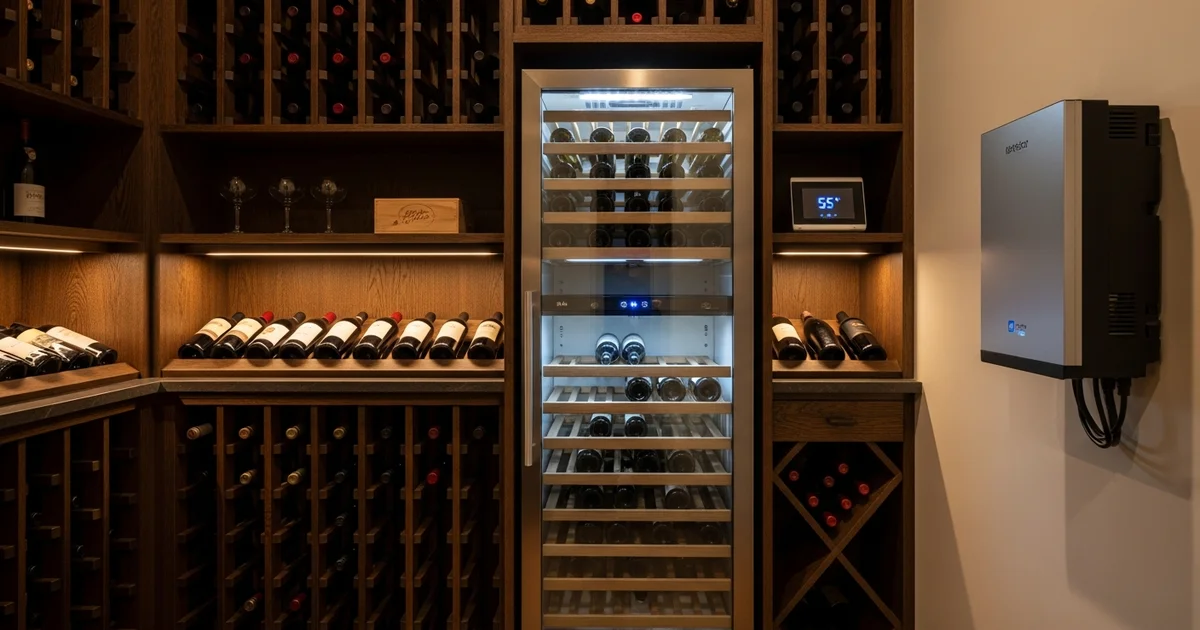
Wine ages best held steady near 55F, but a single 95F Houston August afternoon can push an un-cooled cellar past the safe band within hours (Climate of Houston, National Weather Service normals). When the grid fails for days, that is not a comfort problem. It is a financial one. A serious collection can be worth far more than the battery that would have protected it. The everyday threat in this metro is not a break-in or a flood. It is heat plus time, and a wine fridge or cellar cooler that has no power to fight it.
[INTERNAL-LINK: get a Houston battery backup quote in under 2 minutes → /home-backup-planner?source=blog&slug=battery-backup-wine-cellar-temperature-control]
Key Takeaways
- Wine stores best near 55F at 60 to 70% humidity; sustained heat above 70F ages it faster (Wine Spectator).
- A wine fridge draws roughly 75 to 150W; a dedicated cellar cooling unit draws 500 to 1,200W.
- The real risk is the multi-day summer outage, not the two-hour blip.
- A Plus 18 kWh system covers a wine fridge plus essentials; a Pro 27 kWh system covers a cooled cellar plus the rest of the home.
- The cooling unit must sit on a protected circuit, or the battery will not keep it running.
Will a power outage actually ruin your wine?
Brief outages rarely hurt a well-insulated cellar; the damage comes from sustained heat over days. Wine held above 70F ages faster than is desirable, and a month over 85F can do irreparable harm (Wine Spectator, 2024). In a Houston summer, an un-cooled cellar can cross 70F in well under a day.
A two-hour outage is a non-event. Your bottles barely notice. The problem starts when the cooling stops for 24, 48, or 72 hours during a hurricane or freeze event, which Houston sees regularly.
The slow cook does the damage
[UNIQUE INSIGHT] The threat is not freezing or instant spoilage. It is thermal cycling and humidity collapse. As the cellar warms, relative humidity falls, corks dry, and seals begin to fail. Wine then breathes through the cork. Wine Spectator notes that swings of 14F or more accelerate aging by forcing exactly this exchange. A slow 48-hour climb does more harm than a quick blip ever could.
Citation capsule. Wine stores best near 55F at 60 to 70% relative humidity, and sustained exposure above 70F ages it prematurely while a month over 85F causes irreparable damage (Wine Spectator, 2024). The Houston failure mode is the multi-day summer outage, when heat and dropping humidity dry corks and let wine cook slowly over days.
How much power does a wine fridge or cellar draw?
A wine fridge pulls roughly 75 to 150W; a dedicated cellar cooling unit pulls 500 to 1,200W depending on cellar size and the heat load it fights. That is close to a 10x difference, and it is the single fact that decides which battery tier you need. The fridge is trivial. The cellar cooler is a real, sustained load.
Nameplate watts mislead people here. A spec sheet lists rated draw, but a Houston cellar runs the compressor far harder than rated conditions assume.
Why a Houston cellar runs harder
[ORIGINAL DATA] Take a typical 1,000-bottle conditioned cellar with a 3/4-ton ducted cooling unit. On a 95F day, the unit fights a far larger heat gradient than the 75F lab conditions its spec sheet assumes, so the compressor duty cycle climbs. Modeling that against Houston August normals, daily consumption for the cooling unit alone lands in the 6 to 10 kWh range, not the 3 to 4 kWh a nameplate reading would suggest. Most competitor articles quote rated watts and ignore the ambient heat load entirely.
[INTERNAL-LINK: check if your home qualifies for a 9 to 45 kWh system → /home-backup-planner?source=blog&slug=battery-backup-wine-cellar-temperature-control]
How long can wine survive without cooling?
An insulated, full cellar holds temperature for several hours; in a Houston summer it can climb past the safe 70F band within a day, and a multi-day outage is where lasting damage happens. Thermal mass buys time, but not days. A full cellar coasts longer than a half-empty one because the bottles themselves store cold.
So "it's fine for a couple hours" is true and also a trap. It does not extend to 48 or 72 hours.
Bottle count and insulation set the clock
A packed cellar with good wall insulation might hold under 65F for six to eight hours. A sparsely filled cellar in a converted closet next to a hot garage can cross 70F in three. Either way, once you are past a day of summer heat with no cooling, the corks are drying and the wine is aging on fast-forward.
Citation capsule. A well-insulated, full cellar coasts for several hours after cooling stops, but Houston summer highs near 95F push an un-cooled cellar past the 70F safe band within roughly a day (Climate of Houston, National Weather Service normals). The failure window is the multi-day outage, where sustained heat and falling humidity do cumulative damage that a brief blip never could.
What size battery keeps a wine fridge or cellar running?
For a wine fridge plus household essentials, a Plus 18 kWh system carries the load through a full day and beyond; for a cooled cellar plus the rest of the home, a Pro 27 kWh system is the right tier. The split follows the draw. A 75 to 150W fridge is a rounding error against your daily energy budget. A 500 to 1,200W cellar unit is a genuine sustained load that wants more capacity behind it.
Match the load to the tier by kWh, not by guesswork:
- Essential 9 kWh: covers a wine fridge plus the bare minimum for a short outage.
- Plus 18 kWh: the right starting point for a wine fridge plus full household essentials for a day-plus.
- Pro 27 kWh: built for a cooled cellar plus the rest of the home through a long outage.
- Premium 36 kWh and Ultimate 45 kWh: for large homes running a cellar alongside heavy whole-home loads.
Read the runtime numbers honestly
Those hours are the ceiling at minimal household load, drawn straight from our published specs. A Plus system is rated up to 12 hours and a Pro up to 18 at light draw. Add a 1,200W cellar cooler running hard in summer and the real cellar-plus-home runtime is shorter, which is exactly why a cellar pushes you toward the Pro tier and its three battery modules.
Three more reasons a battery beats waiting on the grid for a cellar:
- Instant cutover. The system takes over in under 20 ms, so the compressor never sees a hard stop or a restart inrush.
- Silent operation. No generator running in or near a living space, no fuel, no fumes.
- Auto-recharge. Between waves of a multi-day outage, the grid tops the battery back up automatically.
[INTERNAL-LINK: see the Plus 18 kWh system for a wine fridge → /plans/plus?source=blog&slug=battery-backup-wine-cellar-temperature-control]
For a cooled cellar, the Pro 27 kWh system is the tier most collectors land on. For the wider picture of how a battery fits a Houston home, see our guide to home battery backup for Houston homes.
Put the cellar cooling unit on a protected circuit
A battery only protects what is wired to it, and the smart panel decides which circuits stay live, so the cellar cooling unit must sit on a prioritized circuit. This is the step collectors miss. The battery is sized correctly, the install is clean, and then the outage hits and the cellar cooler is on a circuit that got shed.
[PERSONAL EXPERIENCE] When we size backup for collectors at Eos, the cellar cooling unit is almost always the single largest sustained load after the air conditioning, and it is the one homeowners forget to flag for a protected circuit. We set it as a priority load during the install so the smart panel keeps it running while shedding non-critical circuits to stretch runtime.
Tell your installer about the cellar before the panel is configured, not after. For the broader load-priority picture, our rundown of the best power outage backup solutions in Houston walks through how the smart panel ranks circuits.
[INTERNAL-LINK: book a free Houston home assessment → /home-backup-planner?source=blog&slug=battery-backup-wine-cellar-temperature-control]
FAQ
Will a power outage ruin my wine collection?
Brief outages are low-risk for an insulated cellar. The danger is a multi-day Houston summer outage that pushes the cellar past 70F for days. Sustained heat above 70F ages wine prematurely, and dropping humidity dries corks and seals (Wine Spectator, 2024).
How much power does a wine cellar cooling unit use?
A dedicated cellar cooling unit draws 500 to 1,200W sustained, depending on cellar size and the Houston heat load it fights. A wine fridge draws only 75 to 150W. In summer, a ducted cellar unit can consume 6 to 10 kWh per day because the compressor cycles harder against a 95F gradient.
What size battery do I need for a wine fridge?
A wine fridge is a small sustained load at 75 to 150W, so a Plus 18 kWh system covers it alongside household essentials for a full day and beyond. The fridge barely dents your daily energy budget, which leaves plenty of the 17.52 kWh usable capacity for the fridge, Wi-Fi, lights, and the rest of the home.
Can a battery keep a whole cooled cellar running during a multi-day outage?
Yes, with adequate capacity and a protected circuit. A Pro 27 kWh system, or larger, plus smart-panel prioritization keeps the cooling unit live while shedding non-critical loads. Because a 500 to 1,200W cooler is a meaningful draw, the Pro tier and its three modules give the headroom a cellar needs.
[INTERNAL-LINK: get a fixed-price install quote for your address → /home-backup-planner?source=blog&slug=battery-backup-wine-cellar-temperature-control]
Bottom line
Wine collectors in Houston are a textbook battery backup case: a narrow temperature band, a sustained cooling load, and a collection that a multi-day summer outage can quietly cook. Hold the cellar near 55F, know your real draw (75 to 150W for a fridge, 500 to 1,200W for a cellar unit), size to the right tier, and put the cooling unit on a protected circuit. A Plus system covers a fridge; a Pro covers a cellar. Get the protected-circuit decision right and the slow Houston cook never gets started.
Talk through your cellar load and the right tier at eos-e.com/home-backup-planner, or call our Houston team directly.
Sources
- Wine Spectator, How to Store Wine: Temperature, Humidity, Coolers and More, retrieved 2026-06-15, https://www.winespectator.com/articles/how-to-store-wine-temperature-humidity-coolers-and-more
- National Weather Service, Climate of Houston (daily high normals), retrieved 2026-06-15, https://en.wikipedia.org/wiki/Climate_of_Houston