Battery Backup for Houston Florists and Flower Shops: The Cooler, the Counter, and the Holiday Rush

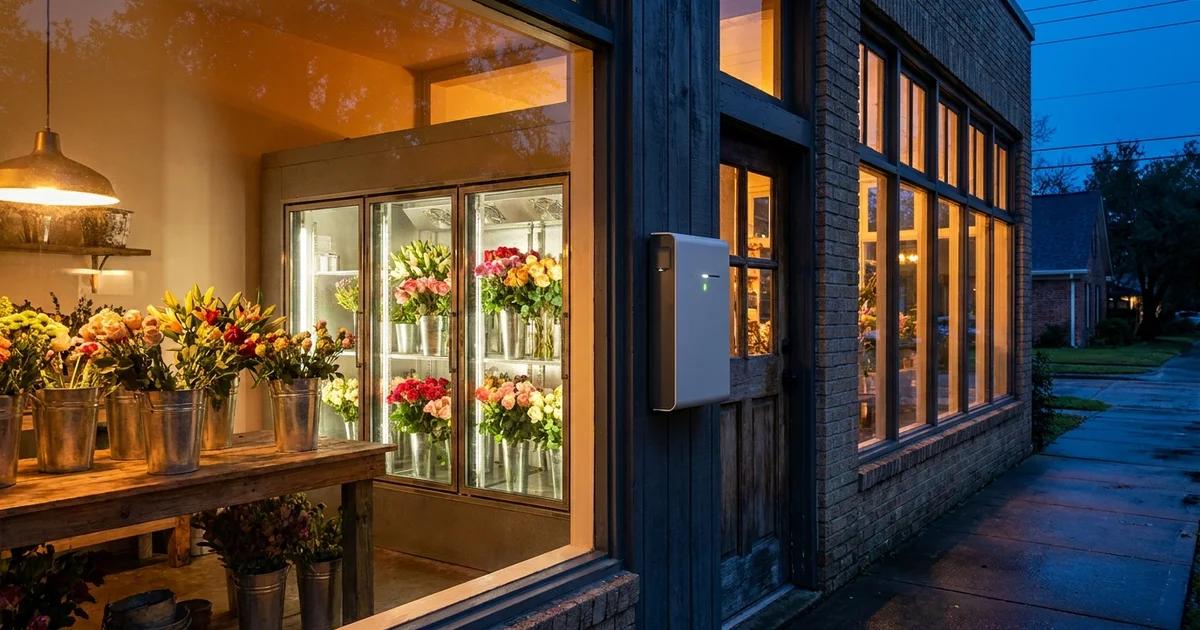
A florist sells a product that is already dying when it arrives. Everything about the business is a race against time, and the cooler is what slows the clock. When the grid drops, the cooler stops slowing it.
This guide is for owners of small Houston flower shops, studios and home-based floral businesses. It covers what an outage does to cut flowers, what I could verify about it, and what a residential-scale battery can and cannot carry. Where the public record runs out, I say so.
Key Takeaways
- For most cut flowers, storage between 0 and 2 degrees Celsius (32 to 35 degrees Fahrenheit) is recommended, and temperature swings drive condensation that favors Botrytis (Chrysal).
- Mother's Day 2026 spending was projected at a record $38 billion, with flowers at $3.2 billion and 75 percent of shoppers planning to buy them (NRF).
- U.S. customers averaged 11 hours of electricity interruptions in 2024, and Hurricane Beryl alone left 2.6 million Texas customers without power (EIA).
- One Eos controller delivers 11.5 kW continuous and 17.1 kW surge. That can cover a small cooler, the register and lights. A large walk-in with several compressors needs an electrician's numbers first.
What does an outage do to cut flowers in a florist's cooler?
It lets the temperature climb, and temperature is the one thing a cooler exists to control. Chrysal, a flower-care company that publishes cold-chain guidance, states that "for most cut flowers, storage temperatures between 0 to 2°C (32 to 35°F) are recommended" (Chrysal, Why Cold Chain Management Is One of the Most Important Factors in Flower Quality). The same article ties temperature changes to condensation, which it says creates "ideal conditions for fungal diseases such as Botrytis."
That detail matters for a shop. An outage is not just a warm cooler. It is a cooler that warms, then cools again when power returns, and the swing is where moisture condenses on petals.
I should be honest about a premise I checked. The commonly repeated cooler range for florists is wider than the research number. Some shops run closer to the high 30s, and some flowers do not want deep cold at all: the Chrysal article notes that chilling-sensitive and tropical species need slightly warmer conditions. So 32 to 35 degrees Fahrenheit is the recommended figure for most cut flowers, not a rule for every stem. Your own cooler setting and your own mix of flowers decide your real number.
What I could not find is a published time limit: how many hours a loaded floral cooler holds acceptable temperature with the power off. It depends on insulation, door openings, load and the outside heat, and I won't invent a figure. If you want yours, the practical test is a thermometer log during any short outage or planned shutoff.
Why do the holidays raise the stakes?
Because a large share of the year's revenue lands in a few days, with stock bought in advance. The National Retail Federation projected Mother's Day 2026 spending at a record $38 billion, flowers at $3.2 billion, and said flowers "remain the most popular gift category, with 75% of shoppers planning to purchase" (NRF). For Valentine's Day, NRF's page reports record total spending of $29.1 billion (NRF). The page I could load did not break out flower spending, so I am not quoting one.
Those are national numbers. I did not find Houston-specific florist revenue, and I won't guess your share. The reasoning is simple, though: the week before a holiday, your cooler holds the most product you will carry all year, bought at a fixed cost and committed to orders.
Now the honest part about timing. I could not find data showing outages cluster around Valentine's Day or Mother's Day in Houston. What I can say is that February is winter-storm season in Texas. During Winter Storm Uri in 2021, the University of Houston's Hobby School found that 69 percent of Texans lost power, for an average of 42 hours (University of Houston). Our winter storm preparation guide covers that scenario for homes.
How likely is an outage in Houston, really?
More likely than most owners assume, and it is lumpy. The U.S. Energy Information Administration reports that customers averaged 11 hours of interruptions in 2024, with major events accounting for nearly nine of those hours, and that Beryl "left 2.6 million customers without power in Texas" in July (EIA, Today in Energy).
Most outages are short. A few are long, and the long ones are what destroy a cooler's contents. Our hurricane season guide goes through how the long events unfold. If you run a shop, ask yourself which kind of outage you are buying protection for: the one-hour blip that resets the register, or the three-day event that spoils a holiday order.
What can a residential battery carry in a flower shop?
A defined set of small loads, not the whole building. Eos plans are residential-scale. Every plan uses one controller rated 11.5 kW continuous and 17.1 kW surge, and one battery module is 9 kWh nominal, 8.76 kWh usable. See the plans page and the Essential plan for the specifications.
Here is how I would think about a small shop, in order of priority:
- The cooler. This is the load that matters. A small reach-in or glass-door floral case is a fraction of what a large walk-in draws. I could not find a published running wattage for floral coolers as a category, because it varies by size, refrigeration type and ambient heat. Read the nameplate on your compressor unit for voltage and amps, and have an electrician confirm the startup draw. Compressors spike when they start, which is why the 17.1 kW surge rating matters more than the kWh number.
- The register and card reader. Tiny loads. Cheap to protect, and they keep you taking orders.
- Phones and Wi-Fi. Many florists take orders by phone and through online ordering platforms.
- Lights. LED lighting is a small load.
What it does not carry: a large walk-in with a multi-horsepower compressor, ventilation, rooftop air conditioning and a delivery van charger all at once. That is a commercial design. Our guide to commercial versus residential battery sizing in Texas explains where a home-scale system stops, and the Houston cold storage guide covers the big refrigerated end.
If you run the business from a home studio with a cooler in the garage, the residential math applies directly. A small cooler, a work light and a laptop are comfortably inside one controller. If you run a storefront with a walk-in, the right first step is a load walk with a meter, and I would rather tell you that now than sell you a system that does not fit.
What about the air conditioning and the heat?
Houston summers are hard on flowers outside the cooler too. The workroom, the design table and the delivery vehicle all matter when the grid is down. I did not find a verified temperature threshold for arranged bouquets on a worktable, so I am not putting a number on it. The general rule from the Chrysal article is the useful one: keep the cold chain unbroken and avoid swings.
Central air for a whole storefront is usually the load that decides whether you need a bigger system. If you only want to protect stock, the better design is a circuit-level plan: cooler first, register and lights second, and air conditioning only if capacity allows. Our smart panel guide explains how to rank circuits so a big load does not starve the important one.
How does this compare with other Houston small businesses?
The logic is the same one other perishable-inventory shops use, with different loads. A scoop shop worries about melt and a nursery worries about heat and water. Our ice cream shop guide, nursery and garden center guide and grocery and convenience store guide show how each handles the same question: what is the one load that decides the business, and does it fit one controller?
For a florist, that load is the cooler. For the wider picture of commercial options in Texas, see commercial battery backup for Texas businesses.
What did I leave out on purpose?
Some claims come up in every article about this trade. I left them out because I could not support them:
- How many hours a loaded floral cooler holds temperature unpowered. No published figure I could verify.
- The percentage of Houston florists with backup power. No data found.
- Valentine's Day flower spending as a separate number. The page I loaded gave only the total.
- Install timelines and your electrical service size. They depend on your building and utility.
What to do next
- Write down your cooler's nameplate voltage and amps, and your main breaker size.
- List the loads you cannot lose: cooler, register, phones, lights.
- Decide whether you are protecting stock for a short blip or a multi-day storm.
- Ask an installer or electrician to confirm the startup draw before you size anything.
Or call Eos at 833-989-3737 to talk through your setup with an installer.
Frequently Asked Questions
What temperature should a florist's cooler be?
For most cut flowers, 0 to 2 degrees Celsius (32 to 35 degrees Fahrenheit) is recommended, with chilling-sensitive and tropical species needing slightly warmer conditions (Chrysal). Your own mix of flowers decides the real setting.
Can a home battery keep a small flower cooler running?
Often yes for a small reach-in or glass-door case, as long as startup surge is checked. One Eos controller is rated 11.5 kW continuous and 17.1 kW surge. A large walk-in with a big compressor needs an electrician's numbers and may need a commercial design.
Why is temperature swing a problem for cut flowers?
Changes in temperature lead to condensation, which Chrysal says creates conditions for fungal diseases such as Botrytis (Chrysal). An outage followed by a restart is exactly that kind of swing.
Are outages more likely around Valentine's Day or Mother's Day in Houston?
I could not find data showing that. February is winter-storm season in Texas, and Winter Storm Uri in 2021 left 69 percent of Texans without power for an average of 42 hours (University of Houston), but that is one event, not a pattern.
Sources
- Chrysal, Why Cold Chain Management Is One of the Most Important Factors in Flower Quality, retrieved 2026-11-05, https://www.chrysal.com/node/5638
- National Retail Federation, Mother's Day Spending Expected to Hit Record $38 Billion, retrieved 2026-11-05, https://nrf.com/media-center/press-releases/mother-s-day-spending-expected-to-hit-record-38-billion
- National Retail Federation, Valentine's Day holiday data and trends, retrieved 2026-11-05, https://nrf.com/research-insights/holiday-data-and-trends/valentines-day
- U.S. Energy Information Administration, Hurricanes in 2024 led to the most hours without power in the United States in 10 years, retrieved 2026-11-05, https://www.eia.gov/todayinenergy/detail.php?id=66744
- University of Houston Hobby School of Public Affairs, New Report Details Impact of Winter Storm Uri on Texans, retrieved 2026-11-05, https://www.uh.edu/news-events/stories/2021/march-2021/03292021-hobby-winter-storm.php