Commercial vs Residential Battery Backup: Sizing and Cost Comparison for Texas

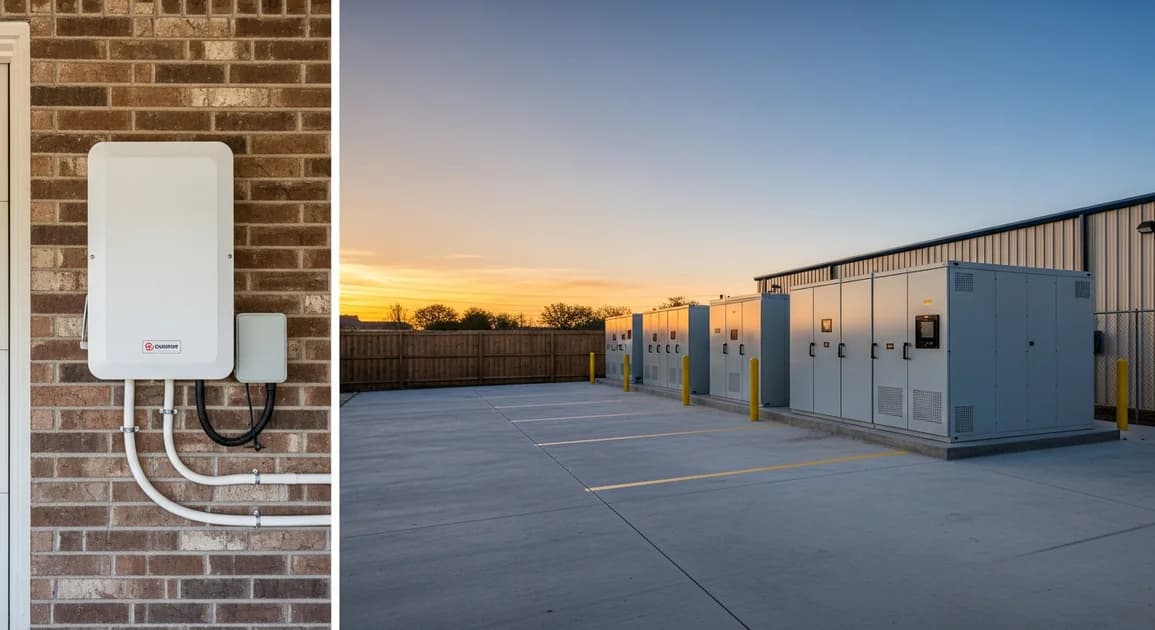
For Texas operators weighing both classes, the same question, "should we add battery backup," yields very different answers. A 13.5 kWh home system in Cypress runs $16,000 to $22,000 installed, per EnergySage 2026 quotes. A 500 kWh commercial cabinet in Stafford lands closer to $400,000 at $800 per kWh. The voltage is different, the code path is different, and the warranty math is different. This guide is the side-by-side I wish every property owner had before they called a contractor.
Key Takeaways
- Texas residential battery backup runs $1,000 to $1,800 per kWh installed; commercial drops to $600 to $1,200 per kWh at scale (EnergySage, 2026).
- Voltage is the first fork: 240V split-phase residential vs 208V or 480V three-phase commercial.
- Residential warranties cap near 6,000 cycles; commercial daily peak-shave duty can warrant 8,000 to 15,000 cycles.
- Residential sizing starts with critical loads. Commercial sizing starts with the demand-charge interval data.
- You generally cannot scale residential equipment up to commercial duty without voiding the UL 9540 listing.
[IMAGE: Split-frame photo, left side a wall-mounted home battery in a clean Houston garage, right side a fenced commercial battery cabinet on a concrete pad behind a strip-center retail building]
How does voltage and phase differ between residential and commercial?
Residential service in Texas is 240V split-phase, single-phase. Commercial service is typically 208V wye or 277/480V wye three-phase, per NEC 220 service-entrance tables. That single difference reshapes everything downstream: inverter selection, transformer needs, conductor sizing, and unit cost per installed kWh.
A residential hybrid inverter (Tesla Powerwall 3, Enphase IQ8, Generac PWRcell) is built around 240V split-phase. It bolts to a standard load center. A commercial inverter (Tesla Megapack, Sungrow PowerStack, Generac POWER ROCK) is engineered for 480V three-phase and ties into switchgear, not a panelboard.
[UNIQUE INSIGHT] The expensive surprise on a "house-looking" mixed-use property is three-phase service hidden behind a residential-style meter base. [PERSONAL EXPERIENCE] On a Bellaire mixed-use job last year, the owner assumed a Powerwall stack would cover the building. The utility had pulled 277/480V three-phase to the property a decade earlier for a previous tenant. We had to spec a commercial inverter and a transformer, which doubled the equipment line item.
Citation capsule: Texas commercial buildings typically take 277/480V three-phase service while homes take 240V split-phase, per NEC 220 and ERCOT interconnection norms. That voltage gap drives the equipment class selection and explains why a residential battery cannot simply be "scaled up" without re-engineering.
How do you size a residential battery vs a commercial one?
Residential sizing in Texas starts with a critical-load list, peak AC inrush, and a runtime target. The 2024 Lawrence Berkeley National Laboratory outage study found median U.S. home outages of 5.5 hours, and a typical Houston home draws 1.5 to 3 kW continuous when running essentials, so a 13.5 to 27 kWh system covers most weather events. Commercial sizing flips the order: start with the demand-charge interval data.
Residential sizing path
Walk the house, list what must stay on (refrigeration, well pump, HVAC, medical equipment, networking, a few outlets), sum the watts, account for AC compressor inrush at 3 to 5 times running current, then multiply by the target runtime in hours. Most Houston single-family homes land between 13.5 and 27 kWh of usable storage and 7.6 to 11.5 kW of continuous output.
Commercial sizing path
Commercial starts with 15-minute interval data from the utility (CenterPoint Energy supplies it on request). Identify the monthly demand peak in kW, the duration of that peak, and the demand-charge rate (often $15 to $30 per kW per month per CenterPoint Energy commercial tariffs). Size the battery to shave the top 10 to 30 percent of demand for the peak window, typically 2 to 4 hours. A restaurant on a 80 kW peak with a 3-hour evening shoulder usually wants a 100 to 200 kWh system delivering 30 to 50 kW.
If full backup is also a goal, the system must cover both the peak-shave kWh and the longest expected outage at the critical-load level. Demand-response opt-in (ERCOT ERS) adds a third sizing constraint: the dispatchable kW the operator commits to.
What does each cost in Texas in 2026?
Texas residential battery backup installs land at $1,000 to $1,800 per kWh in 2026, per EnergySage marketplace data. Commercial systems at 100 to 2,000 kWh price between $600 and $1,200 per kWh installed, per Wood Mackenzie Q1 2026 storage tracker. The gap is real, and it is mostly soft costs and economies of scale.
What drives the residential price band
[ORIGINAL DATA] Across Eos installs in the Houston metro from 2024 to 2026, the residential cost-per-kWh band has stayed remarkably stable at $1,050 to $1,750. Drivers: short conductor runs, single-day install, light permitting (Houston city permit typically clears in 5 to 10 business days), and standardized equipment (Powerwall 3, Enphase 5P, Generac PWRcell).
What drives the commercial price band
Commercial soft costs add line items residential never sees: engineered stamped drawings ($5,000 to $25,000), utility interconnection study ($2,000 to $15,000), NFPA 855 hazard-mitigation analysis, fire-marshal review, switchgear modifications, and concrete-pad civil work. Those costs are roughly fixed, so they amortize down sharply as kWh scales. A 200 kWh system carries the same engineering load as a 1,000 kWh system, which is why the per-kWh price keeps falling above 500 kWh.
Permit timelines also diverge. Residential interconnection in Houston typically takes 2 to 6 weeks. Commercial can take 8 to 20 weeks because of the utility study and AHJ review.
How do warranties and cycle counts compare?
Residential battery warranties in Texas typically run 10 years with a 70 percent capacity guarantee at end-of-term, per Tesla Powerwall and Generac PWRcell warranty documents. Enphase IQ Battery 5P carries 15 years. Commercial batteries warrant 10 to 20 years, with cycle counts that can reach 8,000 to 15,000 when duty cycle is daily peak-shave.
The class label is not the cycle limit
[UNIQUE INSIGHT] Cycle count in a battery warranty is set by the duty profile the customer commits to, not by the class label on the box. A residential Powerwall warranty assumes "unlimited cycles for self-consumption and backup," which in practice rarely exceeds 1.5 cycles per day, or roughly 5,500 cycles over 10 years. A commercial system contracted for daily peak-shave plus weekend grid arbitrage may be warranted to 8,000 cycles or to a throughput in MWh, whichever comes first.
Throughput vs calendar
Residential warranties tend to be calendar-based with a soft cycle floor. Commercial warranties are usually throughput-based: total MWh dispatched across the warranty term. That distinction matters when sizing for arbitrage, because aggressive daily cycling at residential class can chew through the throughput cap years before the calendar runs out.
Which use cases favor residential vs commercial?
Residential equipment fits single-family homes, garages, and small detached structures with one 200A panel. Commercial fits buildings with three-phase service and any meter pulling more than 100 kW peak. The 2024 U.S. Energy Information Administration commercial buildings survey put the median small-business demand peak at 47 kW, well past where residential gear stops being economic.
Residential fits
- Single-family homes (1,500 to 6,000 sq ft)
- Whole-home backup with EV charging
- Home medical equipment (CPAP, oxygen concentrator, dialysis)
- Detached home offices and ADUs
Commercial fits
- Restaurants (refrigeration is the load that bankrupts an outage budget)
- Medical and dental offices (compressors, sterilizers, imaging)
- Multi-family common loads (elevators, lighting, water pumps)
- Small manufacturing (CNC, ovens, paint booths)
- Data closets and small server rooms
[IMAGE: Wide photo of a Houston restaurant kitchen with stainless commercial refrigeration, a small inset showing the battery cabinet outside the back door]
Hybrid scenarios
Estate properties (10,000-plus sq ft, multiple outbuildings, agricultural pumps) sometimes warrant a commercial-class deployment even when zoned residential. Mixed-use buildings (ground-floor retail, upper-floor apartments) almost always need commercial because the retail tenant is on a separate three-phase meter. Ranches with shops, irrigation, and a primary residence often run a small commercial system in the shop and a residential system at the house.
Can you scale a residential system into commercial size?
Generally, no. Residential batteries carry a UL 9540 listing scoped to one-and-two-family dwellings. Putting a stack of Powerwalls on a commercial building can void the listing, the manufacturer warranty, and the homeowner-style installation manual the AHJ relied on for permit. The fire code path is different too: NFPA 855 governs commercial energy storage system installations with size, separation, and ventilation rules that residential equipment was never tested against. NEC 706 carries residential nuance that does not transfer up. Pick the class that matches the building.
What ERCOT participation differs by class?
Residential battery owners in Texas have very limited grid-monetization options in 2026. ERCOT has not yet stood up a robust residential virtual-power-plant program, and most retail electric provider VPP pilots cap participation at 1,000 to 5,000 homes. Commercial systems can stack three revenue paths: 4CP avoidance, ERS bids, and demand-response aggregation, per ERCOT 2026 ancillary services docs.
The 4CP coincident-peak avoidance program alone can return $50 to $200 per kW-year to a commercial battery owner who can reliably drop demand during the four annual ERCOT system peaks, per Texas Coalition for Affordable Power 2025 guidance.
FAQ
Can I use two Powerwalls for a small business?
If the business is in a 240V split-phase building (a converted house, a small office in a residential-zoned structure), two Powerwalls can work and stay within the UL 9540 listing. If the building has three-phase service or pulls more than 30 kW peak, you should specify a commercial-class system. Check the meter base before you call a contractor.
Is a commercial battery louder than a residential one?
Commercial cabinets have larger cooling fans and can run 55 to 70 dB at one meter, per manufacturer cut sheets from Tesla Megapack and Sungrow PowerStack. Residential units run 35 to 50 dB. Site placement matters: keep commercial cabinets 25-plus feet from any sleeping room or dining patio.
Do commercial batteries need a separate building?
Often, yes. NFPA 855 requires three-foot separation, fire-rated walls, or a dedicated outdoor cabinet for systems above 600 kWh aggregate. Smaller commercial systems (under 50 kWh) can sometimes go in an existing electrical room with sprinklers and ventilation upgrades. The fire marshal makes the call.
What is the lead time difference?
Residential lead time in Houston is 4 to 8 weeks from contract to commissioning, per Eos 2026 project records. Commercial lead time is 12 to 24 weeks because of utility interconnection studies, engineered drawings, switchgear procurement, and AHJ review. Megapack-class equipment can run 26 to 40 weeks for the cabinet alone.
Will a commercial system back up a connected apartment?
Only if the apartment is on the same metered service and the system is engineered to do so. Most mixed-use buildings have separate meters for the commercial and residential sides, which means the commercial battery cannot legally feed the apartment without crossing the meter boundary. A second residential-class system at the apartment meter is the clean answer.
Conclusion
Pick the class that matches the building. Residential gear is right for single-family homes and small 240V structures, at $1,000 to $1,800 per kWh installed. Commercial gear is right for three-phase service, demand peaks above 100 kW, and any property that can monetize ERCOT 4CP avoidance, at $600 to $1,200 per kWh. The voltage check at the meter base is the first 30 seconds of every honest assessment. After that, the rest is sizing math and code path.