Salon Battery Backup Houston: Every Dark Chair Loses Revenue

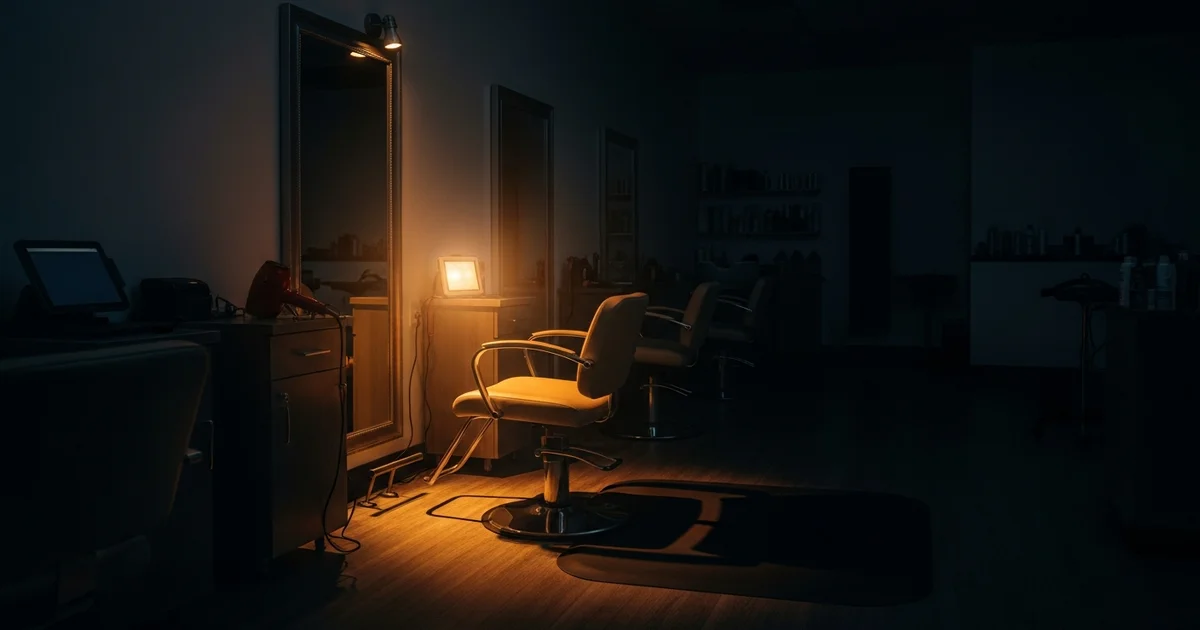
When Hurricane Beryl hit Houston on July 8, 2024, about 2.2 million CenterPoint customers lost power (Houston Public Media, 2024), and roughly 226,000 were still dark eight days later (Texas Tribune, 2024). For a salon or barbershop, every one of those hours is a chair that isn't earning. The dryers stop, the booking tablet dies mid-checkout, and Saturday's appointment column starts cancelling itself.
This article walks through a composite Houston salon and the battery backup that keeps its chairs working. The salon, loads, and dollar figures below are a composite built from public industry benchmarks, TDLR rules, and post-Beryl outage data. It is not a single real customer.
Key Takeaways
- A full-Saturday outage at a busy Houston salon cancels 30 to 60 appointments, roughly $2,000 to $6,000 in same-day service revenue at chair-hour rates of $40 to $120.
- Professional dryers pull 1,600 to 2,000 W each (Marlo Beauty), so six stations can spike past 10 kW.
- TDLR health and safety rules require hot water, adequate lighting, and ventilation, exactly what an outage removes.
- A 20-40 kWh battery with load management keeps a six-chair salon cutting, coloring, and checking out clients.
- Booth renters owe rent whether the lights are on or not, which makes backup power a tenant-retention tool.
[INTERNAL-LINK: get a Houston battery backup quote in under 2 minutes → /home-backup-planner?source=blog&slug=battery-backup-houston-salons-barbershops]
The composite scenario: a six-chair salon in a Houston strip center
The composite salon in this article is a 1,800 square foot leased suite in a Houston strip center: six styling stations split between three employed stylists and three booth renters, two shampoo bowls, a retail shelf, a booking tablet at the front desk, and a 5-ton rooftop HVAC unit. It's an ordinary setup, which is the point. In 2024, IBISWorld sized the US hair salon industry at roughly $60 billion in annual revenue (IBISWorld, Hair Salons in the US, 2024), and the Bureau of Labor Statistics projects about 5% job growth for barbers, hairstylists, and cosmetologists through 2034 (BLS Occupational Outlook, 2024). Thousands of those chairs sit in CenterPoint territory.
[PERSONAL EXPERIENCE] In our post-Beryl commercial assessments around the Houston metro, strip-center tenants asked the same question again and again: what can I install without owning the building? Salon owners weren't chasing an energy story. They had lost a summer weekend of bookings, twice, and wanted the next storm to be a non-event.
Citation capsule. The US hair salon industry generates about $60 billion a year (IBISWorld, 2024), and in Texas every cosmetology establishment operates under a TDLR license (TDLR). A power outage takes the same revenue engine offline in every one of them: the chair.
What does a power outage cost a Houston salon?
A full-Saturday outage cancels 30 to 60 appointments at the composite salon. At chair-hour rates of $40 to $120, that is roughly $2,000 to $6,000 in same-day service revenue, before retail sales and the rebooking cascade. Saturday is the worst possible day to go dark: in 2025, WaitQ's barbershop statistics roundup found Saturday is the top revenue day for about 90% of shops, with end-of-week slots carrying around 40% of bookings (WaitQ, 2025).
The rebooking cascade
The loss doesn't stop at sundown. Booking platform SQUIRE puts the cost of a single missed appointment at $40 to $80 in service revenue, or $60 to $120 once tips and retail are counted (SQUIRE, The Real Cost of No-Shows, 2025). When Saturday's clients rebook, they displace next week's bookable hours, so a one-day outage quietly drains the following two weeks of capacity.
Booth renters still owe rent
[UNIQUE INSIGHT] Here's the angle almost nobody covers: booth renters are independent businesses. In most rental agreements, weekly rent is due whether the salon has power or not. A dark Saturday means your renters paid to earn nothing, and renters who lose faith in the building move their clientele elsewhere. Backup power isn't just revenue protection for the owner. It's tenant retention for everyone paying to work under your roof.
[ORIGINAL DATA] Stacking those pieces with public benchmarks gives the composite outage bill below: same-day service revenue, lost retail sales, displaced rebooking capacity, and the staff and renter friction of a wasted day.
Houston supplied two of these events in a single summer. The May 2024 derecho knocked out power to nearly a million customers, and Beryl followed with 2.2 million just seven weeks later (Houston Public Media, 2024). Our guide on [INTERNAL-LINK: what business interruption really costs Texas companies → /blog/business-interruption-power-outage-cost-texas] runs the same math for other trades.
What loads does a salon actually need to back up?
Five load groups, in priority order: styling stations, the POS and booking tablet, lighting, HVAC, and hot water. The stations dominate. Professional blow dryers pull 1,600 to 2,000 W each, and 1,875 W is the standard high setting (Marlo Beauty; EcoCostSavings, 2024). Run six at once and dryers alone can spike past 10 kW.
| Load | Typical draw | Why it matters |
|---|---|---|
| Professional blow dryer | 1,600-2,000 W each | The dominant load; 1,875 W standard high setting |
| Hooded or processing dryer | 800-1,500 W | Color and treatment timing can't pause |
| Clippers | 15-45 W | Negligible; a barbershop's core tool barely registers |
| Flat and curling irons | 100-300 W each | Small but always on during styling |
| POS tablet and router | Under 100 W | Zero-tolerance load; no checkout means no rebooking |
| Lighting | Varies by suite | Color-accurate light protects color work |
| 5-ton rooftop HVAC | 5,000-6,000 W running | Client comfort in a Houston July; managed cycling works |
| Water heating | Gas tank: minimal. Electric tankless: 18-27 kW | The single biggest sizing question on a site survey |
Two of these deserve a closer look. Lighting isn't an amenity in a color salon: a correction judged under bad light is a redo, so color-accurate lighting is revenue protection. And hot water splits salons into two camps. A gas tank heater rides through an outage on almost no electricity, while an electric tankless unit demands 18 to 27 kW and changes the whole system design. It's the first thing we check on a survey.
Can you legally stay open without power? The TDLR question
TDLR's health and safety rules for barbering and cosmetology establishments require hot and cold running water, adequate lighting, and ventilation as conditions of operating (TDLR establishment rules; TDLR Health and Safety Rules). Notice what that list is: it's exactly what a power outage takes away.
TDLR doesn't publish an outage-specific rule, and this isn't legal advice. But a dark salon with cold shampoo bowls and no exhaust fans isn't operating in the condition its license describes. Backup power is what keeps you inside the rules while the rest of the strip center closes.
Citation capsule. Texas cosmetology establishments must maintain hot and cold running water, adequate lighting, and ventilation under TDLR health and safety rules (TDLR). During a grid outage, backup power is the only way a salon keeps those required operating conditions while continuing to serve clients.
How big a battery does a Houston salon need?
For the composite six-chair salon, 20-40 kWh of storage with a 10-15 kW inverter covers a multi-hour outage, if load management staggers the dryers. Here's the honest engineering insight: you never run all six dryers at full blast simultaneously anyway. Managed backup keeps two or three active stations working, plus the POS, lighting, and HVAC cycling at a reduced duty.
What does that look like in practice? A quiet afternoon of cuts, clippers, and irons barely dents the battery. A full Saturday of color work and blowouts draws it down faster, which is why the sizing conversation starts with your booking pattern, not your panel. Our modular hardware stacks 9 kWh battery modules up to 45 kWh on one controller rated 11.5 kW continuous, so a salon can start at the small end and add capacity later.
One honest caveat, the same one we give gyms and clinics: a 20-40 kWh battery is built for the multi-hour CenterPoint outage, not an 8-day Beryl tail. Multi-day resilience means a larger bank or a battery-generator pairing, and we'll tell you which during the assessment. Pricing is a fixed quote per address, not a guess.
[INTERNAL-LINK: see commercial battery plans sized for small businesses → /plans/commercial]
For the full load-priority method, start with our guide to [INTERNAL-LINK: commercial battery backup for Texas businesses → /blog/commercial-battery-backup-texas-businesses].
Battery or generator for a strip-center salon?
For leased strip-center suites, batteries win on the three constraints that kill generator projects: no exterior slab or gas line for the landlord to approve, no exhaust and noise clearances beside neighboring tenants, and no fuel to store or schedule. A battery install is electrical-room scope, which makes the lease conversation dramatically easier.
There's a checkout-line reason too. A battery switches over in milliseconds, so the booking tablet never blinks. A generator's transfer gap still drops the POS mid-transaction unless you add a separate UPS, and a failed checkout at 4 pm on Saturday is a refund conversation you don't want. The same constraints apply next door: see our take on [INTERNAL-LINK: battery backup for Houston gyms and fitness studios → /blog/battery-backup-houston-gyms-fitness-studios].
What it costs and when it pays back
Measure the system against the outage bill, not the sticker. The composite math above puts one full-Saturday outage at roughly $5,000 to $8,000 all-in, and Houston's grid supplied two qualifying storms in the single summer of 2024. A small commercial battery that turns those Saturdays into normal working days recovers a meaningful share of its cost per event, and it also keeps booth renters earning, which is what keeps them renewing.
Exact pricing depends on your suite, your water heating, and your panel, so we quote it fixed, per address, after a short assessment.
[INTERNAL-LINK: book a free Houston business assessment → /home-backup-planner?source=blog&slug=battery-backup-houston-salons-barbershops]
Prefer to talk it through first? Call Eos at 713-207-2222 for a same-week Houston commercial site survey.
Frequently asked questions
Can a salon stay open during a power outage in Texas?
Only if it can maintain the operating conditions TDLR requires: hot and cold running water, adequate lighting, and ventilation (TDLR). An outage removes all three, so staying open realistically depends on backup power carrying water heating, lights, and exhaust fans.
How many appointments does a salon lose in a one-day outage?
The composite six-chair Houston salon loses 30 to 60 appointments on a full Saturday, its busiest day. Saturday is the top revenue day for about 90% of barbershops (WaitQ, 2025), so a weekend outage costs several times what a Tuesday outage does.
How big a battery does a barbershop need compared with a full-service salon?
A clipper-first barbershop runs on tiny loads, 15 to 45 W per clipper, so 10-20 kWh often covers chairs, POS, lighting, and managed cooling. A color salon running 1,875 W dryers and hooded processors needs 20-40 kWh with load management to keep multiple stations live.
Do booth renters pay rent when the power is out?
Under most booth-rental agreements, yes: rent is due regardless of outages, because renters lease the space, not a power guarantee. That's exactly why backup power doubles as tenant retention. A salon that stays working through a CenterPoint outage protects its renters' income and its own occupancy.
Will a battery run salon hair dryers?
Yes, with load management. Each professional dryer draws 1,600 to 2,000 W (EcoCostSavings, 2024), so the system staggers stations rather than powering all six at once. A 10-15 kW inverter comfortably runs two to three active stations plus the rest of the salon's critical loads.
The bottom line for salon owners
The salon in this article is not a real business. The loads, the outage math, and the sizing ranges are real, and they apply to most six-chair suites in CenterPoint territory. Saturday is the revenue day outages hurt most. Dryers dominate the load, so staggering them is the trick that makes a 20-40 kWh system work. And the conditions TDLR requires you to operate under are the very things an outage removes. Get the chairs a power supply that doesn't depend on the grid, and the next Beryl becomes a story you tell clients while the dryers keep running.
This article is general information for Houston salon and barbershop operators and reflects Eos specifications as of July 2026. The salon is a composite illustration, not a specific client, and does not promise a specific runtime, compliance outcome, or revenue result. Confirm sizing, electrical code, lease terms, and permitting for your suite with the appropriate professionals.