Battery Backup for Houston Blood and Plasma Donation Centers: The Cold Chain

Battery Backup for Houston Blood and Plasma Donation Centers: The Cold Chain
A blood or plasma donation center is three cold chains stacked inside one building, and one of them is not about cold at all.
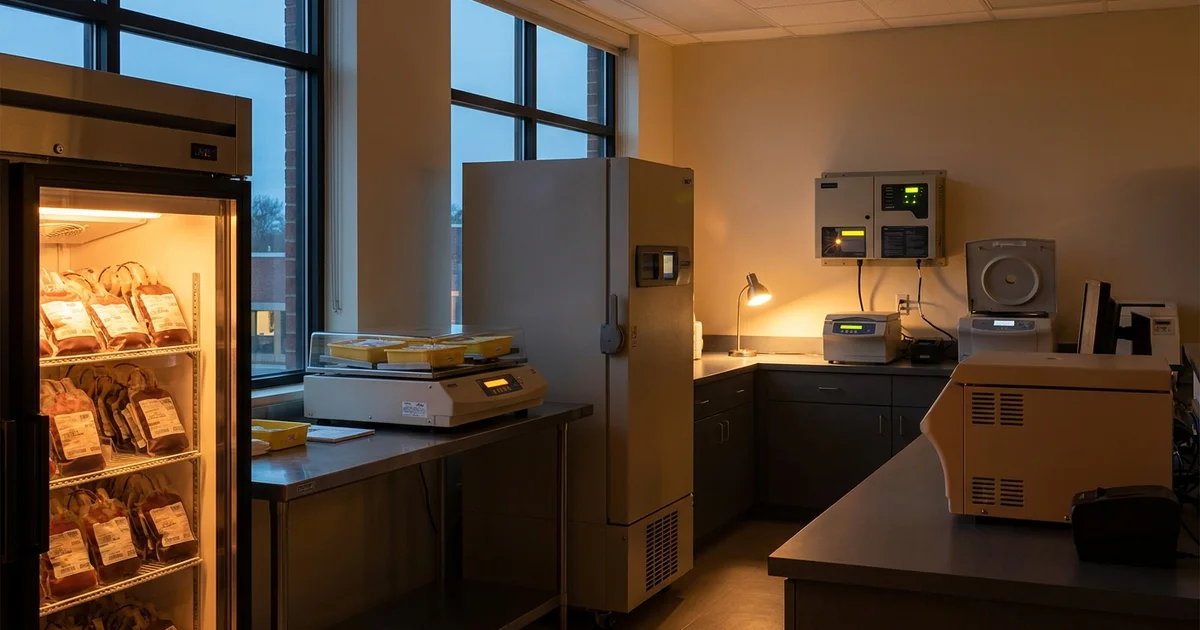
Red cells sit in a refrigerator. Plasma sits in a freezer. Platelets sit at room temperature on a machine that has to keep rocking them, without pause, for the whole storage period. When the grid drops in Houston, all three clocks start at once, on regulated product that a volunteer donor spent an hour of their day giving you.
Here is what the federal storage rules actually require, what happens to product when the power fails, what stored power can realistically hold, and where the honest limit sits.
Key Takeaways
- Red Blood Cells must be placed in storage immediately after processing and maintained between 1 and 6 degrees Celsius (21 CFR 640.11).
- Platelets stored at 20 to 24 degrees Celsius require continuous gentle agitation throughout the storage period (21 CFR 640.25). That is a motor load, not a cooling load.
- Plasma must be stored at minus 18 degrees Celsius or colder (21 CFR 640.34), and Source Plasma intended for injectable products goes to a temperature not warmer than minus 20 degrees Celsius (21 CFR 640.69).
- Product exposed to an out of range temperature is documented and evaluated against time and temperature data, not automatically thrown away (FDA).
- Hurricane Beryl left about 2.2 million CenterPoint customers without power on July 8, 2024 (Houston Public Media, 2024), with more than 1 million still out days later (Texas Tribune, 2024).
Can battery backup keep a Houston blood or plasma center running?
Yes for the regulated storage and the equipment that protects it. One Eos controller is rated 11.5 kW continuous and 17.1 kW surge, which is enough to carry a critical zone: storage refrigerators, platelet agitators and their incubators, plasma freezers, the temperature monitoring and alarm system, donor floor and egress lighting, and the IT that holds donor and product records.
The boundary belongs in the same breath. Full building comfort cooling plus every collection bay at once is a bigger draw than a single controller, and that is a multi controller design. What makes this building type a good candidate is the shape of the load rather than its size: the highest risk inventory runs on small, continuous, predictable circuits, which is exactly what stored power protects best.
The three storage bands a donation center runs at the same time
Three separate sections of federal regulation set three different temperatures inside one processing room. Red Blood Cells must be placed in storage immediately after processing and held between 1 and 6 degrees Celsius (21 CFR 640.11). Platelets are held at 20 to 24 degrees Celsius with continuous gentle agitation, with agitation optional if they are stored between 1 and 6 degrees Celsius instead (21 CFR 640.25).
Plasma is the third band. It must be stored at minus 18 degrees Celsius or colder, and Fresh Frozen Plasma has to reach a freezer within 8 hours or within the timeframe in the directions for use (21 CFR 640.34). Source Plasma intended for manufacturing into injectable products is held at a temperature not warmer than minus 20 degrees Celsius (21 CFR 640.69).
Dating periods show what is sitting in those cabinets. Platelets are dated 5 days from collection. Red Blood Cells run 21, 35, or 42 days depending on the anticoagulant or additive solution. Fresh Frozen Plasma is dated 1 year at minus 18 degrees Celsius or colder (21 CFR 610.53). A freezer holding a year of dated product and a rocker holding five day product fail in very different ways.
Why the platelet agitator is the load nobody plans for
Every cold chain backup plan we read protects the refrigerator. In a donation center, the requirement that cannot pause is a motor. The regulation is direct about it: if platelet concentrate is stored at 20 to 24 degrees Celsius, continuous gentle agitation shall be maintained throughout the storage period (21 CFR 640.25).
Agitation is not housekeeping. It keeps gas exchange moving through the container so pH holds while the platelets keep respiring. Stop the rocker and the chemistry inside the bag drifts quietly, with nothing on the wall to show for it.
The transfusion literature keeps this honest. A 2009 study in Transfusion interrupted agitation for 24 hours to mimic shipment and found pooled leukoreduced whole blood derived platelets in the tested containers still maintained pH and other key in vitro variables at 5 days, although test pool pH ran lower than control at 6.77 versus 6.98 (Transfusion, 2009). By day 7 the gap widened and 5 of 10 test pools fell below pH 6.2. Later work notes that surviving a 24 hour interruption required 10 percent residual plasma in the storage medium (Blood Transfusion, 2018).
So an interruption is not instantly fatal. It is still a documented deviation on regulated product, and it is entirely avoidable. Here is the installer's read: an agitator is a small continuous motor, one of the cheapest loads in the building to keep alive and one of the easiest to lose to a transfer delay. A battery has no crank, no warm up, and no transfer interval. For this load, that is the whole argument.
What actually happens when the power drops
FDA's severe weather guidance is procedural, not dramatic. Note the time of the outage, do not open freezers and refrigerators until power is restored, and record the temperature as soon as possible after restoration so the duration of exposure can be documented (FDA). That record is what a manufacturer or your medical director uses to calculate whether the product is still good.
This is the part most outage content gets wrong. A temperature excursion is an evaluation case, not an automatic discard. The same FDA page draws the sharp line elsewhere: product exposed to flood water is considered contaminated and should be discarded. Losing power puts inventory into review. Losing the building puts it in the trash.
Review still costs you. Federal facility rules require space for quarantine storage of blood or blood components in a designated location (21 CFR 606.40), and establishments must maintain written standard operating procedures covering storage temperatures and the methods of controlling them for all blood products and reagents (21 CFR 606.100). Those procedures are the plan. Power is what lets you execute it instead of invoking it.
The donor in the chair: apheresis and the collection floor
An apheresis procedure is a continuous extracorporeal loop, so an unplanned stop mid collection is a donor event before it is ever a product event. The plasmapheresis rules make the return step explicit: the maximum feasible volume of red blood cells shall be returned to the donor before another unit is collected (21 CFR 640.65). Anything that interrupts that return matters.
Reactions happen on a normal Tuesday. Italian donor haemovigilance data covering 12,030,706 donations from 2016 to 2019 put the overall prevalence of vasovagal reactions at 25.0 per 10,000 donations, and vasovagal reactions accounted for 70.3 percent of the adverse reactions reported for apheresis donations (Blood Transfusion, 2021). Now put that baseline in a dark room with a stalled machine and a donor who cannot see your face.
The loads that prevent it are ordinary: collection bay outlets, floor and egress lighting, the monitoring station, the phones. None are large. Together they are the difference between finishing a procedure calmly and managing a room.
A composite look: a donation center through a multi-day Houston outage
The following is a composite illustration, not a specific client, drawn from the loads we see at Houston medical and cold chain sites. It does not describe any real donation center.
Picture a mid sized center: two blood storage refrigerators, a flat bed platelet agitator with its incubator, an upright plasma freezer, a monitoring and alarm system, four collection bays, a small server closet, and the donor floor lights. Utility power fails at 3 p.m. on a July afternoon.
The freezer has the most thermal mass and coasts longest, assuming nobody opens it. The refrigerators coast next, in hours. The agitator coasts for zero seconds. Three clocks, one panel.
Duration is the part Houston operators already know. Beryl knocked out power to about 2.2 million CenterPoint customers on July 8, 2024 (Houston Public Media, 2024), and more than a million were still without power days later (Texas Tribune, 2024). No passive storage device survives that on thermal mass alone.
With a battery on the critical plan, that week reads differently. Storage stays in band, the agitator never stops, and the monitoring system keeps recording, which leaves you holding continuous data instead of a deviation report. The center keeps its inventory and the donor floor stays usable for the neighbors who show up anyway. For the wider business math, see
.How much battery does a blood or plasma center need?
Less than the building's full connected load, and considerably more than a closet UPS. The unit of design is the critical load island, not the square footage.
Here is the honest hardware picture. Our modular system uses 9 kWh nominal battery modules, 8.76 kWh usable each, and one controller rated 11.5 kW continuous and 17.1 kW surge. One controller with a stack of modules realistically covers a critical cold zone plus the agitators and incubators plus monitoring and IT. A whole center, every collection bay and comfort cooling included, is a multi controller conversation. Our commercial line runs from four modules on one controller up to fifteen modules on three controllers, and larger sites stack from there.
We are not going to publish a kWh number for your center in a blog post. The load list decides it. List every storage device and its duty cycle, add the agitators and incubators, add monitoring and IT, then make the decision most centers put off: does the collection floor run at full or reduced capacity on backup?
Neighboring buildings solve pieces of this. Our guide to how Houston pharmacies protect a refrigerated cold chain covers the single band version, and cold storage backup and compressor loads covers what changes when the compressors get large. For the neighboring medical case, see medical sites that get busier when the grid is down.
The load priority process itself is the same one every commercial site runs.
Battery, generator, or both?
For this building type the two do different jobs, and the agitator is the reason. A battery has no start delay, no crank, no fuel deliveries, and no exhaust, so it carries small continuous loads through the transition without a gap. A generator depends on fuel and has a start and transfer interval, but it suits large sustained air conditioning across days.
FDA's framing is worth borrowing: blood banks and plasma centers typically have back up generators and emergency procedures in place for storing products during a power outage (FDA). For most Houston centers the question is not battery instead of generator. It is what carries the gap and what carries the week.
Your accrediting framework sits on top of both. AABB publishes Standards for Blood Banks and Transfusion Services, now in its 35th edition effective April 1, 2026, covering donor qualification, collection, processing, storage, and transfusion (AABB). WHO's 2023 emergency guidance states that preparedness, including business continuity planning, is essential for blood services to mitigate the impact of emergencies (WHO). Backup power is a line item inside that plan, not a substitute for it.
The three clocks and the one motor
A donation center runs a freezer, a refrigerator, and a rocker at once, and the rocker has no thermal cushion at all. Sequence the critical load panel by how long each band can coast: storage devices and their monitoring first, agitators second, the apheresis bay and IT third, comfort cooling last. That order is the design.
One note on what this article does not claim. No authoritative public source we could fetch carries a dollar value per unit of blood, platelets, or plasma, or a Houston specific blood supply figure, so we have not quoted one. The regulatory clocks are documented. The local price of losing them is not.
Or call Eos at 833-989-3737 to talk through your setup with an installer.
Frequently asked questions
What temperature must donated blood be stored at?
Red Blood Cells are stored between 1 and 6 degrees Celsius (21 CFR 640.11). Platelets are held at 20 to 24 degrees Celsius with continuous agitation, or at 1 to 6 degrees Celsius where agitation is optional (21 CFR 640.25). Plasma is stored at minus 18 degrees Celsius or colder (21 CFR 640.34).
Are blood products thrown away after a power outage?
Not automatically. FDA guidance directs establishments to note the time of the outage, keep refrigerators and freezers closed until power is restored, and record the temperature afterward so the product can be evaluated against time and temperature data. Flood water exposure is a discard case. A power outage is an evaluation case (FDA).
How long can platelets go without agitation?
Federal regulation requires continuous gentle agitation throughout storage at 20 to 24 degrees Celsius (21 CFR 640.25). Research that interrupted agitation for 24 hours to simulate shipping found pH and key in vitro variables maintained at 5 days in the tested containers, with wider gaps by day 7 (Transfusion, 2009). That is a shipping finding, not permission to let the rocker stop.
Do blood banks already have backup generators?
FDA states that blood banks and plasma centers typically have back up generators and emergency procedures for storing products during a power outage (FDA). Battery backup is usually added for the instant a generator cannot cover, and for the small continuous loads like agitators and monitoring that should never see a gap.
How big a battery does a Houston donation center need?
It depends on the critical load list, not the square footage. One Eos controller is rated 11.5 kW continuous and 17.1 kW surge, which realistically covers a critical cold zone plus agitators plus monitoring and IT. A full center with every collection bay and comfort cooling is a multi controller design.
This article is general information for Houston blood and plasma collection operators and reflects Eos specifications as of September 2026. It is not medical, laboratory, or regulatory advice, and the case is a composite illustration, not a specific client. It does not promise a specific runtime or product outcome. Confirm blood component storage requirements with FDA regulations at 21 CFR Parts 606, 610, and 640, with AABB standards, and with your accrediting body.