Battery Backup for Houston Independent Pharmacies: The Cold Chain

Battery Backup for Houston Independent Pharmacies: The Cold Chain
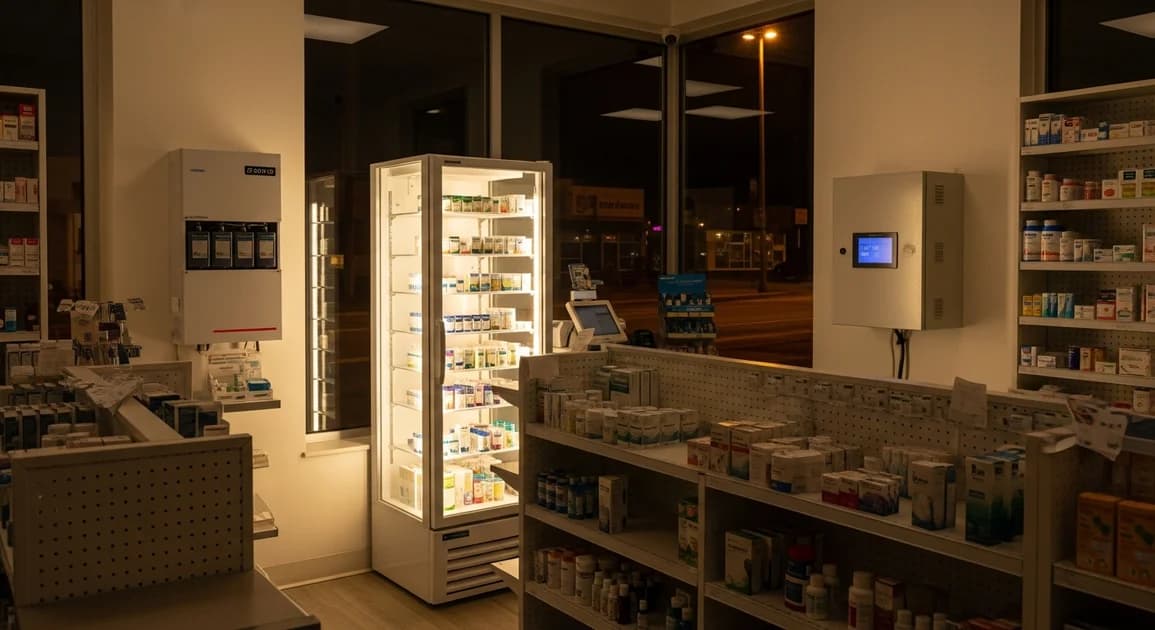
For an independent pharmacy, a Houston outage puts a shelf of expensive, regulated inventory on a clock. Vaccines and refrigerated drugs have to stay in a narrow cold range, and a warmed refrigerator does not just risk spoilage, it triggers a formal do-not-use protocol and can interrupt patient care. The good news is that a pharmacy's essential loads are small enough that battery backup is a genuinely strong fit. Here is how to protect the cold chain and the counter.
Key Takeaways
- Refrigerated vaccines must be stored between 2 and 8 degrees Celsius (36 to 46 Fahrenheit), with a target near 5 degrees Celsius (CDC, 2023).
- Texas pharmacy rules define a refrigerator as thermostatically held at 2 to 8 degrees Celsius (36 to 46 Fahrenheit) (22 TAC §291.15, Texas State Board of Pharmacy).
- A temperature excursion means affected vaccines are labeled do-not-use and quarantined until the manufacturer or health department rules on them (CDC).
- Hurricane Beryl left about 2.2 million CenterPoint customers without power on July 8, 2024 (Houston Public Media, 2024), with about 226,000 still out eight days later (Texas Tribune, 2024).
- A pharmacy's essential loads are small, so one modular system can realistically protect the cold chain and dispensing.
[INTERNAL-LINK: get a backup quote for your pharmacy → /home-backup-planner?source=blog&slug=battery-backup-houston-independent-pharmacies]
Can a battery keep a Houston pharmacy's cold chain safe during an outage?
Yes, and this is one of the better fits in commercial backup. A properly sized system can keep the vaccine and medication refrigerators cold, the dispensing system running, the point-of-sale working, the controlled-substance security live, and the lights on. Because a pharmacy's essential loads are modest compared with a warehouse, one modular system can carry them through a multi-day outage. The honest boundary is that a large drugstore's full air conditioning is a bigger load than one controller handles.
That fit is the point. The highest-value, highest-risk inventory in the building runs on a circuit a battery can protect well. We design around the cold chain first.
Why the medication cold chain is the highest-stakes load
Because the rules are strict and the stakes are patient care. Refrigerated vaccines must be held between 2 and 8 degrees Celsius, about 36 to 46 Fahrenheit, with a target near 5 degrees (CDC, 2023), and Texas pharmacy rules define a refrigerator the same way (22 TAC §291.15). Insulin and many other drugs share that 36 to 46 degree window (FDA).
Cross that line and it is not a simple discard. A temperature excursion means the affected vaccines are labeled do-not-use, stored separately, and held while the manufacturer or health department determines whether they are still viable (CDC). That is quarantined inventory and a gap in what you can dispense, on top of any loss.
How long does refrigerated stock really have?
Less time than an outage often lasts. Federal guidance for household units is that a refrigerator keeps its contents cold about 4 hours if the door stays closed (FoodSafety.gov). A pharmacy-grade refrigerator is better insulated and behaves differently, but that only shifts the window, it does not remove it, and every door opening resets the clock.
The Houston problem is duration. During Beryl, about 226,000 customers were still without power eight days after landfall, in 90-degree heat (Texas Tribune, 2024), and local reporting described medications spoiling as stores lost power. No passive refrigerator survives that. Keeping the compressor running is the only way to hold the cold chain through a multi-day event.
Beyond the fridge: dispensing, security, and staying open
The cold chain is the headline, but a pharmacy needs more to operate. The pharmacy-management and dispensing system has to run to fill prescriptions and check interactions, the point-of-sale to complete a sale, and the security and monitoring systems to protect controlled substances and satisfy your obligations. Lighting keeps the counter safe and workable. Lose those and the pharmacy cannot serve patients even if the fridge holds.
These loads are the rest of the critical-load island. Because they are electronic and modest in draw, they fit comfortably alongside the refrigeration in a single backup plan. Our guide on [INTERNAL-LINK: battery backup for diabetics and refrigerated medication → /blog/battery-backup-diabetics-refrigerated-medication] covers the patient side of that same cold chain.
A composite look: a pharmacy through a multi-day outage
The following is a composite illustration, not a specific client, drawn from the loads we see at Houston independent pharmacies. Picture a community pharmacy: two refrigerators holding vaccines and refrigerated drugs, the dispensing system, two registers, a security and camera system, and overhead lighting. When the grid drops, the compressors stop and the cold-chain clock starts on a shelf of regulated stock.
With a battery system on the critical plan, the refrigerators keep running, the dispensing system and registers stay up, security stays live, and the lights stay on. The pharmacy keeps filling prescriptions and holds its inventory inside the safe window, instead of quarantining stock and turning patients away. For the broader business math, see our look at [INTERNAL-LINK: the cost of business interruption from a Texas power outage → /blog/business-interruption-power-outage-cost-texas].
How much battery does a pharmacy need?
Less than most commercial sites, which is why it fits so well. The essential loads, the refrigerators, dispensing system, POS, security, and lighting, add up to a modest, mostly steady demand rather than the heavy compressor load of a full cold-storage warehouse. That puts a pharmacy squarely in range of a single modular system or a small stack.
Here is the honest hardware picture. Our modular system uses 9 kWh nominal battery modules (8.76 kWh usable each), stacking to 45 kWh on one controller rated 11.5 kW continuous and 17.1 kW surge, with a 10-year warranty. For most independent pharmacies, that covers the cold chain and dispensing loads, often in the 30 to 80 kWh range depending on your refrigeration. A large drugstore that also wants full-store air conditioning would need a bigger system.
[INTERNAL-LINK: see commercial battery options and sizing → /plans/commercial]
The right first question is which circuits keep your inventory safe and your doors open, not how many kilowatt-hours. Our guide on [INTERNAL-LINK: commercial battery backup for Texas businesses → /blog/commercial-battery-backup-texas-businesses] walks through that load-priority process.
[INTERNAL-LINK: talk through a pharmacy backup plan → /home-backup-planner?source=blog&slug=battery-backup-houston-independent-pharmacies]
Prefer to talk it through? Call Eos at 713-207-2222 for a same-week Houston commercial site survey.
Frequently asked questions
What temperature do pharmacy refrigerated medications have to stay in?
Refrigerated vaccines must be held at 2 to 8 degrees Celsius, about 36 to 46 Fahrenheit, with a target near 5 degrees (CDC, 2023), and Texas pharmacy rules define a refrigerator the same way (22 TAC §291.15). Insulin and many drugs share that 36 to 46 degree window.
What happens if the pharmacy fridge loses power?
The stock is at risk of a temperature excursion. If it crosses the safe range, CDC guidance is to label the affected vaccines do-not-use, store them separately, and hold them while the manufacturer or health department determines viability (CDC). That means quarantined inventory and a gap in care, which a battery is meant to prevent.
How long will a pharmacy refrigerator stay cold without power?
Not indefinitely. Household guidance is about 4 hours for a closed refrigerator (FoodSafety.gov), and a pharmacy-grade unit differs but still has a limit. Since Houston outages can last days, as Beryl showed, only a battery or generator keeping the compressor running protects the stock through a long event.
Is a battery a good fit for an independent pharmacy?
Yes, unusually so. A pharmacy's essential loads, refrigeration, dispensing, POS, security, and lighting, are modest and mostly steady, which one modular system can carry. That makes protecting the cold chain and the counter a strong, realistic fit rather than an oversized project.
How big a system does a pharmacy need?
It depends on your refrigeration, but many independent pharmacies fall in the 30 to 80 kWh range for the cold chain and dispensing loads. A large drugstore wanting full air conditioning would need a bigger commercial design. We size it to your specific store.
This article is general information for Houston pharmacy operators and reflects Eos specifications as of July 2026. It is not medical, pharmacy, or legal advice, and the case is a composite illustration, not a specific client. It does not promise a specific runtime or storage outcome. Confirm medication storage requirements with the manufacturer, CDC, USP, and the Texas State Board of Pharmacy.