Battery Backup for Houston Urgent Care: Busiest When the Grid Is Down

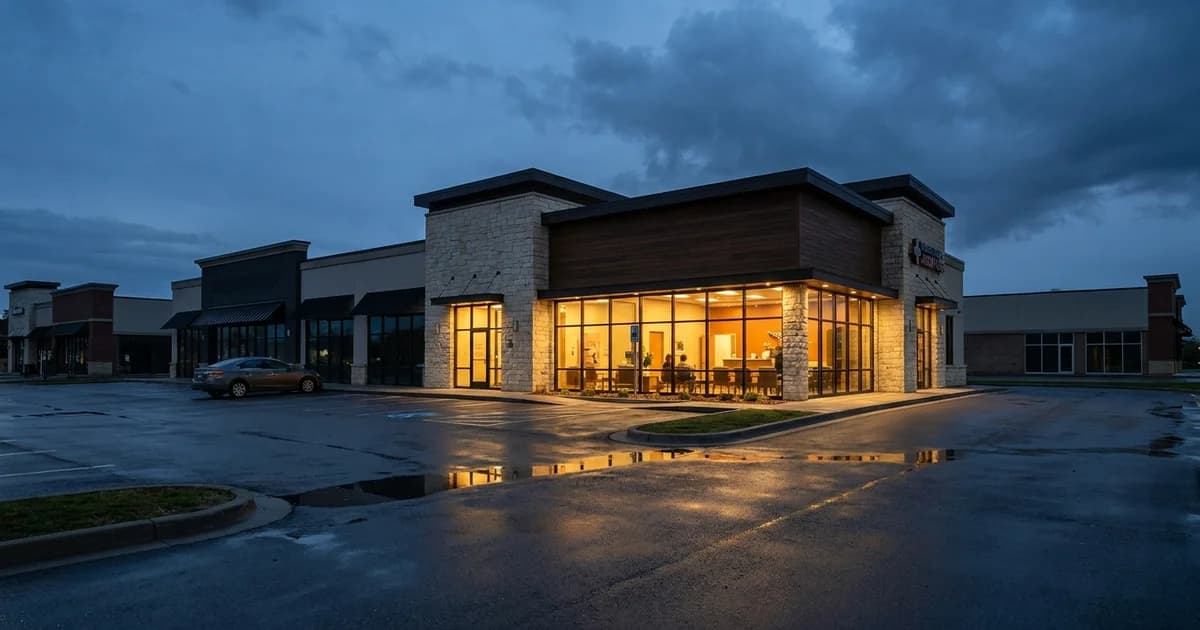
Nine days. That is how long emergency department visits for medication refills and carbon monoxide poisoning stayed statistically above baseline in Houston after Hurricane Beryl (Disaster Medicine and Public Health Preparedness, 2025). Neither complaint needs an emergency department. Both are what a walk-in clinic handles on an ordinary Tuesday.
They landed there partly because the clinics that normally absorb them had no power either. Urgent care is the one clinical format whose demand climbs while its own building is dark. A dental office loses a booked schedule. An urgent care center loses a waiting room of people who never called ahead.
The clinic described here is a composite case study, built from typical Houston-area operating parameters rather than a real client. The layout, staffing, and load profile are illustrative.
Key Takeaways
- After Beryl, Houston emergency department visits stayed elevated for heat illness through day 3 and for medication refills and carbon monoxide poisoning through day 9 (Disaster Medicine and Public Health Preparedness, 2025).
- Beryl cut power to roughly 2.2 million CenterPoint customers at peak in July 2024, more than a million were still out days later, and heat indices ran 100 to 106 F.
- A clinic refrigerator holds vaccine-safe temperature for hours, not days. CDC requires exposed doses labeled "DO NOT USE" and quarantined.
- No code forces a walk-in clinic to install emergency power. NFPA 99 Category 3 spaces are exempt.
- One controller at 11.5 kW continuous covers refrigeration, records, lighting, and one treatment room. Full-building HVAC forces multiple controllers.
Why urgent care gets busier while the lights are off
Because the outage itself manufactures the complaints. Comparing Houston syndromic surveillance counts after Beryl against the two weeks prior, researchers found daily emergency department visits statistically higher for acute cardiac events on days 1 and 2, heat-related illness and dialysis through day 3, and carbon monoxide poisoning and medication refills through day 9 (Disaster Medicine and Public Health Preparedness, 2025).
Read that list as a clinic operator, not a hospital administrator. Heat illness, medication refills, carbon monoxide exposure, and the cuts and sprains of cleanup are walk-in work. That is the urgent care book of business, and for nine days it queued somewhere else.
Beryl cut power to roughly 2.2 million CenterPoint customers at peak (Houston Public Media, 2024), more than a million were still out days later (Texas Tribune, 2024), and heat indices ran 100 to 106 F (National Weather Service Houston). Nationally, customers averaged 11 hours without electricity in 2024 (U.S. Energy Information Administration, 2025).
[UNIQUE INSIGHT] Post-storm volume doesn't always rise. Combined pediatric emergency department and urgent care visits in Houston fell after Harvey, from 11,995 in the comparable 2016 window to 9,100 in the month after landfall (Western Journal of Emergency Medicine, 2021). Harvey was a flood and people could not reach care. Beryl was wind and heat with passable streets, and that is what fills a waiting room.
So this isn't really a question about a day of billing. A clinic with its lights on is triage capacity that keeps low-acuity storm complaints out of a saturated emergency department.
A composite Houston walk-in clinic, hour by hour
Picture 4,000 square feet in a suburban retail strip on a Harris County arterial: two exam rooms, two treatment bays, one provider, two medical assistants, and a front-desk lead per shift, open 8 a.m. to 8 p.m. daily.
Minute zero, the screens die and the open chart disappears with the queue behind it. Minute ten, the first walk-in arrives anyway, because a dark clinic on a busy road still reads as open to somebody holding a bleeding hand.
Hour two, the refrigerator is on a clock nobody can pause. Hour four, the waiting room is past 90 F. Hour six, someone tapes a paper sign to the glass and starts sending people to an emergency department twenty minutes away that is already full of the same complaints.
Nothing there is dramatic, and that is the point. The clinic converts into an unstaffed referral desk in less than a shift, on the day the neighborhood needed it open. Our guide on
covers how that load-priority conversation starts at the panel.What actually stops working, in the order it stops
The electronic medical record and e-prescribing
The chart goes first, and it takes more with it: no allergy list, no medication reconciliation, no prior imaging. Texas has required electronic prescribing of controlled substances since January 1, 2021 under House Bill 2174, with an exception when e-prescribing is unavailable due to temporary technological or electronic failure (Texas Medical Association, 2021; Texas Health and Safety Code Chapter 481).
So paper is lawful, and that isn't the trap. The trap is clinical: the provider prescribes with no medication history, for a patient whose pharmacy down the road is probably dark too.
Point-of-care testing and imaging
Rapid strep, influenza, COVID, and urinalysis are waived tests, and waived testing requires following the manufacturer's instructions in their entirety and without variation (CDC, Waived Tests; CDC MMWR, 2005). Reagents held outside their stated storage conditions don't produce a valid result. Digital X-ray, which handles the post-storm sprains and fractures, is simply off.
Clinical lighting
Suturing a laceration or draining an abscess under a phone flashlight is not a standard of care. There is no workaround, and nobody should pretend otherwise.
HVAC and infection control
August in Houston, a full waiting room, respiratory complaints stacked in it. Air handling is an infection-control function, not only a comfort one. In a seven-storm analysis, pediatric respiratory-disorder visits peaked in post-hurricane week 3 at 56.4% above baseline in directly affected counties, attributed in part to lost air conditioning (Effects of Hurricanes on Emergency Department Utilization, 2020). It is also the largest electrical load in the building.
The refrigerator is the one clock you cannot pause
Refrigerated vaccine has to be held between 36 and 46 F, and any reading outside the manufacturer's stated range is a temperature excursion. CDC guidance is specific about what follows: label the affected doses "DO NOT USE," move them into a separate container inside the unit, and contact the immunization program or manufacturer for a viability determination (CDC Vaccine Storage and Handling Toolkit).
Read that as an operations problem. The inventory does not vanish, it becomes quarantined inventory, unusable until someone else rules on it. The clinic's immunization capacity goes offline for days even when the doses are eventually cleared.
A clinic-grade refrigerator holds safe temperature for hours with the door shut, not days, and the instinct that costs the most is opening the door to check. Injectables, some antibiotics, and tuberculin sit in the same unit under the same rules. Independent pharmacies run this problem at larger scale, and
covers that side of it.[PERSONAL EXPERIENCE] In the week after Beryl, the calls our team fielded from Houston clinical sites weren't about revenue. They were about refrigerators, and what to tell the people standing at a locked door.
Why no one is forcing your clinic to fix this
Because the health care facilities code doesn't require backup power in a space like this. NFPA 99 requires an essential electrical system for Category 1 and Category 2 spaces and does not require one for Category 3 and Category 4 spaces (NFPA 99; IAEI Magazine). Category 3 covers spaces where a failure isn't likely to injure patients but can cause discomfort: examination and treatment rooms in clinics and medical offices.
Compare the neighbors. An ambulatory surgical center is held to a Type 1 essential electrical system. A walk-in urgent care center in a leased retail suite sits in Category 3 and carries no such obligation.
[UNIQUE INSIGHT] Vendor pages here tend to imply an obligation that does not exist. The absence of a mandate is not evidence that the risk is absent. It is why urgent care battery backup stays an owner decision, and why the Houston urgent care map went dark after Beryl while demand was climbing.
Honest sizing: one controller, and where multi-controller starts
Sizing battery backup for a walk-in clinic starts with what has to stay on, not with the square footage. One controller delivers 11.5 kW continuous and 17.1 kW surge, with capacity added in modules of 9 kWh nominal and 8.76 kWh usable each. That is enough for the clinical core of a small urgent care center.
What fits inside it: both refrigerators, the server closet holding the electronic medical record stack, the point-of-care analyzers, clinical lighting and one treatment room zone, and the digital X-ray on an intermittent duty cycle. That is a functioning single-provider triage clinic, not a dark building with a cold fridge in it.
What does not fit is the rooftop package unit running all afternoon in August. Whole-envelope cooling is what pushes a clinic into a multi-controller design, and any proposal implying one unit does everything deserves a second look.
Most owners land on a middle path: cool one treatment room and the medication storage area instead of the entire envelope, then buy duration rather than output, meaning more battery modules behind the same controller. Compressor motors draw well above running current at the instant they start, standard NEMA Design B behavior, and that inrush decides whether the unit starts at all. The separation happens at the panel first, where an electrician splits the clinical core from the large mechanical loads so the battery never sees the rooftop unit.
Frequently asked questions
Do urgent care centers have backup generators?
Most do not. NFPA 99 does not require an essential electrical system for Category 3 spaces, where examination and treatment rooms in clinics generally fall (NFPA 99). It is an owner decision, not a code obligation.
Can an urgent care legally see patients without power?
Nothing forbids it, and Texas recognizes a temporary technological failure exception to its controlled-substance e-prescribing requirement (Texas Medical Association, 2021). Practically, without the medical record, lighting, and valid point-of-care testing, the answer is usually no.
What happens to vaccines during a clinic power outage?
Any reading outside 36 to 46 F is a temperature excursion. CDC guidance directs staff to label the doses "DO NOT USE," separate them inside the unit, and contact the manufacturer for a viability determination (CDC Vaccine Storage and Handling Toolkit).
How long does a clinic refrigerator stay cold without power?
Hours, not days, and every door opening shortens it. Hold time depends on the unit, how full it is, and ambient temperature, which in a Houston August works against you.
What size battery does an urgent care clinic need?
One controller at 11.5 kW continuous and 17.1 kW surge covers refrigeration, the record stack, clinical lighting, and one treatment room zone. Full-building HVAC moves it to multiple controllers. For scheduled-appointment settings, see
.The busiest hours are the dark ones
The clinic above is a composite. The failure sequence and the sizing limits are real, and they repeat every Gulf Coast storm season.
- Demand for what urgent care treats climbs for days after a wind and heat event. After Beryl, refill and carbon monoxide visits stayed elevated through day 9.
- No code makes a Category 3 clinic install emergency power, so the decision is yours and so is the exposure.
- One controller covers the clinical core honestly. Whole-building cooling in August is a larger design.
A clinic that stays lit after a storm is not only protecting a schedule. It is absorbing volume that would otherwise queue at an emergency department that can least afford it that week.
Or call Eos at 833-989-3737 to talk through your setup with an installer.
Reflects Eos Backup and Battery specifications as of August 2026. The clinic described is a composite, not a client, and no runtime or clinical outcome is promised. Confirm equipment loads and electrical code with the appropriate professionals.