How CenterPoint Decides Who Gets Power Back First in Houston

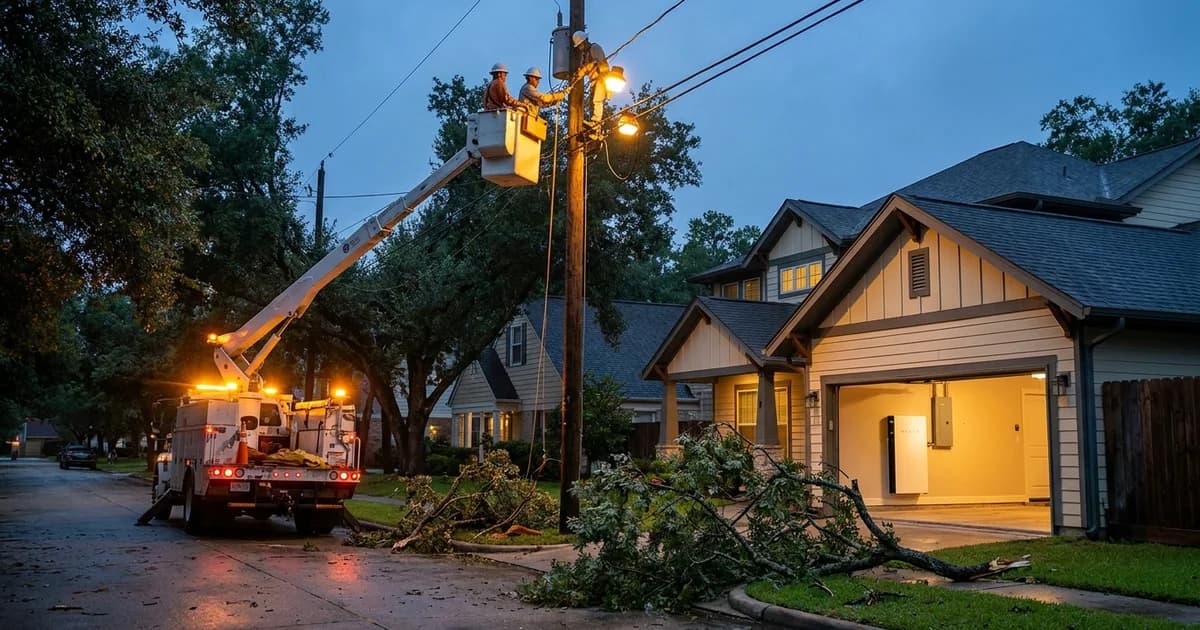
CenterPoint restores Houston in a fixed sequence: facilities vital to public safety first, then the major lines and fuses that carry the most customers, usually starting with transmission and substations, then transformers, then the service drops and underground lines feeding individual homes (CenterPoint Energy, Systematic Power Restoration, retrieved 2026-09-08). That order isn't about who complained loudest. It's arithmetic. And it means the honest answer to "when will I get power back" depends almost entirely on which layer of the grid broke near you.
Key Takeaways
- CenterPoint repairs in this order: public safety facilities, transmission and substations, main lines and fuses, transformers, then service drops to individual homes (CenterPoint Energy, 2026).
- Each transformer typically serves about 10 customers, and a service drop serves one. That's why the final stretch of any Houston restoration is the slowest part.
- Critical care or chronic condition status does not move you up the repair queue. Texas rule 16 TAC 25.497(c)(4) states it "does not guarantee the uninterrupted supply of electricity."
- Storm damage and ERCOT rotating outages are two different mechanisms with two different clocks.
How does CenterPoint decide who gets power back first?
CenterPoint publishes its restoration sequence, and it has four steps. Crews first restore service to key facilities vital to public safety, health and welfare, including hospitals, police and fire departments, and secure downed lines. Then they repair major lines and fuses to restore the most customers in the least time, usually beginning with transmission and substations. Then transformers, "each typically serve 10 customers." Then service drops and underground lines to individual homes (CenterPoint Energy, Systematic Power Restoration, retrieved 2026-09-08).
That order mirrors how the grid is physically built. High-voltage transmission lines move power over long distances, transformers at substations step the voltage down, and distribution lines carry the lower voltage to homes and businesses (U.S. Energy Information Administration, Electricity delivery to consumers, retrieved 2026-09-08). Damage upstream blocks everything downstream. Fixing a broken lateral does nothing if the substation feeding it is still dark.
| Layer repaired | Roughly who comes back |
|---|---|
| Public safety facilities | Hospitals, police, fire, plus secured downed lines |
| Transmission and substations | Whole sections of the service territory |
| Main distribution lines and fuses | Subdivisions and commercial corridors |
| Transformers | About 10 customers each |
| Service drops and underground lines | Individual homes |
CenterPoint defines the service drop plainly: "the small power line between the electric pole and your house" (CenterPoint Energy, retrieved 2026-09-08). If that single wire is what failed at your address, you are, by design, in the last group.
[UNIQUE INSIGHT] Most Houston homeowners assume they're competing with their neighbors for crew attention. They aren't. They're waiting on a queue sorted by customers-restored-per-repair-hour, and their position in it was decided by wind and trees days before any truck rolled.
Why does the last stretch of a Houston restoration take the longest?
Because the payoff per repair collapses as crews work down the hierarchy. One substation repair can bring back an entire section of the grid. One transformer repair brings back about 10 customers (CenterPoint Energy, retrieved 2026-09-08). One service drop repair brings back exactly one. Same crew, same hour, wildly different results.
CenterPoint does not publish a customer count per substation or per feeder circuit at the neighborhood level, so anyone quoting you a precise multiple is guessing. What the published sequence does establish is the direction of the curve: restoration numbers fall fast at first, then crawl.
After Hurricane Beryl made landfall on July 8, 2024, more than 2.6 million Texas power customers lost electricity, and hundreds of thousands were still without power a week after the storm (The Texas Tribune, 2024). At least 23 people died. That gap between "most customers restored" and "all customers restored" is not a scandal by itself. It's the shape of the arithmetic. What made it dangerous in Houston was the July heat sitting on top of it.
[PERSONAL EXPERIENCE] Our install crews heard the same sentence for weeks after Beryl: "the map said tomorrow, every day, for five days." That's what a service-drop position feels like from inside a hot house. The estimate wasn't lying to you. It kept sliding because your repair kept being the lowest-yield job on the list.
For the longer view of how these tails have played out across storms, see our breakdown of ERCOT outage history and Houston grid vulnerability, and what multi-day outages actually demand from a battery.
Does critical care status move you up the repair queue?
No, and the rule says so directly. Texas Administrative Code 16 TAC 25.497(c)(4) states that designation as a Critical Load Customer, Critical Care Residential Customer, or Chronic Condition Residential Customer "does not guarantee the uninterrupted supply of electricity" (16 Tex. Admin. Code 25.497, retrieved 2026-09-08). CenterPoint repeats the same language, telling registered customers that registration "does not guarantee an uninterrupted, regular or continuous power supply" (CenterPoint Energy, retrieved 2026-09-08).
So what does it actually get you? Two real things. Under 25.497(c)(2), designated customers qualify for notification of interruptions or suspensions of service under the utility's tariff, and for protections against suspension or disconnection. Under 25.497(f), it does not relieve you of the obligation to pay your retail provider, and service can still be disconnected under the referenced rules.
Read that carefully. The protections are about billing, disconnection and advance notice of planned work. They are not a promise that a crew reaches your pole sooner after a hurricane. Storm damage doesn't consult the customer database.
Citation capsule. Texas rule 16 TAC 25.497(c)(4) states that Critical Care and Chronic Condition Residential Customer designations do "not guarantee the uninterrupted supply of electricity," and subsection (c)(2) limits the benefit to interruption notification and disconnection protections (16 Tex. Admin. Code 25.497, retrieved 2026-09-08). The designation is a billing and notice protection, not a restoration priority.
Register anyway if someone in your home depends on powered medical equipment. The rule defines a chronic condition customer as a resident "diagnosed by a physician" with a serious medical condition requiring an electric-powered device or electric heating or cooling, so the application runs through a doctor and is filed with your retail provider or the utility (16 Tex. Admin. Code 25.497; Public Utility Commission of Texas, retrieved 2026-09-08). Just build the backup plan as if the designation does nothing during a storm, because operationally it doesn't.
Beryl and Uri broke Houston in two completely different ways
This distinction matters more than any other point in this article. Hurricane Beryl was physical damage: snapped poles, downed lines, trees through laterals. The restoration hierarchy applied exactly as published, and the wait was a repair queue.
Winter Storm Uri in February 2021 was not that. ERCOT directed firm load shed to keep the grid from collapsing, and the event became the largest firm load shed in U.S. history at 23,418 MW (NERC and FERC staff, February 2021 Cold Weather Outages presentation, 2021). For most affected homes, nothing on the street was broken. There was no pole to reset and no queue to climb. Power came back when the grid had enough generation to serve the load again.
Why does that matter to you? Because the two failures reward different preparation. Storm damage produces a long, uneven tail where your neighbor two streets over gets lights days before you do. Grid-level load shed produces shorter, more synchronized outages that can still stack up over days. Stored energy on site is the only thing that answers both, since it doesn't care which mechanism turned the meter off.
The Public Utility Commission's November 2024 investigation into CenterPoint's Beryl response recommended more than a dozen improvements to emergency planning, customer communications and vegetation management, and noted that the maximum penalty for electric service quality violations stood at $25,000 per day (The Texas Tribune, 2024). Communication was a documented failure. The restoration order itself was not the finding.
How do you read the outage map, and why does your neighbor have power?
Report the outage first, then read the map. CenterPoint's outage tracker shows electric outages and estimated restoration times, and you can start an online report or call 713-207-2222 (CenterPoint Energy Outage Tracker, retrieved 2026-09-08). Reporting matters most in exactly the case where you feel most invisible: when your house alone is dark. A single failed service drop may not register as an area outage until someone tells the utility it exists.
Three common reasons your neighbor has lights and you don't:
- Different lateral. Houses across a main road frequently hang off separate distribution branches. One got repaired, yours didn't.
- Different transformer. With roughly 10 customers per transformer, a street can split into two restoration groups mid-block.
- Your own service drop. If the wire from the pole to your house came down, no upstream repair fixes you. That job restores one customer, so it sits near the bottom of the list.
An estimated restoration time is a planning figure, not a commitment. It moves when damage assessment finds more broken equipment than the first pass counted. Treat a sliding estimate as information about the queue, not as a broken promise.
For the wider checklist of what to do in the first hour, our guides on what to do when the power goes out in your house and the Houston power outage preparedness guide cover the sequence. If the house is getting hot, Houston cooling centers and emergency resources lists where to go.
Knowing the order does not move you up it
Here is the uncomfortable conclusion. Every fact in this article is useful for setting expectations and useless for changing outcomes. You cannot register your way to a higher position, call your way up, or argue with a hierarchy built on customers-restored-per-hour. The only variable you control is whether your house needs the queue at all.
That's the case for on-site storage, stated plainly. A home battery system carries your circuits while the repair order works its way down from substations to your street. Eos systems deliver 11.5 kW continuous with 17.1 kW surge, which is what it takes to start an air conditioner rather than just keep a fridge cold. Capacity is what determines how many hours you hold, and that depends on your home. You can compare battery backup plans or size it against your actual loads in a few minutes.
Or call Eos at 833-989-3737 to talk through your setup with an installer.
Frequently Asked Questions
What is CenterPoint's official restoration priority order?
Public safety facilities such as hospitals, police and fire first, then major lines and fuses beginning with transmission and substations, then transformers serving about 10 customers each, then service drops and underground lines to individual homes (CenterPoint Energy, retrieved 2026-09-08).
Does being a critical care customer get my power restored faster?
No. Texas rule 16 TAC 25.497(c)(4) states the designation "does not guarantee the uninterrupted supply of electricity" (16 Tex. Admin. Code 25.497, retrieved 2026-09-08). It provides interruption notification and disconnection protections, not queue position after storm damage.
Why is my power still out when my neighbor's is on?
Usually a different lateral, a different transformer, or a downed service drop that belongs to your house alone. Transformers typically serve about 10 customers, so a single block can split across restoration groups (CenterPoint Energy, retrieved 2026-09-08).
How do I report an outage to CenterPoint in Houston?
Start an online report through the outage tracker or call 713-207-2222 (CenterPoint Energy Outage Tracker, retrieved 2026-09-08). Report even if the map already shows outages nearby, because a service-drop failure affecting only your home may not appear otherwise.
Were the Uri rotating outages the same as a storm outage?
No. In February 2021 ERCOT directed firm load shed totaling 23,418 MW, the largest such event in U.S. history (NERC and FERC staff, 2021). No local repair was pending for most homes, so the restoration hierarchy did not apply the way it did after Beryl.
Sources
- CenterPoint Energy, Systematic Power Restoration, retrieved 2026-09-08, https://actioncenter.centerpointenergy.com/en-us/systematic-power-restoration
- CenterPoint Energy, Systematic Power Restoration (service page), retrieved 2026-09-08, https://www.centerpointenergy.com/en-us/Services/Pages/Systematic-Power-Restoration.aspx
- CenterPoint Energy, Outage Tracker, retrieved 2026-09-08, https://actioncenter.centerpointenergy.com/en-us
- CenterPoint Energy, Support for Registered Critical Care Customers, retrieved 2026-09-08, https://actioncenter.centerpointenergy.com/en-us/resources/support-for-registered-critical-care-customers
- 16 Texas Administrative Code 25.497, Critical Load Industrial Customers, Critical Load Public Safety Customers, Critical Care Residential Customers, and Chronic Condition Residential Customers, retrieved 2026-09-08, https://www.law.cornell.edu/regulations/texas/16-Tex-Admin-Code-SS-25-497
- Public Utility Commission of Texas, Rule 25.497 information page, retrieved 2026-09-08, https://www.puc.texas.gov/agency/rulesnlaws/subrules/electric/25.497/25.497ei.aspx
- U.S. Energy Information Administration, Electricity explained: delivery to consumers, retrieved 2026-09-08, https://www.eia.gov/energyexplained/electricity/delivery-to-consumers.php
- The Texas Tribune, Public Utility Commission releases investigative report on CenterPoint Energy's Hurricane Beryl response, 2024, retrieved 2026-09-08, https://www.texastribune.org/2024/07/25/texas-power-grid-puc-centerpoint-hurricane-beryl/
- NERC and FERC staff, The February 2021 Cold Weather Outages in Texas and the South Central United States, 2021, retrieved 2026-09-08, https://www.nerc.com/globalassets/standards/projects/2021-07/ferc-presentation-phase-2.pdf
About the author. Eduardo Donadi Neto works on backup system design at Eos Backup and Battery, sizing home and commercial storage for Houston-area outage patterns.