Battery Backup for Houston Physical Therapy and Chiropractic Clinics

Battery Backup for Houston Physical Therapy and Chiropractic Clinics
An outpatient rehab clinic does not lose a freezer full of product when the power drops. It loses a calendar. Twenty-six visits booked across a gym floor and a row of treatment tables, each one sitting inside a certified plan of care, each one now a phone call and a reschedule that may never land. That is a different loss than the one most backup power articles describe, and it changes what a physical therapy clinic backup power system actually has to protect.
Key Takeaways
- The HIPAA Security Rule requires a data backup plan, a disaster recovery plan and an emergency mode operation plan, all three marked Required rather than addressable (Cornell LII, 45 CFR 164.308).
- Missed visits are already a structural leak: a study of 6,595 outpatient PT referrals found a 9.6% failure-to-show rate for the initial evaluation (Physical Therapy journal, 2021).
- Houston's normal August high averages 94.9°F (NWS Houston, 1991-2020 normals), so a rehab gym without air conditioning is a clinical problem, not a comfort one.
- Rehab loads are steady and modest rather than surge heavy, which makes a clinic suite an unusually good fit for a single controller.
The composite clinic behind this article
The clinic described here is a composite. It is assembled from patterns we see across Houston area outpatient practices, and it does not describe or name any real Eos customer. Nothing below is medical, HIPAA or legal advice. Confirm your own obligations with your compliance counsel.
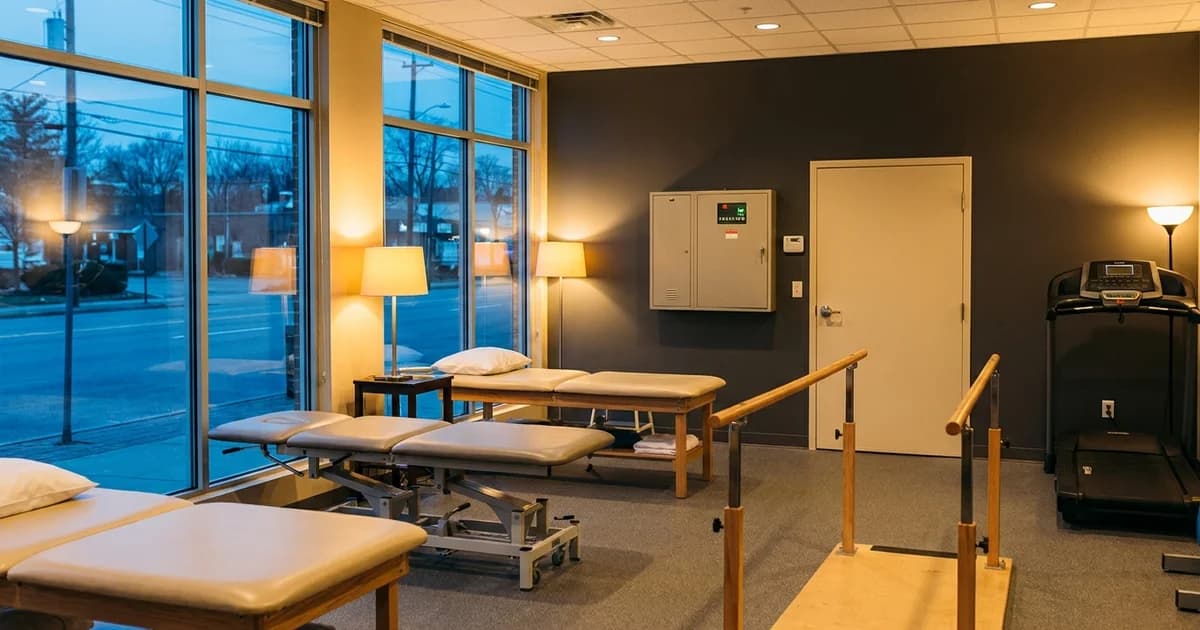
The composite: a 3,400 square foot suite in a Katy medical office building. Two physical therapists, one assistant, and a chiropractor who leases the two rooms at the back. Nine treatment stations, a hydrocollator, a traction table, two treadmills, an ultrasound and e-stim cart, four workstations running a cloud electronic medical record, and a front desk. Roughly 26 visits a day, Monday through Friday, plus a half day Saturday.
Houston has the density to make this a common shape. The metro employed 3,650 physical therapists and 650 chiropractors in May 2023 (BLS Occupational Employment and Wage Statistics), most of them working in suites like the one above rather than in hospitals.
Why a cancelled visit costs more than a cancelled sale
A restaurant that closes for a day sells that meal tomorrow. A rehab clinic does not. The visit was scheduled inside a treatment window, and the window keeps moving whether the patient is on the table or not. Medicare requires a therapy plan of care to be recertified at least every 90 days (eCFR, 42 CFR 424.24). A week of cancelled visits compresses what is left of that window instead of extending it.
Attendance is already fragile without a storm helping. In a review of 6,595 outpatient orthopedic and sports medicine referrals, 9.6% of patients never showed for the initial evaluation (Physical Therapy, 2021). Every clinic owner knows the second half of that pattern: a patient who breaks the routine once often does not come back at all. An outage doesn't just cancel Tuesday. It hands your least committed patients a reason to stop.
That is the number worth putting on the whiteboard. Not the cost of a spoiled fridge, because there usually isn't one. The cost is the slice of your active caseload that quietly does not return, multiplied by the authorized visits each of those patients had left.
What does HIPAA require when the lights go out?
It requires you to have planned for exactly this. The contingency plan standard at 45 CFR 164.308(a)(7)(i) tells covered entities to establish policies and procedures for responding to "an emergency or other occurrence (for example, fire, vandalism, system failure, and natural disaster) that damages systems that contain electronic protected health information" (Cornell LII).
Three of its implementation specifications are Required rather than addressable: a data backup plan, a disaster recovery plan, and an emergency mode operation plan. That last one is the one clinic owners skip. It calls for procedures "to enable continuation of critical business processes for protection of the security of electronic protected health information while operating in emergency mode."
The rule never names a battery, a generator or any other piece of hardware. It names an outcome. If your emergency mode plan for a Houston summer outage is "the server closet is dark and the tablets die at noon," you have a plan on paper and nothing underneath it. Power is what makes the paper true.
Is losing air conditioning a clinical problem or a comfort problem?
Clinical. Rehab is supervised physical exertion, and the room is part of the treatment. OSHA has long recommended that employers keep indoor workplace temperature in the range of 68 to 76°F with relative humidity between 20% and 60%, referencing ASHRAE Standard 55 for thermal comfort (OSHA standard interpretation, 2003).
Houston makes that harder than most markets. The normal daily high at Bush Intercontinental peaks near 96°F in early August, with a monthly mean high of 94.9°F under the 1991-2020 normals (National Weather Service Houston). The humidity is the real problem, not the thermometer. Sweat evaporation is the body's main cooling path, and high humidity slows evaporation, which is why NIOSH lists high humidity and physical exertion together among heat illness risk factors (CDC NIOSH, Heat Stress workplace recommendations).
Now put a 68 year old post-op knee patient on a recumbent bike in that room. You are not going to run that session. You will send everyone home, which puts you right back at the cancelled calendar.
What does a rehab clinic actually draw?
Less than owners expect, and more evenly. This is the part that separates outpatient rehab from the practices we have written about elsewhere. A dental suite has a sterilizer and a vacuum. An urgent care has a vaccine refrigerator running a clock you cannot pause. A rehab clinic has almost none of that.
What it has instead is a steady baseline: lights, four or five workstations, a Wi-Fi stack and router, the front desk, a hydrocollator that behaves like a heated water tank, a modality cart that pulls only in short bursts during treatment, and two treadmills that run at a fraction of nameplate under real patient use. The single largest load in the suite is almost always the air conditioning.
Per-device wattage for hydrocollators, traction tables and modality carts is not published in any standards source we could verify, and manufacturer marketing figures are not evidence. So we don't guess. On clinic walkthroughs we meter the panel for a week and size against the measured curve. The shape is consistent: a flat daytime baseline with small bumps, not the spiky profile of a kitchen or a machine shop.
Honest sizing: where one controller works, and where it stops
A single Eos controller delivers 11.5 kW continuous with 17.1 kW of surge headroom. For a leased clinic suite that covers a great deal: full lighting, every workstation and the network, the front desk, the modality equipment, the hydrocollator, and a mini-split or a single small packaged unit serving the suite.
Here is the boundary, stated plainly. Full building HVAC is where one controller stops. If your suite is served by a shared rooftop unit sized for the whole building, that load is not yours to back up and often not yours to touch, because it belongs to the landlord's system. In those buildings the honest answer is a two part conversation: battery for your suite's electrical panel, and a separate discussion with building management about the rooftop equipment.
The other boundary is duration. Beryl is the reference case. More than 2.6 million Texas customers lost power on July 8, 2024, and hundreds of thousands were still out a week later (The Texas Tribune, 2024). Around 2.2 million of those were CenterPoint customers in the Houston area on day one (Houston Public Media, 2024). No clinic sized battery runs a nine day outage. What it does is cover the far more common case: the four hour feeder fault, the overnight transformer failure, the afternoon storm, and the first day or two after a major event when your building has power restored before your patients' neighborhoods do.
What to do first, in order
- Pull your last twelve months of visit volume and count the days you closed or ran short because of power. That is your real baseline, not a hypothetical.
- Read your emergency mode operation plan. If you can't find it, that is the finding.
- Meter the suite panel for a week before anyone quotes you a system.
- Check your lease. Find out what sits on your panel and what sits on the landlord's.
- Decide what "open" means for you. Treating at full capacity and answering the phone with a working schedule are two different targets, and they size very differently.
For the wider view across practice types, our guide to battery backup for medical and dental practices in Texas covers the cold chain and sterilizer problems that rehab clinics do not have. The urgent care clinic guide covers the walk-in surge that follows an outage, and commercial battery backup for Texas businesses covers the general sizing framework.
Or call Eos at 833-989-3737 to talk through your setup with an installer.
Frequently asked questions
Does HIPAA require a physical therapy clinic to have backup power?
No. HIPAA requires an outcome, not a device. The Security Rule's contingency plan standard makes a data backup plan, a disaster recovery plan and an emergency mode operation plan Required implementation specifications (45 CFR 164.308(a)(7)). How you keep records available during an outage is your decision to document.
Can a chiropractic office stay open during a power outage?
Manual adjustment does not need electricity, but scheduling, billing, records and payment do, and so does the air conditioning. In a Houston summer with a normal August high near 95°F (NWS Houston), room temperature usually decides the question before the equipment does.
How long will a battery run an outpatient clinic?
It depends on measured load, not on a brochure. A suite backed by one controller at 11.5 kW continuous typically runs lighting, workstations, network and modality equipment far longer than it runs air conditioning. Metering the panel first is the only honest way to answer this.
Is a generator a better fit for a small clinic?
Generators cover long duration outages better and need fuel, permitting, exhaust clearance and maintenance. Batteries cover the common short outage instantly and silently, with no fuel and no noise in a treatment room. Many clinics in leased medical office space cannot site a generator at all.
What size system does a physical therapy clinic need?
Most single suite clinics fit one controller. Practices with their own building, their own rooftop HVAC, or several suites under one meter move into multi-controller territory. The dividing line is almost always the air conditioning, not the rehab equipment.
The calendar is the asset
Every backup power decision in a rehab clinic comes back to one question: how many visits do you lose, and how many of those patients never come back? Protect the schedule and the records, keep the room habitable, and the outage becomes an inconvenience instead of a month of recovery.
Sources
- Cornell Legal Information Institute, 45 CFR 164.308 Administrative safeguards, retrieved 2026-09-08, https://www.law.cornell.edu/cfr/text/45/164.308
- eCFR, 42 CFR 424.24 Requirements for medical and other health services furnished by providers under Medicare Part B, retrieved 2026-09-08, https://www.ecfr.gov/current/title-42/chapter-IV/subchapter-B/part-424/subpart-B/section-424.24
- Physical Therapy (Oxford Academic), Predictive Factors for Patients' Failure to Show for Initial Outpatient Physical Therapist Evaluation, 2021, retrieved 2026-09-08, https://academic.oup.com/ptj/article/101/5/pzab047/6124132
- OSHA, Reiteration of Existing OSHA Policy on Indoor Air Quality: Office Temperature/Humidity and Environmental Tobacco Smoke, 2003, retrieved 2026-09-08, https://www.osha.gov/laws-regs/standardinterpretations/2003-02-24
- CDC NIOSH, Heat Stress Workplace Recommendations, retrieved 2026-09-08, https://www.cdc.gov/niosh/heat-stress/recommendations/index.html
- National Weather Service Houston/Galveston, Houston IAH Normals, Means and Extremes for August, retrieved 2026-09-08, https://www.weather.gov/hgx/climate_iah_normals_aug
- U.S. Bureau of Labor Statistics, May 2023 OEWS Houston-The Woodlands-Sugar Land Metropolitan Area Estimates, retrieved 2026-09-08, https://www.bls.gov/oes/2023/may/oes_26420.htm
- The Texas Tribune, Public Utility Commission releases investigative report on CenterPoint Energy's Hurricane Beryl response, 2024, retrieved 2026-09-08, https://www.texastribune.org/2024/07/25/texas-power-grid-puc-centerpoint-hurricane-beryl/
- Houston Public Media, Houston power outages: Hurricane Beryl plunges 2.2 million into the dark, 2024, retrieved 2026-09-08, https://www.houstonpublicmedia.org/articles/news/hurricane/2024/07/08/492833/houston-power-outages-hurricane-beryl-centerpoint/