Jersey Village and Bear Creek Battery Backup: Homes Inside the Flood Pool

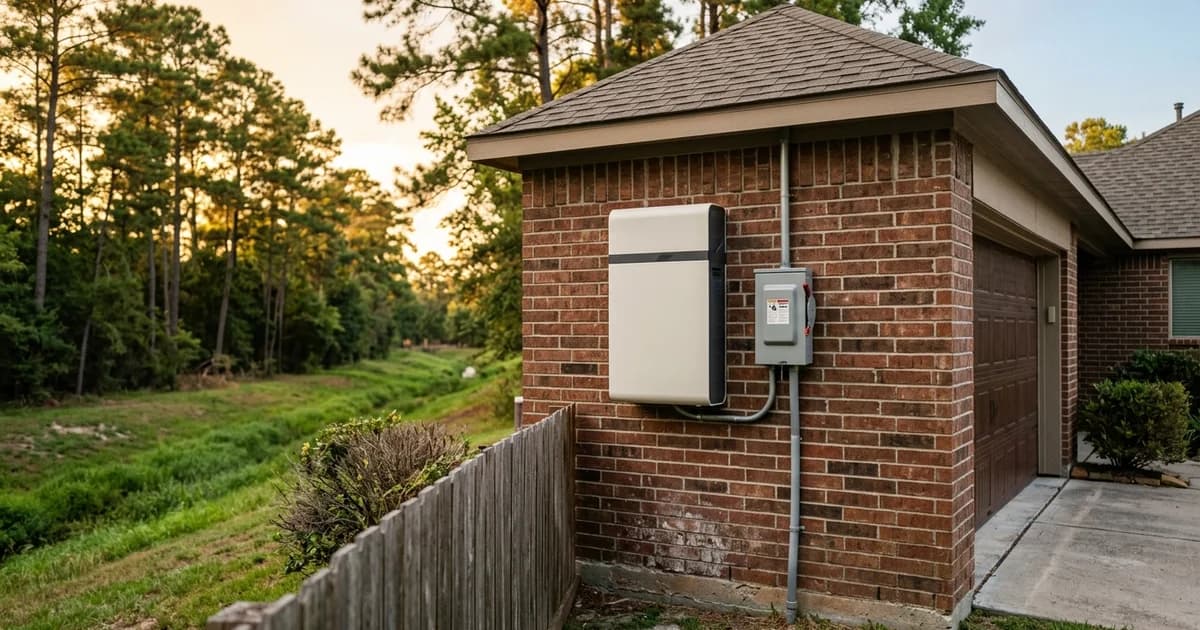
Two northwest Harris County neighborhoods sit a few miles apart and face completely different flood mechanics. Jersey Village is its own incorporated city, built along White Oak Bayou. The Bear Creek area to the south sits beside Addicks Reservoir, on ground the federal government is allowed to put water on. Both lose power in the same storms. Neither should get the standard Houston battery install. This guide covers what actually changes here: where the equipment sits, who issues the permit, and what you have to disclose later.
Key Takeaways
- Behind Addicks Dam the government bought land only up to roughly 103 feet elevation. The pool crested at 109.1 feet on August 30, 2017 (U.S. Court of Federal Claims, 2019).
- Jersey Village is a home rule city with its own permit office, so your install is reviewed at City Hall, not by Harris County.
- Jersey Village requires new construction in flood hazard areas to sit 24 inches above Base Flood Elevation.
- Texas sellers must disclose whether a property is in a reservoir or flood pool, which makes your install records worth keeping.
Why is the Addicks flood pool a real design factor near Bear Creek?
When the dams were built, the United States acquired all land behind Addicks at or below about 103 feet of elevation, roughly 12,460 acres, and all land behind Barker at or below about 95 feet (U.S. Court of Federal Claims, In re Upstream Addicks and Barker, December 17, 2019). Homes were later built above that line but below the maximum pool. That gap is the whole story.
During Harvey the Corps of Engineers initiated releases from both reservoirs shortly after midnight on August 28, 2017, and the flood pools crested two days later at a record 109.1 feet in Addicks and 101.6 feet in Barker. Harvey dropped an average of 33.7 inches of rain over four days and flooded more than 150,000 homes across the region, according to the same post-trial decision. The court held that the government had taken a permanent flowage easement on the upstream properties it inundated.
A Corps reservoir manager put the pre-Harvey view plainly: the agency could "hold approximately a 100-year-flood within the boundaries of the government property," and 2017 was "the first time we have flooded homes located adjacent to and upstream from the property" (Houston Flood Museum). This is documented history and an active property matter, not a scare line. It is also the single best argument for mounting backup equipment high.
Does Jersey Village's own city government change the permit path?
Yes, completely. Jersey Village is a home rule municipality in Harris County with its own mayor, council and staff (Texas Municipal League directory). It runs its own permit office and administers its own floodplain rules through Public Works. The city states that permits are required "for most work done throughout Jersey Village, not just in the floodplain," and that new construction in flood hazard areas must be built 24 inches above the 1% annual chance floodplain, or Base Flood Elevation (City of Jersey Village).
That matters more than it sounds. A battery backup install inside city limits goes through Jersey Village plan review. A Bear Creek address a few minutes away in unincorporated Harris County goes through the county instead, and a nearby address inside Houston city limits goes through a third office. Same product, three different reviewers, three different turnaround times. Ask your installer which office they are filing with before they order equipment.
What does White Oak Bayou history tell you about mounting height?
Jersey Village has been buying its way out of the floodplain for years. After the April 2016 Tax Day flood damaged more than 230 structures, the city identified roughly 60 homes as candidates for elevation or buyout and has secured about $27.6 million in grant awards, elevating homes to Base Flood Elevation plus one foot of freeboard (City of Jersey Village Long Term Flood Recovery Plan). The Harris County Flood Control District is widening the White Oak Bayou channel through the city, and Jersey Village moved to a Community Rating System Class 5 in October 2024, which carries a 25% flood insurance premium discount inside the Special Flood Hazard Area (FEMA, 2024).
Our read: a city that spends eight figures lifting houses out of the water has already answered the question about your battery. Raising the equipment is the cheap version of the same decision, and it costs almost nothing at install time.
How high should the battery and its electrical gear sit?
Federal floodplain rules are blunt about this. Under 44 CFR 60.3, new construction and substantial improvements must have "electrical, heating, ventilation, plumbing, and air conditioning equipment and other service facilities" designed or located to prevent water from entering or accumulating in them during flooding (eCFR). Batteries, inverters and disconnects fall squarely in that sentence.
In practice, for this part of the county:
- Wall mount the battery modules and controller high on an interior garage wall or a protected exterior wall, not on a floor pad.
- Put the disconnect, controller and smart panel above the local elevation requirement, which in Jersey Village means Base Flood Elevation plus 24 inches.
- Seal conduit penetrations and route them downward into the enclosure so water cannot track in.
- Keep the equipment out of any space that has ever taken water, including the back corner of a garage that flooded in 2016.
Elevation also protects the load you actually care about during a wet outage. If you run a sump or a drainage pump, read our guide to battery backup for sump pumps in Houston before you finalize the circuit list.
How much backup capacity does a northwest Harris County home need?
Outages here are long, not brief. U.S. electricity customers averaged 11 hours of interruption in 2024, and major events including Hurricane Beryl accounted for 80% of those hours, with Beryl alone leaving 2.6 million Texas customers without power (U.S. Energy Information Administration, 2025). A storm that floods the bayou is usually the same storm that drops pine limbs onto the distribution lines.
Sizing follows from that. Every Eos system runs a single smart controller rated 11.5 kW continuous with 17.1 kW surge, which is what lets it restart a central air conditioner instead of just holding the refrigerator. The variable is capacity, and the honest starting point for a full day of coverage in a two-story Jersey Village home is the Plus tier. If you are still weighing a standby generator against a battery, our Cypress battery backup versus generator comparison covers the fuel, noise and permitting tradeoffs for the same corner of the metro. Katy homeowners on the Barker side of the divide face the same reservoir question, and our Katy service page covers that market.
What do you have to disclose when you sell?
Texas seller's disclosure is explicit here. The statutory notice under Property Code Section 5.008 asks whether the property is located wholly or partly "in a floodway," "in a flood pool," "in a reservoir," and "in a 100-year floodplain," and it defines a flood pool as the area adjacent to a reservoir above the normal maximum operating level "subject to controlled inundation under the management of the United States Army Corps of Engineers" (Texas Property Code Sec. 5.008).
Keep the permit, the elevation documentation and the equipment photos in one folder. Buyers in this market ask, and an elevated, permitted battery install reads as risk reduction rather than as a red flag. The same folder helps if you ever file after a storm, which we walk through in our guide to power outage insurance claims in Houston.
Or call Eos at 833-989-3737 to talk through your setup with an installer.
Frequently Asked Questions
Is every Jersey Village home in the flood pool?
No. Jersey Village sits on White Oak Bayou, not inside the Addicks or Barker reservoir footprint. The reservoir flood pool question applies to the Bear Creek area and other neighborhoods upstream of the dams, where the government owns land only up to about 103 feet of elevation behind Addicks.
Who issues the electrical permit for a battery install in Jersey Village?
The City of Jersey Village. It is a home rule city with its own permit department, reachable at 713-466-2110, and its own floodplain administration. Addresses in unincorporated Harris County near Bear Creek are permitted through the county instead.
How high does the equipment have to be mounted?
Jersey Village requires new construction in flood hazard areas to be 24 inches above Base Flood Elevation. Federal rules under 44 CFR 60.3 separately require electrical and service equipment to be located so floodwater cannot enter it. Wall mounting handles both requirements at once.
Does a battery help if the house itself floods?
It helps with the outage, not the water. A battery keeps drainage pumps, refrigeration, lighting and communications running while the grid is down, which is often days. It does not stop inundation, and equipment mounted at floor level will be lost with everything else.
Sources
- U.S. Court of Federal Claims, In re Upstream Addicks and Barker (Texas) Flood-Control Reservoirs v. United States, Sub-Master Docket No. 17-9001L, filed December 17, 2019, retrieved 2026-09-08, https://biotech.law.lsu.edu/blog/In-re-Upstream-Addicks.pdf
- Houston Flood Museum, How the Barker and Addicks Dams Work, retrieved 2026-09-08, https://houstonfloodmuseum.org/how-the-barker-and-addicks-dams-work/
- City of Jersey Village, Floodplain Information, retrieved 2026-09-08, https://www.jerseyvillage.gov/228/Floodplain-Information
- City of Jersey Village, Long Term Flood Recovery Plan, retrieved 2026-09-08, https://www.jerseyvillage.gov/248/Long-Term-Flood-Recovery-Plan
- Texas Municipal League, City of Jersey Village directory profile, retrieved 2026-09-08, https://directory.tml.org/profile/city/990
- FEMA, Community Rating System Discount Frequently Asked Questions, September 2024, retrieved 2026-09-08, https://www.fema.gov/sites/default/files/documents/fema-nfip-community-rating-system-discount-faq-09-2024.pdf
- eCFR, 44 CFR 60.3, Flood plain management criteria for flood-prone areas, retrieved 2026-09-08, https://www.ecfr.gov/current/title-44/chapter-I/subchapter-B/part-60/subpart-A/section-60.3
- U.S. Energy Information Administration, Hurricanes in 2024 led to the most hours without power in the United States in 10 years, retrieved 2026-09-08, https://www.eia.gov/todayinenergy/detail.php?id=66744
- Texas Property Code Section 5.008, Seller's Disclosure of Property Condition, retrieved 2026-09-08, https://texas.public.law/statutes/tex._prop._code_section_5.008