Anker Solix X1 vs Sigenergy for Houston Homes: Which Modular Battery Wins?

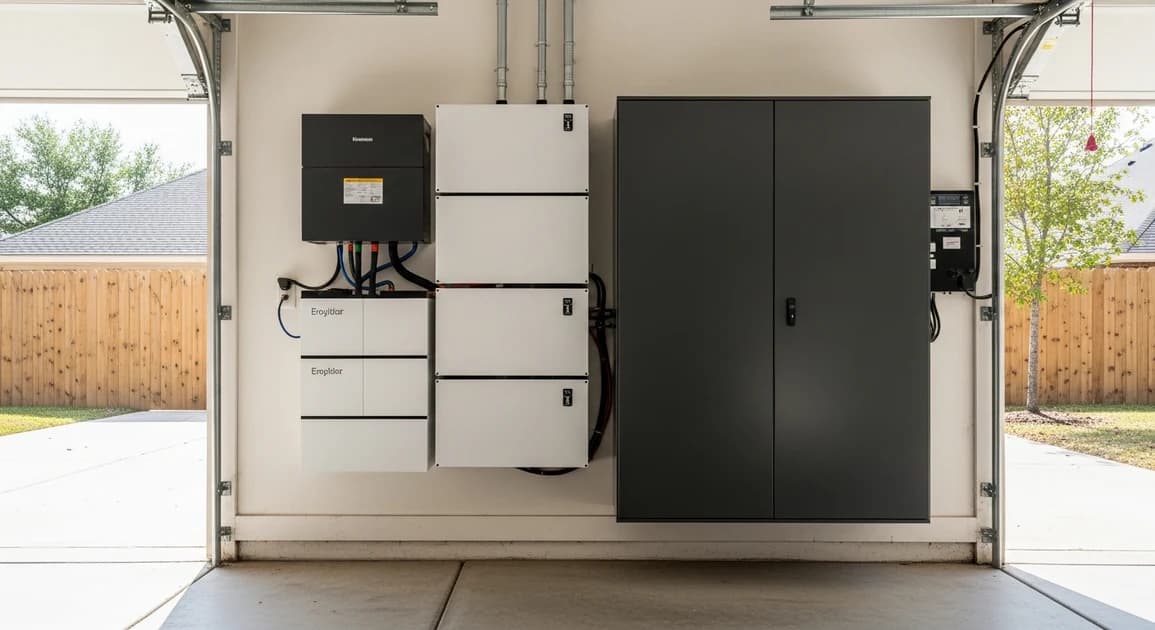
When Hurricane Beryl cut power to 2.2 million Houston customers in July 2024 (Houston Public Media, 2024), battery shoppers stopped asking whether to buy and started comparing brands. Two of the most interesting modular options in 2026 come from very different places. Anker, a consumer electronics giant, entered home storage with the sleek stackable Solix X1. Sigenergy, a storage-native company, built the SigenStor as an all-in-one cabinet with the inverter inside. Full disclosure up front: Sigenergy is the product line Eos installs in the Houston metro. Every spec below comes from manufacturer datasheets and published third-party reviews, and there is an honest when-Anker-wins section, because sometimes it does.
Key Takeaways
- Anker Solix X1 scales in 5 kWh modules from 5 to 30 kWh per stack; Sigenergy SigenStor scales roughly 8 to 48 kWh in one cabinet (Anker Solix, Sigenergy, 2026).
- X1 output runs 3-6 kW per power module, up to 12 kW with a second module; SigenStor pairs an integrated 8-15 kW hybrid inverter.
- Anker claims full-power operation from -4 F to 131 F, a spec aimed directly at garages in climates like Houston's.
- Both warranties run 10 years, but the fine print differs: Anker caps throughput at 16.5 MWh per 5 kWh module, roughly 3,300 full cycles. Sigenergy allows 8,000 cycles.
- Eos installs Sigenergy in Houston; that bias is disclosed here, and the numbers come from datasheets.
[INTERNAL-LINK: get a Houston battery backup quote in under 2 minutes → /home-backup-planner?source=blog&slug=anker-solix-x1-vs-sigenergy-houston]
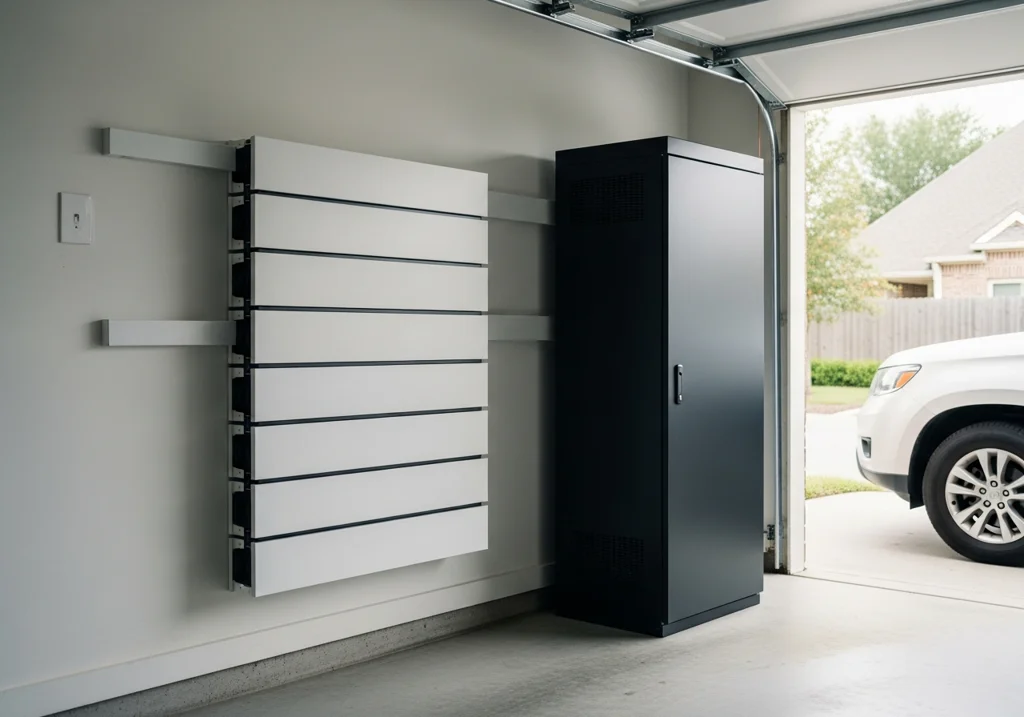
Anker Solix X1 vs Sigenergy SigenStor: how do the spec sheets compare?
In 2026, Anker's official Solix X1 spec page lists stackable 5 kWh LiFePO4 modules that build from 5 to 30 kWh per stack, with up to 6 stacks in parallel for a maximum of 180 kWh and 36 kW (Anker Solix, 2026). The Sigenergy SigenStor scales from 8 to 48 kWh inside one floor-standing cabinet with an integrated 8-15 kW hybrid inverter (Sigenergy, 2026).
The design philosophies show immediately. The X1 is a wall-mounted system just 5.9 inches deep, with a switchover to backup power in under 20 milliseconds, fast enough that most electronics never notice (Anker Solix, 2026). It looks like what it is: a product from a company that obsesses over industrial design. The SigenStor looks more like infrastructure, because it is. Battery modules, hybrid inverter, and an optional EV charger stack into a single enclosure.
Anker Solix X1 vs Sigenergy SigenStor Spec Sheet
| Spec | Anker Solix X1 | Sigenergy SigenStor |
|---|---|---|
| Module size | 5 kWh | ~8 kWh |
| Stack range | 5-30 kWh per stack (180 kWh max parallel) | 8-48 kWh, one cabinet |
| Output per stack | 3-6 kW, 12 kW with a second module | 8-15 kW continuous |
| Inverter | Separate or paired hybrid | Integrated hybrid |
| Switchover | Under 20 ms | UPS-class transfer |
| Operating range | -4 F to 131 F (Anker claim) | Datasheet range, derates in extreme heat |
| Warranty | 10 yr or 16.5 MWh per module | 10 yr, 8,000 cycles |
| Installed $/kWh (Houston) | ~$750-$1,000 | ~$900-$1,100 |
Citation capsule. The Anker Solix X1 builds from 5 to 30 kWh per stack in 5 kWh module steps with 3-6 kW output per power module, while the Sigenergy SigenStor scales 8 to 48 kWh in one cabinet with an integrated 8-15 kW hybrid inverter (Anker Solix, Sigenergy, 2026).
Which system is more modular for a Houston home?
Both are genuinely modular, but they answer different sizing questions. The X1's 5 kWh steps let you buy closer to your true need: a home that calculates 14 kWh of required storage buys 15 kWh, not 16 or 20. Sigenergy moves in roughly 8 kWh increments, so you sometimes round up further, but the single cabinet reaches 48 kWh before you ever need a second enclosure (Sigenergy, 2026). The X1 tops out at 30 kWh per stack and needs parallel stacks beyond that (Anker Solix, 2026).
[UNIQUE INSIGHT] Modularity granularity cuts both ways, and almost no review says so. Finer steps favor small and mid-size builds. A bigger single-cabinet ceiling favors whole-home builds. A Houston home that needs about 17 to 26 kWh usable, the band our Plus and Pro plan tiers cover, fits either architecture cleanly. A home targeting 35 kWh or more, Premium and Ultimate territory, reaches it in one Sigenergy cabinet but needs two parallel X1 stacks.
Citation capsule. Anker's Solix X1 scales in 5 kWh increments to 30 kWh per stack, finer sizing steps than Sigenergy's roughly 8 kWh modules, but SigenStor reaches 48 kWh in a single cabinet before parallel hardware is required (Anker Solix, Sigenergy, 2026).
[INTERNAL-LINK: check if your home qualifies for a 9 to 45 kWh system → /home-backup-planner?source=blog&slug=anker-solix-x1-vs-sigenergy-houston]
Inverter output: where does the power go during an outage?
Output is the widest measurable gap between these two. A single X1 power module delivers 3 to 6 kW of continuous power, and adding a second power module takes a stack to 12 kW (SolarReviews, 2026). The SigenStor's integrated hybrid inverter runs 8 to 15 kW continuous depending on configuration (Sigenergy, 2026).
Why does that matter in Houston specifically? Central air conditioning. A 4 or 5 ton AC compressor demands a large surge at startup and a steady multi-kilowatt draw all afternoon. A 6 kW single-module X1 build can run a Houston home, but it needs deliberate load management: the AC, the dryer, and the oven cannot all fire at once. The SigenStor's higher continuous band covers whole-home loads with less juggling.
On round-trip efficiency, both systems use LiFePO4 chemistry with DC-coupled solar paths that avoid extra conversion steps when charging from panels. Published third-party efficiency test data for both units is thin in 2026, so treat any single percentage claim you read elsewhere with caution and compare architectures instead.
Citation capsule. A single Anker Solix X1 power module outputs 3-6 kW continuous, expandable to 12 kW with a second module, while the Sigenergy SigenStor's integrated hybrid inverter delivers 8-15 kW continuous, a meaningful gap for homes running central air through an outage (SolarReviews, Sigenergy, 2026).
Can either battery handle Houston heat?
Anker's answer is the boldest temperature claim in residential storage. The company states the X1 operates from -4 F to 131 F and delivers full power even at 131 F, crediting a modular cooling design (Anker Solix, 2026). That is Anker's own marketing language, and some third-party coverage cites a narrower band for certain configurations (Solar Builder, 2024), but the target of the claim is obvious: garages in places exactly like Houston.
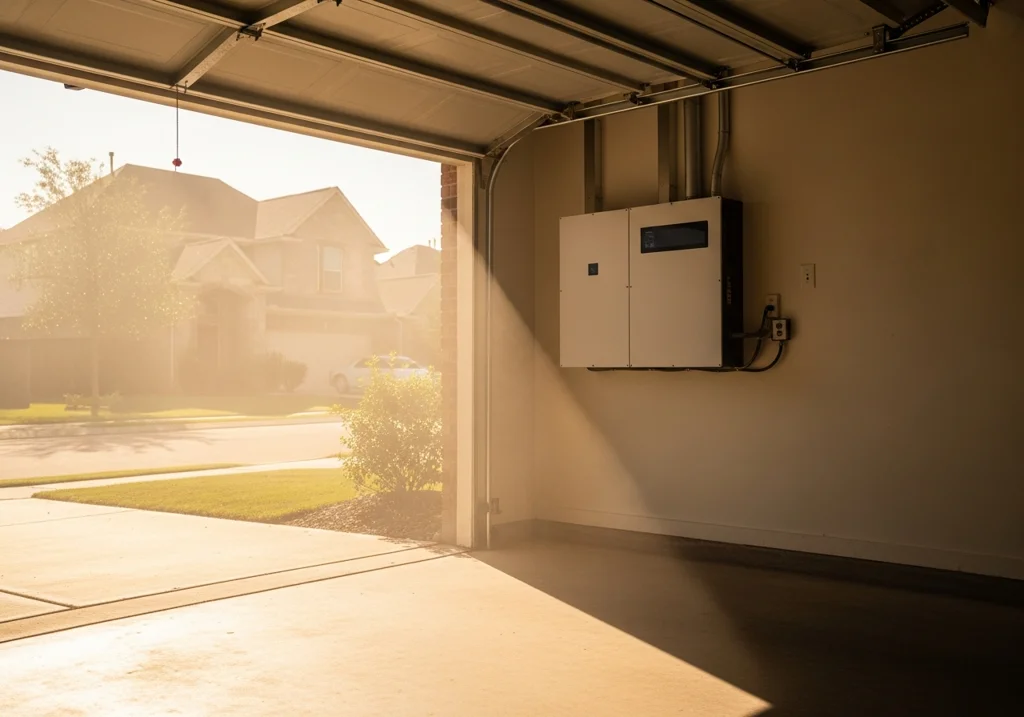
Sigenergy publishes a standard operating range on its datasheet, and like every lithium battery, the SigenStor derates or self-protects in extreme heat. Here is the Houston-specific reality: August garage temperatures in the metro routinely climb past 100 F, so the derating threshold matters more here than in almost any other US market. Whichever brand you pick, a shaded install wall beats a west-facing one.
Citation capsule. Anker claims the Solix X1 delivers full power from -4 F to 131 F via modular cooling (Anker Solix, 2026), a spec pitched at hot-climate garages, while Sigenergy's SigenStor, like all LiFePO4 systems, derates to protect itself as Houston garages pass 100 F in summer.
How do the warranties actually compare?
Both carry 10-year warranties, and both numbers hide different math. Anker warrants each 5 kWh X1 module for 10 years or 16.5 MWh of throughput, whichever comes first (SolarReviews, 2026). Sigenergy warrants the SigenStor for 10 years and 8,000 cycles (Sigenergy, 2026).
[UNIQUE INSIGHT] Those units are not comparable until you convert them, and no published comparison we have found does the conversion. Divide Anker's 16.5 MWh by the 5 kWh module size and you get roughly 3,300 equivalent full cycles. Sigenergy's cap is 8,000 cycles, about 2.4 times more warranty headroom per rated cycle.
Does the gap matter for you? It depends on use. EnergySage estimates home batteries cycle about 200 to 350 times per year when used for daily solar self-consumption (EnergySage, 2026). At 300 cycles per year, Anker's 3,300-cycle throughput cap arrives around year 11, just past the calendar warranty, and at 350 cycles it arrives near year 9, inside it. Sigenergy's 8,000-cycle ceiling sits decades beyond the 10-year term. A backup-only home that discharges 6 to 15 times a year never approaches either cap.
Citation capsule. Converted to the same unit, Anker's Solix X1 warranty allows roughly 3,300 equivalent full cycles (16.5 MWh per 5 kWh module) against Sigenergy's 8,000 cycles, and at EnergySage's estimated 300 daily-cycling events per year, Anker's cap can arrive inside the 10-year term (SolarReviews, EnergySage, 2026).
What do they cost installed in Houston in 2026?
Anker's aggressive equipment pricing is its strongest argument. SolarReviews puts X1 equipment near $650 per kWh, with a 15 kWh system at roughly $9,750 in hardware and $11,250 to $14,750 installed depending on site complexity (SolarReviews, 2026). [ORIGINAL DATA] Houston SigenStor installs run about $11,000 for an 8 kWh build up to roughly $30,000 at 32 kWh, or $900 to $1,100 per kWh at larger sizes, based on Eos Houston quoting data.
Both sit favorably inside the Texas market band. EnergySage pegs the statewide installed average at $1,000 to $1,800 per kWh across premium home battery brands (EnergySage, 2026). Remember what each price includes, though: a SigenStor quote includes the hybrid inverter, while an X1 build's output ceiling depends on how many power modules you add.
At Eos, we price Sigenergy installs as fixed plan tiers rather than per-project quotes, from the Essential 9 kWh system through the Ultimate 45 kWh class, each with cash and monthly options published openly on the plans page.
Citation capsule. In 2026, SolarReviews prices Anker Solix X1 equipment near $650 per kWh, roughly $11,250-$14,750 installed at 15 kWh, while Houston SigenStor installs land between $900 and $1,100 per kWh at scale, both inside EnergySage's $1,000-$1,800 Texas average (SolarReviews, EnergySage, 2026).
[INTERNAL-LINK: see your monthly payment for whole-home backup → /plans]
App, VPP readiness, and the Houston installer network
Software is where Anker's consumer heritage shows. The Anker app carries the polish of a company that has shipped tens of millions of consumer devices, and X1 owners get the same clean monitoring experience. Sigenergy's mySigen app leans more technical, with AI-assisted energy management that schedules charging around weather and usage patterns (Sigenergy, 2026). On aggregation programs in Texas, both platforms are technically capable of grid services, but program participation changes quarter to quarter, so confirm current enrollment options with your installer rather than a spec sheet.
[PERSONAL EXPERIENCE] The installer network is the gap buyers underestimate. Anker launched the X1 in the US in 2024, and its Texas residential storage dealer network is still young; finding a Houston crew that has commissioned ten of them is hard in 2026. Sigenergy's Houston network is smaller than Tesla's but established and growing, and Eos is part of it, which is the bias disclosed at the top. What that means practically: when a firmware fault or a failed module needs a service call in week 3, network maturity decides whether the fix takes days or weeks.
For deeper background on the platform we install, read the full Sigenergy SigenStor review, or see how it stacks up against the bigger names in our Tesla Powerwall 3 vs Sigenergy comparison and FranklinWH vs Sigenergy comparison.
Verdict: which modular battery wins for Houston?
The honest split: the Anker Solix X1 wins on sizing granularity, wall-mounted aesthetics, and entry price for small builds. If you need 10 to 15 kWh, care how the garage wall looks, do not run a 5-ton AC, and already trust the Anker ecosystem, it is a legitimate choice, and its 131 F full-power claim deserves credit for taking hot climates seriously.
The Sigenergy SigenStor wins where Houston homes usually end up: higher continuous output for central air, a 48 kWh single-cabinet ceiling, 8,000-cycle warranty headroom, an integrated hybrid inverter with optional EV charging, and an established local install base. For whole-home backup through a multi-day Beryl-style outage, that combination is the stronger package.
[INTERNAL-LINK: book a free Houston home assessment → /home-backup-planner?source=blog&slug=anker-solix-x1-vs-sigenergy-houston]
Prefer to talk it through first? Call Eos at +1 833-989-3737 and a Houston installer will walk you through both options.
FAQ
Is the Anker Solix X1 available in Houston?
Yes, but through a young dealer network. Anker launched the X1 in the US in 2024, and certified Texas residential storage installers remain limited in 2026 (SolarReviews, 2026). Confirm your installer has commissioned X1 systems before, since network maturity affects service response after the sale.
How many kWh can the Anker Solix X1 reach?
A single X1 stack scales from 5 to 30 kWh in 5 kWh module steps, and up to 6 stacks run in parallel for a maximum of 180 kWh and 36 kW of output (Anker Solix, 2026). Most Houston homes land between 15 and 45 kWh.
Which battery handles Texas heat better?
On paper, Anker: it claims full power from -4 F to 131 F via modular cooling (Anker Solix, 2026). Sigenergy publishes a standard datasheet range, and both systems self-protect in extreme heat. Since Houston garages pass 100 F each summer, shaded placement helps either brand.
What is the real difference between the two warranties?
Units. Anker warrants 10 years or 16.5 MWh of throughput per 5 kWh module, roughly 3,300 equivalent full cycles. Sigenergy warrants 10 years and 8,000 cycles (SolarReviews, Sigenergy, 2026). Daily-cycling homes can reach Anker's cap inside the term; backup-only homes never approach either.
Does Eos install the Anker Solix X1?
No. Eos installs Sigenergy SigenStor systems across the Houston metro, which is why that bias is disclosed throughout this comparison. We publish it because cross-shoppers ask, and the numbers stand on their own. The home assessment is free either way, and it starts at our two-minute qualification form.