Does a Home Battery Increase Your Home's Value in Texas?

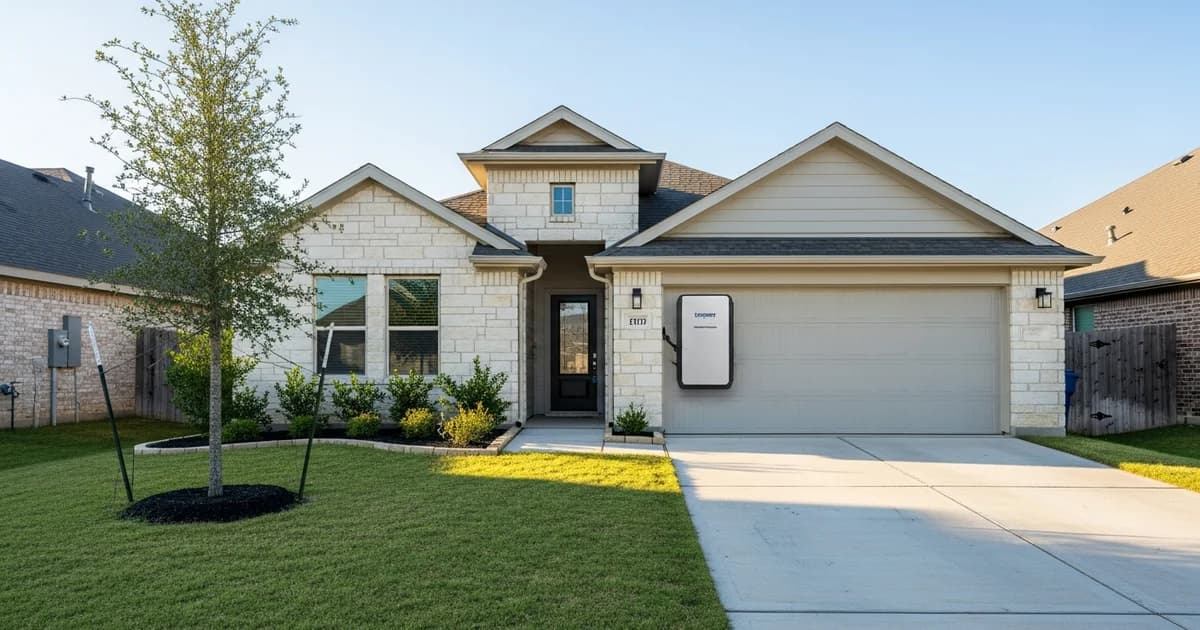
Does a Home Battery Increase Your Home's Value in Texas?
Yes, a home battery does add resale value in Texas, but the lift is modest and conditional, not the main reason to buy. The closest reliable proxy is solar-plus-storage: in 2024, homes with solar sold for roughly 6.8% more than comparable homes without it (SolarReviews, 2024). In a metro that lost power for days after Hurricane Beryl, backup is now a feature buyers notice.
After the 2021 freeze and Beryl in 2024, Houston buyers started asking sellers a question they never used to ask: does this house stay on when the grid goes down? That shift matters if your last objection before installing a battery is whether it will pay you back at resale.
This article gives you the honest data: how much resale lift to expect, how appraisers actually treat a battery, why ownership decides whether it counts, and why resilience, not resale, should drive the decision.
[INTERNAL-LINK: get a Houston battery backup quote in under 2 minutes -> /home-backup-planner?source=blog&slug=home-battery-increases-home-value-texas]
Key Takeaways
- A home battery adds resale value in Texas, but modestly. Solar-equipped homes sell for about 6.8% more, the best available proxy (SolarReviews, 2024).
- Appraisers credit owned, permanently installed, documented systems as a contributory improvement, similar to solar.
- Houston's post-Beryl buyer demand makes backup a genuine listing feature, not a quirk.
- Owned systems transfer and count toward value. Leased or third-party-owned systems usually do not.
- Buy for resilience first. Treat the resale lift as the tiebreaker, not the headline.
Does a Home Battery Increase Home Value in Texas?
In 2024, homes with solar panels sold for about 6.8% more than comparable homes without them (SolarReviews, 2024). That figure is the best proxy we have for a battery's resale effect, because standalone-battery resale data is still thin while solar-plus-storage data is robust. The answer is yes, but modestly and conditionally.
Why lean on solar data? Batteries and solar are valued by the same logic: a permanently installed, owned energy asset that lowers a buyer's risk and bills. The same SolarReviews analysis of Zillow data found solar homes also tend to sell faster, often 15 to 20% quicker than comparable listings. Backup storage rides on that same buyer appeal.
In 2024, homes with solar sold for roughly 6.8% more than equivalent non-solar homes, the strongest available proxy for a battery's resale effect (SolarReviews, 2024). In storm-prone Houston, add a resilience premium on top: buyers who lived through Beryl will pay for a house that keeps the lights on.
The honest caveat: a battery alone will rarely move an appraisal as much as a full solar-plus-storage system. But it shifts buyer perception, and in this market, perception sells.
For the full money math behind a system, see our breakdown of [INTERNAL-LINK: whether battery backup is worth it in Texas -> /blog/is-home-battery-backup-worth-it-texas].
How Do Appraisers Treat a Battery and Solar-Plus-Storage?
Appraisers value a permanently installed, owned battery as a contributory improvement, the same category they use for owned solar. They estimate its added value using a cost approach or paired-sales comparison where local sold-home data exists. A portable plug-in unit does not get the same treatment, because it leaves with the seller.
Three things have to be true for the appraisal to credit your system. It must be permanently mounted and wired into the home, it must be owned (not leased), and it must be documented as transferable with permits and warranty records. Hand the appraiser that paperwork and the battery reads as a fixture, not a gadget.
Appraisers credit an owned, permanently installed battery as a contributory improvement, the same way they handle owned solar (SolarReviews, 2024). Solar homes sell about 6.8% higher and 15 to 20% faster, the closest sold-data benchmark an appraiser can lean on for storage.
Our finding: When we walk a homeowner through resale, the question that actually moves the appraisal is ownership, not brand. Two identical homes, one with an owned battery and one with a leased system, read very differently to an appraiser. The owned one is a fixture with documented value. The leased one is a contract the buyer has to inherit.
Do Houston Buyers Actually Pay More for Backup Power?
In a metro where more than 2.2 million CenterPoint customers lost power at Beryl's peak, and 88,000 were still dark eight days later, backup power has shifted from luxury to selling point (The Texas Tribune, 2024). Across Texas, more than 2.6 million customers went without electricity in the July heat.
Buyer psychology in a storm-prone market is simple. People who sweated through a multi-day outage do not want to repeat it. A house that already solves that problem skips to the front of the list. Medical-device users and work-from-home buyers in particular search listings for backup language.
Our finding: Since Beryl, we have watched Houston-area MLS listings increasingly add "battery backup" and "whole-home backup" to their feature fields. At the quote stage, more Eos buyers now ask whether the system transfers if they sell. Two years ago, almost nobody asked. That is a real, first-party signal that backup has become a resale talking point in this metro.
Post-Beryl, with 2.6 million Texas customers losing power and outages stretching past a week, backup has become a listing feature in Houston (The Texas Tribune, 2024). Buyers who lived through it now read "whole-home backup" on a listing as a reason to tour, not a footnote.
[INTERNAL-LINK: check if your home qualifies for a 9 to 45 kWh system -> /home-backup-planner?source=blog&slug=home-battery-increases-home-value-texas]
Owned vs Financed vs Leased: Which One Actually Transfers?
An owned system transfers with the home and counts toward appraised value. A leased or third-party-owned system usually does not add value and can complicate the sale, because the buyer has to qualify for and accept the contract. This single factor, ownership, decides whether your battery is an asset or an obligation at closing.
Here is how the three structures read at sale time:
| Structure | Transfers with home? | Adds appraised value? |
|---|---|---|
| Owned (cash) | Yes, cleanly | Yes |
| Owned (financed) | Yes, once loan is settled at closing | Yes, asset is owned |
| Leased / PPA | Contract must be assumed by buyer | Usually not |
A financed system is still an owned asset. The loan gets paid off at closing from sale proceeds, just like a second mortgage, and the battery stays with the house as a credited improvement. A lease or power-purchase agreement is different: the equipment belongs to a third party, and some buyers resist inheriting that contract.
A home battery's resale value hinges on ownership. Owned systems, whether bought outright or financed, transfer and count as a contributory improvement. Leased and PPA systems typically add no appraised value and can slow a sale because the buyer must assume the agreement.
Worth noting: every Eos system is an owned battery, from the Essential 9 kWh up through the Ultimate 45 kWh tier. That means it transfers cleanly and reads as a fixture, not a lease the next owner has to take on. You can [INTERNAL-LINK: compare battery backup plans from 9 to 45 kWh -> /plans] to see which capacity fits your home.
How Much Value, Honestly? Resale Lift vs Resilience Value
Treat the resale lift as a bonus that helps at sale time, not the reason to buy. The durable payoff is resilience: no spoiled fridge, no hotel nights during a multi-day outage, no scramble to keep a CPAP or insulin cold. Resale is the tiebreaker that nudges a buyer your way, not the headline that justifies the purchase.
Here is where we deliberately part ways with most content on this topic. Plenty of articles overstate resale ROI to close a sale. We undersell it on purpose. If you buy a battery purely as a resale bet, the math is uncertain and depends on your buyer, your appraiser, and local sold data. If you buy it for resilience, the value shows up the very first time the grid fails, and the resale lift is gravy.
A home battery's everyday value comes from continuity: refrigerated medication stays cold, medical devices keep running, and you skip the cost of spoiled food and emergency lodging during outages. Resale lift is real but secondary. The honest framing is buy for resilience, count resale as the bonus.
For the dollars-and-cents side, our guides on [INTERNAL-LINK: what a home battery actually costs in Texas -> /blog/home-battery-backup-cost-texas] and [INTERNAL-LINK: home battery backup in Houston -> /blog/home-battery-backup-houston-texas] carry the full payback picture.
Key Takeaways
Pulling it together, here is the honest verdict for Texas homeowners:
- Yes, a battery adds resale value, modestly, best measured through the roughly 6.8% solar-plus-storage premium.
- Appraisers credit owned, permanently installed, documented systems as contributory improvements.
- Houston's post-Beryl buyer demand makes backup a genuine listing feature.
- Owned systems transfer and count. Leased or PPA systems often do not.
- Buy for resilience first, and treat the resale lift as the tiebreaker.
Ready to move forward? Call our Houston team or get started online to see what fits your home.
[INTERNAL-LINK: get a fixed-price install quote for your address -> /home-backup-planner?source=blog&slug=home-battery-increases-home-value-texas]
Frequently Asked Questions
Does a home battery increase home value in Texas?
Yes, modestly. Solar-equipped Texas homes sold for about 6.8% more in 2024, the closest reliable proxy (SolarReviews, 2024). A battery adds resilience value on top, especially in storm-prone Houston, where backup has become a real listing feature after Beryl.
Will an appraiser count my battery?
Yes, if it is owned, permanently installed, and documented as transferable with permits and warranty records. Appraisers treat it as a contributory improvement, the same logic used for owned solar, which lifts sale prices about 6.8% (SolarReviews, 2024). Portable units generally are not credited the same way.
Does battery backup add value if I financed it?
The system is still an owned asset, so it transfers and counts once any loan is settled at closing from sale proceeds. That keeps it in the same value category as owned solar. A lease or power-purchase agreement is different and usually adds no appraised value.
Is resale value a good reason to buy a battery?
It is a bonus, not the main reason. After Beryl, more than 2.6 million Texas customers lost power for days (The Texas Tribune, 2024). The durable value is resilience during outages. Resale lift helps at sale time, but it should be the tiebreaker, not the headline.
Conclusion
So, does a home battery increase your home's value in Texas? Yes, modestly, and only when it is owned, permanently installed, and documented as transferable. The roughly 6.8% solar-plus-storage premium is the closest benchmark, and Houston's post-Beryl buyer demand adds a real resilience premium on top.
The smarter way to frame the decision: buy a battery for resilience, and let the resale lift be the bonus that helps when you sell. That keeps your expectations honest and your home protected the next time the grid goes down.
Ready to move forward? [INTERNAL-LINK: get a Houston battery backup quote in under 2 minutes -> /home-backup-planner?source=blog&slug=home-battery-increases-home-value-texas]