Depth of Discharge and Cycle Life: What the 10-Year Warranty Really Counts

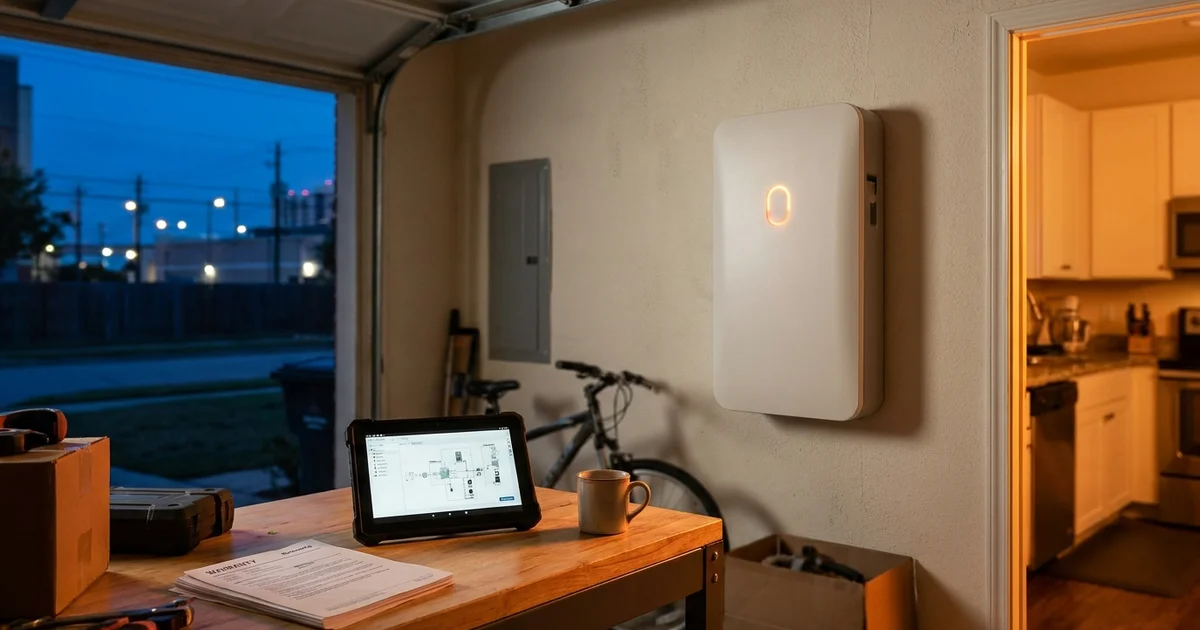
"Ten-year warranty" sounds like one promise. Read the document and it turns out to be at least two: a number of years, and a limit on how much energy the battery has to deliver in that time. Depth of discharge is the idea that connects them, and it is the part most spec sheets leave vague.
This post is about how a warranty counts use, not about how fast a battery ages. We covered aging in how much capacity your home battery loses in 10 years and how often Houston homes actually draw on the battery in home battery usage frequency. Here I want to open one real warranty document and do the arithmetic.
Key Takeaways
- Depth of discharge (DoD) is the share of a battery's capacity you use in one discharge. A "cycle" is just a way of adding those discharges up.
- A warranty may not count cycles at all. The Sigenergy document I read counts total energy delivered (throughput) in megawatt-hours, recorded by the battery itself.
- In that document, the figure for the 8.76 kWh usable model is 26.68 MWh. Divided by 8.76 kWh, that is roughly 3,045 full-capacity discharges.
- A backup-only home gets nowhere near that number. A home that cycles the battery every day could reach it before the 10 years are up.
- That document is for Australia and New Zealand. I could not find the U.S. terms published, so ask for them in writing before you buy.
What is depth of discharge, in plain terms?
Depth of discharge is how much of the battery you drained, as a percentage. Use 4 kWh from a battery that holds 8 kWh and you went to 50 percent DoD. State of charge is the mirror image: what is left.
Two things make the number confusing. First, "capacity" can mean nominal (the label) or usable (what the system lets you take). On the Eos plans, each battery module is 9 kWh nominal and 8.76 kWh usable, so the system already holds back a small slice at the label level. Second, DoD is not a single setting. It changes with every outage, every schedule and every reserve level you pick.
I'm not going to quote a "recommended DoD" for the Eos system, because I did not find a published one that I can verify. What I can verify is the usable-versus-nominal split above and the warranty wording below.
Does a deeper discharge wear a battery out faster?
Generally yes, but the size of the effect depends on the chemistry. A Sandia National Laboratories team cycled commercial lithium-ion cells under different state-of-charge windows (40 to 60, 20 to 80 and 0 to 100 percent). Across all chemistries, the rate of capacity fade rose with depth of discharge. Nickel-based cells (NCA and NMC) were more sensitive. For lithium iron phosphate (LFP), the team found that the state-of-charge range had little effect on capacity (Preger et al., Journal of The Electrochemical Society, 2020).
The same study put LFP cells at 2,500 to 9,000 equivalent full cycles to reach 80 percent capacity, against 200 to 2,500 for NMC. That is a wide range because it spans many temperatures, rates and windows. It is a lab result on small commercial cells, not a promise for any home product.
So the physics is friendly to LFP. But a warranty is a contract, not a physics paper, and the contract counts things differently.
How does a warranty count cycles?
Often it does not count cycles. It counts energy. The Sigenergy "Limited Warranty" document I read (dated 10/6/2025, for Australia and New Zealand) says the manufacturer warrants that the battery system retains either a minimum of 70 percent of usable energy for ten years, or a minimum throughput energy, "whichever comes first." It defines throughput as the overall warranted energy from the warranty start date, "recorded in the control module of the Product" (Sigenergy Limited Warranty, ANZ edition).
That wording matters for three reasons:
- The meter is the battery. Nobody estimates your cycles. The control module tallies kWh in and out.
- Shallow and deep use count the same per kWh. Draw 2 kWh ten times or 8 kWh a few times, and the throughput counter moves by the energy delivered either way. DoD affects aging, but the warranty clock runs on kWh.
- Years and kWh are separate clocks. You are covered until the first one runs out.
I read this as the two limits applying together. The document's phrasing is a little compressed, so if throughput terms matter to your decision, have the installer confirm in writing how the limits combine.
What does the throughput number actually allow?
The document lists a usable energy figure and a minimum throughput figure per model. For the model listed at 8.76 kWh usable, the minimum throughput is 26.68 MWh. For comparison, the 7.8 kWh model lists 23.77 MWh.
Do the division. 26,680 kWh divided by 8.76 kWh is about 3,045. That is the number of times you could drain the full usable capacity of that module before the throughput figure is spent. Both models work out to about 3,046 full discharges, so the manufacturer is scaling the cap with usable size, not setting an arbitrary number.
Two cautions. First, a cell cycle rating in a brochure (often thousands of cycles at lab conditions) is a different thing from this warranty figure. They are not interchangeable, and the warranty figure is the one you can hold the company to. Second, the Eos plans publish 8.76 kWh usable per module, which matches the usable figure in that document for one of its models. I did not find an Eos or Sigenergy statement linking a specific U.S. warranty throughput to a specific Eos plan, so I'm treating the ANZ numbers as illustration, not as your contract.
How much of that will a Houston backup battery use?
Almost none. Take the ordinary outage pattern first. Our usage frequency post walks through Houston outage hours. Put it in warranty terms: if you drained one full 8.76 kWh module ten times a year, every year, for ten years, that is 876 kWh. Against 26,680 kWh, that is about 3 percent of the cap.
Backup-only use is the case the warranty throughput was never going to bind. The 70 percent retention floor and the calendar are what matter, which is the point of the capacity loss post.
When does throughput start to matter?
When you cycle the battery on purpose, every day. Suppose you use the whole usable capacity of one module daily, charging off-peak and discharging in the evening. At about 8.76 kWh a day, you spend roughly 3,200 kWh a year. At the 26.68 MWh figure, you reach the cap in a little over 8 years, which is earlier than the 10-year term. The arithmetic is simple, but it is mine, not the manufacturer's, and it assumes a full daily discharge that most homes will not make.
Two practical notes follow:
- If you only use half the capacity on a typical day, the cap lasts about twice as long. Daily partial use is common.
- With multiple modules in one system, I could not verify from the document how throughput is split across modules. Ask before you assume the cap scales with the number of modules.
This is why the choice between backup-only and daily cycling is a warranty question as well as a savings question. You are spending a finite pool of kWh, and the pool is bigger or smaller depending on the document you sign.
What about the reserve setting and DoD?
A reserve setting is the easiest DoD control you have. If the system keeps a portion in reserve for outages, normal daily use cannot drain it as deep. Our post on setting your backup reserve for Houston winters covers how to think about the level. For this post, the connection is simple: a higher reserve means shallower daily discharges and a smaller throughput burn if you do cycle.
The tradeoff is runtime during a real outage. Energy held back for backup is also energy you are not using for daily savings, so the right number depends on why you bought the battery.
What else in the warranty can end coverage?
Beyond years and kWh, the same document sets conditions. A few that stood out:
- Installation. The battery system must be installed by a skilled and trained installer, in a location ventilated per the user manual.
- Temperature. Operation is specified between -20 and 55 degrees Celsius, with 10 to 30 degrees recommended. In a Houston garage in August, that recommendation is worth a conversation with your installer.
- Internet connection. To activate and maintain the 10-year warranty, the device must stay connected for firmware updates. If it is disconnected for over one year, the document says coverage adjusts to 5 years from the activation date.
Those are the ANZ terms. Our warranty claim process post covers what happens after something goes wrong, and it is worth reading alongside your own paperwork.
Questions to ask before you sign
- Is the warranty a time limit, a throughput limit, or both, and which comes first?
- What is the throughput figure in MWh for my exact model, and how is it counted across modules?
- What capacity do you guarantee at the end of the term, and how is it measured?
- What operating temperature and installation conditions must I meet?
- Does the warranty depend on an internet connection?
- Can I get the U.S. version of the document before I sign?
Frequently Asked Questions
Is a battery cycle the same as depth of discharge?
No. A cycle is one pass of discharge and recharge. Depth of discharge describes how deep that pass went. Two half-depth discharges are often treated as one full equivalent cycle, which is why you see "equivalent full cycles" in research.
Will a deeper discharge void my warranty?
I found nothing in the document I read that sets a maximum depth of discharge. It sets a throughput limit and operating conditions. Confirm the U.S. terms with your installer.
Does an Eos battery wear out faster if I use it daily?
Daily use adds throughput and some aging, and LFP handles it better than other lithium chemistries in the Sandia data. Whether you would approach the warranty throughput depends on how much you discharge each day and on the U.S. figure, which I could not verify.
Is backup-only use worth a 10-year warranty?
For most homes the warranty is protection against defects and capacity loss rather than a meter you will run down. See our Essential plan for the published usable capacity and controller rating, and the plans overview for the rest.
The Short Version
A warranty counts what the battery delivers, not what the brochure calls a cycle. Depth of discharge shapes how a battery ages, but the contract usually cares about total kWh and years. For a backup-only home, those limits sit far out of reach. For a home that cycles daily, they are worth reading before you sign.