ERCOT Conservation Appeals: What Each Alert Level Means for Your Home Battery

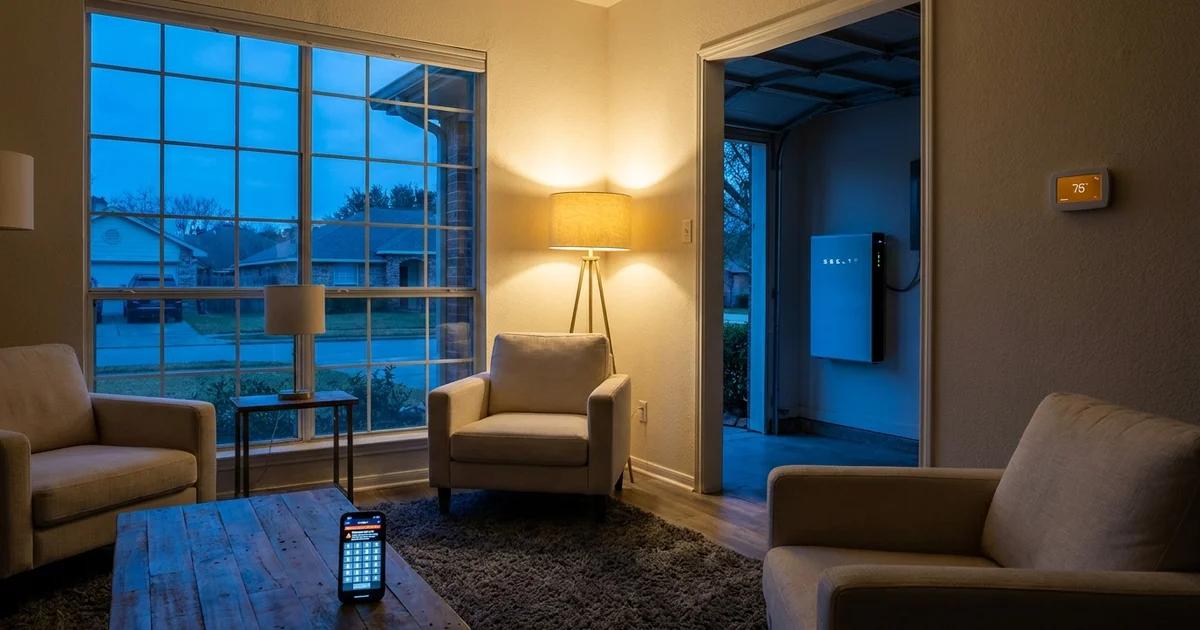
A phone buzzes with a message from ERCOT. Is that a heads-up, a polite request, or the start of rolling outages? The names are close enough to blur together: Weather Watch, Voluntary Conservation Notice, Conservation Appeal, Energy Emergency Alert. They are not the same, and only the last stage in the ladder is the one that turns off power to homes.
This post is a reader's key to the ladder. It is not a history of Texas grid failures (our ERCOT outage history covers that) and it is not a general grid overview (see ERCOT grid reliability for Houston homeowners). It answers one question: when the alert changes, what should you expect, and what is a battery for?
One honest limit first. ERCOT's own web pages and PDFs returned access errors when I tried to read them, so the tier definitions and megawatt thresholds below come from news coverage and explainer sites that cite ERCOT, not from ERCOT's pages directly. ERCOT revises these numbers, so check ercot.com before treating any figure here as current.
Key Takeaways
- Three of the six levels are notices or requests. Only Energy Emergency Alert (EEA) levels involve emergency operations, and only EEA 3 allows controlled outages.
- A Weather Watch is described by ERCOT as an advance notice of weather expected to increase electricity use, with grid conditions normal (NBC DFW).
- At EEA 3, ERCOT tells each transmission operator how many megawatts to shed, and your wires utility chooses which circuits go dark (Texas Power Cost).
- A battery cannot stop an alert. It keeps your essential circuits running if your circuit is turned off.
What are the ERCOT alert levels, in order?
The sequence as laid out by one explainer is Weather Watch, Voluntary Conservation Notice, Conservation Appeal, then EEA 1, EEA 2 and EEA 3 (Texas Power Cost). The first three are notices and requests. The EEA levels are tied to how much reserve power the grid has left.
Here is the ladder with what I could confirm and where it came from.
| Level | What it means | Trigger |
|---|---|---|
| Weather Watch | Early notice of weather expected to raise demand | None, grid normal |
| Voluntary Conservation Notice | Higher demand forecast with lower supply | No fixed number |
| Conservation Appeal | Grid may enter emergency operations; reserves are low | Low reserves, no MW figure given |
| EEA 1 | Emergency resources and imports deployed | Reserves below 2,500 MW, not expected to recover within 30 minutes |
| EEA 2 | Contracted large customers curtailed first | Below 2,000 MW, or frequency below 59.91 Hz for 15 minutes |
| EEA 3 | Controlled outages possible | Below 1,500 MW, or frequency below 59.8 Hz |
Those thresholds are as reported by the Texas Power Cost guide, which attributes them to an ERCOT Grid Conditions Notifications document from December 2025. The same guide warns that older explainers show superseded figures of 2,300, 1,750 and 1,000 MW, and I saw those older numbers in other search results. If a figure matters to you, read it on ERCOT's site.
What does a Weather Watch actually tell you?
Almost nothing about your power, and that is the point. ERCOT describes a Weather Watch as an advance notification of an upcoming weather system expected to increase electricity usage, and says grid conditions are expected to be normal during it (NBC DFW). One explainer puts the lead time at about 3 to 5 days ahead (Texas Power Cost). The January 2025 example was issued late on a Sunday for a window of January 6 to 10, so the actual notice can be shorter.
What to do: nothing dramatic. This is the right moment to confirm your battery is charged and your phone has outage alerts turned on. If you do not own a battery yet, a Weather Watch is a poor time to start shopping, because there is nothing wrong with the grid yet.
Is a Voluntary Conservation Notice a problem?
Not by itself. It is used when higher demand is forecast alongside lower supply, and it has no fixed numeric trigger (Texas Power Cost). In plain terms: the margin is thinner than usual, and ERCOT would like people to ease off during certain hours.
For a household, that means moving optional load. Run the dishwasher and laundry outside the peak window and nudge the thermostat. Our post on keeping your house cool during a Houston outage covers the cooling side of those habits.
How is a Conservation Appeal different?
A Conservation Appeal is the more urgent version of the same request. It is used when the grid may enter emergency operations because reserves are low (Texas Power Cost). It still does not cut anyone's power. It asks Texans to reduce use, usually for a few hours in the evening or morning, in the hope that the grid never reaches an emergency stage.
This is the level people mistake for an outage warning. It is closer to a yellow light. Our earlier grid reliability guide notes that appeals are issued when conditions tighten, and its practical advice, like pre-cooling the house, applies here.
What I cannot tell you is how often appeals are followed by emergency operations. I did not find a fetched, dated source that gives that rate, so I am leaving a number out rather than guessing.
What happens at EEA 1 and EEA 2?
These are emergency operations, but they are still not household outages. At EEA 1, ERCOT deploys emergency resources and imports once reserves fall below the threshold and are not expected to recover quickly. At EEA 2, contracted large customers are curtailed first (Texas Power Cost).
If you live in Houston, you can think of EEA 1 and EEA 2 as the grid using tools reserved for tight conditions. Residential customers are generally not the first to feel it. The practical risk is that the next step, EEA 3, is one worsening hour away.
For context, our outage history post notes ERCOT issued multiple Energy Emergency Alerts in summers 2022 and 2023, and the grid held both years. An alert at these levels is not a prediction of outages.
What happens at EEA 3, and who decides which homes lose power?
EEA 3 is where controlled, rotating outages become possible. The purpose is to protect the grid, since shedding load prevents demand from pushing frequency down into a far larger uncontrolled blackout (Texas Power Cost).
The mechanics, according to that guide:
- ERCOT tells each transmission operator how many megawatts to shed, and each utility's share follows its percentage of the previous year's system-wide peak.
- Your wires utility rotates circuits off. ERCOT orders the outages, but the utility chooses which circuits go dark.
- ERCOT says critical public services are generally prioritized but may still be affected. Prioritization is not exemption.
- Smaller operators typically target 10 to 30 minutes per circuit, while larger ones may run 60 minutes or more.
- In February 2021, rotation broke down and some circuits stayed off for days.
Here is the part that matters for a home battery. A rotating outage is a utility decision made circuit by circuit, so you cannot predict whether your street is on the list, and you cannot opt out by being polite during a Conservation Appeal. If your circuit is chosen, the power goes off for however long the rotation runs.
What does a home battery do at each level?
It depends on the level, so here it is stage by stage.
- Weather Watch: nothing needed. Confirm the battery is charged.
- Voluntary Conservation Notice and Conservation Appeal: a battery does not change the alert, and your power stays on. Whether it makes sense to lean on stored energy during those hours depends on your system settings, which I cannot describe for you without guessing at app behavior that Eos has not published. Our post on the backup reserve setting explains why you generally do not want to drain a battery just before a storm.
- EEA 1 and EEA 2: same as above. Power is still on. This is the moment to top up and stage your loads.
- EEA 3: if your circuit is shed, the battery takes over for the circuits on your backup panel, automatically.
A single Eos battery module is 9 kWh nominal and 8.76 kWh usable, and every plan uses one controller rated for 11.5 kW continuous. Our Essential plan is built to carry the refrigerator, Wi-Fi, lights and medical devices for hours. Because a rotation can run from about 10 minutes to over an hour per circuit, that is usually the right scale of problem. If your worry is the multi-day failure of February 2021, runtime and sizing become the question, and our plans page lays out the module options.
Does a time-of-use plan change any of this?
It changes your bill, not your risk. Some retail plans reward you for using less power at peak times, which is a quiet way of doing what a Conservation Appeal asks. We cover how that works in our time-of-use plan guide. I am not going to claim a battery earns money during an alert, because I could not verify such a thing for Eos systems and it depends entirely on your plan.
How do I get the alerts before the news does?
I could not fetch ERCOT's own sign-up pages, so I will not describe a specific app or screen. What I can say is that ERCOT's notices are public and ERCOT also posts grid conditions on its website, and your wires utility has its own outage notifications. The simplest habit: when you see a Weather Watch, read the next notice carefully, because that is the one that will tell you whether anything is actually changing.
A short checklist for alert season
- Learn the order: Weather Watch, Voluntary Conservation Notice, Conservation Appeal, EEA 1, 2, 3.
- Remember that only EEA 3 is about controlled outages.
- During a notice or appeal, shift optional load rather than panicking.
- Know your essential circuits: refrigerator, Wi-Fi, lights, medical devices, and one cooling or heating zone.
- If you own a battery, check its charge at the first Weather Watch of the season.
- If you are shopping, size for the longest outage you worry about, not the shortest alert.
Our wattage chart for common Houston loads is a useful way to add up what your essential circuits actually draw.
Frequently asked questions
Does a Conservation Appeal mean my power will go out?
No. It is a request to reduce use because reserves are low and the grid may enter emergency operations (Texas Power Cost). Controlled outages are possible only at EEA 3.
What is the difference between a Weather Watch and a Conservation Appeal?
A Weather Watch is an early notice of weather expected to raise demand, with grid conditions normal (NBC DFW). A Conservation Appeal means reserves are low enough that emergency operations are possible.
How long do rotating outages last?
The same guide says smaller operators typically target 10 to 30 minutes per circuit, and larger ones may run 60 minutes or more. In February 2021 some circuits stayed off for days.
Will my home battery run during a Conservation Appeal?
Your grid power is still on, so the battery is not needed for backup. Whether to draw on it by choice depends on your settings. Read our backup reserve guide before changing anything.
Can I rely on these megawatt numbers?
Treat them as a guide. They come from an explainer citing an ERCOT document, and ERCOT revises its thresholds. Verify on ercot.com.
What to do next
Learn the ladder once, and the next alert will read as a status update instead of a scare. If you want a system that handles the worst stage, start with the essential circuits you cannot lose.
Or call Eos at 833-989-3737 to talk through your setup with an installer.