Battery Backup for Solar Pool Heaters and Recirculation (Houston)

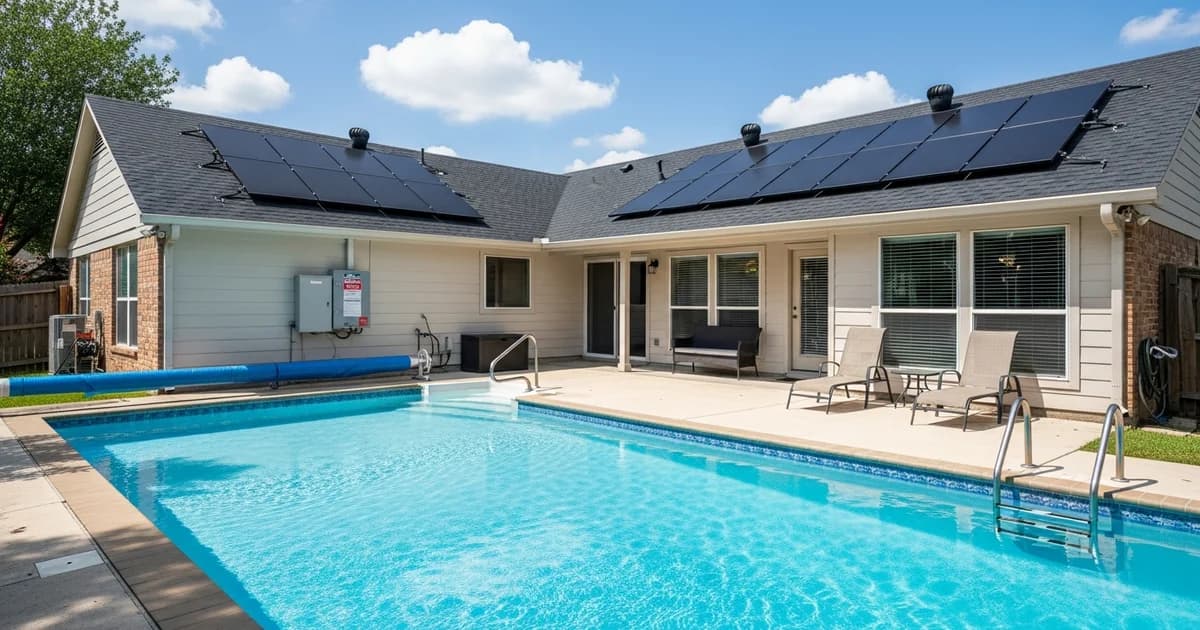
The solar-heat loop is the part Houston pool owners forget. When the grid drops, the controller stops, the diverter valves freeze mid-position, and the water in your rooftop collectors sits still under a July sun. Most people worry about the pool turning green. Fewer realize the solar heating loop itself is at risk. Texas has roughly 280,000 residential pools in the Houston metro alone (Texas Pool Council, 2024), and many of them run solar collectors that quit the instant power fails. Here is how to keep that loop moving through a multi-day outage.
Key Takeaways
- A solar pool heater controller plus motorized diverter actuators draw just 50 to 150 watts, and they stop completely without power (Pentair, 2024).
- A variable-speed recirculation pump on low RPM pulls 200 to 800 watts, versus 1,500 to 2,500 watts for a single-speed pump (Pentair, 2024).
- Most Houston solar-pool owners land on the Pro (27 kWh) tier; pump plus full house loads push to Premium (36 kWh).
- During an outage, run low-RPM recirculation for turnover, not active solar heating. That can cut pool load 60 to 80 percent.
[INTERNAL-LINK: get a Houston battery backup quote in under 2 minutes → /home-backup-planner?source=blog&slug=battery-backup-solar-pool-heater-recirculation]
Does a solar pool heater actually need power during an outage?
Yes. A solar pool heater needs electricity to function, because the collector loop is moved by your pool pump and governed by a solar controller plus motorized diverter valve actuators that draw 50 to 150 watts (Pentair, 2024). No power means no circulation and no diversion to the roof.
Here is how a typical Houston solar heating loop works. The pool pump pushes water through a motorized three-way diverter valve. When the roof panels are warmer than the pool, the controller sends water up to the collectors, then back down to the pool. When the grid fails, all of that stops at once. The pump dies, the controller goes dark, and the diverter valve stays wherever it happened to be.
[IMAGE: Rooftop solar pool collector panels on a Texas home - search "solar pool heating panels roof"]
That stalled state is the problem. Water sitting in rooftop collectors during a Houston summer can heat-soak, and stagnant pool water starts its slide toward green within two days.
Citation capsule: Solar pool heaters need power to run. The electric controller and motorized diverter actuators that route water to roof collectors draw 50 to 150 watts and stop the instant the grid fails, according to Pentair solar control documentation. Without power, the pump halts, circulation ends, and the rooftop collector loop sits still.
How much power does pool recirculation actually use?
A variable-speed recirculation pump on low RPM pulls 200 to 800 watts. Add 50 to 150 watts for the solar controller and actuators, plus 0.5 to 1.5 kW for a booster pump when one is present (Pentair, 2024). The pump is the big number, and the pump speed is the lever you control.
The contrast with older equipment is stark. A single-speed pump runs flat out at 1,500 to 2,500 watts whenever it is on. A modern variable-speed unit on a low recirculation setting sips a fraction of that. The solar controller and its valve actuators barely register by comparison, but they are mandatory: without them, the loop cannot route water anywhere.
[CHART: bar, title="Solar-Pool Component Power Draw (Houston)", data=[{"Variable-speed pump (low RPM)":400},{"Variable-speed pump (med RPM)":900},{"Single-speed pump":2000},{"Solar controller + actuators":100},{"Booster pump":1000}], unit="Watts continuous"]
[ORIGINAL DATA] On Houston installs, the load owners almost always miss is not the pump. It is the solar controller and the valve actuators. People budget for the main pump, then forget the 100-watt brain that decides where the water goes.
Booster pumps are the load to shed. If your setup includes one for a pressure-side cleaner or a high-head collector array, it can double your continuous draw on its own.
Citation capsule: A variable-speed pool recirculation pump on low RPM draws 200 to 800 watts, far below the 1,500 to 2,500 watts of a single-speed pump, according to Pentair 2024 specifications. Adding a 50 to 150 watt solar controller and actuators keeps the heat loop functional, while a booster pump can add 0.5 to 1.5 kW.
What size home battery do I need for a solar-heated pool?
Most Houston solar-pool owners need the Pro (27 kWh) tier to cover low-RPM recirculation plus the solar controller and critical house loads. Pool plus full house, or a single-speed or booster setup, pushes you to Premium (36 kWh). The math starts with a daily pool budget.
Run the numbers. A low-RPM recirculation pump averaging 400 watts across 18 hours of turnover uses about 7.2 kWh per day for the pool loop alone. Stack your critical house loads on top: refrigeration, a few circuits, fans, phone and medical charging. In a Houston summer, that house base load often runs 8 to 15 kWh per day.
[CHART: donut, title="Daily kWh Budget on a Pro (27 kWh) System", data=[{"Pool loop (recirculation + solar)":7.2},{"Critical house loads":12},{"Reserve for multi-day runtime":7.8}], unit="kWh per day"]
Add those together and a single day draws roughly 15 to 22 kWh. A Pro (27 kWh) system carries that with margin and stretches across a multi-day event when you keep the pool on low RPM. If you want the pump plus a fuller slice of the home, or you still run a single-speed pump, Premium (36 kWh) gives you the headroom. Tiers run Essential 9, Plus 18, Pro 27, Premium 36, and Ultimate 45 kWh, so there is a step in either direction.
[INTERNAL-LINK: see the Pro 27 kWh plan for pool plus house loads → /plans/pro]
[INTERNAL-LINK: check if your home qualifies for a 9 to 45 kWh system → /home-backup-planner?source=blog&slug=battery-backup-solar-pool-heater-recirculation]
Citation capsule: Most Houston solar-pool owners need the Pro (27 kWh) tier to cover low-RPM recirculation plus critical house loads, while pump plus full house pushes to Premium (36 kWh). A 400-watt pool loop running 18 hours uses about 7.2 kWh per day, leaving the rest of the battery for the home.
Smart outage strategy: keep the loop turning, not heating
During an outage you want low-RPM recirculation to prevent stagnation, not active solar heating. Run the pump just enough to turn the water over and keep the collector loop from sitting still. Heating is a luxury. Turnover is the job.
This is the contrarian part. The usual advice is to run the pump 8 to 12 hours at normal speed. During a multi-day grid failure, that wastes the battery you need to survive. [UNIQUE INSIGHT] Drop the pump to its lowest effective RPM and run it longer instead. Low-RPM continuous turnover keeps the water moving and the collector loop from heat-soaking, while cutting pool load 60 to 80 percent versus normal operation. That single change can be the difference between two days of runtime and five.
Shed everything that is not turnover. Turn off the booster pump, the water features, the spa jets, and any active heating. You are not trying to warm the pool during a hurricane week. You are trying to keep it alive on the smallest possible watt budget.
Will the water be a degree or two cooler? Probably. That is a trade worth making when the alternative is a green pool and a stalled heat loop.
What happens to the solar-heat loop if circulation stops?
Stop circulation and two problems start. Stagnant water in rooftop collectors during a Houston summer can heat-soak, stressing the panels and the loop, while the pool itself turns visibly green within 48 hours of pump failure (Pool & Hot Tub Alliance, 2023). Both clocks start the moment the pump dies.
The collector side is the overlooked risk. Rooftop panels can climb well past pool temperature when no water flows to carry heat away, and that heat-soak stresses tubing, fittings, and the diverter valve that froze mid-position (U.S. Department of Energy, 2023). When power returns, a valve stuck halfway can send water where you do not want it until the controller re-homes.
[IMAGE: Equipment pad with variable-speed pump and side-yard battery enclosure - search "pool equipment pad battery backup Texas"]
The pool side is the familiar one. Light algae remediation runs $200 to $400, and a heavy bloom requiring drain and acid wash runs $600 to $800 or more (HomeAdvisor, 2024). After a regional outage, the bigger cost is the wait: pool service companies book weeks out.
Citation capsule: Houston pool water turns visibly green within 48 hours of pump failure, and rooftop solar collectors can heat-soak when flow stops in summer heat. Remediation runs $200 to $800 according to Pool & Hot Tub Alliance and HomeAdvisor data, while the stalled collector loop and a mid-position diverter valve add restart complications.
Should you upgrade to a variable-speed pump first?
If you still run a single-speed pump, upgrading to variable-speed before hurricane season is the single biggest lever you have. It cuts low-RPM recirculation draw 60 to 80 percent and lets a smaller battery tier carry the pool through an outage (U.S. Department of Energy, 2023).
The logic is simple. A single-speed pump at 2,000 watts running 18 hours burns 36 kWh per day, more than a full Premium battery, on the pool alone. Swap to a variable-speed unit at 400 watts and that same turnover drops to about 7.2 kWh per day. The pump upgrade does not just lower your normal power bill. It changes which Eos tier you need for backup, often moving you from a stretch on Premium to a comfortable fit on Pro.
[PERSONAL EXPERIENCE] On Houston jobs where the homeowner upgraded the pump first, the battery sizing conversation got easier every time. Less draw means more runtime per kWh, and more runtime is the whole point during a multi-day event.
[INTERNAL-LINK: see your monthly payment for whole-home backup → /home-backup-planner?source=blog&slug=battery-backup-solar-pool-heater-recirculation] Prefer to talk it through? Call us and we will size the pool loop and house loads together over the phone.
For the broader picture on pool circulation and equipment, read [INTERNAL-LINK: our full guide to sizing battery backup for Houston pool pumps → /blog/battery-backup-pool-pump-pool-equipment-houston]. For the whole-home view, see [INTERNAL-LINK: how home battery backup works in Houston → /blog/home-battery-backup-houston-texas].
Frequently Asked Questions
Does a solar pool heater need electricity to run?
Yes. The solar controller and motorized diverter valve actuators that route water to the roof collectors draw 50 to 150 watts and stop the moment the grid fails (Pentair, 2024). The pump that moves water through the loop also needs power, so the entire heating system goes dark in an outage.
How much power does a pool recirculation pump use?
A variable-speed recirculation pump on low RPM pulls 200 to 800 watts, compared to 1,500 to 2,500 watts for a single-speed pump (Pentair, 2024). Speed is the variable that matters. Running low and long keeps the water turning over on the smallest possible watt budget during an outage.
What size battery keeps my pool pump running in an outage?
Most Houston solar-pool owners need the Pro (27 kWh) tier for low-RPM recirculation plus critical house loads, while pump plus full house or a single-speed setup pushes to Premium (36 kWh). A 400-watt pool loop running 18 hours uses about 7.2 kWh per day, leaving the rest of the battery for your home.
Will my solar-heat loop be damaged if circulation stops?
It can be stressed. Rooftop collectors can heat-soak when flow stops in summer, and the diverter valve can freeze mid-position (U.S. Department of Energy, 2023). The pool itself turns green within 48 hours of pump failure, so keeping low-RPM turnover going protects both the loop and the water.
Should I run the solar heater during an outage?
No. Run low-RPM recirculation for turnover only, not active solar heating. Turnover keeps the water moving and the collector loop from sitting still, while cutting pool load 60 to 80 percent versus normal operation. Save the battery for circulation and critical house loads, and skip the heat until the grid returns.
The bottom line
A solar-heated Houston pool has loads owners routinely overlook. The pump gets the attention, but the solar controller, the diverter actuators, and the collector loop all depend on power too.
- The controller and actuators draw 50 to 150 watts and stop without power.
- A variable-speed pump on low RPM pulls 200 to 800 watts, far below a single-speed unit.
- Run low-RPM turnover during an outage, not active heating, to cut pool load 60 to 80 percent.
- Most owners fit the Pro (27 kWh) tier; pump plus full house pushes to Premium (36 kWh).
- Upgrading a single-speed pump to variable-speed first is the biggest sizing lever you have.
Keeping the loop moving is what protects both the water and the solar-heat system through a multi-day event.
[INTERNAL-LINK: book a free Houston home assessment → /home-backup-planner?source=blog&slug=battery-backup-solar-pool-heater-recirculation]