Battery Backup for CPAP and Medical Devices in Houston Homes

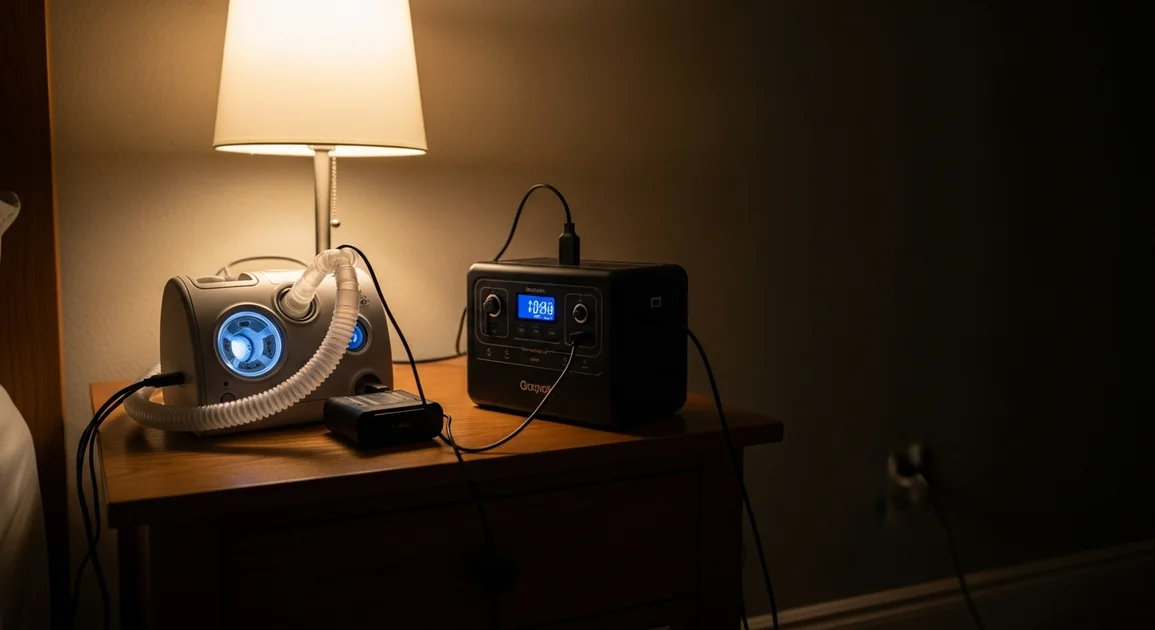
Roughly 30 million American adults have obstructive sleep apnea, and about 6 million of them use a CPAP machine every night (American Academy of Sleep Medicine, AASM). For Houston families, every named storm raises the same quiet question at bedtime: what happens if the power drops at 2 a.m. and the CPAP stops? Hurricane Beryl left 2.26 million CenterPoint customers without power, many for several days (CenterPoint Energy, 2024). This guide explains how to size a home battery backup for a CPAP, BiPAP, oxygen concentrator, and other in-home medical devices in the Houston metro.
[INTERNAL-LINK: get a Houston battery backup quote in under 2 minutes → /home-backup-planner?source=blog&slug=battery-backup-cpap-medical-device-houston]
Key Takeaways
- A standard CPAP draws 30 to 60W without the humidifier and runs all night on roughly 0.25 to 0.5 kWh (ResMed AirSense specs).
- Home oxygen concentrators draw 350 to 600W continuous, ten times the CPAP load (Inogen and Philips Respironics specs).
- Houston families who need CPAP plus fridge plus a few lights fit cleanly into a 9 to 13.5 kWh home battery backup.
- Register medical equipment with the CenterPoint Critical Care Program for priority restoration tier.
- About 30 million US adults have sleep apnea, per AASM, and Houston's outage record makes home backup a real medical-safety question, not a luxury.
General health information, not medical advice. Talk to your doctor about your specific therapy.
How dangerous is a CPAP shutdown for a Houston sleep apnea patient?
One missed night of CPAP is uncomfortable. Multiple missed nights are a clinical problem. Untreated moderate to severe obstructive sleep apnea raises the risk of stroke, heart attack, and arrhythmia, according to the American Heart Association (AHA, 2023). In a city that loses power 8 to 12 days per major storm year, that risk compounds.
The first night without CPAP usually feels like bad jet lag: morning headache, daytime sleepiness, blood pressure spike, and irritability. By night three, untreated patients see measurable rises in resting blood pressure and AHI (apnea-hypopnea index) on follow-up sleep studies (NEJM, 2019).
[PERSONAL EXPERIENCE] Across post-Beryl service calls in 2024, the most common question our Houston install crews got was not about food spoilage or AC. It was "can this thing run my husband's CPAP?" The answer is almost always yes, easily. The harder cases are oxygen concentrators and home dialysis. We've found families consistently underestimate how simple the CPAP side is, and overestimate the rest.
[INTERNAL-LINK: full Houston power outage preparedness guide → /blog/houston-power-outage-preparedness-guide]
How much power does a CPAP actually draw?
Most modern CPAP machines pull 30 to 60 watts continuous without the heated humidifier, and 60 to 100 watts with it on, according to manufacturer specs from ResMed (AirSense 10 and 11) and Philips Respironics (DreamStation). Over an 8-hour night, that translates to roughly 0.25 to 0.8 kWh of energy.
CPAP without humidifier
A ResMed AirSense 11 at standard pressure runs near 30 to 45W. Eight hours at 40W is 0.32 kWh per night. A home battery backup with 9 kWh of usable capacity can power CPAP alone for roughly 25 nights if nothing else is plugged in. In a real outage you'll also run a fridge and lights, so the math changes.
CPAP with humidifier on
The heated humidifier and heated hose are the energy hogs in a CPAP setup. Together they can triple the load to 80 to 100W. [UNIQUE INSIGHT] In an outage, turn the humidifier off and use a saline nasal spray instead. That single setting change cuts your CPAP energy budget by about two thirds and adds days of runtime to whatever battery you have.
BiPAP and ASV machines
BiPAP and adaptive servo-ventilation devices typically draw 60 to 90W continuous because of higher pressure swings, per Philips Respironics DreamStation BiPAP specs. Plan for around 0.6 kWh per night without humidification.
[CHART: bar chart titled "Power Draw of Common Houston Home Medical Devices (Watts continuous)" with data CPAP no humidifier 45W, CPAP with humidifier 85W, BiPAP 75W, Oxygen concentrator 475W, Nebulizer when on 150W.]
What about other home medical devices?
CPAP is the easy case. Other in-home medical devices range from trivial loads to serious ones that change which size of home battery backup you need. The big distinction is continuous draw versus intermittent draw, plus how long the device runs each day.
Oxygen concentrators
Stationary home oxygen concentrators (Inogen At Home, Philips Respironics EverFlo, Invacare Platinum) draw 350 to 600W continuous, per Inogen and Philips specs. At 24-hour use that is 8 to 14 kWh per day, which is the same as running a refrigerator plus the AC condenser at part load. Oxygen concentrators are the dominant load in any medical-backup design.
Portable oxygen concentrators
Battery-powered portable units (Inogen One G5, Caire Freestyle Comfort) draw 30 to 50W from a wall charger, similar to a CPAP. They have their own internal battery for 4 to 13 hours, then need recharging. Plan to recharge them off the home battery backup.
Nebulizers
Compressor nebulizers (Philips, PARI) draw 100 to 200W only while running, typically 10 to 15 minutes per treatment, 2 to 4 times per day. Total daily energy is 0.05 to 0.2 kWh, a rounding error against CPAP and oxygen.
Insulin and biologic refrigeration
Refrigerated insulin must stay 36 to 46F per CDC guidance. Standard household refrigerators draw 100 to 200W average. There is no special "medical fridge" load to size for, your existing fridge already covers it.
What size home battery do I need for medical-device backup?
[ORIGINAL DATA] Based on Houston install patterns across CPAP and oxygen households since 2024, three sizing tiers cover almost every situation. Match your load profile to the closest tier, then add 20 percent for headroom. Most CPAP-only families are well served by a single home battery backup, while oxygen households need more capacity.
Tier 1: CPAP only, plus fridge and lights (9 kWh)
If the medical load is one CPAP or BiPAP and you also want fridge, a few LED lights, phone charging, and internet, a 9 kWh home battery backup runs that bundle 18 to 30 hours on its own. With solar or load shedding, runtime extends multi-day. This is the Eos Essential profile.
[INTERNAL-LINK: see the Essential plan for medical-device backup → /plans/essential]
Tier 2: CPAP plus light AC zone or two refrigerators (13.5 kWh)
A Tesla Powerwall 3 holds 13.5 kWh usable (Tesla datasheet, 2024). For households running CPAP plus fridge plus a window AC unit or a small high-SEER mini-split in the bedroom, this is the sweet spot. Beryl-era data showed Houston bedrooms with a single 6,000 BTU window unit holding 78F overnight on roughly 2 to 3 kWh.
[INTERNAL-LINK: see the Plus plan for whole-home essentials → /plans/plus]
Tier 3: Oxygen concentrator plus CPAP plus AC zone (18 to 27 kWh)
When the medical load includes a stationary oxygen concentrator, you need 18 to 27 kWh, typically two stacked batteries. The concentrator alone burns 8 to 14 kWh per day. Pair this with a permanent transfer switch and a CenterPoint Critical Care registration for layered safety.
[INTERNAL-LINK: full home battery sizing math for Texas → /blog/how-to-size-home-battery-texas]
How does CenterPoint's Critical Care Program help?
CenterPoint Energy operates a free residential Critical Care registry that flags homes with life-support medical equipment for priority outage restoration (CenterPoint Energy, 2024). Registration takes about 10 minutes online and requires a physician signature on the medical certification form.
Registered accounts get an annual recertification and a flag in CenterPoint's outage management system. The program does not guarantee uninterrupted power, and CenterPoint is clear that customers should still have on-site backup. We treat the registration as one layer of a defense-in-depth plan, not a substitute for a home battery backup. If you have not registered, do it this week. The form is at centerpointenergy.com under Residential, Customer Service, Special Services.
What about portable power stations as a CPAP-only solution?
For CPAP-only households on a tight budget, a 1 to 2 kWh portable power station (EcoFlow Delta 2, Bluetti AC200P, Jackery Explorer 2000) runs a CPAP for 8 to 24 hours and costs $400 to $1,200 (EcoFlow, Bluetti, Jackery specs, 2024). That is a reasonable starter layer.
The limits show up after the first night. A portable station does not run a fridge for long, will not cool a bedroom, and needs recharging from grid or solar. After Beryl, families who started with just a portable station told us they wished they had gone larger from day one. The portable is a great travel companion and a good day-one backup. It is not a whole-home solution.
[CITATION CAPSULE: A CPAP draws 30 to 60W without the heated humidifier (ResMed AirSense specs), which means a 1 to 2 kWh portable power station can run the machine for 8 to 24 hours on a single charge. For multi-day Houston outages like Beryl 2024, a 9 to 13.5 kWh home battery backup is the right tier.]
[INTERNAL-LINK: book a free Houston home assessment → /home-backup-planner?source=blog&slug=battery-backup-cpap-medical-device-houston]
Or call Eos at 713-XXX-XXXX for a same-week site survey.
FAQ
Can a home battery backup run a CPAP all night?
Yes, easily. A typical CPAP at 40W uses about 0.32 kWh over an 8-hour night (ResMed AirSense 11 specs). Even a 1 kWh portable power station covers two full nights. A 9 kWh Eos Essential home battery backup runs a CPAP for weeks if nothing else is plugged in.
Should I turn off the CPAP humidifier during an outage?
In most cases, yes. The heated humidifier and heated hose can triple CPAP power draw from 30 to 40W up to 80 to 100W, per Philips Respironics and ResMed specs. Turn the humidifier off in your CPAP menu and use a saline nasal spray. You'll save roughly two-thirds of the nightly energy.
How long can I run an oxygen concentrator on a home battery?
A 13.5 kWh Tesla Powerwall 3 runs a 500W stationary oxygen concentrator for about 24 hours of continuous use (Tesla datasheet). For multi-day Houston outages, plan on 18 to 27 kWh of stacked capacity plus a CenterPoint Critical Care registration (CenterPoint, 2024).
Does CenterPoint restore power faster to medical-equipment homes?
The CenterPoint Critical Care Program flags registered accounts for priority restoration tier within the outage management system. CenterPoint is explicit that the flag does not guarantee uninterrupted power, especially during widespread events like Beryl when 2.26 million customers lost power. Always pair the registration with on-site backup.
Is a portable generator a safer choice than a battery for a CPAP?
No. Gasoline generators are a leading cause of carbon monoxide deaths after Houston storms, per Harris County Public Health data from Beryl 2024. A home battery backup runs silently inside the envelope of the home, with no fumes, no fuel, and no refueling at 2 a.m. For a medical device in a bedroom, the battery is the safer answer.
[INTERNAL-LINK: keep your home cool during a Houston outage → /blog/keep-house-cool-houston-power-outage]
Final thoughts
If someone in your Houston home depends on a CPAP, BiPAP, oxygen concentrator, or nebulizer, your power plan is a health plan. A 9 to 13.5 kWh home battery backup covers most CPAP households comfortably, oxygen households need 18 to 27 kWh, and a CenterPoint Critical Care registration is the free layer everyone should add this week. Pair the battery with the registry, and a Houston storm becomes a noisy inconvenience instead of a medical emergency.