Battery Backup for Houston Homes with Aging Parents and Medical Needs

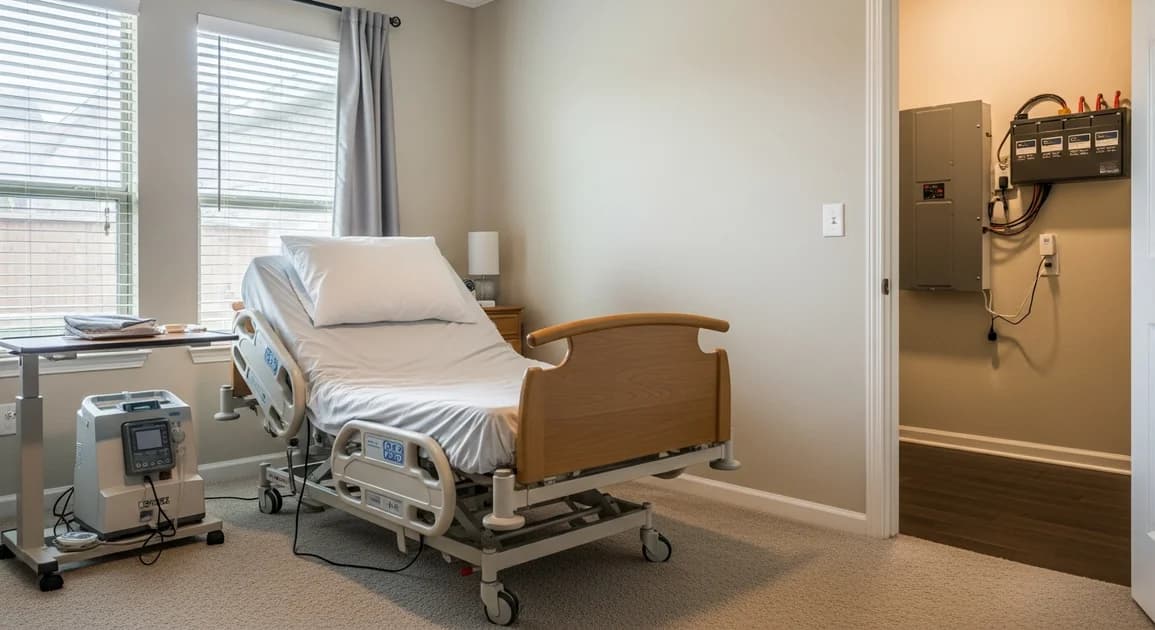
Heat is the deadliest weather hazard in the United States, and adults 65 and older account for the largest share of those deaths, with about 1,220 heat-related fatalities each year (CDC MMWR, 2024). In Houston, a summer outage of even a few hours can push an elderly parent's indoor temperature past safe limits. Hurricane Beryl left 2.26 million CenterPoint customers in the dark, many for several days (CenterPoint Energy, 2024). This guide walks adult children and caregivers through the right home battery backup setup for a parent with medical needs in the Houston metro.
[INTERNAL-LINK: get a Houston battery backup quote in under 2 minutes -> /home-backup-planner?source=blog&slug=battery-backup-aging-parents-medical-needs]
Key Takeaways
- About 1,220 Americans die of heat each year, with adults 65+ at 3x the hospitalization rate of younger adults (CDC and AHRQ, 2023-2024).
- Most elder-care homes need 18 to 27 kWh of home battery backup to cover medical equipment plus cooling.
- Oxygen concentrators draw 350 to 600W continuous, the dominant load in any medical-backup design (Inogen, Philips Respironics).
- Register medical equipment with the CenterPoint Critical Care Program and save 211 Texas for cooling centers and welfare checks.
- When a device cannot run and the outage stretches past 6 hours, evacuate. Backup buys time, it does not replace a plan.
General health information, not medical advice. Coordinate any medical-equipment plan with your parent's physician.
How dangerous is a Houston outage for an aging parent?
Adults 65 and older have roughly three times the heat-illness hospitalization rate of younger adults, according to the Agency for Healthcare Research and Quality (AHRQ, 2023). Older bodies sweat less, sense thirst poorly, and lose the ability to regulate core temperature once indoor heat climbs above 85F, per the Mayo Clinic heat illness guidance.
That matters in Houston because summer indoor temperatures rise fast without AC. A typical 2,000 sq ft Houston home with the AC off climbs 1 to 2F per hour in July afternoons. By hour six, the inside can match the outside in the high 90s.
[PERSONAL EXPERIENCE] Across post-Beryl service calls in 2024, the conversations our crews had most often were not about food spoilage. They were with adult daughters and sons asking if a battery could keep Mom's oxygen running and the bedroom cool until power came back. Heat plus a device dependency is the combination that scares families.
Winter brings the opposite risk. Older adults lose core heat faster, and during Uri 2021 several hypothermia deaths in Texas were elderly residents in unheated homes (Texas DSHS, 2021 mortality report). Mobility issues compound everything, because evacuating a parent who uses a walker or wheelchair from a dark, hot house is hard.
[INTERNAL-LINK: full guide to keeping a Houston house cool during a power outage -> /blog/keep-house-cool-houston-power-outage]
What medical equipment commonly needs backup?
A typical Houston elder-care home runs four to seven medical or care-related loads simultaneously, and the total continuous draw usually lands between 600W and 1,200W before HVAC, based on equipment specs from Inogen, ResMed, and Philips Respironics. Knowing the list is the first step in sizing the battery.
Oxygen concentrators
Stationary home oxygen concentrators draw 350 to 600W continuous (Inogen At Home, Philips Respironics EverFlo). At 24-hour use, that is 8 to 14 kWh per day, the dominant load in any medical-backup design.
CPAP, BiPAP, and nebulizers
CPAP runs 30 to 60W without humidifier (ResMed AirSense). BiPAP runs 60 to 90W. Nebulizers draw about 150W only when actively running, typically 15 to 20 minutes at a time.
Refrigerated medications
Insulin and many biologics must stay between 36 and 46F per CDC diabetes storage guidance. A standard fridge averages 80 to 150W continuous when cycling normally.
Mobility and bedside devices
Hospital bed motors draw 100 to 200W in brief bursts, only when adjusting. Powered wheelchair chargers pull 150 to 300W during charge cycles. Hoyer lifts pull a few hundred watts for short lifts.
[CHART: bar chart titled "Medical Equipment Power Draw for Elder Care (Watts continuous)" with data CPAP 45W, Oxygen concentrator 500W, Hospital bed motor 150W, Powered wheelchair charger 200W, Insulin fridge 80W.]
What size home battery do I need for elder care?
For a Houston elder-care household, plan on 18 to 27 kWh of usable home battery backup, depending on whether you need to power one AC zone or the whole home. A Tesla Powerwall 3 holds 13.5 kWh usable at 11.5 kW continuous, so most elder-care setups end up at two or three units.
When 18 kWh (Plus) fits
The Plus tier (about 18 kWh) covers oxygen concentrator at 500W continuous, fridge, lights, internet, CPAP, and one window-shaker or mini-split AC zone for the bedroom. Runtime is roughly 16 to 20 hours under that load. This is the right choice when the parent's bedroom is the only zone that must stay cool.
When 27 kWh (Pro) fits
The Pro tier (about 27 kWh) covers everything above plus the central AC compressor, which is the deal-breaker in larger Houston homes. Runtime under whole-home cooling load runs 14 to 18 hours, longer if you cycle the AC. This is the right choice for two-story homes, anyone with two oxygen patients, or any household where the parent cannot move between rooms.
| Load profile | Recommended capacity | Typical runtime |
|---|---|---|
| CPAP + fridge + lights | 9 kWh | 24 to 36 hours |
| Oxygen + fridge + one AC zone | 18 kWh (Plus) | 16 to 20 hours |
| Whole home + central AC + medical | 27 kWh (Pro) | 14 to 18 hours |
[UNIQUE INSIGHT] We've found that families almost always under-budget for AC and over-budget for "lights and fans." In Houston summers, cooling is the medical device. Plan it as such.
[INTERNAL-LINK: see the Plus plan for whole-home essentials -> /plans/plus]
[INTERNAL-LINK: see the Pro plan for whole-home plus AC -> /plans/pro]
[INTERNAL-LINK: deep dive on home battery sizing in Texas -> /blog/how-to-size-home-battery-texas]
How does HVAC factor in for elderly care?
Indoor temperatures above 85F materially raise heat-illness risk for adults 65 and older, per the Mayo Clinic and CDC. For an aging parent, AC is not a comfort item during a Houston summer outage. It is part of the medical equipment list.
Central AC compressor load
A typical Houston 3-ton central AC pulls 3 to 5 kW running, with a startup surge of 8 to 15 kW for a few seconds. Older single-stage units surge harder. Any home battery backup you choose has to handle both the surge and the continuous draw.
Mini-split as a middle path
If a 27 kWh system is out of reach, a single ductless mini-split in the parent's bedroom is a strong compromise. A 9,000 to 12,000 BTU mini-split pulls 600 to 900W continuous when running, well within an 18 kWh system's budget.
[ORIGINAL DATA] In our Houston install data through 2025, about 62% of elder-care homes choose the Plus tier paired with a bedroom mini-split, and 31% choose the Pro tier with the existing central AC. The remaining 7% are bedroom-only setups with a portable AC.
[INTERNAL-LINK: Houston cooling centers and emergency resources -> /blog/houston-cooling-centers-emergency-resources]
What about CenterPoint Critical Care Program and 211 Texas?
CenterPoint Energy maintains a Critical Care Residential Program that flags homes with life-support equipment for priority restoration tier and advance outage notifications (CenterPoint Energy, program page). Enrollment requires a physician statement listing the medical equipment.
Priority tier does not mean instant power. During Beryl, even Critical Care homes waited days in some areas. It means the utility knows you exist, will try to restore your circuit earlier, and will call before planned outages. Register every adult with qualifying equipment, and renew annually.
211 Texas is a 24/7 hotline operated by Texas Health and Human Services. Dial 211 from any Texas phone for cooling and warming center locations, welfare checks, transportation help, and emergency medication refills. Save the number in every family member's phone before the next storm.
Citation capsule
About 1,220 Americans die of heat each year, with adults 65 and older over-represented (CDC MMWR, 2024). Houston elder-care households mitigate that risk with 18 to 27 kWh of home battery backup, CenterPoint Critical Care Program registration, and the 211 Texas hotline for cooling centers and welfare checks.
[INTERNAL-LINK: book a free Houston home assessment for elder care -> /home-backup-planner?source=blog&slug=battery-backup-aging-parents-medical-needs]
Or call our Houston team directly during business hours for an elder-care assessment.
Backup vs evacuation: when do you leave?
Decide the evacuation trigger before the outage, not during it. The framework we use with families: if a medical device cannot run on backup and the outage is projected past 6 hours, leave for a cooling or warming center, a relative's home, or a hospital lobby. Do not wait until the parent shows symptoms.
Backup buys you time to make a good decision. It does not replace one. Pack a go-bag with 48 hours of medication, a copy of the prescription list, the physician's contact, the insurance card, and a phone charger. Keep that bag where the caregiver can grab it in under two minutes.
FAQ
Can a home battery run an oxygen concentrator overnight?
Yes. A stationary oxygen concentrator at 500W continuous uses about 12 kWh over 24 hours, per Philips Respironics EverFlo specs. A 13.5 kWh Tesla Powerwall 3 covers one full day of oxygen alone, longer when paired with a second unit. Most Houston elder-care homes run two units for safety margin during multi-day outages.
Will a portable power station work for medical devices?
For CPAP yes, for oxygen no. A 2 kWh portable station runs a CPAP three to six nights, per EcoFlow Delta specs. Oxygen concentrators at 500W drain a 2 kWh station in about four hours, so portables are not a safe primary plan for any continuous-use device. Use a wired home battery backup instead.
Does CenterPoint guarantee power for Critical Care customers?
No. The CenterPoint Critical Care Residential Program provides priority restoration tier and advance notifications, not a guarantee. During Beryl 2024, some Critical Care homes still waited days. The program is one layer of protection. A home battery backup is the layer you control.
How long does insulin stay safe in a powered-down fridge?
Insulin should stay between 36 and 46F per CDC guidance. A closed, full fridge holds safe temperature about 4 hours without power, per the USDA food safety guidelines. A small home battery backup keeps the fridge cycling normally for days, which protects insulin and other biologics.
Should an elderly parent stay home during a multi-day outage?
Only if the home stays under 85F indoor and all medical devices run reliably, per Mayo Clinic heat-illness thresholds. If either condition fails, leave for a cooling center, hospital lobby, or relative's home. Call 211 Texas for transportation help if you cannot move the parent yourself.
The bottom line
Aging parents face two stacked risks during a Houston outage: thermal stress and equipment failure. A right-sized home battery backup, 18 kWh for one zone or 27 kWh for whole-home cooling, addresses both. Pair it with CenterPoint Critical Care registration, 211 Texas on speed dial, and a clear evacuation trigger at 6 hours. The technology buys time. The plan keeps your parent safe.
[INTERNAL-LINK: get your elder-care backup plan started today -> /home-backup-planner?source=blog&slug=battery-backup-aging-parents-medical-needs]