Battery Backup for Houston Self-Storage Facilities: Gates, Climate Control, and Security

During a multi-hour Houston outage, every system a self-storage tenant relies on fails at the same moment. The access gate goes dead. The climate-controlled buildings stop cooling. The cameras go dark. The office cannot answer a phone or run a card. For the operator, that is not one problem. It is four liabilities arriving together, and each one carries a different way to lose money and trust.
This article walks through what fails, how a facility is sized for battery backup, and what that backup protects. The facility, load figures, and dollar ranges below are a composite built from public CenterPoint outage data, NOAA Houston climate records, and DOE commercial energy references. It is not a single real customer.
[INTERNAL-LINK: get a fixed-price install quote for your address → /home-backup-planner?source=blog&slug=battery-backup-houston-self-storage-facilities]
Key Takeaways
- A Houston outage knocks out a self-storage facility's gate, climate-control HVAC, cameras, and office at the same time, turning a power event into a lease-performance problem.
- Climate-controlled HVAC is the single largest backup load, often 60 to 70 percent of total facility kWh on a hot day (U.S. Energy Information Administration, 2023).
- Most facilities need 30 to 150 kWh of battery, scaled mainly by climate-controlled square footage; drive-up-only sites need far less.
- Gate operators and keypads draw very little power, so tenant access is one of the cheapest and first systems to back up.
- Mold can begin growing on damp stored contents within 24 to 48 hours in warm, humid conditions (EPA, 2024), which makes climate control a contract obligation, not a comfort feature.
What actually fails when a self-storage facility loses power?
When the grid drops, four systems fail together: the access gate, the climate-control HVAC, the security cameras, and the office. Houston sees this often. Hurricane Beryl alone knocked out power to more than 2.2 million CenterPoint customers in July 2024, with parts of the metro dark for over a week (Houston Public Media, 2024).
Most storage sites have no generator. They were built lean, run by a small staff or remotely, and the power budget went to lighting and gate motors, not standby generation. So when the lights go out, nothing carries the load. The gate stops, the air handlers stop, the network video recorder stops, and the front desk goes quiet, all within the same second.
The lease is what makes this expensive. A storage agreement typically promises two things a tenant cares about during a storm: 24/7 access and a climate-controlled environment. An outage breaks both promises at once, and tenants do not read the fine print about force majeure when their grandmother's furniture is sitting in a 90-degree box.
Citation capsule. A Houston-area power outage disables a self-storage facility's gate, HVAC, cameras, and office simultaneously, because most sites lack standby generation. Hurricane Beryl left over 2.2 million CenterPoint customers without power in July 2024, some for more than a week (Houston Public Media, 2024), which turns an outage into a breach of the lease's access and climate promises.
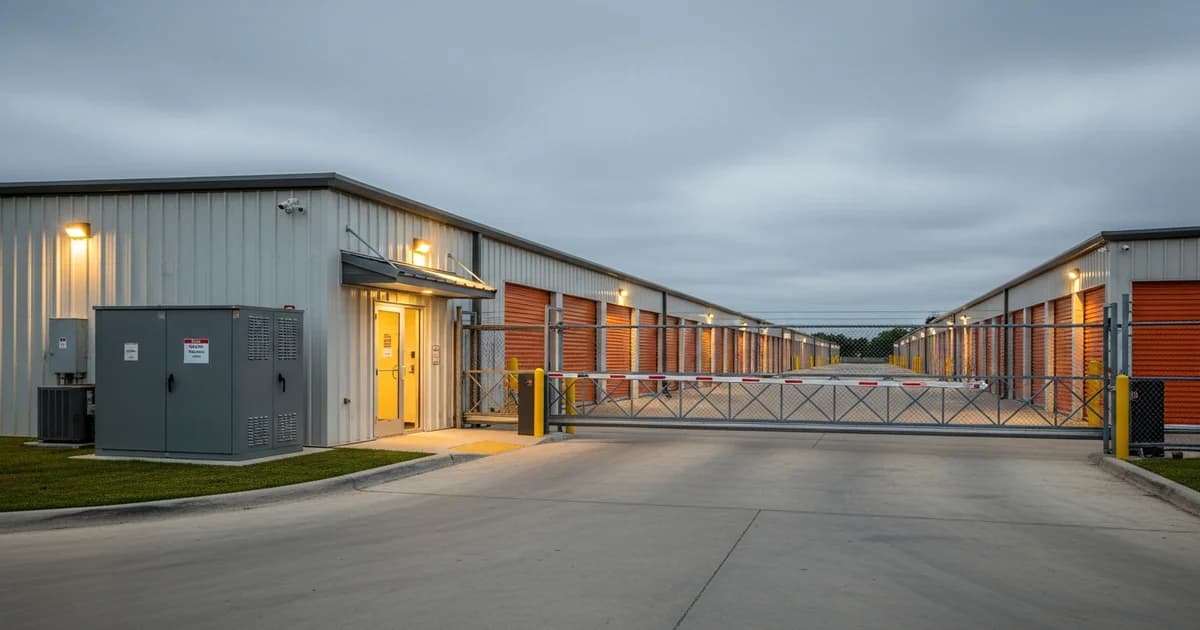
[IMAGE: Houston self-storage facility exterior at dusk with rows of roll-up doors and an electric sliding security gate at the entrance - search terms for Pixabay: self storage facility exterior gate]
Access gates and keypads: tenants locked out
Electric slide gates and keypad controllers lose power the instant the grid drops, and they fail in one of two bad ways. A fail-secure gate stays locked, stranding paying tenants outside. A fail-safe gate drifts open, leaving the whole site unsecured. Neither is acceptable, and tenants remember which one they got.
The good news is that gate access is cheap to protect. A typical slide-gate operator and its keypad controller draw a small continuous load, often well under one kilowatt combined, even with the receiver and access-control board running. Backing up the gate, the keypad, and the access-control panel is one of the smallest line items in the entire battery sizing exercise.
[PERSONAL EXPERIENCE] In a representative Houston facility we modeled, the operator's first instinct was to protect the climate-controlled buildings and treat the gate as secondary. We flipped that. The gate is what tenants test first during an outage, and a dead keypad generates the angriest calls and the fastest move-out threats. It also costs almost nothing to keep alive, so it should never be the system you skip.
Why the gate drives churn
Self-storage churn is sensitive to friction. When a tenant cannot reach their unit during the one week they actually needed it, the trust is gone. Industry operators consistently cite access reliability and security as top retention drivers, and a single high-profile lock-out during a storm can trigger a wave of move-outs once the power returns. Keeping the gate live is retention insurance.
Climate-controlled units: the mold and heat liability
Climate-controlled HVAC is both the largest backup load and the largest liability at a Houston storage facility. The Gulf Coast summer is the reason. Houston regularly runs heat-index values well above 100 degrees Fahrenheit with relative humidity in the 70 to 90 percent range during summer afternoons (NOAA / National Weather Service Houston, 2025), and an unconditioned metal building tracks that outdoor load fast.
Once the HVAC stops, an enclosed storage building can climb 10 to 20 degrees above its setpoint within a few hours on a hot, humid day, and the relative humidity inside rises with it. That combination is what damages stored contents. Wood furniture warps and joints loosen, documents and photos cockle, electronics corrode, and upholstery and mattresses absorb moisture.
Mold is the liability that turns a comfort complaint into a claim. The EPA notes that mold can begin growing on damp surfaces within 24 to 48 hours under warm, humid conditions (EPA, 2024). A climate-controlled lease that promised a stable environment, followed by a moldy heirloom, is a contract-performance dispute, not a weather excuse.
[INTERNAL-LINK: see commercial battery options sized to your climate-controlled square footage → /plans/commercial]
Security cameras, lighting, and office systems
An outage blinds the cameras, kills the exterior lights, and shuts the office, opening a theft-and-vandalism window exactly when the site is least supervised. Cameras and network video recorders need continuous power to capture and store footage, and a dead recorder means no evidence for the days when a break-in is most likely.
Exterior LED lighting is the second safety gap. A dark, unmanned facility at night is an invitation, and most insurance loss-prevention guidance treats lighting and active surveillance as baseline controls. If both fail during an extended outage, a claim after a theft becomes harder to defend, and premiums can follow.
The office is the third gap. When the front desk loses internet, phones, and its payment system, the facility cannot answer tenant calls, process move-ins, or run cards. During a storm, that is the moment displaced people are calling around looking for space, and a facility that cannot pick up loses that business to the competitor who can.
[IMAGE: Bank of security cameras and a network video recorder mounted in a facility utility room with status lights indicating active recording - search terms for Pixabay: security camera dvr surveillance]
[UNIQUE INSIGHT] Most generic commercial-backup content treats every business as a box of loads to keep running. Self-storage is different because the unmanned, lease-bound nature of the site means an outage attacks the contract itself. You are not just keeping the lights on. You are defending the two promises in every storage lease, 24/7 access and climate control, while also protecting an unattended building full of other people's property. That reframes backup power as a retention and liability tool, not a convenience.
[INTERNAL-LINK: see what an outage actually costs a Texas business → /blog/business-interruption-power-outage-cost-texas]
How much battery does a Houston self-storage facility need?
Most Houston self-storage facilities land between 30 and 150 kWh of battery, scaled primarily by climate-controlled square footage. Drive-up-only sites with no conditioned buildings sit at the low end, since they only need to carry the gate, cameras, lighting, and office. A large facility with multiple climate-controlled buildings sits at the top of the range, because HVAC dominates everything else.
The sizing driver is HVAC tonnage. Commercial heating and cooling is the largest end use in most commercial buildings, and on a hot Houston afternoon it can account for 60 to 70 percent of a storage facility's electrical demand (U.S. Energy Information Administration, 2023). Size the conditioning load correctly and the rest of the system falls into place around it.
Partial backup versus whole-site
You do not have to back up everything. A common, cost-effective strategy is to fully protect the cheap-but-critical loads (gate, keypad, cameras, office, exterior lighting) and back up the climate-controlled HVAC on a managed cycle, holding indoor temperature at a safe ceiling rather than the normal setpoint. That keeps contents out of the mold-and-heat danger zone without paying to run every air handler at full tilt.
Matching a system to your site
Eos commercial battery backup is sized in tiers, from the entry Commercial tier up through the largest Commercial configuration, so a small drive-up site and a multi-building climate-controlled campus get different systems. The right tier depends on your conditioned square footage, your HVAC tonnage, and how many hours of runtime you want before any generator support. We model that load before quoting, rather than guessing from building size alone. The same sizing logic applies to other multi-tenant properties, covered in our guide to [INTERNAL-LINK: backup power for multi-family apartments and condos → /blog/multi-family-battery-backup-texas-apartments-condos].
[INTERNAL-LINK: check if your facility qualifies for a 30 to 150 kWh system → /home-backup-planner?source=blog&slug=battery-backup-houston-self-storage-facilities]
A representative Houston facility (composite case study)
Picture a 60,000 square foot Houston facility, half of it climate-controlled, during an August evening outage. The figures here are illustrative and composite, not a real customer. The site has roughly 30,000 square feet of conditioned units across two buildings, an electric slide gate with keypad access, sixteen cameras feeding a single recorder, exterior LED lighting, and a small front office.
At 6:40 PM, a feeder fault drops the whole block. The gate freezes mid-position. Inside the conditioned buildings, the air handlers stop, and with an outdoor heat index still near 100, the interior begins climbing past its 78-degree setpoint within the first hour. The recorder powers down, the lot goes dark as dusk falls, and the office phone and card reader die. Two tenants pull up to a dead keypad and start calling.
With a properly sized battery, none of that happens. The gate, keypad, cameras, lighting, and office ride through on a small fraction of the system, while the battery carries the climate-control HVAC on a managed cycle that holds the conditioned buildings at a safe ceiling. By the time crews restore the feeder, the operator has lost no footage, stranded no tenants, and fielded zero damage claims. The avoided liability and the retained tenants are the real return on the system.
[IMAGE: Climate-controlled interior hallway of a self-storage facility with clean lighting, polished floors, and rows of individual unit doors - search terms for Pixabay: climate controlled storage interior hallway]
FAQ
Can a battery keep my storage gate working during an outage?
Yes, and it is one of the easiest systems to protect. A slide-gate operator, its keypad, and the access-control board draw a small continuous load, often under one kilowatt combined, so they sit at the bottom of the backup load list. Keeping the gate live preserves the 24/7 access your lease promises and prevents the lock-out calls that drive storm-season move-outs.
How fast does a climate-controlled storage building heat up in a Houston outage?
Fast. With Houston summer heat-index values regularly above 100 degrees (NOAA / National Weather Service Houston, 2025), an unconditioned building can climb 10 to 20 degrees above setpoint within a few hours, and humidity rises with it. The EPA notes mold can begin within 24 to 48 hours on damp contents (EPA, 2024), which is why HVAC is the top sizing priority.
What size battery does a self-storage facility need?
Most Houston facilities need 30 to 150 kWh, scaled mainly by climate-controlled square footage and HVAC tonnage. A drive-up-only site that only backs up the gate, cameras, lighting, and office sits near the low end. A multi-building climate-controlled campus sits near the top, because conditioning can be 60 to 70 percent of demand on a hot day (U.S. Energy Information Administration, 2023).
Is battery backup better than a generator for a storage site?
For most outages, a battery wins on the qualities that matter at an unmanned site. It starts instantly with no transfer delay, runs silently with no fuel to store or refill, and needs no on-site staff to operate during a storm. For multi-day events, a battery paired with a generator is the strongest setup, the battery carrying the first hours cleanly while the generator handles the long tail.
[INTERNAL-LINK: read our commercial battery backup guide for Texas businesses → /blog/commercial-battery-backup-texas-businesses]
Conclusion
For a Houston self-storage operator, an outage is not a single inconvenience. The gate, the climate control, the cameras, and the office all fail in the same moment, and each one maps to a real liability: stranded tenants, mold and heat damage, theft exposure, and lost business. Climate-controlled HVAC drives the sizing, which is why most facilities land in the 30 to 150 kWh range, weighted to conditioned square footage. Done right, battery backup stops being a cost line and becomes a tenant-retention and lease-performance tool that pays off the first time a storm rolls through.
The next step is simple: assess your facility's real load and get a sized quote for your address.
[INTERNAL-LINK: get a Houston battery backup quote in under 2 minutes → /home-backup-planner?source=blog&slug=battery-backup-houston-self-storage-facilities]
Call (713) 470-9182 to speak with our commercial team about your facility.