Battery Backup for Houston Optometry and Eye Clinics

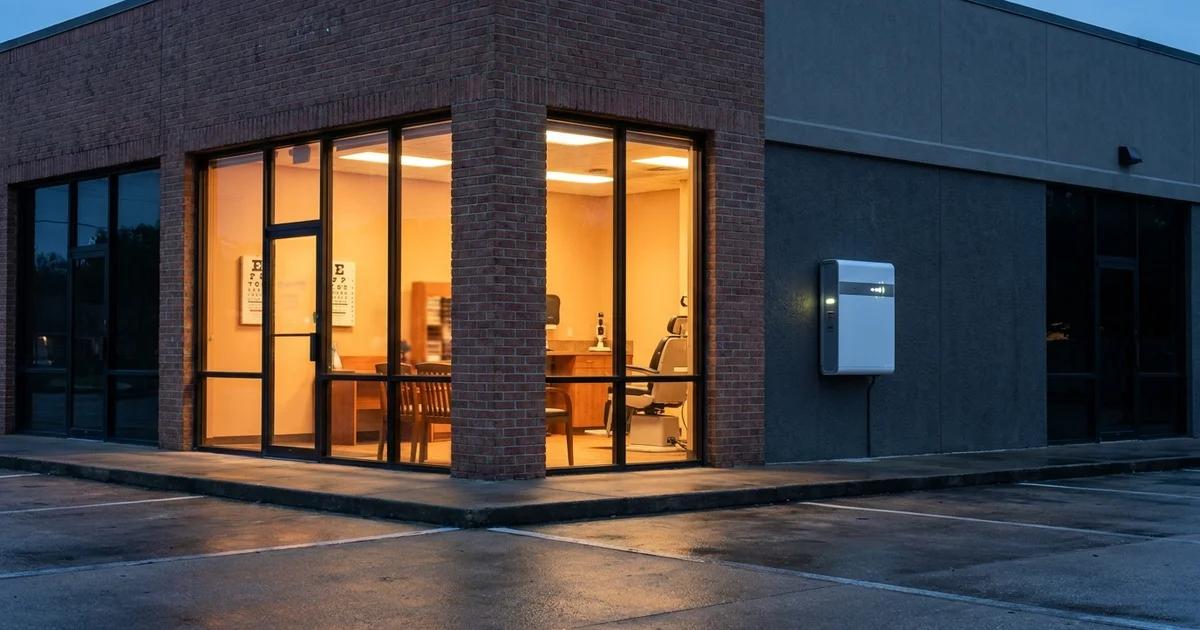
When people picture a clinic losing power, they picture a refrigerator full of spoiling medicine. An optometry office mostly does not have that problem. What it has is a day built from short exam slots, a chair and a set of instruments that all need to be on at the same time, and a record system that has to be there when the patient sits down.
That changes what a battery is for. It is less about saving inventory and more about keeping the schedule alive. This post is about that narrower job, and I will be plain about the limits, because Eos plans are residential-scale systems and some of the equipment in an eye clinic is something I could not find power numbers for.
Key Takeaways
- An optometry office has no required cold chain. The exposure is the exam lane, the front desk and the record system, which is a small, steady load a single controller can often carry.
- Eos plans use one controller rated 11.5 kW continuous and 17.1 kW surge, with capacity added in 9 kWh modules (8.76 kWh usable each). The Essential plan lists up to 8 hours at minimal load.
- One published slit lamp listing shows 40 VA of power consumption (Topcon SL-2G specification). I could not find published power figures for autorefractors or OCT scanners, so those need a nameplate check.
- HIPAA's Security Rule requires covered practices to have a data backup plan, a disaster recovery plan and an emergency mode operation plan (45 CFR 164.308(a)(7)).
- Customers nationally averaged about 11 hours without electricity in 2024, and major events including Hurricane Beryl accounted for 80 percent of those hours (U.S. Energy Information Administration).
How is an eye clinic different from a medical or dental office?
Mostly by what it does not have. Our posts on medical and dental practices and urgent care clinics spend much of their length on vaccine and drug refrigeration, sterilizers and procedure rooms. A typical optometry office has none of those as a core dependency. I am not going to claim a refrigerator-driven loss for an eye clinic, because that would be borrowing a risk from a different kind of practice.
What an eye clinic does have is a room of instruments that are individually small but need to work together: a phoropter or refraction lane, a slit lamp, an autorefractor, a tonometer, a retinal camera or OCT scanner in some offices, and a computer that holds the chart. Add an optical shop with frame displays, a lens edging area in some locations, lighting and a point-of-sale terminal, and the building is a quiet, low-wattage place whose value is entirely in whether it can open.
What does an outage actually stop?
The visit, first. An exam lane without power is a dark room, and without power the instruments do not run and the chart does not open. Texas rules require an optometric record to be legible and accurate and detailed enough that another optometrist can identify the examination and its results, and they say any record kept electronically must be capable of printing a paper record that meets the same requirements (22 Tex. Admin. Code § 277.7). That rule does not tell you how to stay up during an outage. It does mean a clinic that loses its system mid-exam has a documentation problem on top of a scheduling one.
That section does not address how long records must be kept or how they must be backed up, and I did not find a Texas optometry rule that does. Ownership is clearer: under Texas Occupations Code § 351.352 the practice's prescription files, patient records and business records are the sole property of the optometrist (Texas Occupations Code § 351.352). A practice cannot hand the problem to a vendor and walk away.
Second, the front desk. Scheduling, insurance eligibility, the point of sale and the phones are what turn a day of booked exams into revenue. A clinic with working exam instruments but no network is only partly open.
What does HIPAA require when the power goes out?
A written plan, not a particular machine. The Security Rule's contingency plan standard has three required parts for a covered practice that keeps electronic patient information: a data backup plan to "create and maintain retrievable exact copies," a disaster recovery plan to "restore any loss of data," and an emergency mode operation plan to "enable continuation of critical business processes" while protecting that information (45 CFR 164.308(a)(7)).
A battery is one way to support the third part for a short outage. It does not replace the first two, which are about data copies and recovery, not electricity. If your practice management system is hosted in the cloud, the question shifts from your server to your router, your workstation and your exam lane, which is a smaller and cheaper thing to protect.
What can a battery carry in an exam lane?
Probably more than you expect, with one honest gap. The only instrument power figure I could verify is a slit lamp: Topcon lists its SL-2G LED model at 40 VA, running on 100 to 240 V (Topcon SL-2G). That is the draw of a bright light bulb or two.
For autorefractors, tonometers, retinal cameras and OCT scanners I could not find published power figures. A distributor listing for one autorefractor shows its power consumption only as "inquire," and the OCT search turned up resale listings, not a manufacturer rating. I will not guess. The right source is the label on the back of your own instrument or its installation manual, and the number to look for is VA or watts, plus any note about inrush at startup.
A rough split, based on the Eos controller and module numbers above. Confirm every item against your own nameplates.
| Load | Fits one controller? | Notes |
|---|---|---|
| Network, router, workstations, chart server | Yes | Pair with a small UPS for clean shutdown |
| Reception, scheduling, phones, point of sale | Yes | Run as a separate backed-up circuit |
| Lighting in exam lanes and optical shop | Yes | LED lighting is a modest load |
| Slit lamp, refraction lane, tonometer | Likely | Nameplate check on each |
| Autorefractor, OCT, retinal camera | Unknown | No published figures found; confirm with the vendor |
| Lens edging and finishing equipment | Possibly | Motors and compressors start harder than they run |
| Full building HVAC | Not on one controller | Cool one room instead of the building |
The last row matters in Houston. Patients, a retail floor and electronics all want the air conditioning on, and a whole-building system can draw more than one controller can deliver. Our explainer on commercial versus residential battery sizing in Texas shows how that line is drawn.
How much battery does a small clinic need?
Start with the clinical core and size to that. Eos plans use one controller rated 11.5 kW continuous and 17.1 kW surge, with 9 kWh modules that each provide 8.76 kWh of usable capacity. The Essential plan lists up to 8 hours of backup at minimal load, and larger plans add modules for more hours on the same controller (see the Essential plan and all plans). Those hours assume a minimal load, which is what a network closet, lights and one or two instruments look like. They do not describe a full-power day with every lane running.
The practical way to size it is to add up the nameplate watts for the circuits you want to keep alive, include the start-up draw of anything with a motor, and ask whether you want to finish the current patient, finish the day or stay open through a multi-day event. The Houston hurricane season argues for the longer answer. The ERCOT outage history argues for knowing your options before the next event.
The exposure is real but not constant. Nationally, customers averaged about 11 hours without electricity in 2024, and the EIA attributes 80 percent of those hours to major events such as Hurricanes Beryl, Helene and Milton (EIA). In July 2024, Beryl left about 2.6 million Texas customers without power (same source). I am not putting a dollar figure on a lost clinic day, because I do not have a verified one. Our post on the cost of a power outage to a Texas business lays out the categories.
What needs an engineer or a landlord first?
Three things.
- Your lease. Many optometry offices sit in strip centers or medical office buildings. Outside wall space, panel access and utility meters may belong to the landlord. Ask before you design anything.
- Your service. A commercial space may run on 3-phase power. The Eos system is a single-phase residential design, so a 3-phase panel needs an electrician to tell you what is possible.
- Large loads. If your clinic has a laser, a large compressor or a combined edging lab, treat those as vendor questions, not battery questions.
If any of those apply, the realistic plan is a single controller supporting a clinical core panel. Our commercial battery backup overview covers where multiple controllers come in, and the small data room post covers the IT side.
What to do next
- List every instrument and its nameplate watts or VA. Ask the vendor for the ones you cannot find.
- Decide what must stay on to finish an exam and what can wait.
- Have an electrician separate those circuits into a core panel.
- Check your lease and your service type.
- Write the emergency mode operation plan down. It is a requirement, and a battery is only one line in it.
Or call Eos at 833-989-3737 to talk through your setup with an installer.
Frequently asked questions
Does an optometry office need backup power by law?
I did not find a Texas optometry rule requiring a generator or battery. Texas rules set what a patient record must contain and require electronic records to be printable (22 Tex. Admin. Code § 277.7). HIPAA requires an emergency mode operation plan but not a specific technology (45 CFR 164.308).
Can a home battery run an OCT scanner or retinal camera?
I could not verify. Neither a manufacturer rating nor a distributor figure was available when I looked. Check the instrument label or the installation manual for VA or watts and share it with the installer.
Will a battery keep my exam lane running during an outage?
For lighting, a slit lamp and a computer, likely yes, subject to a nameplate check. The runtime depends on what is on the circuit. The Essential plan lists up to 8 hours at minimal load.
Does the optical shop need to be on the same circuit?
Not necessarily. Separating the point of sale and lighting from the exam lane lets you choose what stays on, which stretches the battery.
What about the optical lab's edging equipment?
Possibly, but motors draw more at startup than while running. Confirm with the equipment vendor and size to the startup draw.
Reflects Eos Backup and Battery specifications as of November 2026. Eos plans are residential-scale systems. No runtime or clinical outcome is promised, and equipment loads and electrical code should be confirmed with the equipment vendor and a licensed professional.