Battery Backup for Houston Ice Vending Machines and Packaged-Ice Sellers

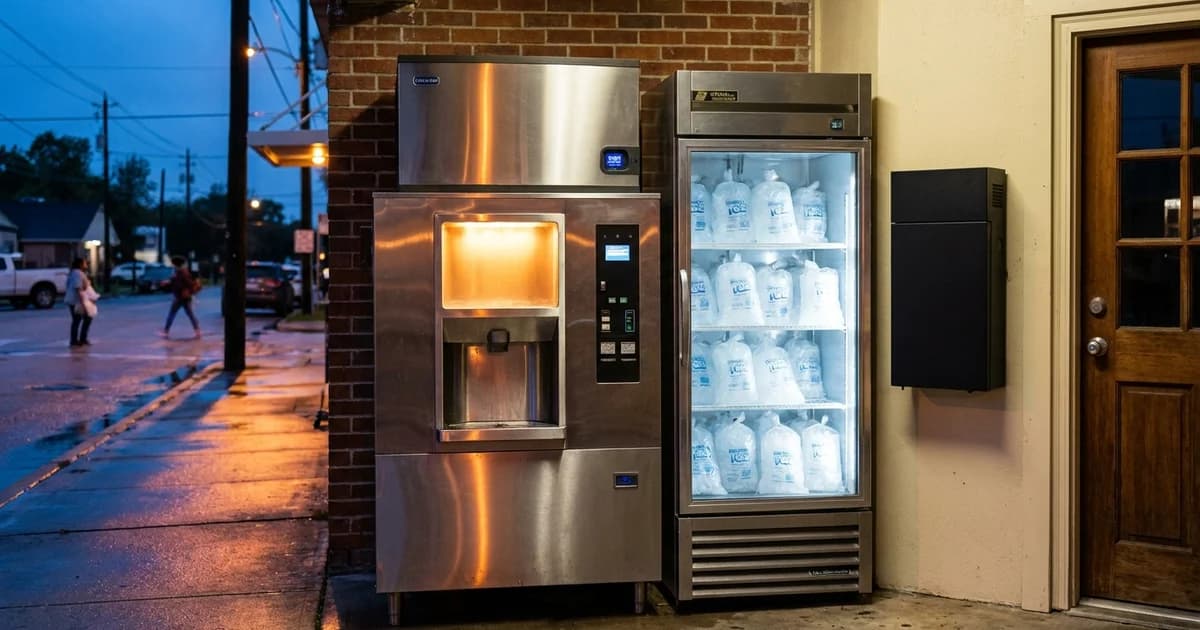
When the grid fails in Houston, ice becomes one of the first things people go looking for. After Hurricane Beryl in July 2024, more than 1.35 million customers were still without power on the Wednesday after landfall, and residents were rushing to distribution centers for food, water and ice (CBS News, 2024). The people who sell ice face an odd problem: demand peaks at the exact moment their own equipment loses power.
This post is for owners of ice vending kiosks and packaged-ice resellers. It is also for anyone who runs an ice maker at a store, truck stop or event business. We will be honest early: a battery is not a magic way to keep a large industrial ice plant running. The realistic win is protecting frozen stock and keeping the point of sale alive.
Key Takeaways
- Ice is regulated as a food, so a thawed pallet is a compliance problem and not only a lost sale (FDA).
- Making ice is the heaviest load. Holding ice frozen, lighting the kiosk and taking payment is a far smaller one.
- Size the battery to the load you choose to protect, not to the nameplate of every machine on site.
Why does ice demand peak when the power is out?
People use ice to hold food at safe temperatures once the refrigerator stops cooling. The CDC says a refrigerator keeps food safe for up to 4 hours without power, a full freezer for 48 hours, and a half-full freezer for 24 hours (CDC). Those clocks start ticking for every household at once.
In Beryl's case, the reporting we could verify describes people heading to distribution centers for ice and water, with the heat index at 100 degrees in Houston (CBS News, 2024). We could not confirm from a primary Houston source that lines formed at retail ice sellers specifically, so we do not claim it. The demand signal is real. The retail queue detail is not something we can document.
The takeaway for a seller is simple. Ice is a product people need on hour four of an outage, not on day four of a normal week.
What do you actually sell, and who regulates it?
Ice is a food. The FDA regulates packaged ice in interstate commerce as a food, requires manufacturers to follow its current good manufacturing practice rules, and expects ice to be produced, held and transported in clean and sanitary conditions using safe, sanitary water (FDA). The governing rules sit in 21 CFR Part 117, whose criteria are used to decide whether a food is adulterated.
Texas adds its own layer. The Department of State Health Services lists bagging ice, ice plants and selling vended water among the operations that need a Food Manufacturer license, including processing or packaging ice for sale through retail customer self-service (Texas DSHS).
Why does this matter for backup power? Because a vending kiosk is a self-service food operation. If the freezer warms and the ice partly melts and refreezes, you may be holding a product you cannot lawfully sell. The battery protects more than revenue.
At the retail end, regulators lean on a model rulebook. The FDA Food Code is the model that local, state, tribal and federal regulators use to build their own retail food rules. Confirm which edition your local health authority has adopted before you rely on any temperature rule.
Can a battery keep an ice maker running?
Sometimes, but be skeptical of anyone who promises it without seeing your nameplate. Ice makers are efficient per pound, yet they make a lot of pounds.
The ENERGY STAR criteria for commercial ice makers cap energy use at 4.24 kWh per 100 lb of ice for air-cooled batch-type machines in the 1,500 to 4,000 lb per day class (ENERGY STAR). That is a ceiling for certified models, so many will use less per pound. Our arithmetic from that figure:
- A 1,500 lb per day machine running at that ceiling uses up to about 64 kWh per day.
- A 4,000 lb per day machine uses up to about 170 kWh per day.
Now compare that with Eos hardware. One battery module is 9 kWh nominal and 8.76 kWh usable, and each controller delivers 11.5 kW continuous with 17.1 kW surge. Stacking modules to 18 kWh and 27 kWh nominal raises usable capacity to 17.52 and 26.28 kWh. A full day of production from a large machine is several times beyond a single stack.
So the honest answer is that a small under-counter or kiosk ice maker may be coverable for some hours. A big production machine usually is not, unless you size a commercial system for it and accept a smaller runtime target. For that conversation, start with our
.Federal rules also bound the size of what a store typically runs. The Department of Energy regulates automatic commercial ice makers with production capacities between 50 and 2,500 lb per 24 hours (U.S. DOE). That is a useful sanity check when you read a nameplate.
What is the smarter load to protect?
For most Houston sellers, the best use of a battery is the part of the business that holds and sells ice you already made. Think of it as protecting inventory, not manufacturing.
A short list of loads worth protecting first:
- The freezer or merchandiser holding bagged ice. Keeping stock frozen also keeps it lawful to sell.
- The payment terminal and kiosk controller. An ice kiosk that cannot take a card is a dark box.
- Lights and a camera. Customers show up after dark in an outage, and an unlit lot is a liability.
- Communications. Router, cellular modem and phone charging so you can post hours and take calls.
- The ice maker itself, last. Add it only after the first four are covered, and only on a schedule your battery can carry.
Staggering the ice maker is the part that surprises people. Instead of running flat out, you let it make ice during the hours you have capacity, while the freezer and kiosk stay live around the clock. No nameplate gives you that answer. You get it by listing each device, its running watts and its hours.
Note on numbers. We do not publish revenue per bag or market-size figures for packaged ice. We could not find a reliable public source for either, so this article leaves them out on purpose.
A composite case: the corner kiosk
This is a composite scenario for illustration. It does not describe a real customer, and every detail is representative, not measured.
Picture an owner with a small lot in the Houston area, an outdoor ice vending kiosk, a glass-door freezer of bagged ice, a card reader and a security light. She has no backup power. During a multi-day storm outage, three things happen in order.
First, the kiosk goes dark and the card reader stops taking payments. Second, the freezer begins to warm. Even a full household freezer is only rated for around 48 hours by the CDC's guidance, and a commercial merchandiser that is opened constantly will not do that well. Third, neighbors who need ice have nowhere to buy it.
Now picture the same site with a battery sized for the freezer, terminal, light and router. The kiosk stays lit. The freezer holds temperature. The owner opens for a few daylight hours, sells stock that is still safe, and closes when the battery reaches a reserve she set in advance. She is not producing ice at scale. She is selling what she has, legally, to people who need it.
That outcome is the realistic target. It also happens to be the part of the business customers remember.
For a deeper look at the same logic applied to retail cold stock, read
. If your ice sits in a larger cold room, see .How do you size the system?
Sizing comes down to four questions.
Which loads stay on? Use the list above. Everything else stays on the main panel and loses power in an outage.
How many hours must they run? A realistic target for a storm like Beryl is a daytime selling window, not 72 continuous hours. Decide whether you want to sell for 6 hours or 12.
What is each device's real draw? Read the nameplate or use a plug-in meter. Freezers cycle, so average draw is lower than the label, but the compressor start adds a surge. The 17.1 kW surge rating on the controller is there for that kind of motor start.
Do you want solar? A battery with solar can refill during the day, which changes the math for multi-day events. That is a site decision, not a default.
Multiply watts by hours for each protected device, add them up, and compare the total to usable kWh. Add a margin. If the total is well beyond what three modules provide, you are in commercial-system territory, and the right move is a site conversation rather than a guess from a blog.
If you run vehicles or other equipment from the same site, our guide on
covers sharing a battery across several loads. For the wider commercial picture, start with .Where should you start?
Start by writing down what you would protect and how long you need it. That one page is more useful to an installer than any model number.
Then walk through the planner. It asks about your site, your loads and your goals, and routes you to a sized recommendation.
Or call Eos at 833-989-3737 to talk through your setup with an installer.
Frequently asked questions
Can a home battery run a commercial ice machine?
It depends on the machine. A small unit might run for hours on a stacked system. Certified large machines can use up to about 64 to 170 kWh per day based on ENERGY STAR's ceiling of 4.24 kWh per 100 lb (ENERGY STAR), which is far beyond one stack.
Is packaged ice really regulated as a food?
Yes. The FDA regulates packaged ice in interstate commerce as a food, like other foods (FDA). In Texas, bagging ice or selling it through vending also falls under the DSHS Food Manufacturer license (Texas DSHS).
How long will my freezer hold bagged ice without power?
The CDC's household guidance is 48 hours for a full freezer and 24 hours for a half-full one, with the door kept closed (CDC). A commercial merchandiser that customers open will lose cold faster. Ask your local health authority which temperature limits apply to you.
What should I protect first on a limited battery?
Protect the freezer holding stock, the payment terminal, lights and your router first. Add the ice maker last, and only on a schedule the battery can carry. Our
page outlines how larger sites are scoped.Did Hurricane Beryl really cause ice shortages at Houston stores?
We can document that residents rushed to distribution centers for ice and water during the outages (CBS News, 2024). We could not verify retail ice shortages from a primary source, so we make no claim about them.
This article is general information, not legal, food-safety or electrical advice. The case is a composite illustration and does not promise a specific runtime or outcome. Confirm licensing with Texas DSHS and your local health authority, and sizing and permitting with qualified professionals. System figures reflect Eos specifications as of October 2026.