Battery Backup for Houston Food Trucks and Commissary Kitchens

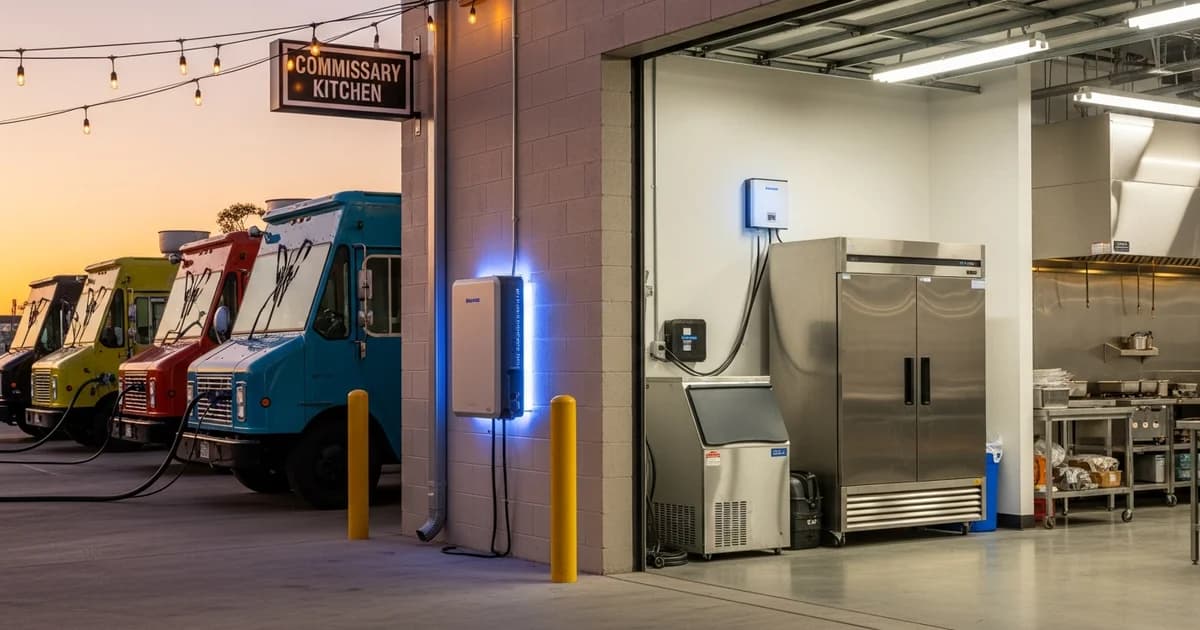
When Hurricane Beryl made landfall in July 2024, it knocked out power for roughly 2.2 million Houston-area customers, with restoration stretching past a week in some neighborhoods (Houston Public Media, 2024). For most food businesses, that meant one dark kitchen. For a commissary kitchen, it meant something worse: every food truck that depends on the building went down with it.
A note on the case below. The commissary described in this article is a composite scenario, not a single real client. The numbers reflect ranges from Houston-area commercial site surveys. Names, location, and revenue figures are illustrative.
TL;DR. Houston requires every mobile food unit to service at an approved commissary within the 24-hour period before each operating day, so one commissary outage cascades across every truck that depends on it: $500 to $3,000 in spoiled inventory per truck, times 10 to 30 trucks. A 50 to 100 kWh commercial battery carries the walk-ins, prep refrigeration, and overnight truck shore power through a multi-hour outage, and peak-shaves the ice machines the rest of the year.
Key Takeaways
- Houston mobile food units must service at an approved Central Preparation Facility within the 24-hour period before each operating day (Houston Health Department), so a commissary outage hits every tenant truck at once.
- Texas food rules require cold TCS food held at 41°F or below; food in the danger zone more than 4 hours must be discarded (Texas DSHS, TFER).
- A composite 22-truck Houston commissary faces $11,000 to $66,000 in tenant spoilage from a single multi-hour outage, before its own walk-in losses.
- Critical load runs 14 to 22 kW, refrigeration-dominated. A 50 to 100 kWh battery covers it, and works against demand charges every other day of the year.
[INTERNAL-LINK: get a fixed-price install quote for your address → /home-backup-planner?source=blog&slug=battery-backup-houston-food-trucks-commissary-kitchens]
[INTERNAL-LINK: commercial battery backup pillar → /blog/commercial-battery-backup-texas-businesses]
Why does one commissary outage hit dozens of Houston food trucks at once?
Because the city concentrates the risk by rule. The Houston Health Department requires every mobile food unit to report to an approved Central Preparation Facility, a licensed commissary, within the 24-hour period before each day of operation, and operators must keep servicing receipts for a year (Houston Health Department, Mobile Food Units). No servicing, no legal operating day.
The commissary is where the dependency stacks up. It is where trucks prep and store food, fill fresh-water tanks, dump wastewater into an approved grease-trap drain, and park overnight plugged into shore power that keeps their onboard refrigeration cold. The city maintains the list of approved commissaries, and fresh-water fill and wastewater disposal are only legal at one of them (HHD approved commissary list). The Health Department briefed a City Council committee on the citywide mobile food unit program in March 2025, and every permitted unit in it is tethered to a commissary (Houston Health Department, City Council Quality of Life Committee, 2025).
[UNIQUE INSIGHT] Here is the framing nobody applies to backup power: Houston's commissary mandate turns one building's electrical service into a single point of failure for 10, 20, or 30 independent businesses. A dine-in restaurant that loses power loses its own inventory. A commissary that loses power spoils inventory it does not even own.
The composite scenario: a Houston commissary with 22 tenant trucks
Picture a shared kitchen inside Beltway 8, about 8,000 square feet, with 22 permitted mobile food units as tenants. Twelve overnight parking bays have 30 and 50 amp shore-power pedestals. Inside: a walk-in cooler, a walk-in freezer, two ice machines, shared prep lines with reach-in refrigeration, a three-compartment sink, and washdown stations fed by electric water heating.
The utility profile is what you would expect from a refrigeration business that never closes: walk-ins and plugged-in trucks running 24/7, ice machines cycling hardest overnight, and a bill heavy on demand charges.
Pre-outage backup posture? None, which is standard for the category. The trucks assume the building will be there; the building assumes the grid will be.
Then a Beryl-class event, or even an ordinary multi-hour ERCOT distribution outage, takes the building dark at 2 a.m. with twelve trucks on the pedestals and both walk-ins full.
What loads does a commissary kitchen actually need to back up?
Refrigeration is the whole game. [ORIGINAL DATA] Across Houston commercial site surveys, the ranges we see for a facility this size: walk-in cooler and freezer at 3 to 6 kW combined running load, prep and reach-in refrigeration at 1 to 2 kW, ice machines at 1 to 2 kW, and overnight truck shore power, with 6 to 12 trucks each drawing roughly 1 to 1.5 kW to run onboard refrigeration. Washdown water heating adds about 4.5 kW but is deferrable until the grid returns.
Just as important is what you do not back up: hoods, cook lines, comfort HVAC, and water heating can all wait. Cooking stops during an outage anyway; cold holding cannot. The same load-priority logic applies at grocery and convenience stores, where refrigeration is likewise the entire critical load.
[INTERNAL-LINK: grocery and convenience store refrigeration backup → /blog/battery-backup-houston-grocery-convenience-stores]
Add it up and the critical load lands at 14 to 22 kW sustained: refrigeration inside the building plus the shore-power circuits keeping a row of trucks cold outside it.
What does an outage cost when the health code forces the discard?
The health code, not the thermometer, is what forces the write-off. The Texas Food Establishment Rules require time and temperature controlled (TCS) food to be held cold at 41°F or below, or hot at 135°F and above; food that sits in the danger zone beyond the allowed window, 4 hours as the general limit, must be discarded (Texas Food Establishment Rules, 25 TAC 228, Texas DSHS, current rules adopted 2021). Inspectors check temperature logs after an event. An outage without documented temperature control forces the discard even of food that looks fine.
Now run the cascade math for the composite facility:
| Loss line | Range |
|---|---|
| Spoiled inventory per truck | $500 to $3,000 |
| Tenant trucks affected | 22 |
| Total tenant spoilage, one event | $11,000 to $66,000 |
| Commissary's own walk-in inventory | $4,000 to $10,000 |
| Lost operating day per truck (cannot complete servicing) | $800 to $1,500 |
Those per-truck figures are composite estimates, labeled as such, but they track what food truck operators themselves report: a commissary closure means lost prep, lost product, and lost operating days for every tenant at once (Food Truck Profit, Surviving Commissary Kitchen Closures, 2024). We covered the single-restaurant version of this math, and the broader picture of what outages cost Texas businesses, in the related reading below. The commissary version multiplies it by the tenant count.
[INTERNAL-LINK: what Beryl cost a Houston restaurant → /blog/battery-backup-restaurants-houston]
[INTERNAL-LINK: what outages cost Texas businesses → /blog/business-interruption-power-outage-cost-texas]
For the commissary owner, that makes backup power a tenant-retention feature, not just an insurance line. Which facility wins the truck that just lost $2,000 of brisket: the one with a dark walk-in, or the one whose pedestals never blinked?
[INTERNAL-LINK: see commercial battery plans for your facility → /plans/commercial]
How big a battery does a commissary need? Sizing 50 to 100 kWh
Start from the load, not the sticker. A 16 kW average critical load carried for 5 hours is 80 kWh of usable storage. That is why the practical commissary range is 50 to 100 kWh: 50 kWh covers a short-duration event with active load management, and 100 kWh carries full refrigeration plus overnight shore power through a multi-hour outage without triage.
[PERSONAL EXPERIENCE] On site surveys we walk operators through the stretch moves that make the smaller number work: trim shore power to refrigeration-only circuits instead of full pedestal capacity, stagger the ice machines instead of letting both cycle at once, and let water heating wait. Those three moves alone can pull a 22 kW worst case down to 14 kW and roughly double effective runtime.
On our modular hardware, that sizing maps to stacked 9 kWh battery modules, 45 kWh per controller with 11.5 kW continuous and 17.1 kW surge output. Two controllers give 90 kWh and 23 kW continuous, which covers the composite facility's full critical load with surge headroom for compressor starts.
The battery also is not idle insurance. The other 360 days a year it peak-shaves the ice machines and refrigeration cycling that set the facility's demand charge. The honest caveat: for a Beryl-length, week-scale restoration, a battery pairs with a small generator at this scale. The battery handles instant transfer, silent overnight hours, and transient peaks; the generator handles the long tail. Compressors never hard-cycle through a transfer gap, because there is no gap.
What changes for the food trucks themselves?
The pedestals stay live, and that changes everything downstream. Onboard refrigeration keeps running overnight, so every truck starts the day with cold holding intact, documented temperatures, and full ice instead of a discard pile and a scramble.
Servicing continuity matters just as much. Because the commissary stays operational, tenants can complete the required 24-hour servicing and legally operate while competitors sit dark. After Beryl, food trucks were among the few food businesses running in some Houston neighborhoods, but only trucks whose commissaries could still service them. A powered commissary is the enabler: it converts a city-wide outage into its tenants' best sales week of the year.
Payback and next steps for commissary owners
The financial case stacks four ways: one avoided spoilage cascade, tenant retention, daily demand-charge reduction, and peak shaving on the ice machines. A single avoided event covers a meaningful share of the system cost on its own. The full framing, including demand charges and ERCOT 4CP, is in the commercial battery backup guide linked above.
The next step is a load walk, not a quote sheet. Which circuits feed the walk-ins, which pedestals need refrigeration-only backup, and where the demand peaks actually come from: that survey sets the size, and the size sets the price.
[INTERNAL-LINK: book a free Houston site assessment → /home-backup-planner?source=blog&slug=battery-backup-houston-food-trucks-commissary-kitchens]
Prefer to talk it through? Call Eos at 713-207-2222 and ask for a commercial site survey.
Frequently asked questions
Do Houston food trucks have to use a commissary kitchen?
Yes. Houston requires mobile food units to service at an approved Central Preparation Facility within the 24-hour period before each operating day, keeping receipts for a year (Houston Health Department). Fresh-water fill and wastewater disposal are only legal at an approved commissary, so every permitted truck depends on one.
What temperature rules force food to be thrown out after an outage?
The Texas Food Establishment Rules require cold TCS food held at 41°F or below and hot food at 135°F or above (Texas DSHS, TFER, 25 TAC 228). Food in the danger zone beyond 4 hours must be discarded, and inspectors expect temperature logs proving control.
How much battery does a walk-in cooler need?
A walk-in cooler and freezer pair draws 3 to 6 kW running load in the site-survey ranges we see. Overnight, that is roughly 15 to 30 kWh of storage for refrigeration alone, before prep units, ice machines, or truck shore power. That is why commissary sizing starts at 50 kWh.
Can a battery power food truck shore-power pedestals?
Yes. The pedestals are 30 and 50 amp hookups, but overnight the trucks mostly run onboard refrigeration at 1 to 1.5 kW each. The practical design backs up refrigeration circuits rather than full pedestal capacity, so 8 trucks stay cold on 8 to 12 kW instead of demanding the full rated load.
Is a battery better than a generator for a shared kitchen?
For daily operation, yes: instant transfer with no compressor hard-cycling, silent overnight running where trucks park and neighbors sleep, and demand-charge work every day the grid is fine. For week-long restorations at commercial scale, the strongest design pairs the battery with a small generator.
The bottom line
Houston's commissary rule concentrates dozens of small businesses' outage risk into one electrical service. That is exactly what makes the fix tractable: protect one building's 14 to 22 kW of refrigeration and shore power, and you have protected every truck on the lot. For the commissary owner, a 50 to 100 kWh battery is spoilage protection, a tenant magnet, and a daily demand-charge tool in one cabinet.
This article is general information for Houston commissary operators and food truck owners, and reflects Eos specifications as of July 2026. The facility described is a composite illustration, not a specific client, and figures labeled as ranges or estimates are illustrative. Confirm loads, health-code requirements, electrical code, and permitting for your facility with the appropriate professionals.