Battery Backup for Your Houston Home Gym: Peloton, Treadmill, and AC

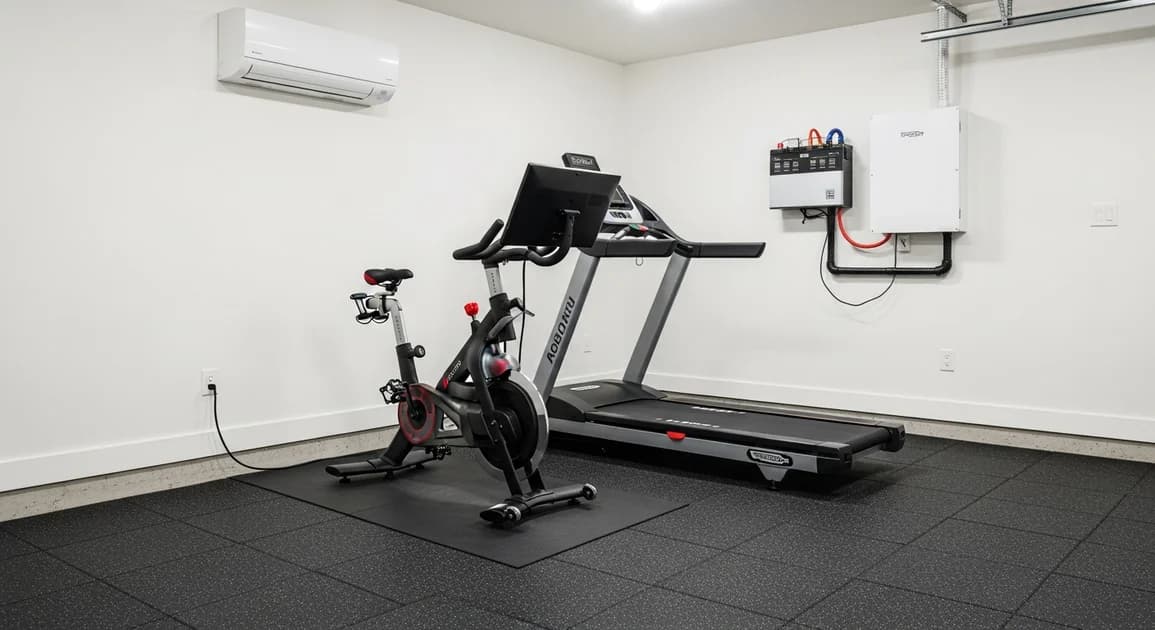
If you have built a home gym in a Houston garage or spare room, you already know the enemy is not the workout, it is the heat. And the moment the power goes out in July, a garage gym becomes unusable in minutes. The surprising part, once you run the numbers, is that your Peloton or treadmill barely registers on a home battery. It is the air conditioning that decides how much capacity you need. This guide breaks down the real loads and the right battery size to keep training through a Houston outage.
[INTERNAL-LINK: size a battery for your home gym in under 2 minutes -> /home-backup-planner?source=blog&slug=battery-backup-home-gym-peloton-treadmill-houston]
Key Takeaways
- A Peloton Bike draws only about 100 to 200W, and even a smart mirror or sound system is a minor load, per manufacturer specs.
- The dominant load is cooling: a garage mini-split pulls 1.2 to 3 kW, far more than all your equipment combined.
- A motorized treadmill is the one heavy piece of equipment, drawing 1 to 2 kW while running.
- Plan on 18 kWh (Plus) for bike-plus-AC sessions and 27 kWh (Pro) for a treadmill plus AC or a family-shared gym.
- Houston summer heat makes the AC non-negotiable; sizing the battery for equipment alone is the common mistake.
How much power does home gym equipment use?
Most connected fitness equipment is surprisingly light on power. A Peloton Bike or Bike+ draws roughly 100 to 200W in use, per Peloton specs, similar to a couple of laptops. A wall-mounted strength trainer like a Tonal or a smart mirror pulls around 300W, and a gym sound system adds 100 to 200W. A ceiling fan is about 75W. Add all of that together and a typical connected home gym, minus cooling, sits well under 1 kW.
The exception is the motorized treadmill. A running treadmill draws 1 to 2 kW depending on speed, incline, and user weight, per treadmill manufacturer datasheets, and a Peloton Tread is in the same range. That single machine can outdraw everything else in the room combined. If your gym is cardio-heavy with a treadmill, it changes the sizing math.
The real load is the AC, not the Peloton
In Houston, the air conditioning is the load that actually sizes your battery. A garage or converted-room gym needs a mini-split or window unit to be usable in summer, and that unit draws 1.2 to 3 kW while running, per Mitsubishi Electric and Carrier datasheets. That is five to fifteen times the draw of your Peloton. During a July outage, an un-air-conditioned garage can climb past 100F fast, which is not just uncomfortable, it is a heat-illness risk during exercise.
So the practical framing is simple: your equipment is a rounding error, and the AC is the budget. If you want to keep training through an outage in Houston, you are really sizing a battery to run a mini-split in cycles for the length of a workout, plus a little equipment on top.
[INTERNAL-LINK: see the Plus plan for gym-plus-AC sessions -> /plans/plus]
Citation capsule. A Peloton Bike draws about 100 to 200W per Peloton specs, while the mini-split that keeps a Houston garage gym usable in summer pulls 1.2 to 3 kW per Mitsubishi and Carrier datasheets, so the air conditioning, not the equipment, is what determines the home-battery size needed to train through an outage.
How long can a battery run my home gym?
It depends almost entirely on whether the AC is running. Equipment-only, a home battery runs your gym nearly indefinitely: a 200W Peloton and a fan on 18 kWh of usable capacity would last days. Add the mini-split and the math tightens, because cooling is the heavy, continuous draw.
Run the numbers: a 2.5 kW mini-split cycling at roughly 60% duty pulls about 1.5 kWh per hour. On the 17.52 kWh usable capacity of a Plus system, that is roughly 11 to 12 hours of cooled training and recovery time, easily covering several workout sessions across an outage day. Add a treadmill into the mix and you draw down faster, which is where the larger Pro tier earns its place.
Sizing your home gym battery: Plus vs Pro
For a bike-and-strength gym with a cooling zone, the Plus tier (18 kWh) is the sweet spot, giving you 8 to 12 hours of air-conditioned training across an outage. For a cardio gym with a treadmill, or a household where several people use the gym through a multi-day outage, step up to the Pro tier (27 kWh) so the treadmill and AC together do not cut your runtime short.
| Home gym setup | Peak load | Recommended size |
|---|---|---|
| Bike + strength + fan, no AC | under 1 kW | 9 kWh (Essential) |
| Bike + strength + mini-split AC | 1.5 to 3.3 kW | 18 kWh (Plus) |
| Treadmill + AC, or family-shared | 2.5 to 5 kW | 27 kWh (Pro) |
Because the AC dominates, pairing your gym plan with the broader goal of keeping the house cool makes sense; our guide on keeping a Houston house cool during an outage covers that load in depth, and the Houston home battery backup guide covers whole-home sizing.
[INTERNAL-LINK: see the Pro plan for treadmill plus AC -> /plans/pro]
[INTERNAL-LINK: book a free Houston home gym assessment -> /home-backup-planner?source=blog&slug=battery-backup-home-gym-peloton-treadmill-houston]
Or call our Houston office at (713) 462-2202 to size a battery around your specific equipment and cooling zone.
FAQ
How much power does a Peloton use?
A Peloton Bike or Bike+ draws roughly 100 to 200W while in use, per Peloton specifications, which is comparable to running a couple of laptops. A Peloton Tread draws far more, in the 1.5 to 2 kW range like any motorized treadmill, because it is moving a motor and belt under load. The bike is trivial to back up; the tread is a real load to plan for.
Can I run a treadmill on a home battery?
Yes. A motorized treadmill draws 1 to 2 kW while running, per manufacturer datasheets, which is well within the 11.5 kW continuous output of an Eos system. The question is runtime, not capability. On an 18 kWh battery the treadmill plus a garage mini-split will run for several hours; for longer or family-shared use, a 27 kWh system gives you more headroom.
Do I really need AC for a garage gym during an outage?
In a Houston summer, effectively yes. A garage without cooling can climb past 100F during a daytime outage, and exercising in that heat raises the risk of heat illness, per general CDC heat-safety guidance. The mini-split is the load that makes warm-season training safe and the load that drives your battery sizing, so plan around it rather than the equipment.
What size battery do I need for a home gym in Houston?
Plan on 18 kWh (the Plus tier) for a bike-and-strength gym with a mini-split, which gives 8 to 12 hours of air-conditioned training across an outage. Step up to 27 kWh (Pro) if you have a treadmill or multiple people training through a multi-day event. Equipment alone needs almost nothing; the air conditioning is what sets the size.
The bottom line
A Houston home gym is one of the easiest spaces to keep running in an outage on the equipment side, and one of the hardest on the comfort side. Your Peloton, mirror, and sound system are minor loads; the mini-split that keeps the room safe to train in is the real budget. Size the battery to run your cooling zone for the length of a workout, plus a little equipment, and you land at 18 kWh for most setups or 27 kWh if a treadmill is in the room. Train through the storm, stay cool, and let the battery refill itself when the grid comes back.
[INTERNAL-LINK: get a Houston home gym battery backup quote -> /home-backup-planner?source=blog&slug=battery-backup-home-gym-peloton-treadmill-houston]