The Woodlands Hurricane Prep: Battery Backup for Storm-Vulnerable Homes

When Hurricane Beryl made landfall on July 8, 2024, The Woodlands sat almost directly under the storm's western eyewall as it moved north through Montgomery County. CenterPoint Energy reported 2.2 million customers without power across the Houston metro at the peak, with Woodlands neighborhoods averaging three days dark and outer Montgomery County stretching closer to six (Houston Public Media, 2024). Two seasons later, the question I hear on every Woodlands site survey is the same: what does a real hurricane-prep battery backup setup look like for a master-planned home, and how soon do we need to start?
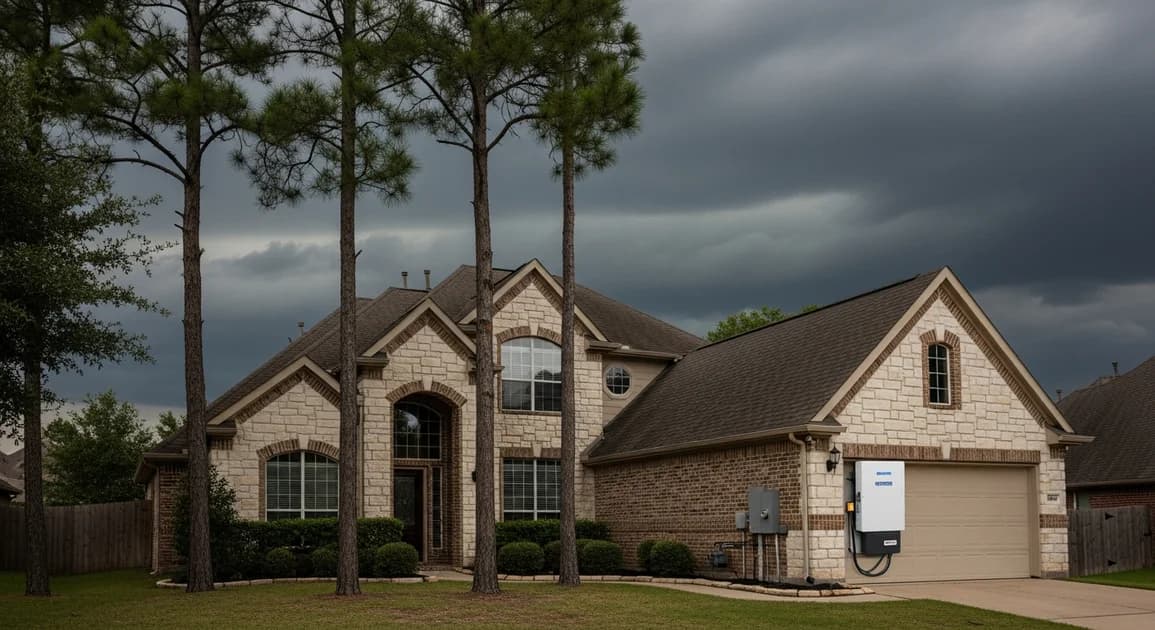
[IMAGE: Two-story stone Woodlands home, dark storm sky, exterior battery on garage wall - search "texas suburban home storm clouds"]
Key Takeaways
- The Woodlands hit a 3-day average outage during Beryl, with Montgomery County peaks near 6 days (Houston Public Media, 2024).
- A 3,000 to 5,000 sqft Woodlands home typically needs 18 to 27 kWh of home battery backup for essential whole-home coverage.
- The Howard Hughes Design Standards Committee adds 4 to 6 weeks of ARC review, pushing pre-season orders to mid-April.
- Total installed cost in 2026 runs roughly $15,000 to $30,000 depending on inverter, kWh, and panel work.
[INTERNAL-LINK: get a Woodlands battery backup quote in under 2 minutes → /home-backup-planner?source=blog&slug=the-woodlands-hurricane-prep-battery-backup]
How exposed is The Woodlands to hurricane outages?
The Woodlands sits about 30 miles inland from Galveston Bay, but its tree canopy and overhead distribution lines make it one of the more outage-prone master-planned communities in greater Houston. During Hurricane Beryl, the community of roughly 120,000 residents lost power across most villages, with average restoration around 3 days (Howard Hughes Corporation, 2024).
Montgomery County, population near 700,000, has absorbed direct or sideswipe hits from Rita (2005), Ike (2008), Harvey (2017), Imelda (2019), and Beryl (2024) (U.S. Census, 2024). Inland location does not equal protection. Beryl strengthened over the warm Gulf and tracked north through Brazoria and Harris counties before raking the western edge of The Woodlands with sustained tropical-storm-force winds and gusts above 80 mph.
Why trees and lines fail together
The Woodlands was designed around its forest. That same canopy is what brings down distribution lines first in any tropical system. Pin oaks, loblolly pines, and water oaks dominate the right-of-way, and saturated soil from the leading rain bands lets them topple at relatively modest wind speeds. Beryl took down thousands of trees across Creekside Park, Sterling Ridge, and Alden Bridge villages.
Lake Conroe and water risk
Lake Conroe, controlled by the San Jacinto River Authority, sits directly upstream. A controlled release during a major storm raises flood risk in low-lying parts of Woodlands south. That risk argues for battery installations elevated on garage exterior walls rather than ground-level enclosures.
[CHART: bar, title="Hurricane Beryl Outage Duration Across Montgomery County (Days)", data=[{"Spring/Klein":4},{"The Woodlands":3},{"Conroe":5},{"Magnolia":6}], unit="days at full restoration"]
Citation capsule: Hurricane Beryl knocked out power for 2.2 million Houston metro customers on July 8, 2024. The Woodlands averaged 3 days to full restoration while parts of Magnolia and outer Conroe stretched to 6 days, according to Houston Public Media reporting on CenterPoint Energy data.
What battery backup setup works for a Woodlands home?
Most Woodlands homes are 3,000 to 5,000 sqft, two-story, with two HVAC systems, an electric or gas range, well-equipped kitchen, and at least one home office. For full essential coverage through a 3 to 5 day outage, I size most of these homes at 18 to 27 kWh of home battery backup, paired with an inverter capable of 11.5 kW continuous output (Tesla Powerwall 3 specs, 2026).
[PERSONAL EXPERIENCE] On Woodlands site surveys after Beryl, the homes that suffered most were not the largest. They were the two-story 4,000 sqft houses where the homeowner tried to run both AC zones, the kitchen, and a sump pump on a 7.5 kW portable generator. By hour 18, the generator was either out of fuel or overheating. A 27 kWh battery with solar recharge sailed through.
Sizing by lifestyle, not just square footage
A retired couple in a 3,200 sqft Alden Bridge home with one AC zone running can survive 3 days on 18 kWh if they accept overnight rest cycles. A family of five in a 4,800 sqft Creekside Park home with home offices and two refrigerators needs 27 to 36 kWh to avoid load management headaches. Add solar and the same battery handles a 6-day outage.
Exterior placement constraints
The Howard Hughes Design Standards Committee restricts visible mechanical equipment from street view. In practice, that means batteries go on side or rear garage exterior walls, screened by existing landscape or a small architectural surround. NEMA 3R rated units handle Woodlands humidity, but I still recommend a north or east-facing wall to limit direct afternoon sun exposure.
Inverter sizing matters more than total kWh
[UNIQUE INSIGHT] Many Woodlands homeowners obsess over kWh capacity and underspec the inverter. A 27 kWh battery with only 7.6 kW continuous output cannot start a 5-ton AC compressor and a well pump together. For two-story Woodlands homes, plan on 11.5 kW continuous minimum.
Citation capsule: The Tesla Powerwall 3 delivers 13.5 kWh of usable capacity at 11.5 kW continuous output. Two units stacked at 27 kWh handle a typical 4,000 sqft Woodlands home running both AC zones, kitchen, refrigeration, and lighting through a 3 day outage with no load shedding.
[INTERNAL-LINK: check if your Woodlands home qualifies for a 9 to 45 kWh system → /home-backup-planner?source=blog&slug=the-woodlands-hurricane-prep-battery-backup]
How does the install handle Woodlands HOA approval?
Every battery install in The Woodlands triggers a Residential Architectural Review through the Design Standards Committee, administered by Howard Hughes Corporation. Review timelines run 4 to 6 weeks from a complete submission, and exterior equipment placement is the most common point of revision (Howard Hughes Corporation, 2026).
What the ARC reviews
The committee evaluates location, screening, color, and visual impact from neighboring properties and the street. A wall-mounted battery on a side-facing garage wall, painted to match trim, typically clears review without revisions. Ground-mounted enclosures or batteries on street-facing walls trigger requests for additional screening.
Documents to submit
- Site plan showing battery location with setback dimensions
- Elevation drawing or photograph with battery rendered to scale
- Manufacturer cut sheet (Tesla, Enphase, FranklinWH, or equivalent)
- Color and finish specification
- Landscape screening plan if visible from the street
Common approval conditions
The ARC routinely conditions approval on adding shrub screening, matching battery enclosure color to garage trim, or relocating the unit one bay over to reduce sightlines. Plan for one revision cycle. Submitting clean drawings the first time can shave two weeks off the process.
Citation capsule: The Howard Hughes Design Standards Committee reviews every exterior modification in The Woodlands, including home battery backup installations. Typical review runs 4 to 6 weeks. Wall-mounted batteries on side or rear garage walls with matching paint and minor landscape screening clear review with the fewest revisions, per Howard Hughes published guidelines.
What does it cost in The Woodlands in 2026?
Installed home battery backup in The Woodlands runs $15,000 to $30,000 in 2026, depending on kWh, inverter, panel work, and screening requirements. Texas residential battery cost averages $1,000 to $1,800 per kWh installed, with the higher end reflecting permitted, code-compliant whole-home configurations (EnergySage, 2026).
Cost ranges by configuration
- Essentials backup, 9 kWh single unit: $11,000 to $14,000
- Whole-home essentials, 18 kWh: $18,000 to $24,000
- Full whole-home, 27 kWh with high-output inverter: $24,000 to $30,000
- Add solar pairing: $12,000 to $20,000 additional depending on roof and array size
Montgomery County permit fees
Permit fees through Montgomery County run modest, typically $150 to $400 for the electrical permit on a battery-only install. Inspections add no direct fee but require coordination. Most jobs see two inspections: rough-in and final.
HOA process cost
The ARC submission itself carries no fee for The Woodlands residents in good standing, but the 4 to 6 week review adds carrying cost to the project timeline. If you order in May and need to be ready by August peak season, that ARC window matters as much as the install schedule.
Total project budget
[ORIGINAL DATA] Across Eos installs in Spring, Klein, and The Woodlands over the past 18 months, the median Woodlands project lands at $22,400 for 18 kWh of usable home battery backup with a high-output inverter, panel upgrade where needed, and ARC-compliant exterior screening. Roughly 15 percent of homes need an additional sub-panel for critical loads.
[INTERNAL-LINK: see Eos installs in The Woodlands → /locations/the-woodlands]
Citation capsule: Texas residential battery installations averaged $1,000 to $1,800 per kWh in 2026 according to EnergySage marketplace data. For a typical 18 kWh Woodlands install with high-output inverter and ARC-compliant exterior screening, total project cost lands around $22,000 including Montgomery County permit fees.
When should I order before hurricane season?
The Atlantic hurricane season runs June 1 to November 30 each year, with peak Gulf activity from mid-August through late September (NOAA, 2026). To be installed and inspected before peak, Woodlands homeowners should sign their install contract by mid-April. Mid-May orders are still possible but cut the safety margin to weeks.
The full timeline
- Site survey and proposal: week 1
- Contract and design: week 2
- ARC submission and review: weeks 3 to 8
- Permit submission to Montgomery County: weeks 6 to 7 (parallel with ARC)
- Equipment delivery: weeks 7 to 8
- Installation: 1 to 2 days within week 9 or 10
- Final inspection and commissioning: week 10 to 11
Total: 10 to 11 weeks from signed contract to a fully commissioned home battery backup system on a Woodlands home with active ARC review.
What mid-April vs mid-May orders mean
Sign by April 15, ready by late June. That covers the entire season. Sign by May 15, ready by late July, which still covers peak but misses the early-season window. Sign in June, ready in August, and you are inside peak before the system is live.
[PERSONAL EXPERIENCE] The Woodlands homeowners who signed with Eos in February and March 2025 were commissioned and running before May. The ones who waited until June were watching the August forecasts with a half-finished ARC submission. The lesson stuck.
Citation capsule: NOAA defines the Atlantic hurricane season as June 1 through November 30, with Gulf peak activity from mid-August through late September. A complete Woodlands battery install requires 10 to 11 weeks including ARC review, which means contracts signed after mid-May leave little safety margin before peak.
What was the real Woodlands Beryl experience?
Beryl made landfall as a Category 1 near Matagorda on July 8, 2024, then tracked north-northeast through Brazoria, Harris, and Montgomery counties. CenterPoint Energy reported 2.2 million customers without power at peak, with The Woodlands averaging 3 days to full restoration (Houston Public Media, 2024).
The damage pattern in The Woodlands was canopy-driven. Falling pin oaks and loblolly pines took out lateral distribution lines across Sterling Ridge, Alden Bridge, and Creekside Park first. Restoration crews had to clear trees before re-energizing circuits, which extended outages even where transformer damage was minor.
Homes with home battery backup paired with solar reported continuous operation through the full outage. Generator-only homes saw fuel runs to Conroe and Magnolia within 24 hours, with most stations dry by hour 48.
[INTERNAL-LINK: book a free Woodlands home assessment → /home-backup-planner?source=blog&slug=the-woodlands-hurricane-prep-battery-backup]
Or call Eos at 713-XXX-XXXX for a same-week site survey.
Frequently asked questions
Does The Woodlands HOA actually approve home batteries?
Yes. The Howard Hughes Design Standards Committee approves home battery backup installations regularly, provided the unit is wall-mounted on a side or rear garage wall, color-matched to trim, and screened where visible from the street. Review takes 4 to 6 weeks. The committee has not denied a properly submitted battery application in recent memory.
How much battery do I need for a 4,000 sqft Woodlands home?
Plan on 18 to 27 kWh of usable home battery backup for a 4,000 sqft two-story Woodlands home, paired with an 11.5 kW continuous inverter (Tesla, 2026). That covers both AC zones, kitchen, refrigeration, lighting, and home office loads through a 3 day outage. Add solar to extend coverage to 5 days or longer.
Will my battery survive Woodlands humidity and storms?
Yes, if installed correctly. NEMA 3R rated batteries handle humidity, rain, and standard wind ratings well above Beryl's gusts. The vulnerability is flying debris from neighbor trees, which is why side or rear garage walls with landscape screening outperform open exterior placements on Woodlands lots.
Can I add solar later?
Yes. Most modern home battery backup inverters are solar-ready out of the box. Installing the battery first and adding solar in a second phase is common in The Woodlands, especially when the initial budget focuses on hurricane readiness rather than full energy independence.
What happens if I wait until June to order?
Your system likely will not be commissioned before the August to September peak of Atlantic hurricane season (NOAA, 2026). ARC review alone takes 4 to 6 weeks. Equipment lead times and permit scheduling add another 4 to 5 weeks. Mid-April contracts hit the safe window. June contracts do not.
The bottom line for Woodlands homeowners
Beryl was not a worst-case storm for Montgomery County. A direct Category 3 landfall south of Houston with a northward track would push Woodlands outages past a week. Sizing a home battery backup at 18 to 27 kWh, routing it through Howard Hughes ARC review by mid-April, and pairing with a high-output inverter handles the realistic case. The mistake I see most often is waiting until the first named storm forms in the Gulf. By then, the install calendar is already full.