Magnolia Battery Backup: Long Restorations in West Montgomery County

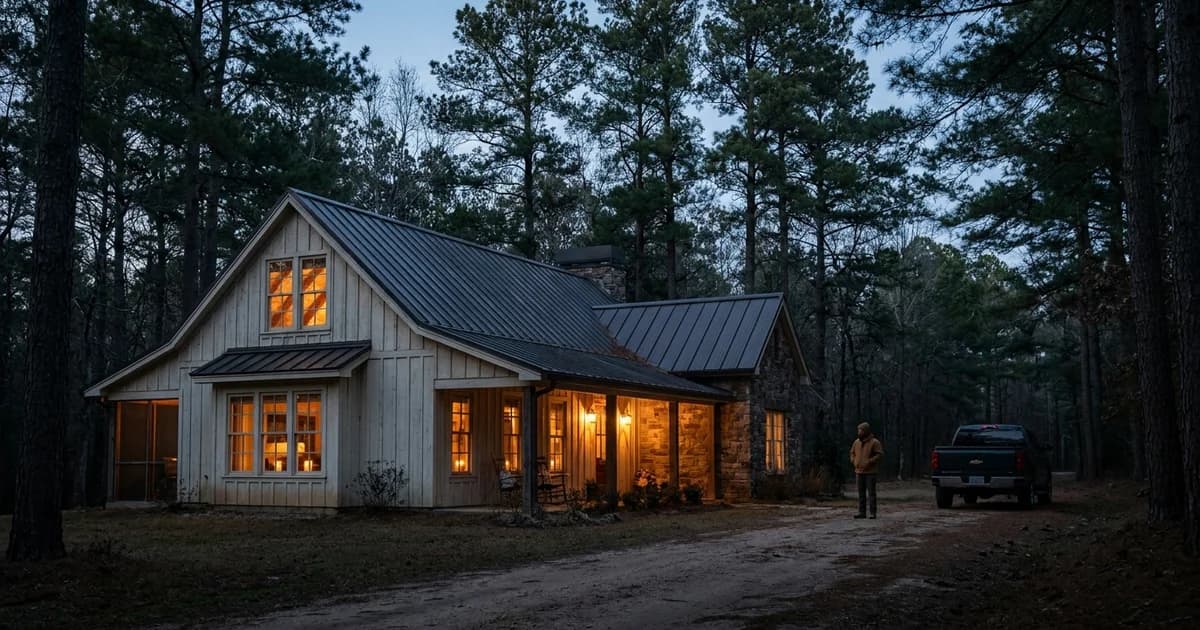
After Hurricane Beryl, Entergy Texas told customers the last outages were an access problem, not a repair problem. On July 14, 2024, with 234,500 of 252,460 affected customers already back on, the utility wrote that "accessibility remains the primary challenge for remaining outages due to the amount of downed vegetation" (Entergy Texas storm update, 2024).
In Magnolia and west Montgomery County, that access problem is the normal case. Tall pine over two-lane rights of way, long feeders and few customers per mile add up to restorations measured in days. This guide covers what keeps a rural home livable through three to five of them, and the question almost nobody asks: what refills the battery on day three?
Key Takeaways
- Restoration order puts scattered rural services last by design, not by neglect (Entergy).
- Rural co-op territory averages 8.7 customers per mile of line against 38.9 for the rest of the industry (NRECA, 2026).
- Pine-canopy faults are a locate-and-clear job before they are a repair job, so they stretch duration more than frequency.
- Out here the real question is not hours of runtime. It is how the system refills on day two and day three.
Why do Magnolia outages last longer than Houston outages?
Because restoration order is written around customers per repair, and west Montgomery County has among the fewest customers per mile of line in the region. Utilities restore emergency services first, then lines serving large blocks of customers, then neighborhood lines. Individual services come last "because fewer customers are involved, and, in the case of scattered outages, it often takes more time and effort to get power back on" (Entergy, How we restore your power).
That sequence is engineering triage, not a knock on the utility. A crew reconnecting a neighborhood feeder restores hundreds of homes in one repair. The same crew on a pasture road restores one.
Density is why rural addresses land on the wrong side of that math. Electric cooperative territory averages 8.7 customers per mile of line, against 38.9 for the rest of the industry (NRECA Electric Co-op Fact Sheet, 2026).
In 2024, U.S. customers averaged 11 hours of interruptions, nearly double the prior decade's typical figure, and major events including Beryl accounted for 80 percent of those hours (U.S. Energy Information Administration, 2025).
What actually causes most west Montgomery County outages?
Vegetation, and specifically pine. Magnolia sits at the western edge of the Pineywoods, where shortleaf, longleaf and loblolly pine dominate the forest (Texas Parks and Wildlife Department). A mature loblolly leaning over a distribution line is the dominant fault mode here, and it does not need a hurricane to fall it.
Beryl put a number on it. Entergy Texas reported damage to 651 poles, 304 transformers and 855 crossarms, plus 171 miles of downed wire (Entergy Texas, 2024). The utility now trims year round: over 1,300 line miles trimmed and nearly 3,600 hazardous trees removed in the year before the 2026 hurricane season (Entergy Texas, 2026). Reliability research splits these faults into growth-related and weather-related categories, both hard to predict at the span level (Doostan, Sohrabi and Chowdhury, 2018).
Why does that matter at your address? A vegetation fault must be found and cleared before it can be repaired, and on a long rural feeder with poor access, finding it can take longer than fixing it. That stretches duration far more than frequency.
What has to keep running out here, and for how long
On a well-and-septic property the backup load list is longer than in a city house, because water and wastewater stop being municipal services and become electrical loads on your panel. On-site sewage facilities are "the system of choice for approximately 20% of the new homes built in Texas" (TCEQ), and Montgomery County Environmental Health permits them under state rules.
The working list for a Magnolia TX home battery usually looks like this:
- Submersible well pump and pressure tank
- Aerobic septic aerator and effluent pump
- Refrigerator and any freezer
- Medical devices and a phone charging point
- One comfort zone, cycled rather than run continuously
- Wi-Fi, router and cell booster
[PERSONAL EXPERIENCE] The pump and the aerator are the two loads homeowners leave off the list, and they are the two that turn a manageable outage into an unlivable one. Nobody forgets the refrigerator. Plenty of people forget that the toilet stops working.
Both are motor loads, and motors pull a large inrush at startup before settling into their running draw. That is ordinary NEMA Design B behavior, and it is why headroom matters. A single Eos smart controller delivers 11.5 kW continuous with 17.1 kW of surge capacity, which absorbs the spike without dropping the rest of the house.
Our guide on
covers the surge behavior in detail.How many days can a battery actually cover?
Capacity sets the floor. Load discipline sets the ceiling. Each Eos battery module holds 9 kWh nominal and 8.76 kWh usable, and the tiers stack from there. At the minimal-load reference draw, Pro reaches up to 18 hours, Premium up to 24, and Ultimate up to 30.
Now the honest part. None of those numbers alone equals five days. Any battery, from any manufacturer, is a fixed tank. Multi-day coverage on a rural feeder comes from pairing that tank with daily recharge and load shedding, which is the next section. Pricing lives on the plans page, because two homes on the same Magnolia road can need very different electrical work.
The recharge question: what refills the battery on day three
A backup system that only discharges is a countdown. One that recharges is a supply. That distinction is the whole ballgame out here, and it is the question competing pages skip.
[UNIQUE INSIGHT] Most battery content asks "how many kWh do I need." On a low-density pine feeder the right question is different: what is my daily recharge versus my daily draw? A positive net runs indefinitely. A negative net just buys time.
Three things refill it, and they are not equal.
Grid auto-recharge between events. Most outages are short, and the system refills the moment the feeder comes back. That is how a household rides through twenty or more interruptions a year without noticing them. It covers the common case, not the Beryl case.
Solar. The only path that adds energy while the grid stays down. Yield depends on your roof, your shading and the weather during the outage. Run your own address and array through PVWatts, the free production calculator published by the National Renewable Energy Laboratory, and use that output below.
Load shedding through the smart panel. Cutting daily draw is mathematically identical to adding recharge. Well pump, refrigeration and medical stay on, the comfort zone runs in cycles, everything else goes.
Here is the framing, with assumptions labeled as assumptions:
| Scenario (assumed, not measured) | Daily draw | Daily recharge | Net | Result |
|---|---|---|---|---|
| No solar, full comfort loads | High | 0 kWh | Negative | Tank empties on schedule |
| No solar, disciplined shedding | Low | 0 kWh | Slightly negative | Days instead of hours |
| Solar plus shedding | Low | Per your PVWatts output | Near zero or positive | Open-ended coverage |
Use your own numbers. The sign of the result matters more than its size.
The full multi-day math is in our guide on
.Which utility serves your Magnolia address, and why it matters
West Montgomery County is a patchwork, and the answer is on your bill rather than on a city map. Entergy Texas serves much of the county. MidSouth Electric Co-op, which operates as Mid-South Synergy, serves more than 25,000 consumer-members in and around Grimes, Walker, Waller, Brazos, Madison and Montgomery counties (MidSouth). Parts of the southern edge fall toward CenterPoint territory.
Do not assume, and do not copy a neighbor. Interconnection paperwork, outage maps and restoration communications all differ by provider. Pull one bill before you plan anything else.
Conroe sits on the other side of the county: denser, lake adjacent, mostly on city water and sewer. See our
.Growth along FM 1488 and FM 149 is adding load to rural lines
The corridor is being rebuilt because the rooftops arrived first. TxDOT is converting FM 1488 from a two-lane undivided road into a four-lane roadway with a median through the Waller and Harris county segments (TxDOT), and construction has been working toward Magnolia for years.
Population explains it. Montgomery County added 30,011 residents between July 2024 and July 2025, fourth in the country for numeric growth in the Census Bureau's Vintage 2025 estimates (U.S. Census Bureau, 2026). New subdivisions attach to feeders laid out for pasture density, and road work adds dig-in risk. Neither trend shortens a queue.
What to do before the next storm season
Four steps, in order:
- Write the load list. Well pump and septic aerator first, then refrigeration and medical, then one comfort zone.
- Pull one utility bill. Confirm the provider before anyone quotes interconnection work.
- Pick a coverage window in days, not hours. Two days and five days are different systems, and the difference is mostly recharge.
- Book the site survey before June. Hurricane season is a bad time to start a permit and inspection cycle.
Or call Eos at 833-989-3737 to talk through your setup with an installer.
Frequently Asked Questions
How long do power outages last in Magnolia, TX?
No source publishes an average for Magnolia specifically. What is documented is the mechanic: scattered individual services are restored last, and after Beryl the remaining Entergy Texas outages were limited by access to downed vegetation rather than by repair time (Entergy, 2024).
Can a home battery run a well pump and a septic aerator?
Yes. Both are motor loads with a startup inrush well above their running draw, standard NEMA Design B behavior. A single Eos controller supplies 11.5 kW continuous and 17.1 kW surge, which absorbs the spike. Size the modules for how long the pump keeps cycling, not just for whether it starts.
How does a home battery recharge during a multi-day outage?
Three ways: automatically from the grid the moment the feeder returns, from solar while the grid is still down, and effectively from load shedding, since cutting draw does the same math as adding energy. Multi-day coverage is daily recharge minus daily draw.
Do I need solar to get multi-day backup in Magnolia?
For one to two days, no. Capacity alone covers that with disciplined loads. For open-ended coverage on a rural feeder, effectively yes, because solar is the only source that adds energy while the grid is down. Size it against your own PVWatts output from the National Renewable Energy Laboratory calculator.
The bottom line
- Rural west Montgomery County sits late in the restoration queue by design, and pine-canopy faults stretch duration more than frequency.
- Wells and aerobic septic systems put water and wastewater on the electrical load list, which changes sizing before anything else does.
- Multi-day backup is a net-energy problem. Pick a coverage window in days, then solve for recharge and load shedding rather than capacity alone.
Plan it in that order and the hardware decision mostly makes itself.