Washer and Dryer in a Power Outage: What a Home Battery Can Run on Laundry Day

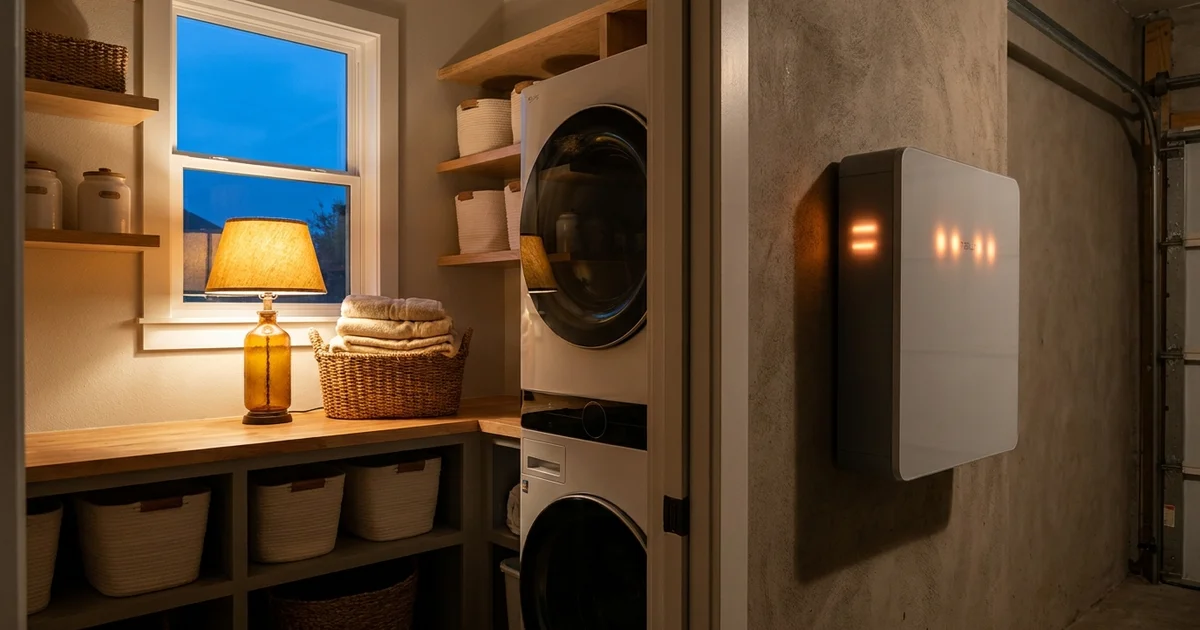
Laundry is the chore nobody plans around until the lights go out and the hamper is full. The washer is a small load. The dryer is not, and that gap decides whether laundry day fits on a home battery or quietly eats your reserve.
I'll stay with published numbers here. Where I could not find a verified figure, I say so instead of guessing.
Key Takeaways
- Virginia Tech Extension lists a clothes washer at 350 to 500 W and a clothes dryer at 1,800 to 5,000 W nameplate (Virginia Cooperative Extension).
- An Eos system's controller is rated 11.5 kW continuous, so one dryer fits under the power limit. The question is energy: a long dryer cycle spends a lot of the battery.
- Heating water is about 90 percent of the energy a washer uses, so a cold cycle is the cheapest laundry change you can make (ENERGY STAR).
- In a short outage, skip the dryer. In a long one, run it by itself and clean the lint filter first.
How many watts do a washer and dryer really use?
Virginia Tech's Cooperative Extension publishes nameplate ranges for common appliances. It lists a clothes washer at 350 to 500 W and a clothes dryer at 1,800 to 5,000 W (Virginia Cooperative Extension, Estimating Appliance and Home Electronic Energy Use). Those are ranges, so your own nameplate or manual overrides them.
The gap between the two is the whole story. A washer is mostly a motor. A dryer with an electric heating element is closer to a space heater than to a motor. Our wattage chart for common Houston loads puts both next to the rest of the house so you can see what stacks with what.
Can a home battery run an electric dryer?
Yes on power, and then it depends on energy.
Every Eos plan uses one controller rated for 11.5 kW continuous and 17.1 kW surge. A 5,000 W dryer is well under 11.5 kW, so the controller can carry it. The limit shows up when you stack loads, which I cover below.
Energy is a different question. The Virginia Tech publication gives the formula: wattage times hours used, divided by 1,000, gives kilowatt-hours. Apply it to a dryer at the top of its range for one hour: 5,000 W for 1 hour is 5 kWh. One Eos battery module is 9 kWh nominal and 8.76 kWh usable. By that arithmetic, one hour of a high-draw dryer would use more than half of a single module.
Two honest caveats. First, I did not find a public source for how long a typical dryer cycle runs or how much of the time the element is actually on, so treat that 5 kWh as a worst-case illustration, not a prediction. Second, runtime on any plan depends on everything else running at the same time. Our standard figure is up to 8 hours at minimal load for a 9 kWh system, and a dryer is the opposite of minimal load.
The practical reading: a single module can run a dryer load, but you are trading that energy against the fridge, the Wi-Fi and the lights for the rest of the outage. A larger plan changes that trade. Our Essential plan is the one-module starting point, and the plans page shows what each added module adds.
What about a gas dryer?
A gas dryer uses gas for the heat, so most of the electricity goes to the drum motor and controls. That is why a gas dryer asks far less of a battery than an electric one.
I could not find a verified wattage for a gas dryer's electrical draw, so I'm not going to quote one. Read the nameplate on yours. It will be far below the electric heating element range above. Whether gas keeps flowing in your outage is a question for your gas utility, not for the battery.
How does a washer fit on a battery?
Easily, with one catch. The washer motor sits in the 350 to 500 W range, which is a small fraction of the controller limit. At the top of that range, one hour is 0.5 kWh by the same formula.
The catch is the water. ENERGY STAR says water heating consumes about 90 percent of the energy it takes to operate a clothes washer, and that switching from hot to warm can cut energy use in half (ENERGY STAR, Clothes Washers). That energy comes from your water heater, not from the washer's motor. If your water heater is on the backed-up circuits, hot cycles quietly cost you the water heater's draw. Our guide to running an electric water heater on a battery shows that load. For an outage, the cold cycle is the easy win.
ENERGY STAR also says its certified washers use about 20 percent less energy and about 30 percent less water than regular washers, which helps if you are shopping before the next storm.
Which loads should not run with the dryer?
This is where laundry day goes wrong. The dryer element plus other resistance loads can pass the 11.5 kW limit. From the same Virginia Tech ranges, the stack looks like this.
| Combination | Published range | Against 11.5 kW |
|---|---|---|
| Dryer alone | 1,800 to 5,000 W | Fits |
| Dryer + washer | 2,150 to 5,500 W | Fits |
| Dryer + washer + dishwasher (1,200 to 2,400 W) | 3,350 to 7,900 W | Fits, with little room |
| Dryer + 40 gallon electric water heater (4,500 to 5,500 W) | 6,300 to 10,500 W | Fits, barely, at the high end |
| Dryer + water heater + dishwasher + microwave (750 to 1,100 W) | 8,250 to 14,000 W | Can exceed 11.5 kW |
All of these are nameplate ranges added together, which is a ceiling and not a typical draw. Central air conditioning makes it worse. Our AC guide covers that load, and our electric range guide covers the other big resistance load in the kitchen.
The rule is simple: run the dryer alone. If the air conditioner is cycling, expect the combined draw to climb fast.
How should you sequence laundry in an outage?
Think of it as a short list, from cheapest to most expensive for the battery.
- Wash on cold. Motor load only, and no water heater load behind it.
- Hang it up. I'm not going to invent a time for air drying, but it costs nothing from the battery, and a patio or a rack inside is free in Houston weather most days.
- Run the dryer by itself. Nothing else heavy on at the same time, and check the battery level before you start.
- Use the dryer last. If the outage is going on longer than you expected, laundry is the first thing to give up. Fridge, Wi-Fi and phones stay.
- Do not start a second dryer load until you know how much battery the first one used.
This is the same triage logic as our guide to cutting your load before sizing a home battery. If you want the circuits prioritized for you, the smart panel prioritization guide explains how loads get ranked.
Is it safe to run the dryer on backup power?
Backup power does not change dryer safety. Dryer fires happen with grid power too, and the cause is usually the same. The NFPA found that the leading cause of home clothes dryer and washer fires was failure to clean, at 32 percent (Albuquerque Fire Rescue, summarizing NFPA data). The same page says dryers and washers were involved in about one in 22 home structure fires in 2006 to 2010.
That is a dated range, so I'm using it for the pattern, not as a current count. The takeaway is plain: clean the lint filter every load, and don't run a dryer while you're away from the house. An outage is exactly when people improvise, and a long dryer run on a battery is not the time to skip basics.
What if you also want to run a heat pump dryer?
If you are replacing a dryer, ENERGY STAR says heat pump dryers use around 70 percent less energy than conventional clothes dryers (ENERGY STAR, Clothes Dryers). That is an energy figure, not a peak wattage, and I don't have a verified wattage for a specific heat pump model, so read the label. It does mean the same laundry could cost your battery far less. If you're sizing a system for a house with an older, high-draw dryer, that's worth knowing before you pick a plan.
What to do next
Look at the label on your dryer, write down the watts, and decide whether laundry is a load you want protected or one you will skip in an outage. Most households land on "skip the dryer, run the washer cold." If you want the dryer on your backed-up circuits, say so when you size the system.
Or call Eos at 833-989-3737 to talk through your setup with an installer.
Frequently asked questions
Can a home battery run a washer and dryer at the same time?
On power, usually yes for one washer and one dryer: the published ranges add up to about 2,150 to 5,500 W, under an 11.5 kW controller. On energy, running both uses a real share of one module, and other big loads can push the total over the limit.
How many kWh does one dryer load use?
I can't give a verified per-load figure. The formula is wattage times hours divided by 1,000. A dryer rated at 5,000 W running one hour is 5 kWh. Your actual cycle length and heating duty cycle will change that.
Is it better to skip the dryer in an outage?
For short outages, yes. Cold-water washing and line drying cost the battery almost nothing, and the dryer is the largest laundry draw. For long outages, run it alone when you know the battery can spare it.
Does a gas dryer work on battery backup?
The electric part, the motor and controls, is a small load. I do not have a verified wattage to quote, so check the nameplate. Whether gas supply continues is a separate question for your gas utility.
Does my washer's hot water come from the battery?
Only if the electric water heater is on your backed-up circuits. ENERGY STAR says water heating is about 90 percent of washer energy, so a cold cycle avoids it.