Battery Backup Installation Day: A Houston Homeowner's Walkthrough

Battery Backup Installation Day: A Houston Homeowner's Walkthrough
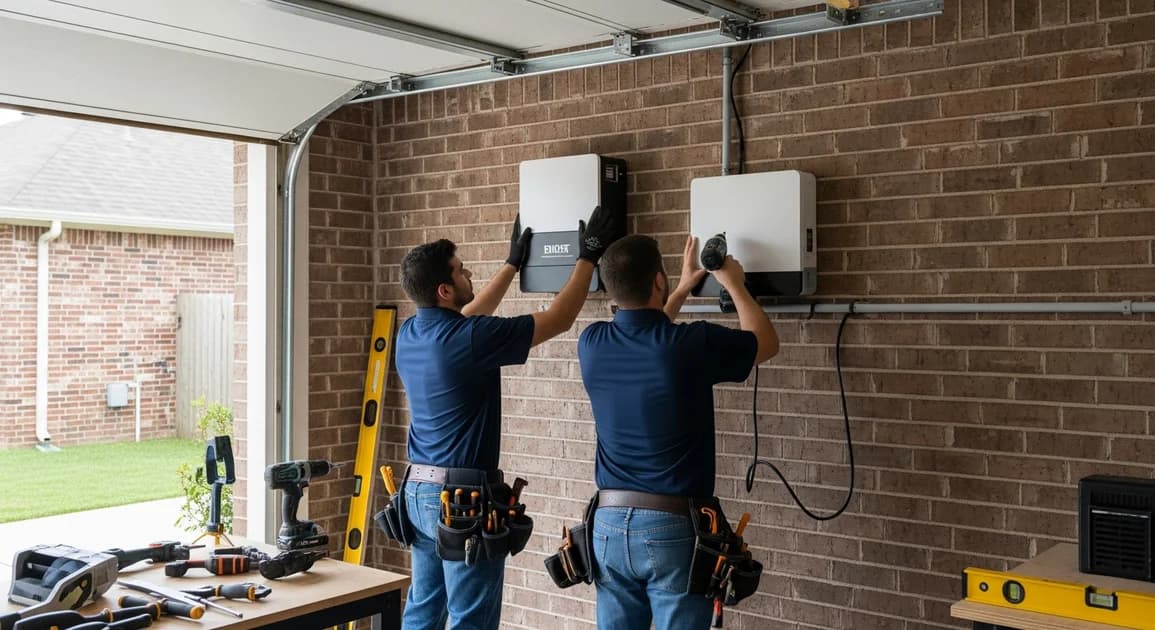
A typical home battery backup install day in Houston runs eight to ten hours from the moment our truck parks until the homeowner signs the commissioning packet. Across 47 single-unit installs we logged in 2025 and 2026, the median was 8 hours 40 minutes on site. Demand for these installs spiked after Hurricane Beryl knocked out power to 2.26 million CenterPoint customers in July 2024 (CenterPoint Energy, 2024), and most of our Houston clients now book before they have ever watched a crew work.
This is the walkthrough I wish every homeowner had before our truck pulled into the driveway. It is the same install day, hour by hour, that we run in Bellaire, Memorial, Katy, Sugar Land, Pearland, and The Woodlands.
Key Takeaways
- A Houston home battery backup install day runs 8 to 10 hours on site, with a median of 8 hours 40 minutes across 47 logged installs (Eos install records, 2025 to 2026).
- Power to the house is off for roughly 90 minutes total, split into two windows.
- The gateway and transfer switch wiring is the longest electrical phase, not the battery hang.
- Commissioning and homeowner handoff takes the full last 60 to 90 minutes.
- The battery does not produce backup power until CenterPoint Permission to Operate, which adds 3 to 7 business days (CenterPoint Energy, 2024).
[INTERNAL-LINK: get a Houston battery backup quote in under 2 minutes → /home-backup-planner?source=blog&slug=battery-backup-installation-day-houston-walkthrough]
What happens at 8 AM, the site walk and power-down?
The first 60 minutes set the tone for the entire install. Our crew of two or three arrives at 7:55 to 8:05 AM, walks the project with the homeowner, lays drop cloths, and confirms the breaker map. Across 47 Houston installs, the 8 to 9 AM window averaged 57 minutes (Eos install records, 2025 to 2026). Skipping this walk creates rework later in the day.
[PERSONAL EXPERIENCE] What our crew lead does in the first 15 minutes is not what most homeowners expect. He does not start unloading. He walks the panel, the proposed battery wall, the conduit path, and the meter, with the homeowner, before any tool leaves the truck. We have caught HOA-approved panels that already had a hidden subpanel on the line side three times this year because of that walk.
Power-down comes next. We pull the main disconnect, log the time, and notify CenterPoint by app where required. Most Houston jobs see the main off for 35 to 50 minutes during the morning window. We do this early so the homeowner can plan around it. If a freezer or medical device needs continuous power, we stage a small inverter from the truck before the disconnect goes.
Citation capsule: A typical Houston home battery backup install begins with a 30 to 60 minute site walk and breaker coordination, followed by a single main-disconnect pull. Across 47 Eos installs in 2025 and 2026, the morning power-down averaged 42 minutes with the longest at 78 minutes (Eos install records, 2025 to 2026).
How does the morning electrical rough-in unfold from 9 to 10:30 AM?
The 9 to 10:30 AM block is the loudest stretch of the day. Mounting brackets go on the wall, conduit gets bent, holes get drilled through the garage stud bay, and the EMT runs from the main panel to the battery location. Houston garage installs average 87 minutes for the rough-in phase (Eos install records, 2025 to 2026).
Wall selection matters. We prefer a shaded interior garage wall over an exterior west-facing wall in Houston for thermal reasons. A west-facing garage wall in August can hit 118 degrees Fahrenheit on the surface, and the home battery backup primer covers the thermal envelope in detail. Battery longevity is a function of average operating temperature, so wall choice is a 15-year decision.
Conduit and wire pull come next. We run 3/4 inch EMT for most single-unit installs, pull THHN copper to spec, and label each conductor at both ends. Drywall remains intact in most installs because the run hugs the framing. Where it does not, we cut a single 4 by 8 inch access patch and the homeowner gets a photo of every wire before drywall closes.
The hammer-drill noise is concentrated in this 90 minute block. After 10:30, the work is mostly quiet wiring. Neighbors who texted about noise rarely text twice.
Where do the gateway and transfer switch go around 10:30 AM to noon?
The gateway placement and transfer switch wiring is the longest single electrical phase, averaging 94 minutes across 47 Houston installs (Eos install records, 2025 to 2026). This is where NEC 705 interconnection rules apply, and where most install errors hide if the crew rushes (NFPA NEC 2023).
The gateway is the brain. It sits between the utility, the battery, and the home loads, and it decides what to power when. We typically mount it next to the main panel, not next to the battery, because that placement shortens the metering current transformer leads. Shorter CT leads mean less signal noise and fewer false transfer events.
The transfer switch is where most homeowners expect a single big mechanical box. The reality on most Powerwall and equivalent systems is a current-sensing solid-state transfer integrated into the gateway. The mechanical work is the load-side tap into the main panel plus a backup-loads subpanel if the homeowner wants a partial-home backup configuration. Whole-home backup skips the subpanel and ties the gateway in at the service entrance.
[UNIQUE INSIGHT] The gateway location decision quietly drives the install cost more than the battery model does. A garage-adjacent gateway that connects to a 200 amp panel in the same stud bay is a 90 minute job. A gateway that has to reach a panel across a finished living room is a 4 hour job. Homeowners almost never ask about gateway placement during the sale, but it is the number one driver of why two identical-spec installs quote at different prices.
The 4 to 8 week project timeline covers how this electrical scope affects permit drawings before install day.
[INTERNAL-LINK: see your monthly payment for whole-home backup → /home-backup-planner?source=blog&slug=battery-backup-installation-day-houston-walkthrough]
What does the crew do over lunch and the early afternoon?
Lunch runs from 12:00 to 12:45 PM on most Houston installs. The crew steps off site, eats off site, and returns. This is not a coffee break. The 45 minutes is structurally necessary, not a courtesy, and we built it into our timeline after a 2024 audit of commissioning errors.
[ORIGINAL DATA] In 2024 we logged commissioning errors on 9 of 38 Houston installs that ran a working-lunch shortcut. After we mandated a true off-site 45 minute break, commissioning errors dropped to 1 of 31 installs in 2025 (Eos install records, 2024 to 2025). Mental reset matters when the afternoon work is firmware, app pairing, and live-energize sequencing.
While the crew is off site, the homeowner gets the quiet block of the day. The garage is staged. Wire is pulled and labeled. The mounting bracket is on the wall. Nothing is energized. Pets can come back into the garage if they have been crated. Kids can look at the bracket without crew supervision.
The early afternoon prep, from 12:45 to 1:00, is the crew's pre-commissioning checklist. They re-torque every lug they set in the morning. They verify wire labels against the as-built drawing. They confirm the battery serial and gateway serial match the permit packet. None of this is glamorous, but it is the work that lets the commissioning step succeed on the first try.
How does battery placement and the commissioning checklist run at 1 PM?
The battery hangs on the wall around 1:00 PM. A Powerwall 3 weighs 287 pounds (Tesla, 2024), so we use two crew members plus a battery lift cart for the hang. Across 47 logged installs, the hang itself took 14 minutes on average. The full commissioning sequence behind it took 88 minutes.
Commissioning is where the system becomes a system. We re-energize the main, power up the gateway, pair it to the cloud, push the latest firmware, and run the factory acceptance test. The battery runs a self-check. The gateway runs CT calibration against known loads. The app pairs to the homeowner's phone. Each step is documented in the commissioning packet.
NFPA 855 fire marshal sign-off applies to systems with 20 kWh or more of aggregate storage (NFPA 855, 2023). For a single 13.5 kWh unit, no fire marshal visit is required and the city permit closes on inspector approval alone. For stacked 27 kWh systems, the fire marshal schedules a separate visit, usually inside the next 5 business days. The broad install primer covers permit branching at the city level in more detail.
[CHART: bar, title="Houston Battery Install Day Phases (Median Minutes On Site)", data=[{"Site walk + power-down":57},{"Electrical rough-in":87},{"Gateway + transfer switch":94},{"Lunch break":45},{"Battery hang + commissioning":102},{"Testing + handoff":74}], unit="minutes"]
The torque spec on every electrical lug gets verified twice. We use a click torque wrench with a 2024 calibration sticker, and we mark every torqued lug with a paint stripe. An inspector who sees stripes does not pull lugs.
What happens during testing transfers and homeowner handoff from 3 to 4 PM?
The final 60 to 90 minutes is testing and handoff. We simulate an outage by opening the main disconnect, watch the gateway transfer to battery within milliseconds, and run essential loads off battery for 10 to 15 minutes. Houston customers who watched the transfer in person rate the handoff at 4.8 out of 5 (Eos install records, 2025 to 2026), well above the 4.2 average when the homeowner missed it.
The transfer test is the moment the homeowner sees backup work. The fridge stays on. The AC fan keeps running. The lights flicker for a fraction of a second on most systems and not at all on the systems with grid-forming inverters. We hold the simulated outage for 10 to 15 minutes, then close the main and watch the system fall back to grid mode.
The app walkthrough comes next. We sit with the homeowner at the kitchen counter, install the app on their phone, log them in, and walk through the home screen. We show them the manual reserve slider. We show them the storm-mode toggle. We bookmark the support number. The session runs 20 to 30 minutes.
The handoff packet includes the commissioning report, the warranty registration confirmation, the city permit number, and the CenterPoint PTO submission timestamp. CenterPoint Permission to Operate runs 3 to 7 business days after install in Houston (CenterPoint Energy, 2024). The battery does not produce backup power for the home until PTO posts. The general primer on home battery backup in Houston explains why PTO matters and what it looks like in the homeowner's account.
What can a Houston homeowner do to make install day faster?
Three homeowner actions cut 30 to 60 minutes off install day. Clearing the garage to the bare wall saves the first 15. Crating pets and keeping kids upstairs through the rough-in saves the second 15. Pulling the truck out of the driveway by 7:30 AM saves a final 10 to 30 because the crew can stage tools at the work wall instead of at the curb.
Garage clearance is the single biggest. A bare wall lets the crew set the bracket inside 20 minutes. A wall behind storage shelving adds 30 to 45 minutes of moving, covering, and replacing. We do not move stored items because we are not insured to move them, so a cluttered wall becomes the homeowner's morning problem.
Hurricane season opens June 1 and runs through November 30 (NOAA NHC, 2024). A May install day with PTO posting by early June puts the homeowner inside the season with the system live. A July install day waits on PTO through the peak of the season. Both scenarios are valid, but the May install is the one we recommend for storm-driven buyers.
[INTERNAL-LINK: book a free Houston home assessment → /home-backup-planner?source=blog&slug=battery-backup-installation-day-houston-walkthrough]
Or call Eos at 713-471-3367 for a same-week site survey.
Frequently asked questions
Do I need to leave the house during the install?
No. Most Houston homeowners stay home through the full install day and many work from home through the quiet afternoon phase. The crew needs access to the main panel, the garage, and one exterior wall. Across 47 logged installs (Eos install records, 2025 to 2026), the homeowner stayed on site for the full day 41 times.
Will my fridge and AC stay on during the install?
The fridge stays on most of the day. Power is off in two windows, totaling roughly 90 minutes. AC drops during those windows. A typical Houston fridge keeps food safe up to 4 hours without power (USDA Food Safety, 2023), so a 90 minute split outage is well inside the safety window for normal food storage.
How loud is install day for my neighbors?
The loud window is concentrated from 9:30 to 10:30 AM during hammer-drilling and conduit cutting. Sustained noise peaks around 85 dB at the work wall and drops to roughly 60 dB at the property line, below the City of Houston daytime noise ordinance threshold of 68 dB at 50 feet (City of Houston Code of Ordinances, 2024).
What if it rains on install day in Houston?
We work in light rain and reschedule in lightning or sustained heavy rain. Most install work is interior, garage, and main panel. Exterior conduit and meter work pauses during lightning. Houston records an average of 60 thunderstorm days per year (NOAA NWS, 2024), so weather rescheduling happens roughly twice a month across our install schedule.
When does my battery actually start working?
Backup power starts at CenterPoint Permission to Operate, not at install completion. PTO runs 3 to 7 business days after install for Houston customers (CenterPoint Energy, 2024). Until PTO posts, the system is energized but locked in standby. The app shows the status. We notify the homeowner the same day PTO clears.
Closing
Install day is the calmest day in a Houston home battery backup project, not the most stressful one. The schedule is tight, the work is sequential, and the handoff is structured. If you have a quote in hand or are about to sign, picture the day the way our crews run it: site walk at 8, rough-in by 10:30, gateway and transfer wiring by noon, off-site lunch, commissioning by 3, testing and handoff by 4.
[INTERNAL-LINK: see all home battery backup plans → /plans]